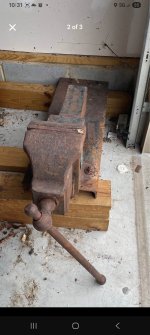
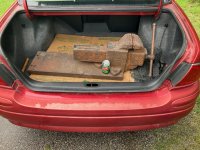
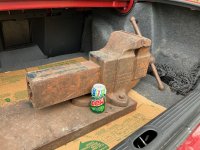
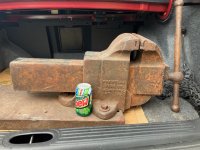
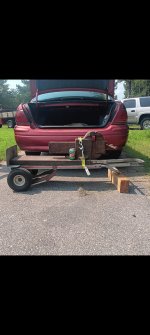
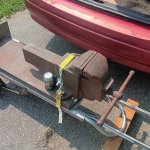
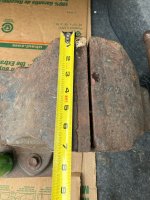
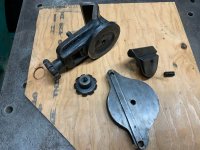
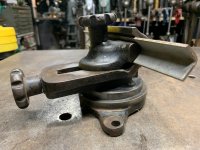
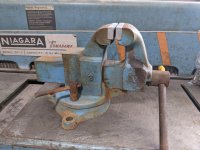
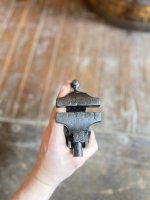
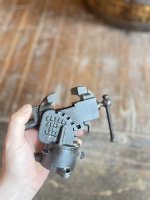
Of all the vises I might’ve expected to reel in this year, this wasn’t in my forecast. One of the rarest vises ever made - the seldom scene Lewis & Lurie 6lb, 3” bench vise.
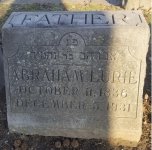
This vise and its inventor are shrouded in mystery. It was patented on July 25th, 1893 by NY resident, Abraham Lurie. Later that year, several large publications including the Scientific American issued articles lauding the new vise and its features. By late 1895, The Iron Age proudly advertised the vise in their October issue and stated their manufacturer as “the Lewis & Lurie Mfg. Company” of 142 Duane St, NY. After 1895, history appears to be utterly and completely SILENT on Abraham and his vise for nearly 30 years. That is, until the February 14th, 1921 issue of the NY Evening Journal illuminates the mysterious inventor in an article celebrating his 50th wedding anniversary. According to the article, Abraham Lurie was born October 11, 1836 in Manchester England to Jewish parents. He married Bertha Blum on February 9, 1874 with whom he had ten children. Abraham worked as a steamboat captain, carpenter, and inventor of machinery. After retiring from “active business…as president of the Lurie Vise Company”, Lurie passed away at the age of 95 on December 5th, 1931.
No records have yet been found to prove who the “Lewis” of “Lewis & Lurie” was. However, to’ve displaced Lurie, the inventor himself, and placed himself at the forefront of the company name seems to imply significant sway. Mortimer G Lewis (co-founder of the Prentiss Vise Company), issued 23 patents between 1880-1905 (15 of them vise related). Lurie undoubtedly would’ve needed capital and a foundry to manufacture his vise. I theorize that Mortimer G Lewis was Lurie’s partner, at least for a time. Lewis & Lurie’s 142 Duane, NYC address was only 0.3 miles from the headquarters of the Prentiss Vise Company at 44 Barclay St.
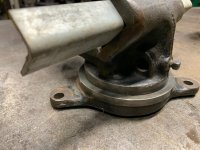
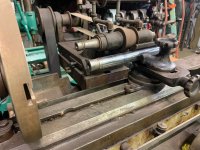
The vise itself: A thin crack is present on both arms comprising the slide that runs about halfway through. Given the structure of the vise, it seems like an obvious point of weakness. All three of the base’s thumb screws had been sheared off when I purchased the vise, so I carefully extracted and replaced these. I carefully stripped the aftermarket paint while leaving enough while trying to preserve anything remaining of the base layer. I finished it with Sculpt Nouveau and a thin coat of Fluid Film. That combo yields as close to the look of aged japanning that I’ve ever seen.