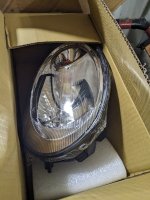
Finallygotit
ALLIANCE MEMBER
We can no longer buy parts from Rock Auto if we live in Arizona. Some legal ******** stopped that. 


Seems Arizona says Rockauto owes the state taxes. So they just stopped selling in AZWe can no longer buy parts from Rock Auto if we live in Arizona. Some legal ******** stopped that.

Seems Arizona says Rockauto owes the state taxes. So they just stopped selling in AZ

Yes, well.. the only time I had a core charge was on the brake shoes, themselves. Never a drum. From what I understand, drums were considered as consumables, rotors, too. Brake shoes, a person could put new lining on, never a disc brake pad. The thing I had to be careful of when I was turning my own drums and rotors was to leave enough material left for wear, the final time I turned one. In the case of a drum, the maximum diameter. In the case of a rotor, minimum thickness. That's not numbers I could find in a Haynes or Chilton's repair manual. I was supposed to depend on the size, either stamped in or cast into the drum or rotor. In many cases, those numbers were rusted beyond recognition. In many cases, I bought a new drum or rotor, just to get that number. Then I'd pencil that into my manual so that I knew what to do at the next brake job. I always tried to keep myself honest and my family safe.Sounds like you've already bought both brake pads so you can just move forward on the job. Or, if you are thrifty and energetic, you could mailorder brake pads that you fancy, and for less, from RA, and return the other pads at the store.
I've been a mailorder fiend since forever. Had a funny little furrin car and am persnickety about parts quality. And I'd rather deal with somebody who knows my type of car and is enthusiastic about them, than, in those days, some counter guy who resented their very existence.
Yeah, better learn to do the internet shopping.
Core charges can be a bummer. I did buy reman calipers for our Durango more than ten years ago, and the shipping cost on those heavy things meant that my core refund got 80% eaten up by the postage. Boo! Yeah, I remember the days when brake shoes might get returned as cores -- and customers were buying remans! I didn't know about drums, though.
I'm still persnickety about quality, and RockAuto is actually kind enough to categorize parts by their quality range, from "you must be broke/you might be a shady used car lot/you should be ashamed of yourself you tightwad" to good to very good/heavy duty.
All that being said, I mostly buy from Amazon. I'm getting free shipping there and returns can be easy. But the filtering at Amazon stinks (make, year, model, engine, show me brake pads for, etc) whereas the RockAuto filtering is outstanding and really shows you the whole world of parts available in the aftermarket for your car. Even Mopar, Motocraft parts can show up at RA or Amazon.
So I look up part numbers at Rock Auto sometimes then start searching at Amazon and compare prices. For bigger jobs I might make an order with each, depending on each part's price.
Ohoh...We can no longer buy parts from Rock Auto if we live in Arizona. Some legal ******** stopped that.
Good on Rock Auto. Off soapbox, before I get trip to band camp.Seems Arizona says Rockauto owes the state taxes. So they just stopped selling in AZ
Ok I will go first.Good on Rock Auto. Off soapbox, before I get trip to band camp.
No more, please, or the mods will send you to band camp for violating the TOS.Ok I will go first.
What happened to the “we the people”?
In Michigan the gas tax was raised by 21c to 52c , nominally to pay for fixing the roads. I have not seen any improvements and roads are as crappy as they have always been. Leave it to freaking politicians and bureaucrats to squander and piss away hard earned tax payer money.
Next please.
But id agree with most people that a brake rotor doesn't really warp. That's not the issue... What really happens is that the thickness changes. A warped rotor pushes the brake pads side to side. Axial runout. And possibly a tilt to the spindle axis. Thus, making the pads try to grab at the maximum diameter of the rotor on the outside with one pad verses the minimum diameter with the inside pad, within the range of the pads. But very out of parallel between the pads and the rotor. That could very well happen, I do not disagree, but I've not witnessed that happening, myself. (I should actually see (witness) some of that, as I turn rotors)(And I have in some extent) Mostly, the thickness changes, making the pulsation happen. Now..... Bob, Squankum, Kay could speak otherwise. Bob owns Corvette cars. Squankum really got into car racing. Kay has done many brake jobs. But I really think pulsations come from thickness variations, not warping and parallelism.
That's pretty neat that you drilled holes in your rotors to save weight. I would've never thought of that. But in your racing scene, every little bit helps. I always thought that by drilling holes in your rotors was a way to add to the cooling efforts of the rotor. I'm sure you've seen where a ball endmill was used to create grooves in the rotor surface, to also add to the cooling efforts.The peculiar form of racing I was involved in was very easy on brakes! At least on our car, which kept getting lighter and lighter. So easy that we "backdated" the front rotors from the vented discs found on later VW's of that era, to the solid/unvented rotors of the diesel model. That also solved a wheel clearance problem, but it also saved weight. Then my friend laid out a pattern on these solid rotors and we whacked away on them with a 1/2" drill bit in the drill press, to save even more weight! Never had a problem with cracking that I know.
Since I gave up on the sport I think my friend has reduced even more weight out of the brakes, but in other ways, mostly calipers, as the rules got looser about what you could run for brakes.
So again, we didn't get a lot of heat or wear into our brakes, but one year we went to nationals, and famous road race care preparer Carroll Smith was there, and he gave a talk in a nearby hangar, so we went to see what he learned. According to my googling and my ten fingers tonight, that was over 20 years ago!
He didn't say anything about brakes that day that I can remember, but he did write this about brake rotors and it's worth reading:
Something else that changed in our modern times is that manufacturers took a lot of mass out of rotors, I think for EPA mpg testing. Less room for error when they get too hot. Less meat to machine -- if any.
I call ******** on the No Warped Rotors statement. I've turned too many rotors back into parallelism to believe that. Now the fact that the braking vibration returns quickly to turned rotors, I can attribute to cheesy modern rotors. Old school rotors had enough mass that you had a chance of restoring them to usefulness. But then they warped a lot less, if at all. Right now, I've got a warped rotor on the Escape. And it's really warped. And I'll replace it because it was too thin when new, let alone now that it's worn and warped.The peculiar form of racing I was involved in was very easy on brakes! At least on our car, which kept getting lighter and lighter. So easy that we "backdated" the front rotors from the vented discs found on later VW's of that era, to the solid/unvented rotors of the diesel model. That also solved a wheel clearance problem, but it also saved weight. Then my friend laid out a pattern on these solid rotors and we whacked away on them with a 1/2" drill bit in the drill press, to save even more weight! Never had a problem with cracking that I know.
Since I gave up on the sport I think my friend has reduced even more weight out of the brakes, but in other ways, mostly calipers, as the rules got looser about what you could run for brakes.
So again, we didn't get a lot of heat or wear into our brakes, but one year we went to nationals, and famous road race care preparer Carroll Smith was there, and he gave a talk in a nearby hangar, so we went to see what he learned. According to my googling and my ten fingers tonight, that was over 20 years ago!
He didn't say anything about brakes that day that I can remember, but he did write this about brake rotors and it's worth reading:
Something else that changed in our modern times is that manufacturers took a lot of mass out of rotors, I think for EPA mpg testing. Less room for error when they get too hot. Less meat to machine -- if any.
I put the dial gauge on it. It's warped.I still firmly believe that the reason that you experience pulsations is because of thickness changes, not parallelism.
Good point. Just for reference , most of our early roads in Australia were built by convicts that we imported from England. A little bit before my time, but was a cheap solution a couple of centuries ago, as they cost very little rum to run. @gman007 : not sure if that scheme is still running but might be worth looking into for your state ?No more, please, or the mods will send you to band camp for violating the TOS.
Thank you, that was indeed a concern of mine. And here I was ready to book an appointment....I still firmly believe that the reason that you experience pulsations is because of thickness changes, not parallelism.

I call ******** on the No Warped Rotors statement. I've turned too many rotors back into parallelism to believe that. Now the fact that the braking vibration returns quickly to turned rotors, I can attribute to cheesy modern rotors. Old school rotors had enough mass that you had a chance of restoring them to usefulness. But then they warped a lot less, if at all. Right now, I've got a warped rotor on the Escape. And it's really warped. And I'll replace it because it was too thin when new, let alone now that it's worn and warped.
That's pretty neat that you drilled holes in your rotors to save weight. I would've never thought of that. But in your racing scene, every little bit helps. I always thought that by drilling holes in your rotors was a way to add to the cooling efforts of the rotor. I'm sure you've seen where a ball endmill was used to create grooves in the rotor surface, to also add to the cooling efforts.
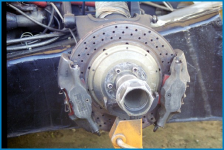

Great and interesting info. Thx for sharing !Was no invention on our part, drilling (or better, casting) holes to improve braking performance started with the Porsche 917 race cars of the of the late 60's/early 70's.
I believe the goal of drilling in those days was getting the gasses from the brake pads out so the gasses didn't make the brake pad float above the rotor surface. I don't think cooling was the real goal. Later on, yes, grooves were a way of getting this done, too. If you have a keen eye you can spot another tactic for extreme braking performance in the picture above.
These brake rotors and the calipers (one per wheel) did eventually make their way to some of Porsche's street cars. Dual calipers, to my knowledge, didn't show up on a street car until the Mercedes-Benz Maybach sedan/limo around 1997.
But we already knew from seeing real race cars at the autocross, and from race parts catalogs, that Formula Ford race cars were doing crazy things like this with brake rotors:
Now that's about rotational mass and unsprung weight! Although I suppose the surface area for cooling has increased, too.
Sprint cars and high-tech motorcycles have since gone on to have crazier rotors.
Was no invention on our part, drilling (or better, casting) holes to improve braking performance started with the Porsche 917 race cars of the of the late 60's/early 70's.
I believe the goal of drilling in those days was getting the gasses from the brake pads out so the gasses didn't make the brake pad float above the rotor surface. I don't think cooling was the real goal. Later on, yes, grooves were a way of getting this done, too. If you have a keen eye you can spot another tactic for extreme braking performance in the picture above.
These brake rotors and the calipers (one per wheel) did eventually make their way to some of Porsche's street cars. Dual calipers, to my knowledge, didn't show up on a street car until the Mercedes-Benz Maybach sedan/limo around 1997.
But we already knew from seeing real race cars at the autocross, and from race parts catalogs, that Formula Ford race cars were doing crazy things like this with brake rotors:
Now that's about rotational mass and unsprung weight! Although I suppose the surface area for cooling has increased, too.
Sprint cars and high-tech motorcycles have since gone on to have crazier rotors.