I've answered a similar question a number of times.
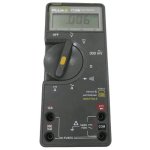
1. Fluke is my favorite when someone else is paying the bills. I really like the 87-3, 87-5 and the 187. I don't care for the 113-117. My issues with them is the lack of Touch Hold which is a great Fluke feature. When you set the meter to touch hold it waits for a stable reading then freezes the display. This is great because that means you can keep your eyes on the probes, not the screen since the reading you want will be there when you remove the probes from the sparking bits. Most Fluke's also have very fast continuity checking. If you are willing to look used, sometimes the old (like sold when Regan was in office) Fluke 27's can be had on eBay. They are very robust and can be used as bricks if the need is there. The Fluke 101 may be a good deal if you want a very basic but very well made meter for likely $50-60. It will not do current ranges. Amazon's price is high but I think other sites have it for less.
2. Second to Fluke, and the meter family I typically recommend the most, is something made by Brymen. They are an OEM for many good meters including the Matco MD251 and MD257 (often very good deals used on Ebay). They also make the GreenLee MD820A I used in the garage. If you look at either their smaller or bigger family of meters (Matco is the smaller family, the MD820A is the larger) you will see the family resemblance. Any of those are very solid meters and all but equal to Fluke in terms of safety and accuracy. Only the lack of touch hold bothers me.
3. Depending on your uses and honestly, one I always suggest as a second meter is the Uni-T UT210E (must be the E version). This is a low cost clamp meter that can read AC and DC and down into the mA range. I will not claim Amazon has a good price, I recall these being ~$50 not the current asking price.
https://www.amazon.com/dp/B0188WD1NE?tag=atomicindus08-20
These are nice because you can measure current through a wire without breaking the circuit. Note, it measures net current so if you clamp it around an extension cord you will see zero net current even if you are clearly loading the cord. You can only measure one leg at a time. Anyway, thanks to having voltage, capacitance and resistance ranges it really does most of what you need. The electrical safety features aren't as good as those used by Fluke and Brymen but that is less important if you are doing mostly home/automotive (non-EV) work. Of the above options this might be the one I would get as an only meter so long as you know you don't need inline current measurements and you don't need temperature measurements. It, along with the Fluke 101 are the only ones that are available for around $50-60 new. The others are ebay searches.






 !
!