To avoid these ads, REGISTER NOW!

concrete blocks for foundation?

BOTTLEDZ28

Member
Joined
Mar 13, 2007
Messages
15
Location
Mass
Why would you use concrete blocks to build a foundation for a garage rather then just form a foundation and pour it as one continuous wall of concrete. Is one cheaper then the other or does it come down to code?
 
To avoid these ads, REGISTER NOW!

PurdueSD

Well-known member
Joined
Mar 25, 2006
Messages
1,577
Location
Indiana
DSC01317.jpg


:rocker: Cause block work can be DIY. In hind-site, man its alot of work...
 

Kevin54

MEMBER EMERITUS
Joined
Jan 12, 2005
Messages
29,341
Location
Urbana, Ohio
Is one cheaper then the other or does it come down to code?

Condiderably cheaper. You don't need form boards for one. No bracing. And probably about half the price of solid concrete. Around here a block is about $.85/pc and $1.00/block to lay them.

Kevin
 

zvezdah1

Well-known member
Joined
Sep 9, 2007
Messages
71
Location
columbus, GA
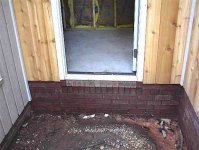
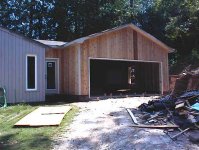
Fyi, I opted for a brick foundation, and as stated, they didn't need forms poured into the brick, with expansion joint, looks much better than the concrete block.

Chris
 

Attachments

  • garage8.jpg
    garage8.jpg
    23.6 KB · Views: 67
  • garage1.jpg
    garage1.jpg
    35.3 KB · Views: 47

wilbilt

Banned
Joined
Aug 17, 2006
Messages
5,602
Location
NorCal
Monolithic poured slab/footing is the only way it's done around here for most homes and garages on flat ground.
 

timgr

Well-known member
Joined
Dec 19, 2006
Messages
544
Location
Medford, MA USA
Monolithic poured slab/footing is the only way it's done around here for most homes and garages on flat ground.

As I understand it, the footing has to descend as far as the frost line (ie depth of freezing) for the locale. That's why monolithic slabs are popular in CA, because there's no need for digging deep. Here in the NE, almost every house has a basement... you may as well take the space when you have to dig that deep.

I would think that block would be good in locales where the trench is deep, but not so deep that you can't easily reach the bottom to set the blocks - ie less than basement depth. Might also be ok for a small building with a basement - again, good access to set the block. Plus it might be more practical for smaller buildings where the labor to set and pour forms can't be offset by the economy of scale of pouring the whole foundation at once. That and the DIY factor...
 

wilbilt

Banned
Joined
Aug 17, 2006
Messages
5,602
Location
NorCal
As I understand it, the footing has to descend as far as the frost line (ie depth of freezing) for the locale. That's why monolithic slabs are popular in CA, because there's no need for digging deep.

That makes sense. The standard footing trench here is 12" wide by 12-18" deep.
 

IDASHO

Well-known member
Joined
Mar 5, 2007
Messages
1,809
Location
Moscow, Idaho
While the required footing depth around here (idaho) is 32 inches below grade.

And due to the soil conditions on my property, my footers were 16"x12".

LOTS of mud.

As for blocks.... my project required a bit over 500 blocks. I tried the blocks, simply because it is one method Id never used before for foundations. And as "easy" as it was, Ill never use this method again. Next time Ill form and pour. SO much labor involved. Cheaper yes, but the cost savings goes right out the window when you factor in labor.


here are a couple of photos to show the process, as well as to show just how deep my footers were.....

July1_01.jpg


July6_03.jpg


July7_04.jpg


July22_03.jpg
 

zvezdah1

Well-known member
Joined
Sep 9, 2007
Messages
71
Location
columbus, GA
When we bought our house some years ago, our retaining wall was made of concrete blocks (what a nightmare due to leakage etc) Isn't leakage of moisture a big issue with concrete block?

The retaining wall the original owner left us with as well as detached garage (of which one wall was the retaining wall) are the reason we finally tore the whole mess down and started over.
Chris
 

Kevin54

MEMBER EMERITUS
Joined
Jan 12, 2005
Messages
29,341
Location
Urbana, Ohio
When we bought our house some years ago, our retaining wall was made of concrete blocks (what a nightmare due to leakage etc) Isn't leakage of moisture a big issue with concrete block?

For something like a garage, moisture leaking is not really an issue. The blocks may get damp but not fully wet. In something like a basement on a house, you do not want moisture, so the outside is sealed with a tar like substance to keep moisture from seeping through.

Kevin
 
To avoid these ads, REGISTER NOW!
OP
B

BOTTLEDZ28

Member
Joined
Mar 13, 2007
Messages
15
Location
Mass
hmm, you know I may just have to go with th forms for my garage then, I have access to all the forms and ties for free from my work and I can install them myself. thanks for the replys
 

HacksawsGarage

Well-known member
Joined
Aug 10, 2007
Messages
69
Location
southern Ct.
When we bought our house some years ago, our retaining wall was made of concrete blocks (what a nightmare due to leakage etc) Isn't leakage of moisture a big issue with concrete block?

The retaining wall the original owner left us with as well as detached garage (of which one wall was the retaining wall) are the reason we finally tore the whole mess down and started over.
Chris

actually, i am considering doing the ret wall/shop wall thing. what was the problem with yours?
what did you replace it with?
 

zvezdah1

Well-known member
Joined
Sep 9, 2007
Messages
71
Location
columbus, GA
actually, i am considering doing the ret wall/shop wall thing. what was the problem with yours?
what did you replace it with?

Well keeping in mind the guy I bought the house from did the wall and garage himself. Whenever we had heavy rains the garage would flood, obviously he didn't seal it right, he also didn't fill the openings with concrete, I tried everything over the years to prevent the moisture issue and all failed. Had it been built right in the first place guess it would've been fine. But I'd have a concern about humidity with retaining wall serving as one wall of a garage.

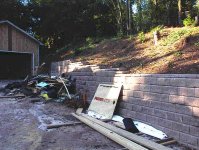
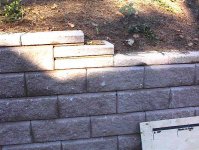
Our solution, we tore it all down, chopped deeper into the slope, installed an interlocking concrete block wall (120 ft. long!) and moved the garage away from it about 3 ft. Here's a couple pics, work is still in progress.
Chris
 

Attachments

  • garage5.jpg
    garage5.jpg
    41.1 KB · Views: 39
  • garage6.jpg
    garage6.jpg
    41 KB · Views: 32

PanelDeland

Well-known member
Joined
Mar 24, 2007
Messages
184
IDasho,I don't know about block but the "Block Layer" in your last pic looks like she could put a hurtin' on ya!!!
 

HacksawsGarage

Well-known member
Joined
Aug 10, 2007
Messages
69
Location
southern Ct.
she certainly does look like she can hold her own. and very attractively i may add.

that wall is most excellent, if rather expensive. i do have a pile of Versa-Loc blocks. not nearly enuff to do retain the whole area, but i will now consider expanding on that idea. thanks.
 

kbs2244

Well-known member
Joined
Nov 11, 2006
Messages
14,065
In my travels I have found it is mostly a matter of local custom.
Block is the less expensive material, but if you have to use union people to lay it, the savings go out the window. If you are thinking DIY be aware that it is HARD WORK.
But then, hauling and working concrete isn't for sissies either.
The poured walls guys will claim higher strength, and it may be true, but if all you need to do is get below the frost line to hold up a back filled slab, the block will work fine.
Are you in a part of Mass where you may hit rock before you get to the frost line? I have seen some inspectors let you pour right onto a well washed rock ledge, without the need for a footing. The flexabilty of concrete over the pre-made stright edges of block win out then.
I once hit a granit boulder when digging a footing trench. We started digging around it, thinking to pull it out and the continue with the trench. When it became clear it was bigger than a VW we left it there and continued the trench. When we called for the pre pour inpsection we told the guy about it before he even got out of his truck, so it was the first thing he went to look at. After looking at the rest of the trench, he came back and looked it over again and said "It dosn't look like it is going anywhere. Pour up to it, and then pour the wall over it. Just use some extra rebar in the wall."
 

HacksawsGarage

Well-known member
Joined
Aug 10, 2007
Messages
69
Location
southern Ct.
extra rebar in the wall? LOL! heck, granite is pretty tuff stuff. if i was concerned at all, i would drill and grout a couple of bars into the granite to tie it into the footing. just like builders should be doing when pouring concrete onto ledge. i have seen some pretty impressive structures made from granite.
 

timgr

Well-known member
Joined
Dec 19, 2006
Messages
544
Location
Medford, MA USA
Are you in a part of Mass where you may hit rock before you get to the frost line? I have seen some inspectors let you pour right onto a well washed rock ledge, without the need for a footing.

North of Boston, where I live, ledge in the basement is common. When I was looking for my house, many of the houses had sections of the basement that are bedrock.

The house I bought, where I live now, has a level lot and no ledge in the basement. However, when I dug my trench for my garage utilities, I started off diagonally across the yard. I gave up, because it's solid rock about 6" under the middle of the lawn - ledge I presume. When I encountered big rocks in the rerouted trench (bigger than I could move), I went around them, and then the electrician heated and bent the conduit to go around.

No wonder almost all the farms in MA were abandoned in the late 19th century - too many rocks.
 
To avoid these ads, REGISTER NOW!
Top Bottom