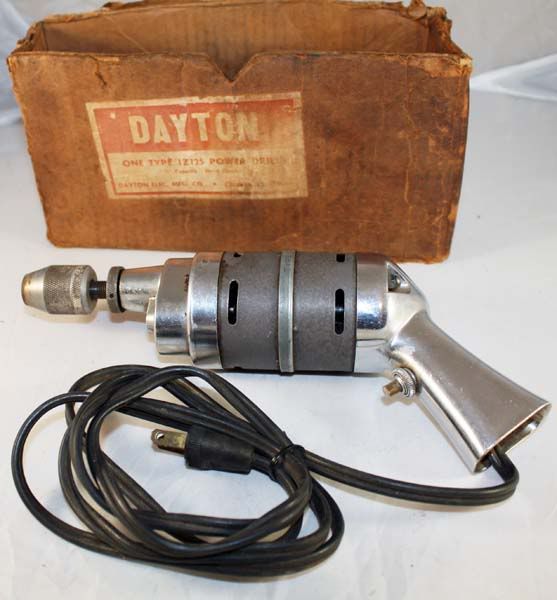
Very simple indeed.
Most times the cords are deteriorated badly and need to be replaced anyway.
All you have to do, is attach the ground wire to the metal case somewhere.
Agreed, if I'm going to replace the power cord anyway, I go ahead and install a ground. When I come across a totally defunct power tool, I disassemble it and save the power cords and strain relief. Then, when an older tool needs a new cord, I have a complete newer one ready to bolt in. The green ground wire usually even has a ring terminal on it, ready to go under an convenient screw.
If it doesn't need a new cord, I just use it in the original two prong form. FWIW, I've been "grabbed aholt of", as we say in the south, by 110v dozens of times. It does get your attention, but is not often fatal. More than you wanted to know:
110V AC Kills!
"According to the United States Consumer Safety Report published in 1995 based on statistics provided by NCHS (National Center for Health Safety) on electrocutions by consumer products, the home is truly a dangerous place for the unaware. According to the 1995 statistics, the latest statistics available, there were 550 electrocutions in and around the home because of consumer products. Out of a total of 560 electrocutions in the United States, 230 electrocutions or 41 percent were related to consumer products.
· Installed household wiring accounted for 23 percent, or 53 deaths caused by household electrocutions. You need to know what’s inside that wall you’re cutting into with your Saws All.
· Another 17 percent, or 40 deaths, resulted from defective or improperly used small appliances.
· Another 14 percent, or 33 deaths, resulted from defective or improperly installed major appliances
· Another 10 percent, or 24 deaths, resulted from improperly installed television antennas.
· Another 9 percent, or 20 deaths, result from defective or improperly installed or used lighting equipment
· Another 7 percent, or 15 deaths resulted from people coming into contact with electrical wires while working on ladders
· Another 6 percent, or 13 deaths, resulted from using defective or improperly wired power tolls
· Another 6 percent, or 14 deaths resulted from defective or improperly used farm and garden equipment
· The remaining 8 percent or 18 deaths resulted miscellaneous causes of electrocution."
http://factoidz.com/the-home-handy-p...-can-kill-you/
"Voltage is not a reliable indication of danger because the body's resistance varies so widely it is impossible to predict how much current will be made to flow through the body by a given voltage.
AC is more dangerous than DC, and 60-cycle current is more dangerous than high-frequency current. Skin resistance decreases when the skin is wet or when the skin area in contact with a voltage source increases. It also decreases rapidly with continued exposure to electric current.
Offhand, it would seem that a shock of 10,000 volts would be more deadly than 100 volts. That is not necessarily so! Individuals have been electrocuted by appliances using ordinary house supplies of 110 volts and by electrical apparatus in industry using as little as 42 volts direct current. The real measure of a shock's intensity lies in the amount of current (amperes) forced through the body, and not the voltage. Any electrical device used on a house wiring circuit can, under certain conditions, transmit a fatal current."
http://www.spgs-ground.com/information/shock-hazard
"According to the U.S. Consumer Product Safety Commission (CPSC), approximately 400 individuals are killed in the U.S. each year as a result of electrical shocks and electrocution accidents in the home. The National Fire Protection Association estimates that on average, 53,000 residential electrical fires occur yearly, leading to more than 450 deaths, 1,400 injuries, and at least $1.4 billion in property damage.
Many accidents result from misuse of electrical outlets, with almost 4,000 injuries reported yearly. One-third of these injuries occur when young children insert objects such as keys, safety pins, or hairpins into wall outlets. Electrical shocks can cause severe muscular contractions, nerve damage, cardiac arrest, severe burns, and even death from electrocution."
http://www.consumerwatch.com/safety/electrical-safety
Having read all the above, I'll continue to use my ungrounded power tools:
Cause of Death Lifetime Odds
Heart Disease 1-in-5
Cancer 1-in-7
Stroke 1-in-23
Accidental Injury 1-in-36
Motor Vehicle Accident 1-in-100
Intentional Self-harm (suicide) 1-in-121
Falling Down 1-in-246
Assault by Firearm 1-in-325
Fire or Smoke 1-in-1,116
Natural Forces (heat, cold, storms, quakes, etc.) 1-in-3,357
Electrocution 1-in-5,000
http://www.livescience.com/environme..._of_dying.html
jack vines