To avoid these ads, REGISTER NOW!

concrete... how long before it can get wet?

bluesman2a

Well-known member
Joined
Aug 16, 2005
Messages
1,312
Location
Atlanta, Ga.
OK, so I got a slab poured today and it's not quite dry all the way across. not quite dry enough for them to put a power-float on it.

I've got some rain coming in this evening... Looks pretty threatening, right now. Do I need to worry about the slab, about how they finish it, or anything else? They talked about coming in to finish the rest tomorrow, what is the deal there, sounds fishy to me.

Anybody have any advice here?
 
To avoid these ads, REGISTER NOW!
OP
B

bluesman2a

Well-known member
Joined
Aug 16, 2005
Messages
1,312
Location
Atlanta, Ga.
oops, sorry, wrong forum...

Well, some guy with a beard just started loading animals into a boat by twos...

The slab is covered, but it's POURING... I guess I'll take a look in the morning and see what I have...
 

MXtras

Well-known member
Joined
Aug 17, 2005
Messages
1,356
Location
On the Right Coast
If you have it covered, you should be fine. Concrete will cure under water, after all.

When it stops raining, I would strongly suggest getting out there and getting any puddles off the covering, but I wouldn't mess with any water sitting on the slab itself. Leave it uncovered if the rain has passed - at least for a little while.

Scott
 

PAToyota

Well-known member
Joined
Jan 20, 2006
Messages
4,366
Location
South Central Pennsylvania, USA
Ummm... Concrete should set up enough to power trowel it in a few hours at most. If it is too wet to trowel it something is definitely wrong. Coming back the next day to finish it is sending up red flags for me...
 

brad d

Well-known member
Joined
Sep 2, 2007
Messages
361
Location
Winnipeg
yeah i thought some guys keep it wet after its power troweled.. to make the cure better??
 
OP
B

bluesman2a

Well-known member
Joined
Aug 16, 2005
Messages
1,312
Location
Atlanta, Ga.
Update: Thunderstorms passed over, pulled the cover off and they went back to work.

They finished the second truck pour this morning between 11:30 and noon. It's now 6:30 and they are still trowelling wet "mud" around on half of the slab. The other half has been finished and is fairly dry, has a dark grey texture and they've power-floated it.

When they brought the second load in, I had to step away for a while and when I came back the second load had about 1" or more of standing water on top of the concrete. It hasn't set up as fast as the other stuff. Have I been screwed here? If I allow them to move forward with this, is this something I need to worry about failing in the future?

In talking to the slab foreman, he is telling me it won't affect the ultimate strength, just requires longer for his crew to work it until it's right. Does this sound right?

I haven't paid anybody anything at this point, is there something that I should do to make sure the concrete is good before I pay?
 

Bib Overalls

Well-known member
Joined
Dec 4, 2006
Messages
3,318
Location
Jonesboro, Arkansas
Strength is a function of the mix. Or better said, the ratio of components; cement, gravel, sand, and water. Off the truck, the mix should be right on specification. Adding water generally reduces strength. If the standing rain water was worked into the mix I would be concerned. If, however, the bulk of the water was pulled off things should be OK.
 
OP
B

bluesman2a

Well-known member
Joined
Aug 16, 2005
Messages
1,312
Location
Atlanta, Ga.
Bib,

The water I'm concerned about didn't come from the rain, it was in the original mix from 11:30 this morning. The slab was covered during the rain and I don't think that's part of the issue now.

I saw the bill of lading and it doesn't say there was any water added on the specification, but it's still too wet to put a machine on it and it's now a little after 7:00 in the evening.
 
Last edited:

dxdexter

Well-known member
Joined
Aug 1, 2006
Messages
1,923
The water was propably whats called "bleed water" which is in the concrete and separates (or bleeds out ) from the mix and rises to the surface after placing, especially if the concrete is "wet". Bleed water usually appears as puddles, but I have never seen it as you describe - 1" of standing water.

When finishing the slab, the bleed water must be allowed to evaporate prior to power floating, so that it is not incorporated into the surface thereby increasing the water/cement ratio and thus the durability of the surface.

Residential finishers are notorious for placing high slump or "wet" concrete. Any water that was added to the load (if any was) may not show as a notation on the batch slip. If the concrete readily flowed around the slab with little or no raking (or complaining) by the finisher, then it more than likely was placed at a high slump.
 

Mr. Welsh

Well-known member
Joined
May 21, 2007
Messages
1,425
In talking to the slab foreman, he is telling me it won't affect the ultimate strength, just requires longer for his crew to work it until it's right. Does this sound right?

Wet curing concrete adds a significant amount of strength. Adding water to the mix significantly decreases strength.

It sounds like your finishers added too much water to the mix. Way too much.

Aren't you guys having a drought? Anyway, it is unlikely to cause you problems unless it's a heavy duty application. Is there a warranty? Did you specify the strength of the concrete?

Most residential contractors are more concerned with their backs than your concrete strength, and it is typical to add several gallons of water on-site for residential jobs. I know I did it a lot when I worked for a residential concrete company - there are several factors that come into play. There are chemicals that can be added at the batch plant to improve workability without affecting strength, but obviously they add to the cost.
 
Last edited:
OP
B

bluesman2a

Well-known member
Joined
Aug 16, 2005
Messages
1,312
Location
Atlanta, Ga.
So, some good news this morning!!! I talked to the main guy at my concrete company. His take on it: I know you're putting a lift in there, and I want that concrete to be right. Give me two weeks and we'll have the slab tested, if it's not up to specs, I will personally jack-hammer out every bit of that slab and the concrete vendor will pay to have it replaced to spec for you.

WHEW!!! It's a huge PITA, but I'm happy to have a man who stands behind his product!!!

Also FYI, having learned my lesson, ain't NObody been paid a dime yet...
 
To avoid these ads, REGISTER NOW!
OP
B

bluesman2a

Well-known member
Joined
Aug 16, 2005
Messages
1,312
Location
Atlanta, Ga.
is what he said in writing ???

Not yet, but I have no reason to believe he won't do it... I'm naturally skeptical of course, but I can guarantee you it WILL be in writing before any money changes hands. I mean thus far I have a slab and sidewalk installed on my property and they have none of my money. It would behoove them to make me happy and make me WANT to sign that check. They understand my position and have shown every indication they want to make it right before we discuss payment or any further action.

I think 2 weeks is fair on their part to wait for the curing process before they test it, and I'm willing to wait, especially if they are doing the testing and verification on THEIR dime. It's a helluva lot easier to correct the problem NOW when it's just a slab, before I put a building and a lift on top of it. Frustrating, of course, but I'd rather deal with it now than in 3-5 years. :beer:
 

dxdexter

Well-known member
Joined
Aug 1, 2006
Messages
1,923
There are chemicals that can be added at the batch plant to improve workability without affecting strength, but obviously they add to the cost.


Workability can be improved in the high slump range (6" to 10") with the use of super plasticizers ( High Range Water Reducers ).
Slump in the range of 5" to 6" is what many finishers consider adequate and can be achieved using a "Mid Range Water Reducer".

As stated these add cost to the mix and therefore are usually not used because water is cheaper.:(

High water/cement ratios cause reduced strength, shrinkage cracks, curling, and dusting of the surface. The ready mix producer will need to retrieve core samples from the slab and have them tested at an independent lab. If they opt to use "non destructive " methods of testing (ultra sonic,Schmidt hammer), then take the results with a grain of salt, since they are only an estimation. Even if strength is adequate, the other problems mentioned above can still occur.
 
OP
B

bluesman2a

Well-known member
Joined
Aug 16, 2005
Messages
1,312
Location
Atlanta, Ga.
OK so another question here:
When I got home last night and looked at the section they had let sit overnight before they finished it, it looks like they put a skim-coat of concrete on top of the slab to smooth it out rather than taking off the ridges and stuff.

Is this something I need to worry about going forward? I mean it looks OK now, but do I need to worry about it bonding or flaking off in the future?
 

Kevin54

MEMBER EMERITUS
Joined
Jan 12, 2005
Messages
29,341
Location
Urbana, Ohio
There is no way that concrete should still be unworkable after seven hours. I'd be very leery about that pour.

That's correct. After 7 hours you should be able to walk all over it. The drier concrete is poured the stronger. Mind you not so dry that it is not workable. My garage was power troweled in about an hour and a half after it was screed down. 7 hours and you have a wrong mix I would think. And like stated...adding water reduces strength, but keeping wet daily after it is troweled will make it stronger. Slow cure strengthens it.

Kevin
 

dxdexter

Well-known member
Joined
Aug 1, 2006
Messages
1,923
OK so another question here:
When I got home last night and looked at the section they had let sit overnight before they finished it, it looks like they put a skim-coat of concrete on top of the slab to smooth it out rather than taking off the ridges and stuff.

Is this something I need to worry about going forward? I mean it looks OK now, but do I need to worry about it bonding or flaking off in the future?

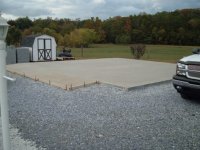
Do you have any pictures?

Normally proportioned concrete without set retarders will generally achieve initial set (500psi) at around 3 to 4 hours. If the concrete was still being worked after 7 hours then I would be very suspect of how the finish was achieved (voluminous amounts of water to produce a paste ???).

It is not uncommon for concretes subjected to cool temperatures to be finished many hours after placing, but at this time of year I'm sure thats not the case.
 

03bluesilver

Active member
Joined
Sep 10, 2007
Messages
40
Location
Shippensburg PA
My concrete guy just told me that one hour after he gets done that it could get wet!!! He got it all in today without no rain,It was cloudy all day!!
 

Attachments

  • DSCF0448.JPG
    DSCF0448.JPG
    39.7 KB · Views: 136

jay_imok

Member
Joined
Oct 13, 2007
Messages
18
if there was a skim coat without a bonding agent it could separate. i think floor concrete is usually 3,000# to 3,500# psi mix. and the curing curve is 0-28 days to high cure and then the curve flattens ad infinitum.

ever try to break up 50 year old concrete?
 

Bigger Hammer

Well-known member
Joined
Jun 26, 2007
Messages
173
Do you have any pictures?

It is not uncommon for concretes subjected to cool temperatures to be finished many hours after placing, but at this time of year I'm sure thats not the case.


I have personaly been on several slab pours where they laid for a long time before we could get in and start working them on knee boards let alone run a machine on them. I had a total of 27 hours in on one slab from initial pour to final finish, but it was a dead of winter basement pour in a totally enclosed structure. Basically no where for the moisture to go and if we let dry air in it would have been too cold.

I have also been on a few slabs that got hammered with rain. Once it is placed and gets rained on I wouldn't be so concerned with the overall strength of the slab but the surface finish will be pretty lean in the cement to aggregate ratio. There have been times where we had to dump some bags of portland cement on the surface to get enough cream built back up in order to get a finish on it.

Rain and concrete just ***** for everyone, the only thing worse is winter concrete work.

I'd be interested in seeing some pictures as well.
 
OP
B

bluesman2a

Well-known member
Joined
Aug 16, 2005
Messages
1,312
Location
Atlanta, Ga.

dxdexter

Well-known member
Joined
Aug 1, 2006
Messages
1,923
Its a good thing you documented the placement with photographs. By the looks of the surface delamination, the slab would be a mess after the first winter, if not sooner.

Its my belief that the concrete company in your photos "Lafarge Construction Products" would have removed the slab even if the contractor would not. In my part of the world they are a very professional and conscientious producer. I'm sure the driver got an earful from his manager if enough water was added to produce that much bleed water.

As a side note, thats quite a rebar layout in the sidewalk. The sidewalk would actually perform better if the rebar was omitted. It is preferred that a sidewalk be jointed (or sawed) and allowed to crack (within the joint) and move freely longitudinally as temperatures change. Aggregate interlock will help prevent vertical movement.

For the replacement concrete I would recommend Lafarge's Ultradrive mix at 4500psi (31 Mpa) or 5000psi (35Mpa) for durability if exposed to freeze-thaw or deicing chemicals. Minimum code requirements probably specify a lower strength, but the extra cost is worthwhile.
 
OP
B

bluesman2a

Well-known member
Joined
Aug 16, 2005
Messages
1,312
Location
Atlanta, Ga.
As a side note, thats quite a rebar layout in the sidewalk. The sidewalk would actually perform better if the rebar was omitted.

It wasn't by design, that was my fault, I had a ****-load of rebar left over and I told them to use it all somewhere and not to leave any out of the concrete.

BTW, thanks for the critique on the material, I appreciate knowing I'm justified in my concern... :beer:

As for LaFarge, I told my contractor not to ever send them out to my place again (next time we're going with Thomas). The driver was a real yutz, I found him washing his conveyor RIGHT into my footer, and asked him to wash his junk elsewhere. I was less than impressed with their performance.
 

Mr. Welsh

Well-known member
Joined
May 21, 2007
Messages
1,425
I would assume that LaFarge is paying for it, so I'm surprised you are changing suppliers.

Surely the contractor isn't eating it...I wouldn't be surprised if you are locked into LaFarge for the replacement, not that it would really matter.
 
Last edited:
To avoid these ads, REGISTER NOW!
Top Bottom