To avoid these ads, REGISTER NOW!

Another gas line plumbing safety question

Thruxton

Well-known member
Joined
Dec 30, 2010
Messages
767
Location
Virginia
In renovating my attached shop/garage I am moving my dust collector to a small shed addition I am building on the exterior of the shop, in a corner where the shop joins the house. The propane line comes to this corner and is split there by a "manifold" to go to the furnace and the kitchen stove (see photo). The shed will be small, about 2.5 X 4.5 feet, and fully enclosed. It will contain the dust collector with its 220V circuit and a sandblast cabinet with a 110V circuit for its lamp.
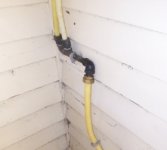
gas1.jpg

My question is, is it safe to enclose this "manifold" in the same shed as the items mentioned above? My gut feeling is no, but I worry that my worries are going to cause me some unnecessary work. Feedback much appreciated!
 
To avoid these ads, REGISTER NOW!

ishiboo

Well-known member
Joined
Oct 27, 2010
Messages
9,481
Location
Oshkosh, WI
In renovating my attached shop/garage I am moving my dust collector to a small shed addition I am building on the exterior of the shop, in a corner where the shop joins the house. The propane line comes to this corner and is split there by a "manifold" to go to the furnace and the kitchen stove (see photo). The shed will be small, about 2.5 X 4.5 feet, and fully enclosed. It will contain the dust collector with its 220V circuit and a sandblast cabinet with a 110V circuit for its lamp.

gas1.jpg

My question is, is it safe to enclose this "manifold" in the same shed as the items mentioned above? My gut feeling is no, but I worry that my worries are going to cause me some unnecessary work. Feedback much appreciated!

Looks like CSST with appropriate fittings. It would be fine to have this in your basement, so I don't see why not your shed. It would not be okay to bury them in a wall. I'd leak check them "just in case" before you build the shed, because a compressor starting up/running/stopping WILL spark.

You need venting for the compressor unless you're in a frigid area.
 

Frank The Plumber

Well-known member
Joined
Feb 19, 2011
Messages
2,644
Location
Chicago.
I'm not really sure how I feel about this. We more or less use black pipe. I'm guessing this is outside of the home in an area where it won't be bumped into or banged around. As it is, if your gas supplier feels it is safe it should be fine. And then we alter the situation a little. So now you would want to build a shop extension and enclose this piping within the shop. In this scenario we would ask a few questions, Is this product legal and considered safe by your gas supplier if installed within a confined space? Is the material in a good and operable condition, no wear or damage? Will you be doing work, storing items by over or near the installation? Will you be contacting, bumping into or causing motion and stresses to the product? In short, will it survive well in your new environment? I would not encase it, I would hope that it would be in a place that it could not get hit by something and damaged. If it were pipe, you could abuse it more. A few things to consider, hope it helps.
 
OP
T

Thruxton

Well-known member
Joined
Dec 30, 2010
Messages
767
Location
Virginia
Thank you, gentlemen. The gas supplier did the installation, using the flexible pipe that is common here. The shed will have a passive louver vent since the dust collector does displace quite a bit of air (and the comments about a compressor are useful, who knows what I will do in the future). Since the piping is in a protected space, and located where it will not get bumped into or even touched, so I am not concerned about that aspect of the installation. And I certainly will do a leak test. If it were a boat I would add a sniffer...
 

tdkkart

Well-known member
Joined
Jun 17, 2006
Messages
6,887
Location
Eastern Iowa
Not trying to get on Frank's good side, but it looks sloppy to me too. Plus, I'm not too keen on flexible lines on the exterior of buildings, although that tight into a corner makes it a bit better.

BTW, I have no doubt it's perfectly legal in your area......
 
OP
T

Thruxton

Well-known member
Joined
Dec 30, 2010
Messages
767
Location
Virginia
I understand all the above, and I agree, it looks sloppy. It is well protected however, even the exposed supply end is not very exposed to mishap (it joins black pipe a few feet to the right, against the house, behind a genset installation), and the lines on the interior going to the furnace and range are well protected. And again, I will leak test it regularly - I'm retired, but my old man was in plumbing and heating, and he taught me caution first. Thanks again, this is one of the best forums I belong to.
 

Frank The Plumber

Well-known member
Joined
Feb 19, 2011
Messages
2,644
Location
Chicago.
Not trying to get on Frank's good side, but it looks sloppy to me too. Plus, I'm not too keen on flexible lines on the exterior of buildings, although that tight into a corner makes it a bit better.

BTW, I have no doubt it's perfectly legal in your area......
I was just yanking rifles chain a little, he and I have been having a bit of good humored fun on a couple of threads. We're sharing plumbers humor. I stand by what I posted earlier, and this is a hard product to make pretty and perfect looking any ways you install it.
 

BBQ&Love

Well-known member
Joined
Nov 12, 2010
Messages
1,061
Location
Texas
Not trying to get on Frank's good side, but it looks sloppy to me too. Plus, I'm not too keen on flexible lines on the exterior of buildings, although that tight into a corner makes it a bit better.

BTW, I have no doubt it's perfectly legal in your area......

There are rules for plumbers on forums. Chicago plumbers and non-Chicago plumbers have to "scrap". It's just how it is.
 

Frank The Plumber

Well-known member
Joined
Feb 19, 2011
Messages
2,644
Location
Chicago.
Man, I'm learning all the time, secret handshakes, all that stuff...

We ain't scrappin, this is how we act over breakfast, over the last packet of real sugar or bacon, it's all good. The secret handshake is a Curly Howard chin wave, just so you know. No barking though, that's the secret Wisconsin one. La de da La de de.
 

mrb

Well-known member
Joined
Dec 31, 2008
Messages
3,734
id make sure that csst is properly bonded. alot of houses have burned down from an electrical arc piercing the csst
 
OP
T

Thruxton

Well-known member
Joined
Dec 30, 2010
Messages
767
Location
Virginia
I think it is. The csst connects to a section of black iron which is directly bonded to the house ground. I'll post a pic if that would help.
 
To avoid these ads, REGISTER NOW!

Norcal

Well-known member
Joined
Mar 16, 2008
Messages
13,792
CSST is common but I do not like it, black iron is rugged & has not been subject to recalls*, now that I have said my peace, if the OP is careful & does not stash stuff against the gas line it should be OK.

*There was a issue w/ pinhole leaks in CSST, after that they started requiring a 6 AWG bond instead of the prev. 12 AWG.
 

P Dubya

Well-known member
Joined
Dec 30, 2010
Messages
408
Location
Iowa
You say it connects to black iron a few feet away? An hours time, a few feet of pipe/fittings and my trusty 12R and that could not only be safer but it would look a bit more pleasing too! Dubya
 
OP
T

Thruxton

Well-known member
Joined
Dec 30, 2010
Messages
767
Location
Virginia
From that fitting in the pic to the service is not far, but that's the good part, it's the long runs into the house, well over 50 feet total, that would be some fun plumbing. And why do part if you are not going to do it all? But I agree, that would be the 100% solution. It's an old and very modest farmhouse, all systems, plumbing, electrical, and gas were done easiest/cheapest (well, the previous owners remodeled the kitchen and that wiring was done pretty well). I have had to redo 95% of the electrical and probably 90% of the plumbing. The csst was in place for the furnace, and I can see why they went that way - as I said before, it's pretty common in this part of rural Virginia.
 

Frank The Plumber

Well-known member
Joined
Feb 19, 2011
Messages
2,644
Location
Chicago.
If I recall correctly there was a major manufacture that had some problems with a similar product and it related to lightning strikes. Which you may say , no biggie how often does that happen, well more than you think actually. I'll PM you the company name which may have had the problems so you may investigate it.
 

HoosierBuddy

Well-known member
Joined
May 9, 2006
Messages
2,960
Location
Southern Indiana

That's a video on bonding CSST from Gastite.

To use CSST, you are required to be trained on installation. Unfortunately, because the manufactuers of CSST don't want to be liable for the installation (or the training of the installers) they just give you the booklet, you are responsible to learn it and then (get this) sign off on your own training.

Then, the box stores just sell the stuff to whomever with no regard at all if they've been trained.

Then, I have to go shut off gas meters because they've got CSST hooked to the meter, running through a window into a building, not bonded and leaking gas.

Who said black pipe was better? Give that guy a gold star and a beer on my tab!

Phil
 

ishiboo

Well-known member
Joined
Oct 27, 2010
Messages
9,481
Location
Oshkosh, WI

That's a video on bonding CSST from Gastite.

To use CSST, you are required to be trained on installation. Unfortunately, because the manufactuers of CSST don't want to be liable for the installation (or the training of the installers) they just give you the booklet, you are responsible to learn it and then (get this) sign off on your own training.

Then, the box stores just sell the stuff to whomever with no regard at all if they've been trained.

Then, I have to go shut off gas meters because they've got CSST hooked to the meter, running through a window into a building, not bonded and leaking gas.

Who said black pipe was better? Give that guy a gold star and a beer on my tab!

Phil

That dude has a sick 'stache.
 

Frank The Plumber

Well-known member
Joined
Feb 19, 2011
Messages
2,644
Location
Chicago.

That's a video on bonding CSST from Gastite.

To use CSST, you are required to be trained on installation. Unfortunately, because the manufactuers of CSST don't want to be liable for the installation (or the training of the installers) they just give you the booklet, you are responsible to learn it and then (get this) sign off on your own training.

Then, the box stores just sell the stuff to whomever with no regard at all if they've been trained.

Then, I have to go shut off gas meters because they've got CSST hooked to the meter, running through a window into a building, not bonded and leaking gas.

Who said black pipe was better? Give that guy a gold star and a beer on my tab!

Phil
I have a few questions for you on this, If Thruxton does not mind, Is this same problem possible on a copper gas line? I sort of assume so but I feel you know for certain. I would wonder how long those copper linkages for grounding the gas service would stay around with the copper theft being so rampant, must you strip the covering off of the wire? and may you paint or coat the installed wire to deter theft?
 
OP
T

Thruxton

Well-known member
Joined
Dec 30, 2010
Messages
767
Location
Virginia
Frank I don't mind at all. Obviously this is a very important safety issue, and the first thing I found was this: http://www.subrogationrecoverylawblog.com/2010/10/articles/products-liability/csst-1/jury-rules-that-csst-is-a-defective-product-in-landmark-case/

This is from October 2010, so I don't think the results have filtered down into common knowledge, much less codes. But it sure gives me pause. Now I am thinking of following P Dubya's suggestion and taking black iron into the house, and continuing from there with the existing csst. This would be fairly easy, and it would reduce, but not eliminate, the risk from lightning-induced perforation, so I am still researching.

I have to say, if you read the article on this link, it raises a lot of questions, and not just about materials. As I get into this I'll add to this thread, so if you're not interested, avoid it! Fair warning given!
 
OP
T

Thruxton

Well-known member
Joined
Dec 30, 2010
Messages
767
Location
Virginia
Oh, and I realize that these guys are to some extent what some would call "ambulance chasers", so take it any way you want. And Frank, the same thing about copper occurred to me. I wonder if its much greater thickness reduces the risk.
 

fishheds

Well-known member
Joined
Apr 30, 2010
Messages
164
Location
Outer Banks,NC
There are CSST tees available that could've eliminated that black iron manifold totally.
I've ran what seems like miles of that stuff,I prefer Gastite over TracPipe because the fittings seem easier to work with. As long as you get a good clean cut without burrs it works great.
I've seen high volume applications,usually pool heaters, where the gas flow through the corrugation would cause the pipe to whistle like a carnival toy.
 

HoosierBuddy

Well-known member
Joined
May 9, 2006
Messages
2,960
Location
Southern Indiana
I have a few questions for you on this, If Thruxton does not mind, Is this same problem possible on a copper gas line? I sort of assume so but I feel you know for certain. I would wonder how long those copper linkages for grounding the gas service would stay around with the copper theft being so rampant, must you strip the covering off of the wire? and may you paint or coat the installed wire to deter theft?

I don't think you can draw conclusions from CSST and then say "well that would effect copper tubing too." Copper is a much better conductor of power than stainless steel so it wouldn't heat up (as much) transfering power from a lightning jolt. I don't think you could say it wouldn't melt either though!

What I've seen out in the real world with high voltage burning through gas facilities is pretty limited.

1. I've not run into any CSST fires personally or seen where it was damaged by high voltage. However, the literature says it does happen if not bonded properly...and way back in the day...a lot of it (or maybe all of it) wasn't bonded.

2. I have seen lightning hit a normal black steel line, travel back toward the gas meter, jump the insulating (arc across) union at the gas meter to the meter seeking ground and burn a hole through the aluminum casing of the meter, causing a fire on a metal building (turkey house).

3. I have seen a 7KV power line dropped onto a house's gas piping (16 year old wiped out the power pole 10-minutes after school let out) and do exactly the same thing seeking ground.

I guess my thought is, once you get enough voltage, it's going to go where it wants to go and where it wants to go is ground. Whatever conductor it jumps on better be able to handle some serious current. AND...when it arcs across an insulator, you get a bunch of heat and that's an issue.

Also...I assume the question related to copper was for propane? But that's a whole nother thread (natural gas in copper lines is normally not recommended and sometimes not allowed).

Phil
 
Last edited:

cowboyjosh

Well-known member
Joined
Mar 11, 2010
Messages
1,066
Im surprised no one has mentioned this, but maybe only in states Im familiar with like parts of Colorado, Arizona, Ohio, and Texas; CSST must not be exposed to UV (aka the sun) because it will degrade the outer jacket. I have no doubt its a legal install where your at, but in my parts of the world, it would not be approved by the AHJ's being exposed outside.

We found this out when our plumber ran CSST to a couple generators my electrical contracting business installed (when I build custom homes CSST is a no no we don't use it, however it was occasionally used on retrofitting in on backup generators, but we no longer use it on gensets either because of the lightning / arc risk) when the AHJ failed the plumbing inspection because he ran the CSST right up to the generator leaving a few feet of CSST exposed to UV and the elements.

Not to bore ya'll but a few years ago before most plumbers stopped using CSST on generator installs we found out the generator manufacturers like Kohler, Generac, and Briggs and Stratton in the install manual told us in bold face print not to bond the gas line CSST, black pipe, or otherwise; but the AHJ's would insist even with the generator manufacturer manual in hand; it eliminated allot of questions and problems by just making sure all generator gas lines are hard piped.

CSST must not be all that bad though, I see it used on Holmes on Homes almost every week.
 

Byron

Member
Joined
Dec 27, 2010
Messages
10
Propane Limits of Flammability - The lower and upper limits of flammability are the percentages of propane that must be present in an propane/air mixture. This means that between 2.15 and 9.6% of the total propane/air mixture must be propane in order for it to be combustible. If the mixture is 2% propane and 98% air, there will not be combustion. If the mixture 10% propane and 90% air, combustion will not occur. Any percentage of propane in a propane/air mixture between 2.15% and 9.6% will be sufficient for propane to burn. However, an improper air/gas mixture can produce Carbon Monoxide (CO) that is a deadly product of incomplete combustion.
Flash Point - The flash point is the minimum temperature at which propane will burn on its own after having been ignited. This number states that below -156°F, propane will stop burning on it's own. In other words, if the outside air temperature is -155°F, propane will burn on it's own. If the outside air temperature falls to -157°F, propane will no longer burn on it's own. However, if a source of continuous ignition is present, propane will burn below - 156°F.
Ignition Temperate in Air - This number states that propane will ignite if it reaches a temperature between 920-1020°F. If propane is heated up to a temperature between 920 and 1020°F, it will ignite without needing a spark or flame.:FIREdevil
 
To avoid these ads, REGISTER NOW!
Top Bottom