I just got my column tilted up and started drilling the holes on my new Atlas 10K, extra wide and extra tall lift. Got about 2 1/4" and hit rebar. Stopped and moved to the next hole. Just shy of 4" of concrete and then the drill just dropped. When I shinned my light in there and took a measurement, there is atleast a 4" void of nothing under the slab there. %&^*(^@#. Can I get that area mudjacked or have a slurry shot down underneath to fill it up or do I have to cut it out and pour new concrete in that area. Also, my garage peak is 2 inches taller than my lift so tilting those posts up and down is not easy if I have to start over on the concrete. Any thoughts. Stopped dead in my tracks at 2:00 oclock on saturday.


You are using an out of date browser. It may not display this or other websites correctly.
You should upgrade or use an alternative browser.
You should upgrade or use an alternative browser.
Drilling Holes For 2 Post Lift and Its Hollow, Mudjacking or replacement?
- Thread starter Joey-D
- Start date
Torque1st
MEMBER EMERITUS
I would contact the lift supplier for footing dimensions. Whatever you do will hold you up for at least 4 weeks for concrete curing before you can use the lift.
If you are in a hurry and don't want to wait on any mud jacking contractor or info from the lift company just sawcut the existing concrete an inch or so deep for a rectangular pad 4' wide and 2' on either side of the lift. Break out the concrete leaving the existing rebar. Remove the debris. Add some extra re-bar. Mark some reference points for the new bolt holes that will miss the rebar. Fill the hole with 5K concrete pushing some under the existing floor void in all directions. Finish as appropriate.
If you are in a hurry and don't want to wait on any mud jacking contractor or info from the lift company just sawcut the existing concrete an inch or so deep for a rectangular pad 4' wide and 2' on either side of the lift. Break out the concrete leaving the existing rebar. Remove the debris. Add some extra re-bar. Mark some reference points for the new bolt holes that will miss the rebar. Fill the hole with 5K concrete pushing some under the existing floor void in all directions. Finish as appropriate.
Last edited:
Torque1st
MEMBER EMERITUS
I can understand not wanting to cut but it also gives you an opportunity to put even more reinforcement in the floor.
Floating slabs are common where the substrate was not compacted properly or moisture levels have changed.
Floating slabs are common where the substrate was not compacted properly or moisture levels have changed.
UncleJoe
Well-known member
Am I missing something here. Why are you tilting up the posts? Is it to mark where the holes go> If that is the case, cut a piece of scrap plywood the size and shape of the lift bottom plate. Lay it up against the plate and mark you holes through the plate. Drill out the holes and you have a nice easy to use template.
Of course if you are lifting the posts for some other reason then as Rosanna Danna Danna use to say "Never mind"
Of course if you are lifting the posts for some other reason then as Rosanna Danna Danna use to say "Never mind"
PAToyota
Well-known member
I'd advise against mudjacking in this situation. The "mud" they use is very low strength concrete - not what I'd want to be relying on for either bearing for the lift or for keeping the bolts from pulling out.
Am I missing something here. Why are you tilting up the posts? Is it to mark where the holes go> If that is the case, cut a piece of scrap plywood the size and shape of the lift bottom plate. Lay it up against the plate and mark you holes through the plate. Drill out the holes and you have a nice easy to use template.
Of course if you are lifting the posts for some other reason then as Rosanna Danna Danna use to say "Never mind"
The lift columns are lying flat on the ground, as he picks them up (tilt) they are longer/taller compared to them installed.
Billy T.
[email protected]
The slab is in great shape and the slab is all the posts bolt to. The bolts that come with the lift are ment to go into the concrete 4 inches. Bolting to the slab is what keeps the lift from "falling over". I have no concern about that. My concern is the vertical point load. The 5K on 22" x 22" foot print. My concern is dropping through the bottom of the concrete since there is nothing below it. If there was gravel and/or dirt underneath it I would have not concern. I say this in reply to Patoyota, I think a weak psi concrete would be stronger than dirt and/or gravel. Would you agree? I really see this as the best and easiest solution but always like to here others opinions. I am going to read that link gn posted now.
rasit
Well-known member
You can get a rebar cutter bit to finish the hole you already started:
http://www.powers.com/pdfs/drills/concreteauger.pdf
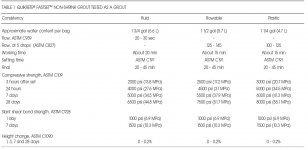
You could use non-shink grout to fill the void. Follow the directions for adding water to make it flowable. It sets up pretty fast and yeilds compressive strength of 6500psi. I think I would core drill a larger hole (2") about a 12" outside of the lift pad area to pour the grout through while using the anchor hole you already drilled as an observation hole. Continue pouring until grout fills both holes to top of slab, ensuring the void is completely filled. Let it set up a coulple of days and redrill he anchor hole.
http://www.quikrete.com/PDFs/SPEC_DATA-FastSetNon-ShrinkGrout.pdf
http://www.powers.com/pdfs/drills/concreteauger.pdf
You could use non-shink grout to fill the void. Follow the directions for adding water to make it flowable. It sets up pretty fast and yeilds compressive strength of 6500psi. I think I would core drill a larger hole (2") about a 12" outside of the lift pad area to pour the grout through while using the anchor hole you already drilled as an observation hole. Continue pouring until grout fills both holes to top of slab, ensuring the void is completely filled. Let it set up a coulple of days and redrill he anchor hole.
http://www.quikrete.com/PDFs/SPEC_DATA-FastSetNon-ShrinkGrout.pdf
59 wagon man
Well-known member
maybe the jagermiester talking but sometimes i think we try and over engineer on this forum .not that anything is wrong with that . considering the size of your pad on the avg weight of a car the load on the concrete maybe equal to the load you place on that floor just by walking on it. i have a prolift which reguraly stores a 59 chevy wagon and the footprint of the lift is nowhere near 22" x 22". yet in 8 yrs of storing the car the concrete has never let go. if there is rebar close it will help even more. plus when i had my first lift installed the professional who installed it always told me drill completely thru the slab. this way when you have to remove the lift you pound the anchors thru the slab and just a little sand mix and the hole is patched
just cut the slab and do the proper footing, do you really want to have a your car up in the air on your lift and have it fail?
+1
With a good saw it won't be nearly as bad as you think.
But what is bad is I only have the forklift for the weekend, I have to drop the columns again to get them out of the way, and then I have to wait weeks until the new concrete is set to remount. Obviously I want to do it once and do it right, but I think the most simple and best cosmetically is to just fill the void. But I haven't made my decision yet.
79firebird
Well-known member
What a local shop did close to me for one of there posts on a lift where 2 of the 6 holes where only 2 inches thick rest where 6 inces dono why the outhers where off. Yhey got a 2 foot by 1 1/2 foot inch thick steal plate under the post then bolted it dow to help try to spread the foot print out a bit more. So it would lift still strait they just adjusted the cables.
PAToyota
Well-known member
My concern is dropping through the bottom of the concrete since there is nothing below it. If there was gravel and/or dirt underneath it I would have not concern. I say this in reply to Patoyota, I think a weak psi concrete would be stronger than dirt and/or gravel. Would you agree?
The first concern is why there is a void. If things continue to settle after the mudjacking, you're going to end up with the mudjacking pulling away from the slab and you won't know it.
gsport
Well-known member
Obviously I want to do it once and do it right, but I think the most simple and best cosmetically is to just fill the void. But I haven't made my decision yet.
i think in this situation i'd go for the strength and security of the install before i'd go for a simple and cosmetic install..
cut out a new foot print and know it's done right....
I just got my column tilted up and started drilling the holes on my new Atlas 10K, extra wide and extra tall lift. Got about 2 1/4" and hit rebar. Stopped and moved to the next hole. Just shy of 4" of concrete and then the drill just dropped. When I shinned my light in there and took a measurement, there is atleast a 4" void of nothing under the slab there. %&^*(^@#. Can I get that area mudjacked or have a slurry shot down underneath to fill it up or do I have to cut it out and pour new concrete in that area. Also, my garage peak is 2 inches taller than my lift so tilting those posts up and down is not easy if I have to start over on the concrete. Any thoughts. Stopped dead in my tracks at 2:00 oclock on saturday.
I don't know which model you have but according to the Atlas manual, you need a mininum of 4". You stated that you're just shy of 4". That's too close for me.
To have a peace of mind, I would cut the floor and do it right.
page 6 http://www.atlasautoequipment.com/sites/default/files/documents/atlas_pv10p_manual.pdf
Billy T.
[email protected]
just cut the slab and do the proper footing, do you really want to have a your car up in the air on your lift and have it fail?

i think in this situation i'd go for the strength and security of the install before i'd go for a simple and cosmetic install..
cut out a new foot print and know it's done right....
I don't know which model you have but according to the Atlas manual, you need a mininum of 4". You stated that you're just shy of 4". That's too close for me.
To have a peace of mind, I would cut the floor and do it right.
page 6 http://www.atlasautoequipment.com/sites/default/files/documents/atlas_pv10p_manual.pdf
Billy T.
[email protected]
I'm sure that is 4" with solid ground under it, not the grand canyon. But
on cutting the floor and doing it right.%^#&%$( I just dropped the post and am going to pour new. *($)#(&*%$)
Good decission in my book. You will know for a fact that it is done right. When you do your new footings, make sure that you add some rebar into your existing floor to tie them together so your hoist doesn't sway your footing.
wssix99
Well-known member
The slab is almost 40 years old. We had a huge rain last night and it is dry down there. I am sure the base was never proper tamped and now it has settled.
That's probably the case.
Whatever you do - you don't want to cut the slab or pour a footing. (You'll notice that your instructions don't tell you to do this.) The concrete slab acts like a "beam" along the length of the car and resists the posts "twisting" front and back when the lift takes a load. If you cut the slab to put in a footing, it will be weaker in resisting this force. If you have an unbalance weight on the lift, the whole thing could fall over.
An uncompressible substance under the slab will help the bearing (mudjacking is a good idea) of the lift but when you think about it - the concrete is pretty strong as it is now. When you put your car on the lift, (given that your base plate is larger than the contact patch of a tire) the pressure on the concrete probably only increases by 2X or less.
jumbo61
Well-known member
If you cut out the slab, you might want to follow Mohawks requirements for new slab sections in an old floor. See link.
http://www.mohawklifts.com/consumer/library/Slab_Req-Reco_2-2010.pdf
http://www.mohawklifts.com/consumer/library/Slab_Req-Reco_2-2010.pdf
rasit
Well-known member
+1 on not cutting the slab all the way through. You already stated that there is re-bar in the slab and that's where the strength is. Cutting it would be a mistake. If you are set on re-pouring you should score the concrete about 1" deep to provide a clean 4' square (per the manual) and chip the concrete out around the rebar. Clean everything out, add more rebar or wire mesh if makes you happy, and repour. I would not add any stone to save on concrete. Fill the void and vibrate.
Personally I would go the other route because it will be a cleaner fix and the end result is the same if done properly. You could core drill a larger hole (3"-4") to accomadate a small ******** to ensure complete grout filling. A lot of people here tend to overkill.
Personally I would go the other route because it will be a cleaner fix and the end result is the same if done properly. You could core drill a larger hole (3"-4") to accomadate a small ******** to ensure complete grout filling. A lot of people here tend to overkill.
Last edited:
I am going to call greg smith in the morning and get their opinion. I plan on renting the saw and going to town on the floor tomorrow if they say so. I will let everyone know the outcome as I am sure someone else will have this problem in the future. There is a little more involved here that I have kept quiet about. To gain more height clearance, I am removing the collar ties above the lift. A collar tie is the horizontal 2 by that keeps the roof from flattening out. Buy using a collar tie, it creates, for a lack of better terms, a truss. This puts the load of the roof on the "front and back" walls. The way a cathedral ceiling is designed, the ridge beam is much larger and is supported on the "left and right" walls. The oversized and properly supported ridge beam now keeps the roof from flattening out. What I am doing is removing 3 collar ties above the lift and supporting the ridge beam underneath with an I-Beam. This will give me a "cathedral" ceiling above the lift. I am using a W 8 x 28lb beam over the 12' foot span. The beam will be welded and gusseted to the side of the lift. Why the side, because I do not have room to do it above. My beam is way oversized. Big enough to span 30', but I got it for $100 so I bought it. This beam will not only resupport the roof, but also strengthen the lift and give me a place to hang a chain hoist from. I know some will give me grief about this, but I have no bought this safe and well engineered.

Torque1st
MEMBER EMERITUS
That is why I told him to leave the existing rebar and add more.Whatever you do - you don't want to cut the slab or pour a footing. (You'll notice that your instructions don't tell you to do this.) The concrete slab acts like a "beam" along the length of the car and resists the posts "twisting" front and back when the lift takes a load.
Joey-
Sounds like a plan. My only other suggestion would be to double up on your collar ties on each side of your lift.
BTW- 4" is better than the 12-18" void I have under my garage floor or the 4 FOOT void under the neighbor's floor.
Last edited:
rasit
Well-known member
There is a little more involved here that I have kept quiet about. I know some will give me grief about this, but I have no bought this safe and well engineered.
Please disregard my previous comments, especially the one about "people here tend to overkill". I think you should jackhammer up the entire floor and start over......Baaahahaha. Just kidding, good luck with it.
toolmanmark
Active member
- Joined
- Jan 2, 2011
- Messages
- 31
I am working on installing a old 2 post lift now. I cut out a section, drilled horizontally into the old floor, added rerod and poured.


If it were me...I would cut two squares out of the concrete...somewhat larger that the footprint of my lift posts. I would rent an auger and drill 3 foot down. I would then make a template of my bolt patterns for my lift and form them up in the center of my holes.
Have the cement truck come out and fill the holes..for a minimal amount of work you now have three foot deep piers for you lift posts and you will never have to wonder about it again.
Have the cement truck come out and fill the holes..for a minimal amount of work you now have three foot deep piers for you lift posts and you will never have to wonder about it again.
I just spoke to greg smith himself and he says go ahead with it as it is. Not to worry about the void or cutting it out and replacing it. He also said it was his opinion and he was not an engineer. His main concern was the whether or not the anchors grabbed tight. I am going to make a template and drill all my holes. Then I am going to use that non-shrink grout and fill up the voids just for piece of mind.
The Atlas manual says slab must be 4" MINIMUM thickness of >3000psi concrete, 6" thickness preferred.
Yup, that sure sounds like you will need to pour piers/footings for the lift posts.
Atlas calls out for a 4 ft x 4 ft x 6 inch thick 3000 psi minimum concrete pad keyed to the existing slab if the anchor bolts don't tighten to 85 ft-lbs installation torque (page 6 step 5 of the aformentioned manual).
By the time you take into account the minimum edge set-backs for the anchor bolts and the post-to-post spacing, if you poured two piers for the posts you'd end up with about 4 ft between those two piers of old 'floating' slab. For the about extra 1/2 cubic yard of concrete that that would take (pouring the piers/slab at 12" thick), I say to just cut out one continuous rectangle out of the old slab and then pour the new pier/slab as a continuous rectangle going 'across' from post-to-post. A roughly 4 ft wide x 12 ft long x 12 inch deep slab is still going to be under most redi-mix truck 'minimum' orders at not even 2 cubic yards of concrete. So you'd usually end up having to pay a 'short' fee/cost as well. By this point, you might call and check your local redi-mix places as to their 'minimum' order size and then maybe just go and pour a bigger and thicker 'slab' than the post minimums in order to not end up paying a fee/cost for less concrete than a slightly larger concrete order would cost.
Putting a lift on top of a 'floating' slab is NOT a good idea. At all.
Because then you have run into the situation spelled out in the Mohawk manual (mentioned above) of putting a lift on a floor NOT directly on the ground (and supported by that ground by 'soil' of a minimum of 2000 lb/ft2 bearing strength).
Doing things outside of the manufacturer's recommendations means you pretty much need to get 'experts' involved. Not folks from a forum on the web. Experts as in soils engineers, structural engineers, that sort of thing. Folks who would put their STAMP (actual licensed stamp imprint) of approval on the design, backed up by their education and reputation and knowledge and liability.
Still not sure? Although you called Greg Smith Equipment Inc., the person you talked to said flat out that they were not an engineer and that his 'opinion' was that things should be 'ok' as is. Call him back and ask him to put that in WRITING that it is OK to put their 10K 2-post lift on a slab of unknown compressive strength that is less than 4 inches thick and that has at least a 4" void underneath the slab. Bet you that the person who previously said it was all 'ok' will NOT put all that in writing.
It doesn't have to race or fly, so overkill is a GOOD thing. Make it stronger than the 'minimums' and then you don't have to worry about it at all.
btw, Mohawk puts even more restrictions/qualifications on slab work for their 2-post lifts than Atlas seems to. Mohawk calls for 4000 psi minimum concrete, as well as minimum required rebar specs in that concrete. And that if the existing concrete slab does not meet their specs, that a new slab going 'across' from post to post be formed 12 inches deep and 4 ft wide MINIMUM and length goes 'past' the posts (actual length depends on the model of lift under consideration). Mohawk further calls out that 'no hand mixed concrete is to be used', ie they want a concrete company to have a material cert/spec and paperwork for same to 'prove' that the concrete meets their minimum 4000 psi requirement.
Yup, that sure sounds like you will need to pour piers/footings for the lift posts.
Atlas calls out for a 4 ft x 4 ft x 6 inch thick 3000 psi minimum concrete pad keyed to the existing slab if the anchor bolts don't tighten to 85 ft-lbs installation torque (page 6 step 5 of the aformentioned manual).
By the time you take into account the minimum edge set-backs for the anchor bolts and the post-to-post spacing, if you poured two piers for the posts you'd end up with about 4 ft between those two piers of old 'floating' slab. For the about extra 1/2 cubic yard of concrete that that would take (pouring the piers/slab at 12" thick), I say to just cut out one continuous rectangle out of the old slab and then pour the new pier/slab as a continuous rectangle going 'across' from post-to-post. A roughly 4 ft wide x 12 ft long x 12 inch deep slab is still going to be under most redi-mix truck 'minimum' orders at not even 2 cubic yards of concrete. So you'd usually end up having to pay a 'short' fee/cost as well. By this point, you might call and check your local redi-mix places as to their 'minimum' order size and then maybe just go and pour a bigger and thicker 'slab' than the post minimums in order to not end up paying a fee/cost for less concrete than a slightly larger concrete order would cost.
Putting a lift on top of a 'floating' slab is NOT a good idea. At all.
Because then you have run into the situation spelled out in the Mohawk manual (mentioned above) of putting a lift on a floor NOT directly on the ground (and supported by that ground by 'soil' of a minimum of 2000 lb/ft2 bearing strength).
Doing things outside of the manufacturer's recommendations means you pretty much need to get 'experts' involved. Not folks from a forum on the web. Experts as in soils engineers, structural engineers, that sort of thing. Folks who would put their STAMP (actual licensed stamp imprint) of approval on the design, backed up by their education and reputation and knowledge and liability.
Still not sure? Although you called Greg Smith Equipment Inc., the person you talked to said flat out that they were not an engineer and that his 'opinion' was that things should be 'ok' as is. Call him back and ask him to put that in WRITING that it is OK to put their 10K 2-post lift on a slab of unknown compressive strength that is less than 4 inches thick and that has at least a 4" void underneath the slab. Bet you that the person who previously said it was all 'ok' will NOT put all that in writing.
It doesn't have to race or fly, so overkill is a GOOD thing. Make it stronger than the 'minimums' and then you don't have to worry about it at all.
btw, Mohawk puts even more restrictions/qualifications on slab work for their 2-post lifts than Atlas seems to. Mohawk calls for 4000 psi minimum concrete, as well as minimum required rebar specs in that concrete. And that if the existing concrete slab does not meet their specs, that a new slab going 'across' from post to post be formed 12 inches deep and 4 ft wide MINIMUM and length goes 'past' the posts (actual length depends on the model of lift under consideration). Mohawk further calls out that 'no hand mixed concrete is to be used', ie they want a concrete company to have a material cert/spec and paperwork for same to 'prove' that the concrete meets their minimum 4000 psi requirement.
Well I have it cut out now. What a nightmare. The place I usually rent from did not have a saw in stock so have to run another 15 miles out. Got it back and got cutting. Now this was a walk behind wet concrete floor saw. A larger engine then a demo saw. I say this because I have run a demo saw in the basement to do plumbing and never had a problem. Well today I had the garage door open and the windows open on a breezy day. I cut the first 4'x4' square. Took a couple whacks at it with the sledge hammer and it dropped. Only problem was I did too. The headache, the fatigue, the vertigo. Oh ****, carbon monoxide poisoning. I made it to the front yard, far away from the garage and collapsed. Sat there for an hour. Finally called my cousin and paid him to cut the second hole with fans going since I only had the saw for a couple more hours. Depending on the severity of the poisoning, it takes 3-5 hours to replace the carbon monoxide molecules in your blood to be replaced with oxygen again. Here it is 4 1/2 hours later while I do feel a whole heck of a lot better, I am still hurting. I am able to pop a hole in the removed slabs and pluck them out with the forklift. The left side was in great shape and didn't need to come out, but the right side sure did. See attached pictures.


Bad Hammer
Well-known member
I admit I'm not the sharpest knife in the drawer, and I may be missing something, but I don't see any sign of rebar in that slab.