To avoid these ads, REGISTER NOW!

Central Air: Figuring out duct size for supply/return trunks

alecmcmahon

Well-known member
Joined
May 20, 2010
Messages
233
Location
Woodbridge NJ
I've got a bit of HVAC knowledge, but when it comes to residential application- i know next to nothing. My background is in commercial maintenance ( chillers, pumps, vav boxes,package units, etc )

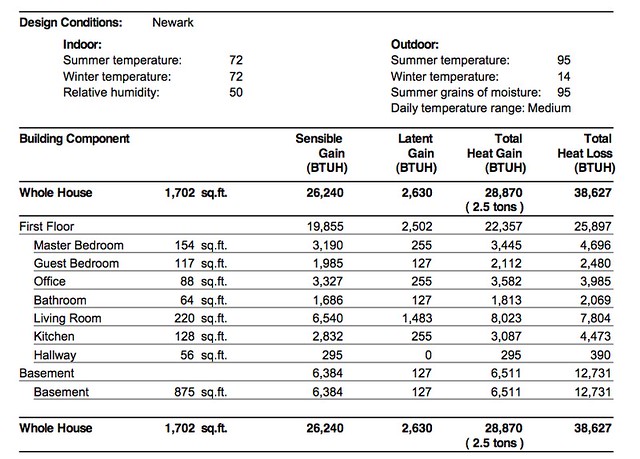
Im installing central air in my small ranch home, the main floor is just under 900 sq feet, and the same for the basement which is getting finished. Did a Manual J load calc and picked up a 2.5 TON luxaire split unit.

Getting ready to peice together my duct work, I've already picked up 8" flex for all my rooms , and a 6" flex for the bathroom. ( along with all the nessasary collars, ceiling boxes, etc. I've also picked up a 16"x25" return grill, and 16" flex for my main return.

My problem is trying to figure out what size supply trunk I need for my air handler, and also the return air duct.

Also, the actuall connections are throwing me a curve. It looks like it'd be easy enough to connect to the supply end, as i have a flat surface to screw into, but the return side is all open and doesnt give any hint on what to actually connect the duct to.

my air handler dimensions are 21.5x17.5.

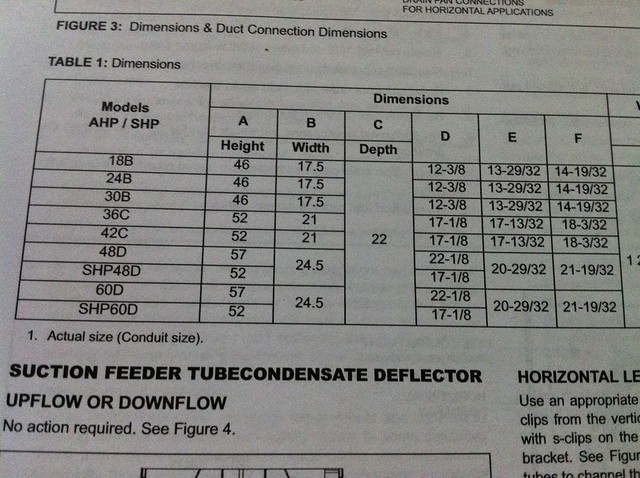
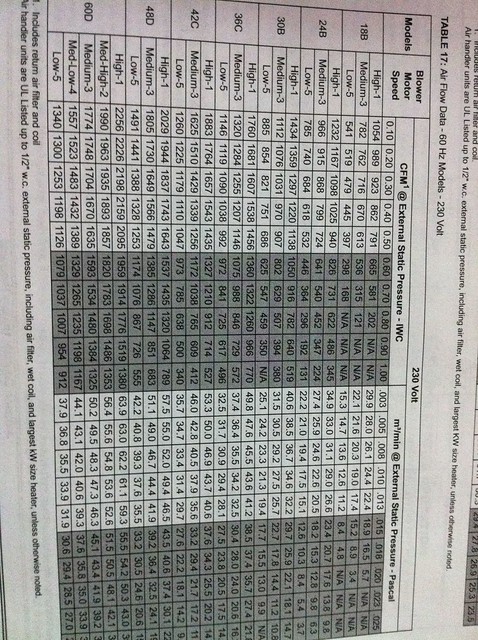
Here is some info. on the units, as well as some pictures as what im talking about.

Return side:
5679704713_805237fdc8_z.jpg

5679705539_2631bdbdb7_z.jpg


supply side:
5679706593_5a3ac11d86_z.jpg


I have the " 30B " unit.
5680275306_156d4862ff_z.jpg


5680277022_e590141af0_z.jpg


5680278444_473f4f7292_z.jpg


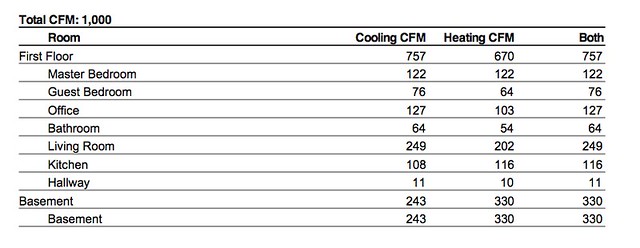
CFM chart produced by "HVAC calc " assuming total cfm is 1000 ( 400 per ton @ 2.5 ton =1,000 CFM ???)
5679283466_2f7cddbd9f_z.jpg


Manual J
5678401380_093c1e56a7_z.jpg


Thanks in advanced.
 
To avoid these ads, REGISTER NOW!

rickairmedic

Well-known member
Joined
May 31, 2005
Messages
4,165
Location
louisville ,Ky
On that setup I would run a 10X25 main trunk and the air handler should set up on a box that you can bring the return into . I could go break out the duct calculator but thats pretty standard size on a 2&1/2 ton system .

Rick
 
OP
A

alecmcmahon

Well-known member
Joined
May 20, 2010
Messages
233
Location
Woodbridge NJ
On that setup I would run a 10X25 main trunk and the air handler should set up on a box that you can bring the return into . I could go break out the duct calculator but thats pretty standard size on a 2&1/2 ton system .

Rick

Oh forgot to mention, horizontal post. in an attic.

So even though the actual measurments of the AH are 17.5 x 21.5 I should tranistion from that to 10x25 ?

same size for return trunk?


Also, while reading the manual , it states:
The supply air duct should be properly sized by use of a transistion to match the unit opening

& Size outlet pleum or transition to discharge opening sizes in figure 3
 
Last edited:
OP
A

alecmcmahon

Well-known member
Joined
May 20, 2010
Messages
233
Location
Woodbridge NJ
I don't mind doing the leg work with research. I just don't want the static
To be so high it blows my hat off my head but not so low I have flow issues
 

Mike007

Well-known member
Joined
Dec 4, 2010
Messages
2,639
You bought a York rebadge. Ugh. Do yourself a favor, go over the air handler with a fine tooth comb before you put it in the attic. Make sure you check the blower wheel. It should spin true and not rub anything. And if you got a microchannel condenser, you may need to disassemble it and reassemble it with foam tape between the panels and top if you want it to run quiet.
 

rickairmedic

Well-known member
Joined
May 31, 2005
Messages
4,165
Location
louisville ,Ky
Yes you want to make a transition from the ends of the air handler down to the 10X25 duct ( trunk runs ) . I generaly make these out of flat sheet metal . I will add since you are putting this in an attic I would wrap all of the duct with insulation . They make a special insulation for duct . The attic location will cause the system to pick up residual heat from the attic without insulating the ducts .


Rick
 
Last edited:

mrobins297aaa

Well-known member
Joined
Sep 20, 2010
Messages
3,283
Location
south east michigan
The easiest way to size your duct work is with a ductulator, but most people don't have one so heres another easy way you can do with a calculator.
the formula is V X A = CFM.

V stands for velocity like in feet per minute, the standard residental design for trunk ducts is 900 fpm so V = 900
A is the area of the duct in sq ft and CFM is cubic feet per minute.

so like you said 400 cfm per ton (another industry standard) 2.5 tons = 1000 cfm.
the equation looks like this.....1000/900= A in sq feet
so 1000/900= 1.1 sq feet is the area of your trunk duct at the unit.
1.1 x 144 (144 to change to sq inches) = 160 sq inches so you can pick any multiple of sizes 20x8=160 16x10=160 etc.
start out with 20x8 pick up half your run outs and and do the cals again and pick a new size for the rest of the supply trunk. (500/900=.55 etc)
few tips when you pick the last size make it a little larger the air cools of as you get near the end of the run so you need more of it.
no run outs smaller than 6" dia., all with dampers
insulate everything in the attic
make the return the same size as the supply (the air don't know which way its going)

if you want make the sizes a little bit bigger you can't get hurt making them larger. but 25 x10 seems a little large for 2.5 tons

here's the table we used for years sizing run outs.
6" dia. 150 cfm or less
8" dia. 250 cfm or less
10" dia. 450 cfm or less
12" dia. 650 cfm or less
 
OP
A

alecmcmahon

Well-known member
Joined
May 20, 2010
Messages
233
Location
Woodbridge NJ
Thanks, lot of good info there.

The house is very small, all dampers on one level ( ranch ) .... So i should only need 1 trunk off the air handler to hit all my diffusers.

Is it possible to oversize the trunk ? I have some 12x18 ="216", would this to big resulting in low static?

I had figured i'd just run my 12x18 off the air handler in my attic 10' out and branch off to my rooms.

What about my return size? same rule applies? i have some 20"x20" by 30" long for my return plenum, for my 16" return flex.

thoughts?
 
Last edited:

mrobins297aaa

Well-known member
Joined
Sep 20, 2010
Messages
3,283
Location
south east michigan
usually you can't get hurt by oversizing the duct work. I've always been a big fan of making it bigger to a point. the system needs some resistence that the ductwork provides.

the chance you take is moving too much air across the cooling coil.
there is a reason for the 400 cfm per ton, moisture removal, if you move too much air across it you will not get the proper dehumidification and thats what makes you feel cool is getting rid of all that moisture in the air. I think the normal temp drop across that coil would be about 14-18 deg, less and your moving to much air, more than 18 your not moving enough.

18x12 would be fine.......actually after I posted I went and got my ductulator and the sizes are closer to 17 x 10 and maybe 23 x8 the ductulator takes in account something that the fomula doesn't..........aspect ratio, the ratio of one side to another ie........you get more air out of a 10x10 duct than you would out of a 50x2 yet both are 100 sq inches. the fomula has no way of knowing what size you will pick....lol ,no more than 4 to 1 is the standard ratio 8" deep would be 32" max the other way + -.
20x20 box with 16" flex should be fine 18x12 x 10' with flex runouts would also be fine, if you run flex you can get a lot of air out of it if you keep the sags and dips to minimum, put lots of hangers on it.
 

mrobins297aaa

Well-known member
Joined
Sep 20, 2010
Messages
3,283
Location
south east michigan
one last thought, well two
make sure your all your runouts together are capable of handling the 1000cfm when you total them up.

on the return side make sure your return grilles have enough area to return the 1000cfm, keep in mind that those grilles only have about a 50-70% free area because of all the fins. if possible try to use 500 fpm for V (VxA=CFM)for your sizing of the return grilles, 900 maybe be noisy at the grille. its just a common mistake people put in enough supply registers and then try to pull all that air back thru one 30x8 grille.....when in doubt make it bigger it'll be quieter and wife won't go whats all that noise....lol
 
OP
A

alecmcmahon

Well-known member
Joined
May 20, 2010
Messages
233
Location
Woodbridge NJ
Thanks! you are my new best friend. It's hard to find clear info on the net, and the people that do know it well, dont want to explain.


7 of my diffusers( 8 total on main living space ) are 8x8 4 way diffusers with the adjusters on them. As well as 8" flex. I have a 6x6 box for my bathroom with 6" flex

From what I found, an 8x8 box will handle 148 CFM.

Im pretty sure i've got everything pieced together correctly now, it just seemed odd running a supply trunk off the air handler that was wider then the actual air handler.

So, the supply opening off my airhandler is about 10x14. From this I will transition to 12x18, this trunk will run 10 feet down my attic. Off this main supply trunk I will run all of my run offs to each room ( seven 8" , and one 6 " ) I will also be running 2-8" returns and 2-8" supplies to my basement in the near future.

on the return side, i will transition from the 17.5x21.5 airhandler opening to my 20"x20" by 30" long return ' plenum ' ... Off this i will run my 16" flex to my 16x25 return grille, and in the near future an additional 2 - 8" returns that go to my basement.


for return filter grill it looks like:

Main filter grill 1st floor - 24x14 (Ak 1.52) up to 758 cfm
and the 2 additional 8" returns in the basement : 8x8 (Ak 0.30) up to 148 cfm

758+148+148= 1054 CFM on my return side... which should accommodate my 1000 CFM blower.

This sound correct?
 
Last edited:
OP
A

alecmcmahon

Well-known member
Joined
May 20, 2010
Messages
233
Location
Woodbridge NJ
Here is a quick drawing.

5692726968_2795246a63_b.jpg


Also, How would you go about connecting the duct runs to the actual air handler, my local duct supply doesnt make transitions my size requriments, Also, the return side is throwing me a curve ball on how to connect it, do i fit the duct around the airhandler and screw it into the sides?
 

mrobins297aaa

Well-known member
Joined
Sep 20, 2010
Messages
3,283
Location
south east michigan
sounds good.....
only other thing to consider is how close that 20x20 box is to that return grille if its real close you may get noise from the blower motor. if it is close you can insulate that box on the inside with some duct liner. try to get at least 1 90 deg turn in that 16" or at least cut it in out of the side of the duct not off the end. you could try it and if its noisy you could pull the duct apart and insulate it later you could use some 1" ductliner and put it on there with stick pins.
otherwise it should work fine.
 
OP
A

alecmcmahon

Well-known member
Joined
May 20, 2010
Messages
233
Location
Woodbridge NJ
I'll have 2- 16" 90's for my main return line

you mean watch how close the 16x25 return grill is the unit? if so - it looks right next to the unit, but it's probably a good 5-6 feet away. Again, it will have 16" insulated flex duct, 2 90's.
 

mrobins297aaa

Well-known member
Joined
Sep 20, 2010
Messages
3,283
Location
south east michigan
since you don't have any way of making your own fittings try this:
on the supply end take the 18 x 12 and bend a 1" lip out 90 deg all around and just screw that thru the 1" lip right to the top of your air handler and put some caulking on it., I think you said your supply connection was 14 x 10 so the 18 x 12 would slip right over it...there's nothing that says you have to match that size on the air handler exactly, just make sure on the inside of the air handler your not going to screw into anything....like the cooling coil

on the return I think your connection is 22 x 17.5?
there should be a flange turned in on the back of that unit so take two sides of your 20 x 20 box and turn 1" out 90 deg for the 22" side and for the 17.5 side you could turn 1" in 90 deg which would give you a 18" opening so you would still be a .5" short, you add a couple pieces of light gauge 90 deg angle to make the 17.5" opening closer to 20".........clear as mud, you have to creative with this stuff......lol

I think you'll be all right with that 16x25 return, the noise travels thru the duct so its that distance, so it looks like your far enough.
 
OP
A

alecmcmahon

Well-known member
Joined
May 20, 2010
Messages
233
Location
Woodbridge NJ
Thank you sir, lots of great info.

Yeh, the supply side should be easy enough to screw into with a lip, but the return side will take a little thought. It just blows my mind that they sell air handlers like this that will not meet up with any sort of stock size, or give any clue or easy method to make the connection and you have to Frankenstein something up just to get it to work...and also make sure that i can still access the filter rack somehow!

Thanks again.
 

mrobins297aaa

Well-known member
Joined
Sep 20, 2010
Messages
3,283
Location
south east michigan
gotta sign off and get some sleep its 3:31am here, don't really matter I'm retired so its like saturday every day.........I'll check back tomorrow to see if you have any other questions.

that insulation on that 16" won't help you much for sound because its on the outside.
 

danski0224

Well-known member
Joined
Jan 29, 2005
Messages
13,724
Location
Near Naperville, IL
It's hard to find clear info on the net, and the people that do know it well, dont want to explain.

I guess one reason is because it takes a lot of education to know it and do it well.

Posting up the "secrets" reduces the value of the education and training.

Doctors don't post their secrets.

Lawyers don't post their secrets.

HVAC B&M supply houses and internet sources sell the parts, but they do not (generally) offer the knowledge. They perpetuate the myth that HVAC isn't rocket science and anyone can do it.

The easy availabilty of what people perceive as the bits and pieces creates false confidence. There are a couple of threads running right now concerning failed radiant heat installations. There are frequent questions about poorly functioning forced air systems. People are taking advice from non-professionals to "save money" on the biggest energy user of the home or shop.

Internet stores want to sell you something, and provide just enough information to be dangerous, so you buy something.

There is quite a bit of information on the net about HVAC design and how to make it work, but it's complicated and people want the easy answer.

Field installation is a whole set of variables that is impossible to account for.

Watching a machinist turn a metal block into something is mesmerizing to me, but given the right training and machinery, the essential processes must be duplicated by someone else looking to make that item. Yes, there is the personal experience end of it, but the essential process boils down to machine setup, math and geometry, and it is repeatable. Of course, you have to make the investment in the tooling to do so. Not too many places selling high end lathes and mills for cheap... then you need the tooling to use that equipment... but lots of places selling bits and pieces of HVAC supplies/equipment.

The internet is also full of failed DIY and unfortunately, professional HVAC failures.

The internet can provide the information required to be an educated customer when shopping for a professional.

There are several places in your system drawing that, if not done properly, will significantly reduce the operational efficiency of the system.

I bet I could test, and document, less than 70% operational efficiency of 80%of all forced air HVAC installations. I just did one that had a 54% operational efficiency test result... on a 92% rated furnace... excluding duct losses.

A very good carpenter told me that he has a much greater appreciation for the workings behind a HVAC system after solving problems in his own installation. I then told him that the one carpentry thing that I mess with and is WAY more complicated than it looks is hanging doors- even prehung units. He laughed. Maybe I'll get more HVAC stuff and pass along some more door stuff :)

There is a whole lot more to it than feeling "warm" or "cold" air from the registers.
 
Last edited:
To avoid these ads, REGISTER NOW!
OP
A

alecmcmahon

Well-known member
Joined
May 20, 2010
Messages
233
Location
Woodbridge NJ
I understand the importance of pros, i do. Im in the HVAC/Building Engineer field myself, but most my work is commercial and only involves maintance and operations of chillers, cooling towers, Crac units,etc in office buildings and data centers.

I've already had my Universal EPA CFC license, NJ State seals for blue seal refrigeration and high pressure steam. When it comes to residential, i know just enough to make me dangerous- but enough will power to want to learn to figure it out correctly.

With things the way they are now I simply cannot afford to pay a pro $3000-5000 dollars labor to come in and do something I can do
myself with a little research.

HVACPhill, which flex are you talking about? the 16" flex ? If your basing that on the poor sketch I drew up it is really not to scale, the total length of the return might be 7 or 8 feet, and i'll be adding 2 additional returns into my basement.

and danski, what aspects of my sketch concern you with performance issues?
 

rickairmedic

Well-known member
Joined
May 31, 2005
Messages
4,165
Location
louisville ,Ky
Alec the only major issue I see with your sketch is the 2 supplies comming off the end of your supply trunk. You really want all of your supplies comming off the sides of the trunk not the end .

Rick
 

HVAC Phil

Well-known member
Joined
May 3, 2011
Messages
221
Location
Akron, Ohio
I guess one reason is because it takes a lot of education to know it and do it well.

Posting up the "secrets" reduces the value of the education and training.

Doctors don't post their secrets.

Lawyers don't post their secrets.

HVAC B&M supply houses and internet sources sell the parts, but they do not (generally) offer the knowledge. They perpetuate the myth that HVAC isn't rocket science and anyone can do it.

The easy availabilty of what people perceive as the bits and pieces creates false confidence. There are a couple of threads running right now concerning failed radiant heat installations. There are frequent questions about poorly functioning forced air systems. People are taking advice from non-professionals to "save money" on the biggest energy user of the home or shop.

Internet stores want to sell you something, and provide just enough information to be dangerous, so you buy something.

There is quite a bit of information on the net about HVAC design and how to make it work, but it's complicated and people want the easy answer.

Field installation is a whole set of variables that is impossible to account for.

Watching a machinist turn a metal block into something is mesmerizing to me, but given the right training and machinery, the essential processes must be duplicated by someone else looking to make that item. Yes, there is the personal experience end of it, but the essential process boils down to machine setup, math and geometry, and it is repeatable. Of course, you have to make the investment in the tooling to do so. Not too many places selling high end lathes and mills for cheap... then you need the tooling to use that equipment... but lots of places selling bits and pieces of HVAC supplies/equipment.

The internet is also full of failed DIY and unfortunately, professional HVAC failures.

The internet can provide the information required to be an educated customer when shopping for a professional.

There are several places in your system drawing that, if not done properly, will significantly reduce the operational efficiency of the system.

I bet I could test, and document, less than 70% operational efficiency of 80%of all forced air HVAC installations. I just did one that had a 54% operational efficiency test result... on a 92% rated furnace... excluding duct losses.

A very good carpenter told me that he has a much greater appreciation for the workings behind a HVAC system after solving problems in his own installation. I then told him that the one carpentry thing that I mess with and is WAY more complicated than it looks is hanging doors- even prehung units. He laughed. Maybe I'll get more HVAC stuff and pass along some more door stuff :)

There is a whole lot more to it than feeling "warm" or "cold" air from the registers.

This is spot on. Most people think anyone can do HVAC. There is a difference in doing it and doing it right. I think it's ridiculous that places even sell to non-HVAC contractors. Then we get looked down on when we say it's gonna be X amount of dollars to fix the hacked in mess. Hey i own a tooth brush, guess i should do dental work.
 
Last edited:

HVAC Phil

Well-known member
Joined
May 3, 2011
Messages
221
Location
Akron, Ohio
I understand the importance of pros, i do. Im in the HVAC/Building Engineer field myself, but most my work is commercial and only involves maintance and operations of chillers, cooling towers, Crac units,etc in office buildings and data centers.

I've already had my Universal EPA CFC license, NJ State seals for blue seal refrigeration and high pressure steam. When it comes to residential, i know just enough to make me dangerous- but enough will power to want to learn to figure it out correctly.

With things the way they are now I simply cannot afford to pay a pro $3000-5000 dollars labor to come in and do something I can do
myself with a little research.

HVACPhill, which flex are you talking about? the 16" flex ? If your basing that on the poor sketch I drew up it is really not to scale, the total length of the return might be 7 or 8 feet, and i'll be adding 2 additional returns into my basement.

and danski, what aspects of my sketch concern you with performance issues?

The 16" flex is the one i was referring to. By having only 1 central return, it's gonna be noisey. I would run a 20x8 trunk from the central return, parallel with the air handler, say 8-10', then jump from that trunk with the 16" flex to the air handler. That should quiet it down. To take it a step further, insulate the 20x8 duct with 1/2" duct liner.
 

mrobins297aaa

Well-known member
Joined
Sep 20, 2010
Messages
3,283
Location
south east michigan
Alec definetly lots of good info here from people who know what there doing.
HVACPhil is right about central returns being noisey. Thats just a fact, so if your going to use one you have to try and put some bends and distance between the blower motor and the RA grille and some duct liner helps a lot.
The best system would be a return trunk and a RAG in each room, but thats a lot more work and money.
Not knowing what you have there in the way of ceiling joist, but if your 20x20RA duct runs perpindicular to your ceiling joist and your unit is laying on the joist you could cut a opening in the bottom of the 20x20 duct and use the joist space as a duct by adding some joist panning on top. Due that for about 3 or 4' and then cut your 16" into that. Wood is pretty good at deading the sound and as long as you have 2x8 ceiling joist and use two joist spaces you could do that, its basically the same thing that they do in the basement for returns. There's lots of ways of doing things.
 

danski0224

Well-known member
Joined
Jan 29, 2005
Messages
13,724
Location
Near Naperville, IL
With things the way they are now I simply cannot afford to pay a pro $3000-5000 dollars labor to come in and do something I can do
myself with a little research.

and danski, what aspects of my sketch concern you with performance issues?

There is another misconception.

It isn't "labor".

It is knowledge and experience.

Because that knowledge and experience has value, I prefer not to give it away for free. I'll use your excuse of the current economy.

Fortunately for you, there are others here that will willfully give away their hard fought knowledge and experience.

Unfortunately for them, they are not smart enough to realize that while they may not be paid to do your job in another city, state or even country, one of their potential local customers could happen upon detailed information and decide to do it themselves, rather than pay for "labor". So, they perpetuate and feed the misconception that the skilled HVAC trade is nothing more than labor.

Hints or nudges to do your own research if you want to DIY, or (better) become an informed consumer seeking out a professional, sure.

Design, no.
 

crazy wheel

Well-known member
Joined
Feb 26, 2011
Messages
197
There is another misconception.

It isn't "labor".

It is knowledge and experience.

Because that knowledge and experience has value, I prefer not to give it away for free. I'll use your excuse of the current economy.

Fortunately for you, there are others here that will willfully give away their hard fought knowledge and experience.

Unfortunately for them, they are not smart enough to realize that while they may not be paid to do your job in another city, state or even country, one of their potential local customers could happen upon detailed information and decide to do it themselves, rather than pay for "labor". So, they perpetuate and feed the misconception that the skilled HVAC trade is nothing more than labor.

Hints or nudges to do your own research if you want to DIY, or (better) become an informed consumer seeking out a professional, sure.

Design, no.

Very well said.....
 
OP
A

alecmcmahon

Well-known member
Joined
May 20, 2010
Messages
233
Location
Woodbridge NJ
We should rename garage journal -

" no need for a garage, just pay a professional dot com "

I wouldnt expect too much of this here, this is garage journal - im sure 90% of the people here are avid DIY folks. Why have a garage and be surrounded by tools if you arent going to use them?

Like I said, I understand the need for professionals, and that they need to earn a living too. And when I said labor - i didnt apply it like day monkey labor, labor is what it is whether it's hauling bags of dirt, or engineering a plant.

Yes - times are hard, money is tight, and some people simply do not want to spend the money even if they do have it.

But I still pride myself for wanting to learn and do things myself, I dont care if it's hanging a door, replacing an electrical panel, or laying bricks. The more knowledge,experience, and trades I can expose myself to, the better.
If people never made mistakes, we would never learn how to do it right.

good day.

-alec
 
Last edited:

danski0224

Well-known member
Joined
Jan 29, 2005
Messages
13,724
Location
Near Naperville, IL
I'm pretty sure that code (as in International Residential Code) dictates a drain pan under air conditioning equipment located above a finished ceiling (2nd floor, attic, etc).

This keeps water from ruining the ceiling in case the evaporator coil freezes up and starts to melt, or the drain line gets plugged.

The safety switch, located in the pan, shuts the equipment down when the pan has water in it. This can (1) save the equipment and (2) prevent further property damage.

So, if your system has a water related problem, which damages the finished space below, and you call the insurance company, and they determine that the installation is not to code and the damage could have been minimized or prevented using approved installation methods, you could be SOL.

But, suit yourself :)
 
Last edited:

HVAC Phil

Well-known member
Joined
May 3, 2011
Messages
221
Location
Akron, Ohio
No drain pan. No safety shutoff switch. Questionable service access. Filter likely too restrictive for airflow requirements.


There is nothing wrong with this install, it's the DIY hacked in special. Hope an inspector never sees that job......

Hopefully the charge never gets low or filter clogged. That fancy pvc drain will never keep up....but hey the bath is below...free shower.
 

mrobins297aaa

Well-known member
Joined
Sep 20, 2010
Messages
3,283
Location
south east michigan
I understand the importance of pros, i do. Im in the HVAC/Building Engineer field myself, but most my work is commercial and only involves maintance and operations of chillers, cooling towers, Crac units,etc in office buildings and data centers.

I've already had my Universal EPA CFC license, NJ State seals for blue seal refrigeration and high pressure steam. When it comes to residential, i know just enough to make me dangerous- but enough will power to want to learn to figure it out correctly.

With things the way they are now I simply cannot afford to pay a pro $3000-5000 dollars labor to come in and do something I can do
myself with a little research.

HVACPhill, which flex are you talking about? the 16" flex ? If your basing that on the poor sketch I drew up it is really not to scale, the total length of the return might be 7 or 8 feet, and i'll be adding 2 additional returns into my basement.

and danski, what aspects of my sketch concern you with performance issues?

Alec don't ever apologize for asking for help, your just one tradesman asking another for help. In 41 years of doing HVAC work every time I was doing something around my house I never called a professional I just asked the other trades on the job how to to it, whether it was plumbing, carpentry, electrical, drywall, and i can't remember one time when someone gave me the kind of answers your getting here........lighten up guys, he's not going into business he just needs a little help doing a project at home.
 
To avoid these ads, REGISTER NOW!
Top Bottom