To avoid these ads, REGISTER NOW!

Air line in the shop

Joined
Feb 21, 2011
Messages
6
Location
Houston area
I got a 30x40 shop and wanting to run air lines throughout and put maybe 6-8 outlets. Couple questions...

Copper or pvc? Its in the Houston area. It doesnt freeze much here. maybe 10 days out of the season.

Do I need an air seperator at every drop?

Any other input or questions are welcome!!

BBR
 
To avoid these ads, REGISTER NOW!

saabman

Well-known member
Joined
Oct 8, 2009
Messages
594
Location
Sebago Lake, Maine
Galvanized can flake off and foul downstream items (or so I have been told, no direct experience). I plumbed my shop in black iron, 3/4 distribution (up high) with 1/2 drops to water separators/pressure regulators.
 

Brad54

Well-known member
Joined
Jun 13, 2006
Messages
4,646
Galvanized can flake off and foul downstream items (or so I have been told, no direct experience). I plumbed my shop in black iron, 3/4 distribution (up high) with 1/2 drops to water separators/pressure regulators.

I mentioned that to him, and he said he'd never had an issue in 20 years (it was 10 years ago when I first met him)

-Brad
 

Jack Olsen

Super Moderator
Staff member
Joined
Mar 22, 2009
Messages
6,678
Location
Los Angeles
Copper or black pipe. Not PVC under any circumstances.

There. Let's let the PVC part of the discussion end at that.
 

MP&C

Well-known member
Joined
Oct 21, 2009
Messages
4,403
Location
Leonardtown, MD
I have heard the same cautionary advise of the galvanized flaking off. I think you would only need be concerned if the air system is used for paint jobs, then it may make it's way into your paint finish. Additionally, my paint jobber told me that dessicant in the dryers also have a tendancy to break down and contaminate a paint finish. If you're only using air tools, not painting, then galvanized or dessicant either one should not pose any ill effects. I ran black pipe in my shop and use a refrigerant dryer system.
 

mike13u

Well-known member
Joined
Mar 1, 2008
Messages
616
Location
S.Florida
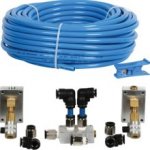
I have the RapidAir system. Its $100, easy to set up, and works very well for my shop. You may need to buy some extra hose or a couple of elbows as your shop is a little bigger than mine, but all that is available seperately if needed.

Rapidair.jpg

Northern Tool sells them through Amazon.

Mike
 
Last edited:

930dreamer

Super Moderator
Staff member
Joined
Oct 7, 2009
Messages
22,963
Location
Amarillo,TX and Stinnett,TX
Hello, I used black pipe because it was free. I ran the main line from one side of the shop, up and over to the other side. I use one water filter, regulator and a coalescing filter before the three drops I have.
 

Doxhog

Well-known member
Joined
Apr 1, 2011
Messages
148
Location
Illinois
I used black pipe in my house garage and I will be using black pipe in my large workshop.
 

darkk

Well-known member
Joined
Dec 24, 2009
Messages
3,361
Location
Willimantic, Ct.
PEX tubing used for plumbing and heating. Reasonbly priced,easy to work with and or repair if necessary,comes in several colors,won't produce schrapnel like pvc,and worksgreat. Don't let anyone tell you differently....
 

PaulR

Well-known member
Joined
May 25, 2010
Messages
728
Location
Hadley MA
I just did my 30x50 garage with the rapidair system. It's good for me, for now. I'm just a Joe homeowner who works on Jeeps and my own junk, not a shop for hire running sanders all day or anything.

I would recommend the rapidair for any joe homeowner, cheap, easy, nice fittings and outlets, but as was mentioned in another thread the nylon-type hose they give you is 1/2" OD, not very good if your running any type of length (I'm not smart enough to run cfm-drop calcs). If your running sanders or have a shop I would step it up to 1/2" ID lines.


I was going to run PEX-AL-PEX but this kit came along and I figured I'd be quick and done with it rather than piecing my junk together.
 

VWandDodge

Well-known member
Joined
May 20, 2011
Messages
951
PEX tubing used for plumbing and heating. Reasonably priced,easy to work with and or repair if necessary,comes in several colors,won't produce shrapnel like pvc,and works great. Don't let anyone tell you differently....


This is only partly correct. There is a specific type of PEX that is for carrying compressed gasses. It would behoove anyone considering this to ensure the correct material is selected.
 

darkk

Well-known member
Joined
Dec 24, 2009
Messages
3,361
Location
Willimantic, Ct.
This is only partly correct. There is a specific type of PEX that is for carrying compressed gasses. It would behoove anyone considering this to ensure the correct material is selected.
nobody said anything about GAS pex. Pex for heating and plumbing is safe. I just left my Pex Water system pressurized to 130 psi for a month.....no problem It will withstand joe averages garage air system. In the unlikely event that it fails, it will just split at the failure site.
 

AZAV8

Well-known member
Joined
Apr 3, 2006
Messages
56
Location
Mesa, AZ
I am a registered mechanical engineer and I've designed hundreds of compressed air systems. That said, copper or black steel. NEVER PVC, it fractures under impact loads or pressure transients. The flexible kits sold by Northern Tool, I've never installed, even though they may be approved for compressed air. I wouldn't install one for my own shop as I would be concerned about sharp object damage to the lines.

Copper vs black steel. What do you want to pay for and there are trade offs with each. I will install copper in my own new shop. No rust and or zinc clogging the lines. Moisture, I'll handle with a cooling loop/grid at the compressor. Drops come off the top of the header, down to a dirt leg with filter. The steel will corrode, as will galvanized. The galvanized will corrode at the threads into the fittings. The copper is easier for me to fabricate up on the bench and then hang in place. Also, I don't have to cut threads in the steel pipe. About the same amount of labor, if your are skilled. If not, the steel will take you longer. Its also heavier to support. Copper is more expensive to install, but there is much less maintenance throughout the life of the system.

All the commercial and residential systems I've designed have been copper. One residential client who chose to install black steel, told me later that he wished he had listened to me and installed copper.

That's my nickel's worth of free advice.

Phil
 

AZAV8

Well-known member
Joined
Apr 3, 2006
Messages
56
Location
Mesa, AZ
I did a little research. The Plastic Pipe Institute's Design Guide for PEX (cross-linked polyethylene pipe) only addresses liquid systems. The PPI recommends a PEX-AL-PEX pipe for compressed air and a similar for natural gas. This is a flexible aluminum tube within a sandwich of PEX inside and outside. They also address using compressed air to pressure test PEX potable water systems and recommend not exceeding 100 psi and not keeping the system under pressure longer than 15 minutes. Based on these recommendations I would NOT use PEX water pipe/tubing for compressed air systems in home shops. That's my professional opinion offered at no charge.

Phil
 

AZAV8

Well-known member
Joined
Apr 3, 2006
Messages
56
Location
Mesa, AZ
This is only partly correct. There is a specific type of PEX that is for carrying compressed gasses. It would behoove anyone considering this to ensure the correct material is selected.

You are correct. The Plastic Pipe Institute recommends using a PEX-AL-PEX flexible aluminum tubing for compressed gases. This is a flexible aluminium tube within a sandwich of PEX inside and outside. See my post on my PEX research for some additional info.

Phil
 
To avoid these ads, REGISTER NOW!

trainer

Well-known member
Joined
Nov 28, 2005
Messages
2,019
Location
Northern Ontario, Canada
nobody said anything about GAS pex. Pex for heating and plumbing is safe. I just left my Pex Water system pressurized to 130 psi for a month.....no problem It will withstand joe averages garage air system. In the unlikely event that it fails, it will just split at the failure site.

Compressed air is a whole different animal than pressurized water, since water is basically uncompressable. Compressed air is umm... compressed and has energy stored within it.
 

NASTYZEN

Well-known member
Joined
Jun 11, 2010
Messages
2,823
Location
St-Colomban,Que. Canada
I put in 5/8 copper lines behind the drywall of my shop 15 years ago.Still going strong today.:thumbup:
Only problem I had was when I drove my forklift into an outlet once. Had top cut the wall open to weld it back up again.:)
 

CaptainRay

Well-known member
Joined
Nov 8, 2010
Messages
85
Location
Missouri
Home Depot and Eastwood sell PEX kits for airlines, my son says the PEX lines work great and is easy to install. However, for my shop when I get to that point in the building process, will be black pipe. I'll run it uphill with a drain point at the lowest point and I'll be buying an air dryer, probably from Harbor Freight since I'm nearly broke building the shop. Schedule 40 PVC isn't a real good choice from what I’ve read, I wouldn’t trust it, go with PEX if you don’t like black pipe… copper is for rich people with lots of money to waste.
 

VWandDodge

Well-known member
Joined
May 20, 2011
Messages
951
Home Depot and Eastwood sell PEX kits for airlines, my son says the PEX lines work great and is easy to install. However, for my shop when I get to that point in the building process, will be black pipe. I'll run it uphill with a drain point at the lowest point and I'll be buying an air dryer, probably from Harbor Freight since I'm nearly broke building the shop. Schedule 40 PVC isn't a real good choice from what I’ve read, I wouldn’t trust it, go with PEX if you don’t like black pipe… copper is for rich people with lots of money to waste.

PVC isn't just a bad choice, it's not suited for air pressure -- period. Some quick Google searches will answer that question.


http://www.lascofittings.com/support...pressedAir.asp
 

MP&C

Well-known member
Joined
Oct 21, 2009
Messages
4,403
Location
Leonardtown, MD
One of the biggest advantages of metal tubing/pipe over (an approved) plastic line would be especially noticed by someone who does not have a dryer system, as the metal is much more proficient at condensing the water vapor out of the heated air, making any of your water traps better at doing their job. Plastics are less likely to cool the air, so any water vapor is more likely to reach the water traps still as a vapor, where it passes on through. You'll notice this effect as water coming out of your air tools.
 

bluebolt

Well-known member
Joined
Dec 28, 2008
Messages
5,447
Location
Benton LA
One of the biggest advantages of metal tubing/pipe over (an approved) plastic line would be especially noticed by someone who does not have a dryer system, as the metal is much more proficient at condensing the water vapor out of the heated air, making any of your water traps better at doing their job. Plastics are less likely to cool the air, so any water vapor is more likely to reach the water traps still as a vapor, where it passes on through. You'll notice this effect as water coming out of your air tools.

I have black pipe installed by myself and there was a night and day difference in water getting in my bead blaster hose. There is at least 30 feet of uphill pipe before the first outlet and it really takes the water out of the system. I designed it to NOT have to do any threading and have 3 drain points.
 

MrMark

Well-known member
Joined
Jan 25, 2010
Messages
4,626
Location
Southern Cal.
I am a registered mechanical engineer and I've designed hundreds of compressed air systems. That said, copper or black steel. NEVER PVC, it fractures under impact loads or pressure transients. The flexible kits sold by Northern Tool, I've never installed, even though they may be approved for compressed air. I wouldn't install one for my own shop as I would be concerned about sharp object damage to the lines.

Copper vs black steel. What do you want to pay for and there are trade offs with each. I will install copper in my own new shop. No rust and or zinc clogging the lines. Moisture, I'll handle with a cooling loop/grid at the compressor. Drops come off the top of the header, down to a dirt leg with filter. The steel will corrode, as will galvanized. The galvanized will corrode at the threads into the fittings. The copper is easier for me to fabricate up on the bench and then hang in place. Also, I don't have to cut threads in the steel pipe. About the same amount of labor, if your are skilled. If not, the steel will take you longer. Its also heavier to support. Copper is more expensive to install, but there is much less maintenance throughout the life of the system.

All the commercial and residential systems I've designed have been copper. One residential client who chose to install black steel, told me later that he wished he had listened to me and installed copper.

That's my nickel's worth of free advice.


Phil

Awesome. Exactly what I am doing. But, you forgot to mention the whole reason for using the metal pipe in the first place. I chose copper too for installation and cosmetic reasons. It is a lot more expensive though.

I would like to see a diagram of your cooling loop at the compressor. Some kind of homemade aftercooler? The metal piping system of 50 feet to the first drop should not require that loop correct?

Are you brazing or soldering? I am just soldering. There are apparently issues with brazing.
 
Last edited:

AZAV8

Well-known member
Joined
Apr 3, 2006
Messages
56
Location
Mesa, AZ
Awesome. Exactly what I am doing. But, you forgot to mention the whole reason for using the metal pipe in the first place. I chose copper too for installation and cosmetic reasons. It is a lot more expensive though.

I would like to see a diagram of your cooling loop at the compressor. Some kind of homemade aftercooler? The metal piping system of 50 feet to the first drop should not require that loop correct?

Are you brazing or soldering? I am just soldering. There are apparently issues with brazing.

My diagram is an old one I found on here at Garage Journal; but there is a better way. Follow this link:

http://www.garagejournal.com/forum/showthread.php?t=40753&highlight=compressor+air+condensate

By searching this site you may get some better ideas

I soldered the copper. Brazing takes too much heat and you end up oxidizing the inside of the copper if you don't use a nitrogen purge. The oxidized copper flakes off and plugs everything up. Besides, the tin-antimony solder makes a joint strong enough for the pressure-temperature range on a compressed air system. If you want the technical details, get the copper pipe handbook from the Copper Development Association. You can download it for free.

I will probably do a air cooler between the compressor and the tank with an automatic drain valve.

The amount of water you end up condensing depends on your local ambient conditions. Florida and its humidity will condense a whole lot more water than I ever will here in the Sonoran desert of Arizona with it "dry heat" low humidity conditions. Also monsoon season will generate more moisture for me than the drier times of the year. Just plan on a way to remove the moisture from your system.

Phil
 

Ron Lombardo

Well-known member
Joined
Feb 20, 2006
Messages
393
Location
New York
Galvanized or stainless would be the best ... the flaking of galvanized is a old myth. I have been in the Plumbing business for 28 years and have yet to see this case. Black pipe is ok but will rust inside and restirct the flow eventually. Remember to ground the pipe ... otherwise where you tie into brass parts ... you will corrode the joints ... disimiliar metals .. galvanic action.
 

dbleskey

Active member
Joined
Oct 9, 2006
Messages
34
Compressed air is a whole different animal than pressurized water, since water is basically uncompressable. Compressed air is umm... compressed and has energy stored within it.

Water is compressible. Water hammer. BUT you are very much case on point.

Water systems in a house are at far lower pressures, or at least they should be. Air systems are as you say and at far greater pressures in the normal operating state. The risk of a failure carries far greater consequences.
 

iron_worker

Well-known member
Joined
Mar 15, 2011
Messages
102
Water IS compressible... but it's almost a negligible amount at "low" household pressures (<100psi). So when a blowout occurs in a pressurized water system the water does not have to expand very much to release it's energy.

When a blowout occurs in a pressurized air system the air then expands many many times it's compressed volume to release it's energy. Hence, "explosive decompression" which is very dangerous.

The company I am working at now is designing a jet boring system for mining applications. They will use a water system with operating pressures in the neighborhood of 15,000psi. This water will be fed through a nozzle and blasted at rock/ore to reduce it to slurry and then can be pumped out. At these pressures the compressibility of water is significant and must be considered.

Just my 2 cents.

IW
 

darkk

Well-known member
Joined
Dec 24, 2009
Messages
3,361
Location
Willimantic, Ct.
This is only partly correct. There is a specific type of PEX that is for carrying compressed gasses. It would behoove anyone considering this to ensure the correct material is selected.

??? Where do you people get this stuff from?....pressure is pressure, gas,gel or liquid period. There is a Pex gas rating that is just a pex tubing rated/made specifically for propane/lp gas, just like flex trac etc...there are items that are over engineered for flammable gasses. But Air or water makes NO DIFFERENCE. All PEX line in my state has to be *AIR* pressure tested at 2 1/2 times the working water pressure in my area. When I tested mine I kept it at 130 psi for a month. Trust me, there is no problem unless you are running extremely high air pressure. Pex tubing will not explode either...the worst that happens is you get a rip or tear because the line is pretty flexible...no shrapnel, no flying pieces etc. And it's repairable.
 
Last edited:

mathil

Well-known member
Joined
Jan 23, 2011
Messages
64
??? Where do you people get this stuff from?....pressure is pressure, gas,gel or liquid period. There is a Pex gas rating that is just a pex tubing rated/made specifically for propane/lp gas, just like flex trac etc...there are items that are over engineered for flammable gasses. But Air or water makes NO DIFFERENCE. All PEX line in my state has to be *AIR* pressure tested at 2 1/2 times the working water pressure in my area. When I tested mine I kept it at 130 psi for a month. Trust me, there is no problem unless you are running extremely high air pressure. Pex tubing will not explode either...the worst that happens is you get a rip or tear because the line is pretty flexible...no shrapnel, no flying pieces etc. And it's repairable.

You're right in the fact that pressure is pressure...until something goes wrong and the vessel is compromised.

The difference is that water at the same pressure as air expands to fill a much smaller volume. When a vessel fails and releases its contents to equalize the pressure it only has to release a small volume of water, compared to a large volume of gas. The result is that unless you have a constant source of compression (a city water line, a pump, etc etc.) the water depressurizes almost instantly, whereas the gas gradually reaches equilibrium.
 

Defender Chassis

Well-known member
Joined
Dec 7, 2007
Messages
1,129
Location
Williamstown, WV
Water is compressible. Water hammer. BUT you are very much case on point.

Water systems in a house are at far lower pressures, or at least they should be. Air systems are as you say and at far greater pressures in the normal operating state. The risk of a failure carries far greater consequences.

I thought the phenomenon known as "water hammer" was because of momentum and not compressability?
 

VWandDodge

Well-known member
Joined
May 20, 2011
Messages
951
Water hammer
Water hammer (or, more generally, fluid hammer) is a pressure surge or wave resulting when a fluid (usually a liquid but sometimes also a gas) in motion is forced to stop or change direction suddenly (momentum change). Water hammer commonly occurs when a valve is closed suddenly at an end of a pipeline system, and a pressure wave propagates in the pipe. It may also be known as hydraulic shock.

This pressure wave can cause major problems, from noise and vibration to pipe collapse. It is possible to reduce the effects of the water hammer pulses with accumulators and other features.

Rough calculations can be made either using the Joukowsky equation,[1] or more accurate ones using the method of characteristics.

If the pipe is suddenly closed at the outlet (downstream), the mass of water before the closure is still moving forward with some velocity, building up a high pressure and shock waves. In domestic plumbing this is experienced as a loud banging resembling a hammering noise. Water hammer can cause pipelines to break if the pressure is high enough. Air traps or stand pipes (open at the top) are sometimes added as dampers to water systems to provide a cushion to absorb the force of moving water in order to prevent damage to the system. (At some hydroelectric generating stations what appears to be a water tower is actually one of these devices, known as a surge drum).

In the home, water hammer may occur when a dishwasher, washing machine, or toilet shuts off water flow. The result may be heard as a loud bang, repetitive banging (as the shock wave travels back and forth in the plumbing system), or as some shuddering.

On the other hand, when an upstream valve in a pipe is closed, the water downstream of the valve will attempt to continue flowing, creating a vacuum that may cause the pipe to collapse or implode. This problem can be particularly acute if the pipe is on a downhill slope. To prevent this, air and vacuum relief valves, or air vents, are installed just downstream of the valve to allow air to enter the line and prevent this vacuum from occurring.

Other causes of water hammer are pump failure, and check valve slam (due to sudden deceleration, a check valve may slam shut rapidly, depending on the dynamic characteristic of the check valve and the mass of the water between a check valve and tank).
 

ptschram

Well-known member
Joined
Sep 8, 2006
Messages
2,573
Location
Churubusco, IN
Galvanized or stainless would be the best ... the flaking of galvanized is a old myth. I have been in the Plumbing business for 28 years and have yet to see this case. Black pipe is ok but will rust inside and restirct the flow eventually. Remember to ground the pipe ... otherwise where you tie into brass parts ... you will corrode the joints ... disimiliar metals .. galvanic action.

Grounding the pipe will have no effect upon the reduction/oxidation that will occur due to the differences in oxidation potentials of the dissimilar metals. The reaction will occur regardless.
 

BD1

Well-known member
Joined
Mar 18, 2007
Messages
4,602
Location
north side
hi, if you have access to copper, a propress gun, and fittings that is awesome air installation. propress is a copper crimp type fitting with o-ring, no torch, flux, or solder. just stick copper in fitting, mark line around fitting to make sure it is seated all the way in and crimp. it is clean and quick. draw back is that you cannot disassemble. this is great for the main and runouts. not cheap.
 
To avoid these ads, REGISTER NOW!
Top Bottom