To avoid these ads, REGISTER NOW!

When did Craftsman add the lines to its logo?

Jim C.

Well-known member
Joined
Jan 8, 2010
Messages
2,598
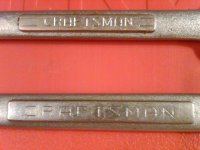
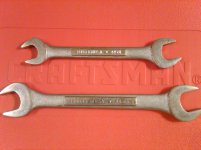
A little while back I acquired a couple Craftsman raised panel wrenches that were sized in 32nd increments. One of those wrenches looks a little older than the other one. I noticed that the wrench on the bottom in the photos below has no hash marks (=) before the "C" nor after the "N." (Compare to the wrench on top in the photos.) Both wrenches in the photos have a "-V-" manufacturer code on the reverse panel.

I know there's a Craftsman Date code thread, but I'm most interested in knowing when Craftsman started adding the hash marks (=) to its tools. If anyone wants to venture an educated guess on the approximate age of the bottom wrench, I'd be interested in your thoughts.

Finally, I know neither wrench has any significant value. I use both of them. I'm really just interested in learning a little more about the history of the Craftsman logo and its changes over the years. Thanks.

Jim C.
 

Attachments

  • IMG01029-20110813-1955.jpg
    IMG01029-20110813-1955.jpg
    147.4 KB · Views: 149
  • IMG01030-20110813-1956.jpg
    IMG01030-20110813-1956.jpg
    145.6 KB · Views: 161
To avoid these ads, REGISTER NOW!

Steevo

Well-known member
Joined
Aug 18, 2009
Messages
8,738
Location
43.49600, -112.04300
If anyone can answer that, it would be member lauver here at GJ
He has the most extensive Craftsman marking database I know of.
 
OP
J

Jim C.

Well-known member
Joined
Jan 8, 2010
Messages
2,598
Thanks for the link Dave (B17E1943). You're right on the money.
 

lauver

Well-known member
Joined
Nov 11, 2007
Messages
1,433
Location
Belton, TX
Jim C,

The double line Crafty logo and the V-series tools appear to have been introduced in 1947, according to catalog evidence. This was the beginning of the "modern era" of Crafty tools, and also marked the beginning for Moore Drop Forging as the main OEM for Sears/Craftsman tools.
 
OP
J

Jim C.

Well-known member
Joined
Jan 8, 2010
Messages
2,598
Jim C,

The double line Crafty logo and the V-series tools appear to have been introduced in 1947, according to catalog evidence. This was the beginning of the "modern era" of Crafty tools, and also marked the beginning for Moore Drop Forging as the main OEM for Sears/Craftsman tools.

Thanks for the info Gary. Looks like my wrench is pre-1947. Like I said earlier, I use the wrench a lot when I'm tinkering with old woodworking machinery. When I got the wrench, I could tell that it had been well used in the past. It was worn pretty smooth, and just seemed "better" somehow. I could tell by the logo, and the feel of it, that it was a little older than all my other wrenches. Actually, it's a lot older. All my other wrenches are from the 1980s. I paid about $5 for it shipped to my door. I'm glad to have it. Thanks again for the info.

Jim C.
 

lauver

Well-known member
Joined
Nov 11, 2007
Messages
1,433
Location
Belton, TX
Jim C,

If you study Sears/Craftsman tools very long, you will soon realize that there are always exceptions to the general rules. A large part of this is because Sears could not control all of the stamping variations of their OEM's. In other words, these might have been outside of Sears control.

Looking back at the vintage Sears and Craftsman Tool catalogs, a couple of things are pretty clear:

Leading up to and including 1944, New Britain was making most of the hard line tools.

In 1945 and 1946, New Britain was making some of the tools (sockets & drive tools), and Moore Drop Forging was making some of the tools (wrenches & pliers). This appears to have been a transitional period among OEMs.

Starting in 1947, Moore Drop Forging was making all the hard line tools.

It is possible that your wrench without the "= = " stamped on the raised panel could have been one of the early wrenches made by MDF during the transitional years. But, we will probably never know this for sure.

Can you post a photo of the other side of your two wrenches? I'm curious about other marking variations that may be on the flip side. Thanks.
 
Last edited:
To avoid these ads, REGISTER NOW!
OP
J

Jim C.

Well-known member
Joined
Jan 8, 2010
Messages
2,598
Jim C,

If you study Sears/Craftsman tools very long, you will soon realize that there are always exceptions to the general rules. A large part of this is because Sears could not control all of the stamping variations of their OEM's. In other words, these might have been outside of Sears control.

Looking back at the vintage Sears and Craftsman Tool catalogs, a couple of things are pretty clear:

Leading up to and including 1944, New Britain was making most of the hard line tools.

In 1945 and 1946, New Britain was making some of the tools (sockets & drive tools), and Moore Drop Forging was making some of the tools (wrenches & pliers). This appears to have been a transitional period among OEMs.

Starting in 1947, Moore Drop Forging was making all the hard line tools.

It is possible that your wrench without the "= = " stamped on the raised panel could have been one of the early wrenches made by MDF during the transitional years. But, we will probably never know this for sure.

Can you post a photo of the other side of your two wrenches? I'm curious about other marking variations that may be on the flip side. Thanks.

Gary,

Thanks for the GREAT information. I will definitely post a couple more photos of the flip sides of the wrenches. Look for the photos here some time tomorrow in the early evening.

Jim C.
 
OP
J

Jim C.

Well-known member
Joined
Jan 8, 2010
Messages
2,598
Gary,

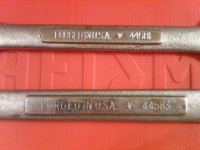
Here's the reverse panel photos of the wrenches I described/depicted above. Thanks again for all the great information. If you see anything noteworthy, let me know.

Jim C.
 

Attachments

  • IMG01034-20110815-0554.jpg
    IMG01034-20110815-0554.jpg
    148 KB · Views: 51
  • IMG01035-20110815-0554.jpg
    IMG01035-20110815-0554.jpg
    146 KB · Views: 73

lauver

Well-known member
Joined
Nov 11, 2007
Messages
1,433
Location
Belton, TX
Gary,

Here's the reverse panel photos of the wrenches I described/depicted above. Thanks again for all the great information. If you see anything noteworthy, let me know.

Jim C.


Jim C,

Glad you posted photos of the flip side. Both of those wrenches are way newer than I suspected. The fact that they are both V-series wrenches and have model numbers stamped on them dates them to somewhere between 1975 and 1986, perhaps a few years later. And this puts them in the Easco (OEM) years.

Both wrenches are interesting because of the 19/32" and 25/32" sizings. These are sizes that most OEM's abandoned several decades earlier. I think this says something about the state of affairs (i.e. antiquated) at the MDF/Easco production facilities in the 1970's and 1980's.
 
Last edited:
OP
J

Jim C.

Well-known member
Joined
Jan 8, 2010
Messages
2,598
Jim C,

Glad you posted photos of the flip side. Both of those wrenches are way newer than I suspected. The fact that they are both V-series wrenches and have model numbers stamped on them dates them to somewhere between 1975 and 1986, perhaps a few years later. And this puts them in the Easco (OEM) years.

Both wrenches are interesting because of the 19/32" and 25/32" sizings. These are sizes that most OEM's abandoned several decades earlier. I think this says something about the state of affairs (i.e. antiquated) at the MDF/Easco production facilities in the 1970's and 1980's.

Thanks for your response Gary, but then I still don't understand why the larger wrench doesn't have the hash marks (=) before the C and after the N. Based on the earlier information I read at Alloy Artifacts, I thought the hash marks started showing up around 1947. Wouldn't that mean my wrench was manufactured around 1947 or earlier? I'm really just trying to figure out why that wrench has no lines on it. Maybe I just misunderstood the information I read earlier. Can you clarify this for me?

As for the sizes being in 32nd increments, I actually sought those out. I like to tinker with old woodworking machinery from the 1940s and 1950s. More than several times, I've come across some original fastners with larger sized hex head bolts and/or nuts that are sized on 32nd increments, to include 17/32, 19/32 and 25/32. Consequently, I'm ALWAYS looking for old wrenches and sockets sized on 32nd increments. I'm pretty sure that Craftsman still offers some version of the two wrenches I posted above.

Anyway, if you can provide some clarification about the hash marks, that would be great. Thanks again.

Jim C.
 
Last edited:

lauver

Well-known member
Joined
Nov 11, 2007
Messages
1,433
Location
Belton, TX
Jim C,

Ok, I think I remember the Craftsman scripts/logos discussion at AA. I've must have read it 10 times over the years. But let me go reread it one more time so it's fresh. BRB

EDIT: Good thing I checked, the Crafty sections at AA have been heavily revised.

OK, the section you refer to is talking about the very beginnings of V-series wrenches and the recently revised Craftsman logo and the double line brackets (i.e == CRAFTSMAN ==). And they show one example of a V-series wrench without the double line brackets; and they speculate that this particular wrench could be a transitional wrench made before the new tooling was set in stone. This may be true for that particular wrench. But your wrenches are definitely not late 1940's wrenches... they are most likely 1975-1986 wrenches. So why is one of your wrenches missing the double line brackets. My guess is that the wrench without the double brackets missed one of the stamping processes and consequently didn't get it's brackets. It could be that simple. I read a post today from a guy who just bought one of the new Professional Grade ratchets and the Craftsman logo was misstamped CRAFTSMA_. This kind of stuff happens more often than most people think.
 
Last edited:
OP
J

Jim C.

Well-known member
Joined
Jan 8, 2010
Messages
2,598
Thanks Gary. Let me know what you find out. AA says 1947. Who knows?? Interesting stuff.

Jim C.
 

twillers

Well-known member
Joined
Apr 28, 2010
Messages
579
Location
Long Island, New York
Jim C,

Ok, I think I remember the Craftsman scripts/logos discussion at AA. I've must have read it 10 times over the years. But let me go reread it one more time so it's fresh. BRB

EDIT: Good thing I checked, the Crafty sections at AA have been heavily revised.

OK, the section you refer to is talking about the very beginnings of V-series wrenches and the recently revised Craftsman logo and the double line brackets (i.e == CRAFTSMAN ==). And they show one example of a V-series wrench without the double line brackets; and they speculate that this particular wrench could be a transitional wrench made before the new tooling was set in stone. This may be true for that particular wrench. But your wrenches are definitely not late 1940's wrenches... they are most likely 1975-1986 wrenches. So why is one of your wrenches missing the double line brackets. My guess is that the wrench without the double brackets missed one of the stamping processes and consequently didn't get it's brackets. It could be that simple. I read a post today from a guy who just bought one of the new Professional Grade ratchets and the Craftsman logo was misstamped CRAFTSMA_. This kind of stuff happens more often than most people think.

Gary, isn't it also true that they didn't start putting part numbers on wrenches & sockets until the late 60's or early 70's?
 

lbgradwell

Well-known member
Joined
Mar 21, 2007
Messages
4,707
Location
Oakville, ON
Gary, isn't it also true that they didn't start putting part numbers on wrenches & sockets until the late 60's or early 70's?

Yes.

The fact that they are both V-series wrenches and have model numbers stamped on them dates them to somewhere between 1975 and 1986, perhaps a few years later.


AA says 1947. Who knows?? Interesting stuff.

Jim, what Gary is saying - correctly - is that your wrench cannot be earlier than when the part numbers were first added to Craftsman tools. I've forgotten why he feels that date is 1975 (he'll be back to clarify), but regardless of whether it's late 60s to 1975, the wrench is from much later than 1947. As Gary mentions, the absence of the marks if very likely simply a skipped step in the stamping process...
 
OP
J

Jim C.

Well-known member
Joined
Jan 8, 2010
Messages
2,598
Thank you all for some VERY good insight and comments. I love this stuff. It's all really interesting to me. 1947 or 1975 or somewhere in between.... I really enjoy learning about the tools. Thanks for the great input!!

Jim C.
 
To avoid these ads, REGISTER NOW!
Top Bottom