To avoid these ads, REGISTER NOW!

recommend me a voltage detector

To avoid these ads, REGISTER NOW!

BigJohn20

Well-known member
Joined
Sep 4, 2011
Messages
168
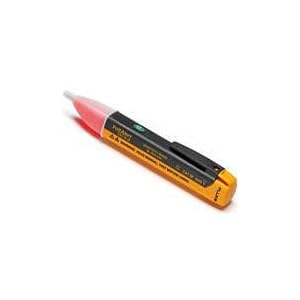
I have that one, a Fluke, and the Klein, along with the NCVT built into my Ideal 4-in-1 meter.

Whichever one you get, make sure you have either a DMM or Wiggy to confirm the results from those, especially if you work alone.
 

Slip_Kid

Well-known member
Joined
Apr 20, 2010
Messages
615
Location
Rhode Island
Handy to have but no replacement for a real DMM.

2149063ZRQL._SL500_AA300_.jpg


http://www.amazon.com/Fluke-1AC-A1-II-Volt-Alert-Non-Contact-Voltage/dp/B000EJ332O/ref=sr_1_1?s=hi&ie=UTF8&qid=1319587993&sr=1-1
 
OP
M

madmikeee

Well-known member
Joined
Feb 20, 2011
Messages
322
Location
MA
actually you bring up a good point my dmm died a couple of years ago i shoul replace it lol suggestions on that as well??
 

GoBlue

Well-known member
Joined
May 10, 2011
Messages
1,070
Location
Under a car...swearing
I would get a powerprobe III. I know its way more than a VOM but if your working on cars or electrical systems you really should have one. A good excuse for an awesome tool!
 
OP
M

madmikeee

Well-known member
Joined
Feb 20, 2011
Messages
322
Location
MA
my use would be minimal on a basic hobbyist level so an expensive tool would be wasted on me.
 

Outlawmws

Well-known member
Joined
Aug 9, 2011
Messages
39,080
Location
The Badlands
my use would be minimal on a basic hobbyist level so an expensive tool would be wasted on me.

The HF <$10 DVM's (Yellow? orange? flavor of the week?) are totally adequate for hobby use, and even some more serious work, and are direct knock offs of a decent designed DVM.

I keep several around here and there as I use them all the time.

One word of warning though. pitch the factory provided 9V battery, and check "calibration" in your house voltage once in a while, if the house voltage appears to be going abnormally high, the battery is dying and you are getting false voltage readings.

EDIT (One of the few HF tools/products I will recommend)
 

71flh

Banned
Joined
Jun 15, 2011
Messages
379
If you just want a detector, a cheap neon tester will be fine. You can touch one lead to your skin and the other to a wire to see if its the hot.
 

amolaver

Well-known member
Joined
Mar 10, 2009
Messages
834
The HF <$10 DVM's (Yellow? orange? flavor of the week?) are totally adequate for hobby use, and even some more serious work, and are direct knock offs of a decent designed DVM.

I keep several around here and there as I use them all the time.

One word of warning though. pitch the factory provided 9V battery, and check "calibration" in your house voltage once in a while, if the house voltage appears to be going abnormally high, the battery is dying and you are getting false voltage readings.

EDIT (One of the few HF tools/products I will recommend)

2nd this - my HF freebie DVM's match my fluke into the thousandths of a volt. don't feel particularly robust, but they've maintained their consistency over a couple years and since you can get them for free during many of HF's sales...

ahm
 

Rogue1987

Well-known member
Joined
Jul 13, 2011
Messages
891
Location
Missouri
Day to day I carry a Klein non contact voltage detector. I also have a Fluke, a Greenlee and a few others, but the Klein is number one right now (even tho in less than 3 months I had to warranty it).

But x2 to whomever said always keep a DMM around to be sure. Saving a few seconds is not worth your life. +1 to Fluke equipment as well.
 
To avoid these ads, REGISTER NOW!

metal1313

Well-known member
Joined
Apr 28, 2009
Messages
3,416
Location
clinton NJ
way to remind me of another item i need to buy. i have a cheap one but it only works some times, and only on contact....it was free...so spending a few bucks it fine.

i use a ddm, and other voltage detectors, but i like the non contact since i do deal with old knob and tube in my house
 

rlitman

Well-known member
Joined
Oct 18, 2010
Messages
24,576
Location
Long Island
I used to have a Fluke non contact voltage detector. It was the old style, just a red light at the tip. You were never really sure it was working, and if you tapped it on anything, just the bump would get the light to blink.
The good thing, was that batteries in it lasted literally for years, and you didn't even have to turn it on or off (there wasn't even a switch). The bad thing was that eventually the batteries exploded and ruined it (I guess because they were years old).

I now have a Klein from HD. $17ish. Looks like it's made by the same people as the Milwaukee in the OP. Green light to say it's on, red light when it detects voltage. Different sounds for turned on, off, and volt detect. MUCH more confident in it because of this, but it is still no substitute for a DMM. Auto off. Batteries last only a couple of months, EVEN when it's left off the whole time, so it seems that most times when I need it, the batteries are dead.

I strongly suggest that you do NOT get an HF DMM. They're an accident waiting to happen.
Let me explain:
First, read:
http://support.fluke.com/find-sales/download/asset/1263690_6116_eng_h_w.pdf
or if you'd prefer something more independent (i.e. not from Fluke), then read:
http://www.csao.org/UploadFiles/ResearchDocument/Multimeters.pdf

Now, first, understand that HF meters are only rated by HF as category II, and are not independently tested (by UL, CSA, etc.).
The Fluke and Extech DMMs I use are all at least category III, and this rating affects the overall safety of the meter when used for it's safest purpose, reading voltage.

Here's another thing to consider. Unless you're using a clamp meter, the meter will have current reading plugs. Those connect through a shunt, and if you were to accidentally plug your wires into the current plugs and contact a voltage source, you can end up with a blown up meter (regardless of what the dial is set to).
My Fluke and Extech meters (not pushing any brand, that's just what I've got) have fuses on the shunt. The HF meters are unfused.
Interestingly enough, my Extech DMM will sound a beeping alarm if you plug a test lead into the current slot when it is set to read anything other than current, or if you set it to current without a lead in the slot (it can detect the presence of the connector). That a nice safety feature.

As a note, Extech is a FLIR company, and makes some of the Craftsman DMM's too.
My favorite DMM was my Craftsman with the built in IR temperature probe, that was $90 on sale (and was also true RMS). Unfortunately they don't sell that one any more.
 
Last edited:

kngelv

Well-known member
Joined
May 25, 2011
Messages
2,214
Location
Detroit, MI
In the trade we call them "deathsticks". I suggest a real meter. If you must use one get a Fluke. Trying to save money on electrical testing equipment is foolish. Those HF ones are utter ****.

James
 

Outlawmws

Well-known member
Joined
Aug 9, 2011
Messages
39,080
Location
The Badlands
OK I think the last two posters (Edit, Not Jeffmoss, I took too long to finish..) owe it to everyone else to clarify:

For testing high voltage (house current on up) I agree, you want the best. For diddleing around on a car or on the bench on ordinary stuff, I personally find the flukes (Depending on which one you have) to generally be inappropriate (won't test what I'm trying to test) or just cumbersome, (both to use and for the very heavy test leads they usually have).

In kngelv's post: what trade? Electricians? I agree. a hobbyist testing batteries, wire continuity, and the 12V found in cars? lets not be ridiculous. Secondly are you talking about a DVM/DMM? or the non contact tester? Two different animals.

For doing the usual **** around the house and if you take reasonable care, verifying a socket on a wall, the HF is perfectly adequate. Note I did not say best. Testing for a living? yes you should spend several hundred on an industrial strength meter.

For simple light duty there is nothing wrong with the HF cheapo. It is identical in every way to the unit I spent nearly a hundred on before HF ripped the design. That one came from a electronics store and I've compared them in detail; no damn difference, physically, or in performance. I've also compared both to much better Simpson, fluke and other high end meters for accuracy. No difference...

Please take three minutes and clarify your posts, and to what purpose you are using them for. This thread took a couple of forks and you need to be clear about what you mean when you make sweeping statements.
 
Last edited:

kngelv

Well-known member
Joined
May 25, 2011
Messages
2,214
Location
Detroit, MI
OK I think the last two posters (Edit, Not Jeffmoss, I took too long to finish..) owe it to everyone else to clarify:

In kngelv's post: what trade? Electricians? I agree. a hobbyist testing batteries, wire continuity, and the 12V found in cars? lets not be ridiculous. Secondly are you talking about a DVM/DMM? or the non contact tester? Two different animals.

For doing the usual **** around the house and if you take reasonable care, verifying a socket on a wall, the HF is perfectly adequate. Note I did not say best. Testing for a living? yes you should spend several hundred on an industrial strength meter.

For simple light duty there is nothing wrong with the HF cheapo. It is identical in every way to the unit I spent nearly a hundred on before HF ripped the design. That one came from a electronics store and I've compared them in detail; no damn difference, physically, or in performance. I've also compared both to much better Simpson, fluke and other high end meters for accuracy. No difference...

Please take three minutes and clarify your posts, and to what purpose you are using them for. This thread took a couple of forks and you need to be clear about what you mean when you make sweeping statements.

I'm a Journeyman Electrician. I work primarily in industrial settings. I just hate those things (non-contact voltage detectors). They are wildly inaccurate and roughly 30% of the readings (that I have seen) are false positives. They are useless if there are any servos nearby. Most of the AC ones only detect above 50 volts. Some, not till 90. I do admit that the average homeowner does not encounter 99% of the situations I am in so my opinion may not be completely relevant in some regards. That said . . . let me give you a household example. Say you are dealing with a two wire 120 circuit in the house (no ground). The neutral is cracked or partially out of the neutral bar. This = voltage drop. I have seen this many times. The hot is now reading 35 or 40 volts maybe up to 80 with a meter but is not detected by one of these NCVD's. You open up the outlet and touch the hot while leaning against something grounded or the resistance drops at that moment and you now have 120v again. In either case you get zapped. As far as the HF ones. Have you looked at the insulation on the leads. that is enough to steer me well away. Cheap quality in a wrench leads to a busted knuckle, in electrical test equipment it could lead to death.

James
 

rlitman

Well-known member
Joined
Oct 18, 2010
Messages
24,576
Location
Long Island
. . . As far as the HF ones. Have you looked at the insulation on the leads. that is enough to steer me well away. Cheap quality in a wrench leads to a busted knuckle, in electrical test equipment it could lead to death.

The insulation in the leads is just an indication of what's happening inside.
They're junk from the ground up. Hardly worth the nothing I paid with the coupon.
If you're testing batteries (up to maybe a D cell), then fine.

If you're using an HF meter with an unfused current port, then I suggest at the very least, filling that hole up with a non-conductive glue (hot melt glud would be my choice) before ONLY using it for voltage readings, and NEVER taking voltage readings within a circuit panel box. At an outlet, I guess it's just barely ok, but I still don't trust the WAY too thin insulation on the test leads.
 

jeffmoss26

Well-known member
Joined
May 25, 2011
Messages
12,851
Location
Cleveland, Ohio
I don't do electrical work, but I do phone and computer work. I carry the Klein NCVT-2 because I need a way to check outlets. The fact that it also will detect 12-48 volts is a nice bonus. I also have an outlet tester and a DMM.
 

Outlawmws

Well-known member
Joined
Aug 9, 2011
Messages
39,080
Location
The Badlands
The insulation in the leads is just an indication of what's happening inside.
They're junk from the ground up. Hardly worth the nothing I paid with the coupon.
If you're testing batteries (up to maybe a D cell), then fine.

If you're using an HF meter with an unfused current port, then I suggest at the very least, filling that hole up with a non-conductive glue (hot melt glud would be my choice) before ONLY using it for voltage readings, and NEVER taking voltage readings within a circuit panel box. At an outlet, I guess it's just barely ok, but I still don't trust the WAY too thin insulation on the test leads.

Once again, apple and oranges. for High voltage work/facilities work I agree, leads are not up to it, nor is the case design. For bench and automotive work the leads on mine appear to be the same lead material and thickness my expensive bench equipment uses. And just to make sure we are discussing the same device, and not some still cheaper unit. this is the one I'm talking about.

http://www.harborfreight.com/7-function-multimeter-98025.html

For heavy electrical work, not the one you want to use, (But who would be using a DVM with a transistor tester in that sort of work any way? different target audience...) There are electricians, and there are hobbyist wanna-be electron pushers. apples and oranges.
 

rlitman

Well-known member
Joined
Oct 18, 2010
Messages
24,576
Location
Long Island
And just to make sure we are discussing the same device, and not some still cheaper unit. this is the one I'm talking about.

http://www.harborfreight.com/7-function-multimeter-98025.html

Cheaper than that? That one is free with a coupon and any purchase.
It is probably fine for electronics bench work, and I'd be happy to use it on automotive, IF it isn't used to directly test the battery over unfused wires.
These are simply missing the industry standard safety features that you come to expect (like a car with seat belts, it's THAT rudimentary).
 

kngelv

Well-known member
Joined
May 25, 2011
Messages
2,214
Location
Detroit, MI
Same device. I have four of them since they seem to be the only free item that is ever in stock. I opened one of them and looked it over carefully. It sits in a drawer with the other three. I won't give them to anybody nor use one but I'm not letting HF off the hook on the coupon.

James
 

rlitman

Well-known member
Joined
Oct 18, 2010
Messages
24,576
Location
Long Island
. . . they seem to be the only free item that is ever in stock. . .

Heh heh heh. Yeah, I've seen that too, but I have gotten a bunch of the work gloves.
I think I've gotten 6 of these. I'm not letting them off the hook for the coupon either. Gave them all away though. They get used by guys at work troubleshooting low power 24V control wiring, alarm wiring, and telecom stuff. They're ok for that purpose, but not much else, and it's nice to stash them all over, and not have to look for one.
 
To avoid these ads, REGISTER NOW!
Top Bottom