Sigh, hijack on.... Sorry Dave.
You should read 250.53 of the 2008 NEC and 250.104 together.
While not much has changed in .104, there have been changes to .53. I'm using the current 2011 NEC......... I suppose some jurisdictions may still using the old code.
Those two sections pretty much answer the question.
But then again the conversation is being had.
The 5 feet is a relic of the past apparently. I'm really not sure where it came from. I asked a local inspector about it when I upgraded my service and he laughed and said there was an old timer in Huntington Beach that still makes people bond to the water line within 5 feet even though it's not required. There are even licensed electricians around that believe this too, mostly because they "heard" that inspectors like to see this.
Well, I'm still being asked to see the 5' from entrance bond with the cold water by inspectors..... so I wouldn't call it a relic from the past. I haven't heard inspectors like it, I've had to show actual inspectors the point of connection. As to why..... It comes from 2011 NEC 250.68.C.1
2011 NEC said:
250.68 Grounding Electrode Conductor and Bonding Jumper Connection to Grounding Electrodes. T
(C) Metallic Water Pipe and Structural Metal. Grounding
electrode conductors and bonding jumpers shall be permitted to be connected at the following locations and used to extend the connection to an electrode(s):
(1) Interior metal water piping located not more than 1.52 m (5 ft) from the point of entrance to the building shall be
permitted to be used as a conductor to interconnect electrodes that are part of the grounding electrode system.
Exception: In industrial, commercial, and institutional
buildings or structures, if conditions of maintenance and
supervision ensure that only qualified persons service the
installation, interior metal water piping located more than
1.52 m (5 ft) from the point of entrance to the building shall be permitted as a bonding conductor to interconnect electrodes that are part of the grounding electrode system, or as a grounding electrode conductor, if the entire length, other than short sections passing perpendicularly through walls, floors, or ceilings, of the interior metal water pipe that is being used for the conductor is exposed.
If you read 250.53 you will see that the cold water is allowed to be used as a grounding electrode if it is bonded within 5 feet etc. A supplemental ground rod is required if this method is used because that cold water pipe may be replaced with plastic in the future. The cold water is one of several types of grounding electrodes allowed. A UFER, ground rings and RODS are some others. Why anyone would use the cold water as the ground when supplemental rods are required is beyond me.
Actually, a supplemental electrode is required with any single rod, pipe, or plate electrode, as well as water pipe. Since most older dwellings don't have a ufer ground and since 250.50 requires either all electrodes in 250.52 be bonded into a system. Should both structural metal and cold water not be available then the there is the allowance for the use of any of the electrodes listed in 250.52. to be installed ie: ground rods.
Again, we are not using the cold water as the grounding electrode, we are using UFER's or Rods.
We've established that if a ufer isn't available the the cold water must be used. Not everything existing has a ufer........ And if both the ufer and cold water aren't available then a minimum of two ground rods can be permissible.
This brings us to section 250.104 which makes it clear in the comments that "Bonding the metal water piping system of a building or structure is not the same as using the metal water piping system as a grounding electrode."
2001 NEC said:
250.104 Bonding of Piping Systems and Exposed Structural Steel.
(A) Metal Water Piping. The metal water piping system
shall be bonded as required in (A)(1), (A)(2), or (A)(3) of this section. The bonding jumper(s) shall be installed in
accordance with 250.64(A), (B), and (E). The points of
attachment of the bonding jumper(s) shall be accessible.
(1) General. Metal water piping system(s) installed in or
attached to a building or structure shall be bonded to the
service equipment enclosure, the grounded conductor at the service, the grounding electrode conductor where of sufficient size, or to the one or more grounding electrodes used. The bonding jumper(s) shall be sized in accordance with Table 250.66 except as permitted in 250.104(A)(2) and (A)(3).
(2) Buildings of Multiple Occupancy. In buildings of
multiple occupancy where the metal water piping system(s) installed in or attached to a building or structure for the individual occupancies is metallically isolated from all other occupancies by use of nonmetallic water piping, the metal water piping system(s) for each occupancy shall be permitted to be bonded to the equipment grounding terminal of the panelboard or switchboard enclosure (other than service equipment) supplying that occupancy. The bonding jumper shall be sized in accordance with Table 250.122, based on the rating of the overcurrent protective device for the circuit supplying the occupancy.
(3) Multiple Buildings or Structures Supplied by a
Feeder(s) or Branch Circuit(s). The metal water piping
system(s) installed in or attached to a building or structure
shall be bonded to the building or structure disconnecting
means enclosure where located at the building or structure,
to the equipment grounding conductor run with the supply
conductors, or to the one or more grounding electrodes
used. The bonding jumper(s) shall be sized in accordance
with 250.66, based on the size of the feeder or branch
circuit conductors that supply the building. The bonding
jumper shall not be required to be larger than the largest
ungrounded feeder or branch circuit conductor supplying
the building.
As you can see the metal water pipe SHALL be bonded to the service equipment enclosure.
2011 NEC said:
(B) Other Metal Piping. If installed in, or attached to, a
building or structure, a metal piping system(s), including
gas piping, that is likely to become energized shall be
bonded to the service equipment enclosure; the grounded
conductor at the service; the grounding electrode conductor, if of sufficient size; or to one or more grounding electrodes used. The bonding conductor(s) or jumper(s) shall be sized in accordance with 250.122, using the rating of the circuit that is likely to energize the piping system(s). The equipment grounding conductor for the circuit that is likely to energize the piping shall be permitted to serve as the bonding means. The points of attachment of the bonding jumper(s) shall be accessible.
Since section A adresses metal water piping directly, section B other metal piping does not apply to metal water piping.
These sections are not well written and I can see where some of the confusion apparently comes from.
Seems reasonably clear to me.
Although, I have seen houses built in tracts going back to the late 70's with UFER grounds where they bonded to the cold water over at the water heater rather than trying to pick it up at the entrance to the house so it has been know for a long time that when you are not using the cold water as the electrode that the electrode attachment rules don't apply.
No need to waste time and money trying to pick up cold water at the entrance, just get it where convenient.
Perhaps they weren't applied, or perhaps the code was different at that time. Personally I've passed on or gotten rid of my old code books as the only one that really matters is the current code being enforced.
I think it's fairly clear. When bonding the service use your ufer ground if it's available. If it's not and cold water is available you shall use it, and yes within 5' of entrance, and yes with a supplemental electrode - ground rod. If neither of those is available you may use two ground rods.
No?


 Great job!

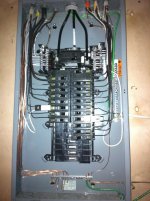
 Read up on the bonding screw that came with my panel (broke down and read instructions LOL) So just to see if I'm catching the principle. Now days with the 4 wire new code, that makes the bonding screw obsolete, would that be correct? So in other words if you have a 4 wire feed there's no need to bond neutral to the box ?


 (I am not joking BTW).


