To avoid these ads, REGISTER NOW!

How long after epoxy-coat should I wait to fill my garage with junk?

mfive

Active member
Joined
Sep 25, 2011
Messages
35
Hey all,

I finished my epoxy-coat on Monday morning, and although it's pretty hard and I can walk on it with no problems, I've noticed I can still dig my nail in and leave a mark. I have to try, but I figured this was a good way to test. Is this normal? Does it ever get "rock" hard?

I want to move my garage contents back into the garage (from the kitchen) before my girlfriend kills me, but I don't want to put heavy stuff on the floor if it's not ready.

Should I keep waiting? How long does this usually take?
 
To avoid these ads, REGISTER NOW!

gatchel

Well-known member
Joined
Dec 12, 2009
Messages
672
Location
West of King of Prussia, PA
From their web site:

Dry time for foot traffic in 18 hours and heavy traffic in 24 hours at room temperature (70° degrees F) regardless of thickness. Drying times are longer at cooler temperatures. Temperature and humidity can affect dry time. AS WITH MANY HIGH PERFORMANCE FLOOR COATINGS FULL CHEMICAL RESISTANT CURE IS 3 DAYS.


I would wait at least 3 days.
 
OP
M

mfive

Active member
Joined
Sep 25, 2011
Messages
35
From their web site:

Dry time for foot traffic in 18 hours and heavy traffic in 24 hours at room temperature (70° degrees F) regardless of thickness. Drying times are longer at cooler temperatures. Temperature and humidity can affect dry time. AS WITH MANY HIGH PERFORMANCE FLOOR COATINGS FULL CHEMICAL RESISTANT CURE IS 3 DAYS.


I would wait at least 3 days.

Its already been 72 hours in mostly 50s at night 70s during the day. I wonder if that indicates a problem our just extra long cure time.
 
OP
M

mfive

Active member
Joined
Sep 25, 2011
Messages
35
Did it ever harden? And how long did it take?

Funny you should ask. No, it has not hardened completely yet... I emailed Epoxy-coat yesterday but haven't heard back yet. It's hard enough to walk on and I'm storing stuff out there with no problems (shelves are up, etc). However, I had a little mishap when trying to park a car on it for the first time...

Here's the details of what happened:

I rolled my floor down November 20th (base coat) and 21st (clear coat). It was hard the next day, but not "rock" hard or fully cured by any means. I waited a week and I noticed that I could still leave a blemish with my fingernail. I called and spoke to someone at Epoxy-coat on the phone last week, and the person I spoke with said I should wait another week and then it should be cured. I did the fingernail check a few times and it seems to be getting harder to leave an indent in the coating. At one point on Friday I wasn't able to leave an indent.

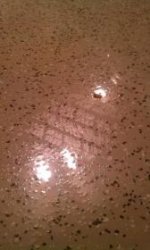
Monday came around and I decided to park on the floor for the first time. My tires were cool and dry when I pulled it in (car was parked outside all day) When I pulled out of the garage later that night, I noticed that there were very noticeable tire marks in the clear coat (see attached image).

I'm certain that my mixtures were right. I meticulously prepared the floor, and am even more certain in my mixes for the clear coat than the base coat as I had already done it once the day before. Temperatures here have varied since but on application days it was mid 70s during the day and high 50s at night. Since then it has dropped lower than 50 for only a few days (last weekend, one week after application), but most days have been in the 60s or low 70s with nights dipping down into the 40s and 50s. The floor temperature has seemed to stay relatively close to 60 degrees in temperature since application.

When I got home from work yesterday, I was chatting with a neighbor who asked how the floor turned out (he is thinking about purchasing an epoxy-coat kit as well). I told him it looks great but that it hasn't cured yet and went to show him the marks from the the tires where my Jeep was parked on it. To my surprise, the same mark in the attached picture is 95% gone. I could not believe that it "healed" itself so well. Both marks seemed to have "healed" up enough that no repair will be necessary provided the floor eventually gets hard. You would have to really look or know that I parked the car there to see the marks. I even have a had a hard time finding them today.

The million-dollar question now is, what's going on and when is this floor going to finally cure?
 

Attachments

  • IMAG0344.jpg
    IMAG0344.jpg
    8.9 KB · Views: 167
To avoid these ads, REGISTER NOW!

dcs Inc

Well-known member
Joined
Dec 13, 2010
Messages
803
Location
Indianapolis, Indiana
I don't know what these guys tell you on mixing their stuff and I can only relate to what I sell and use. MOST epoxies are a two part system with (2) parts A the solids, to (1)Part B the activator, catalyst, or hardener..... what ever they want to call it.

Anyway, I pour my measured amount of part B into my mixing bucket. Then I pour part A into that. I scrape the sidewalls real well and the bottom of the bucket. Then slow drill mix it. Do the scrape thing again and then pour it into a delivery bucket. Pour that out in a long line till it just starts to dribble. Give the bucket back to my mixing guy and spread the epoxy out. By the time I have the epoxy gaged out with a notched squeegee and rolled smooth, the next batch is ready to pour out. I normally mix 5 to 15 gallon kits this way.Here's what I'm getting to.

If you don't mix it correctly, the epoxy will take forever to dry hard. NEVER pour out your bucket to the last drop. I don't care how well you mixed it, one of the components is still hanging on the wall of the bucket not mixed correctly.

Temps: Yes epoxy will slow down or speed up a little with high or low temps. It is exothermic so the drying is Dependant on a chemical reaction. Colder temps will cause it to slow down a little but it will harden. Extreme temps will cause a problem on some epoxies and that is determined by the mix design of the manufactures.

Now if you have a problem with the first coat of epoxy. Drying to touch but not completely dry and then re-coating it. It may take forever and a day to allow the undercoat epoxy to dry.... if it ever does. You have encapsulated it and not allowed it to completely set. The top coat will (should) eventually dry. Good luck in any case. gene ec-Indy
 
OP
M

mfive

Active member
Joined
Sep 25, 2011
Messages
35
Epoxy-coat is a 2-part to 1-part mixture. I know that my measurements were correct there. I used a drill-mixer that was included in the kit with a timer set to 3 minutes after each mixing. However, I did not use a spatula or scrape the sidewalls, as the instructions that came with the kit did not dictate that. I mixed for 3 minutes with the drill after combining, and then poured directly onto the floor as the instructions said.

Both coats were able to be walked on within 18 hours.

I hope that when you say "forever" to dry that's not literal. I'd love to be raving about my epoxy-coat application, but unfortunately I can't just yet. I hope that changes soon...
 

dcs Inc

Well-known member
Joined
Dec 13, 2010
Messages
803
Location
Indianapolis, Indiana
I had one project that took 3 weeks to finally harden. The mix wasn't mixed correctly and the hardener took a long time to kick. Be patient. Scraping the sidewalls of your mix to completely encapsulate the 2 components should be part of the directions.
gene ec-Indy
 

Edger

Well-known member
Joined
May 18, 2011
Messages
623
Location
Melbourne Australia
mfive, you should be OK with your epoxy eventually, it does sound like a mixing problem. When it has hardened it should be as good as any other epoxy. A hard epoxy will be harder than the concrete so wait until you are sure by using a heavy weighted object on its corner to do your test in an inconspicuous spot until it is very hard.

There have been many posts about epoxy coat not mixing properly or one of the products left over after measuring and mixing and they have said on this forum that they allow extra of one of the components which seems strange to me. When the ratios are out it just takes longer to cure.

An epoxy chemist told me a long time ago that the two components do not want to mix so you have to bash them together with a mixer for long enough for them to chemically interact, I am sure advances have been made in modern epoxies, but some of what he said will probably still be true.
 
To avoid these ads, REGISTER NOW!
Top Bottom