Well my Hydronic system is running strong...I have it set at 62...but I am finding my feet are sweating and I do not want the shop any cooler..... I guess I am going to put in a auxiliary heater so I can lower the floor temp........... Does anyone else here have issues with hot feet with your hydronic system ?

You are using an out of date browser. It may not display this or other websites correctly.
You should upgrade or use an alternative browser.
You should upgrade or use an alternative browser.
New Hydronic Heat running Strong ! Sweaty feet ?
- Thread starter CRE Neal
- Start date
Sureshot
ALLIANCE MEMBER
Do you have a ceiling fan?
do you have a ceiling fan?
no !
Charles (in GA)
Well-known member
You are cold because all the heat goes straight to the ceiling. As noted, get a fan or fans (depending on shop size) and your problems will most likely be solved.
Any time ceilings are over 8 or 9 ft, you really need ceiling fans.
Charles
Any time ceilings are over 8 or 9 ft, you really need ceiling fans.
Charles
You are cold because all the heat goes straight to the ceiling. As noted, get a fan or fans (depending on shop size) and your problems will most likely be solved.
Any time ceilings are over 8 or 9 ft, you really need ceiling fans.
Charles
Makes sense... I am beating myself up for not thinking of that already LOL !
the shop is 22x28 10ft ceiling....
tdkkart
Well-known member
Well my Hydronic system is running strong...I have it set at 62...but I am finding my feet are sweating and I do not want the shop any cooler?
A couple things......
#1 how long has the system been running?? The floor will be hotter till the thermostat is satisfied.
#2 what is the actual floor temp?? IF you are well insulated, and after the system has been running and stabilizes a bit, the floor temp should be only about 3-5* warmer than your air temp, unless it's REALLY cold outside, well below your design temp.
#3 The radiant takes a bit to get used to, I'll be that if your building is free from drafts and you are doing any actual work, rather than just sitting on your ***, you will find that 62* or less is plenty warm.
I run mine at 55* and am plenty comfortable in just a long sleeve shirt.
A couple things......
#1 how long has the system been running?? The floor will be hotter till the thermostat is satisfied.
#2 what is the actual floor temp?? IF you are well insulated, and after the system has been running and stabilizes a bit, the floor temp should be only about 3-5* warmer than your air temp, unless it's REALLY cold outside, well below your design temp.
#3 The radiant takes a bit to get used to, I'll be that if your building is free from drafts and you are doing any actual work, rather than just sitting on your ***, you will find that 62* or less is plenty warm.
I run mine at 55* and am plenty comfortable in just a long sleeve shirt.
the system has been running since Saturday afternoon..it came up to temp of 64 by Monday...with a starting return water temp of 40...Now return water temp is 70, input 100...at a room temp of 64 it was uncomfortably hot on the feet ....We turned it down to 62 and its better, but still too warm on the feet for me...room temp is fine if I was doing manual labor, but much of what I do is micro machining sitting in one place mostly....Outside temps dipping down to -30, with 60 KMH North Winds...shop is well insulated and sealed with closed cel foam insulation top to bottom....
jvitez
Well-known member
Hello fellow Canuck!
At -30C your floor temp will be noticeably higher than at warmer temps, due to the deta T. Do you have an infrared thermometer gun? If not, get one and check the floor temp itself, then the wall temps. You'll see how much difference there is depending on outdoor temps.
In the interim, I would just plug in an electric radiant type portable heater and face it towards you while your sitting. Another option is a propane fired Mr. Heater Portable Buddy.
http://www.mrheater.com/ProductFamily.aspx?catid=41
At -30C your floor temp will be noticeably higher than at warmer temps, due to the deta T. Do you have an infrared thermometer gun? If not, get one and check the floor temp itself, then the wall temps. You'll see how much difference there is depending on outdoor temps.
In the interim, I would just plug in an electric radiant type portable heater and face it towards you while your sitting. Another option is a propane fired Mr. Heater Portable Buddy.
http://www.mrheater.com/ProductFamily.aspx?catid=41
ixlr8
Well-known member
If your feet are sweating... take off your shoes.  I would also be tempted to lower the water temp going to the floor. 100dF seems a little high unless the system can't maintain the temp you are requesting, depends on how well insulated your shop is.
I would also be tempted to lower the water temp going to the floor. 100dF seems a little high unless the system can't maintain the temp you are requesting, depends on how well insulated your shop is.CARS
Well-known member
Your input is 100 and return of 70? You have problems. The differential should never be more than 10 degrees.
My input is 100 and my return is 95. It took me a while to tweak all the valves to balance my system but now it is running great.
I too keep my room temp at 65 but I rarely get sweaty feet. I guess I am moving around enough to not notice. I would imagine anyone who stood in one spot all day running a machine would have a different opinion.
My input is 100 and my return is 95. It took me a while to tweak all the valves to balance my system but now it is running great.
I too keep my room temp at 65 but I rarely get sweaty feet. I guess I am moving around enough to not notice. I would imagine anyone who stood in one spot all day running a machine would have a different opinion.
today we had a rapid drop in outside temperature and a huge increase in the wind.... today I go into the shop to see my room temp at 61 , so the boiler is running.......... However the last few days the the temp has been rock solid at 62....... Is it normal for a hydronic system to take a day to catch up to a rapid weather change....
My shop is well insulated, however my pad is not...I poured the pad before I did enough research..I had a concrete contractor/friend who did the pad, he told me insulating it was a waste of money ! LOL....I was soo busy with work at that time I didn't pay much attention, I was just happy to have the pour done before the frost came...... obviously a big mistake, and big reason I am thankfull to have this forum for advice..I wish I came here sooner.....I Am planning to dig out 2 sides in the spring and insulate the best I can, 2 other sides there is nothing I can do as there is a new walkway and a parking pad butted up to the shop....However in the end I do fear having a non insulated pad is going to leave me with a very expensive heating system to run....
Plan 2...2 electric wall heaters will now be installed.....if the hydronic system proves to be struggling too much I will switch over to the heaters...In spring I will insulate the 2 sides I can get at and try again next winter.....If that doesn't work I am going to work extra hours to pay for the mistake ! Tell you guys what tho, if I built another shop I would save myself a pile of money and headache...as I know a pile more today then I knew when I first started...no small thanks to all the helpful members of GJ
My shop is well insulated, however my pad is not...I poured the pad before I did enough research..I had a concrete contractor/friend who did the pad, he told me insulating it was a waste of money ! LOL....I was soo busy with work at that time I didn't pay much attention, I was just happy to have the pour done before the frost came...... obviously a big mistake, and big reason I am thankfull to have this forum for advice..I wish I came here sooner.....I Am planning to dig out 2 sides in the spring and insulate the best I can, 2 other sides there is nothing I can do as there is a new walkway and a parking pad butted up to the shop....However in the end I do fear having a non insulated pad is going to leave me with a very expensive heating system to run....
Plan 2...2 electric wall heaters will now be installed.....if the hydronic system proves to be struggling too much I will switch over to the heaters...In spring I will insulate the 2 sides I can get at and try again next winter.....If that doesn't work I am going to work extra hours to pay for the mistake ! Tell you guys what tho, if I built another shop I would save myself a pile of money and headache...as I know a pile more today then I knew when I first started...no small thanks to all the helpful members of GJ
CARS
Well-known member
Another thought.
I was told with in-floor heat you don't want a ceiling fan. My installer said not to and the radiant forums I have visited state the same.
Those sites that sell in-floor systems have neat, colorful images of how the floor is warmer than the ceiling. One of these days I need to buy a few thermometers and put them on one of the walls to see what is really going on.
I was told with in-floor heat you don't want a ceiling fan. My installer said not to and the radiant forums I have visited state the same.
Those sites that sell in-floor systems have neat, colorful images of how the floor is warmer than the ceiling. One of these days I need to buy a few thermometers and put them on one of the walls to see what is really going on.
tdkkart
Well-known member
Another thought.
I was told with in-floor heat you don't want a ceiling fan. My installer said not to and the radiant forums I have visited state the same.
Those sites that sell in-floor systems have neat, colorful images of how the floor is warmer than the ceiling. One of these days I need to buy a few thermometers and put them on one of the walls to see what is really going on.
Absolutely correct, the floor acts as a big 'ole heating element, the closer you are to it the wamer you feel. Stick your hand over an oven element, the closer you get the more heat you feel. Yes, check it with a thermometer or a heat gun, you will see that the ceiling is cooler than the floor.
Unless you have a floor temp sensor and an outdoor reset thermostat your floor may indeed lag slightly behind with sudden drops in outdoor temps. the outdoor reset will see the rapid change in outdoor temp and jumpstart the heat so it keeps ahead of the change. That floor is a big rock and it takes a bit to catch up. On the other hand, it also holds temp better when going the other direction, so it's 6 of 1 and 1/2 dozen of the other.
Charles (in GA)
Well-known member
Heat rises. While I'll bet the floor is warmer than the air at say 4 or 5 ft high, I'll bet the ceiling is quite warm because it will rise till it has no where to go, then sit. Get on a step ladder and sit on top with a thermometer and see!
You need air circulation for even temps.
Charles
You need air circulation for even temps.
Charles
tdkkart
Well-known member
Get on a step ladder and sit on top with a thermometer and see!
Sorry, been there and done that, and I can tell you that the ceiling is cooler than the floor or anywhere in between.
overdriv
Well-known member
My shop with in floor heat is set to 62* air temp, which I find real nice while working. In most cases the floor will be 64-65*. When the temp outside gets down in the 20s and below, the difference in the floor will increase by 2-3 degrees. I notice the increased warmth on my feet, but my feet still don't sweat. Are you wearing heavy socks or insulated shoes?
The air temp 6' off the floor feels the same at my 14' ceiling. There is no need for ceiling fans in the winter, but use them all the time in the summer with just a large window A/C unit.
My system usually shows about a 15* drop across the inlet and outlet manifolds. I input at 120* till the water heater is exhausted then it will run the input at 90*, but still with a 15* drop. After the first start up of the year and the floor is up to temp, the water heater is seldom exhausted before the circulating pump shuts off.
The air temp 6' off the floor feels the same at my 14' ceiling. There is no need for ceiling fans in the winter, but use them all the time in the summer with just a large window A/C unit.
My system usually shows about a 15* drop across the inlet and outlet manifolds. I input at 120* till the water heater is exhausted then it will run the input at 90*, but still with a 15* drop. After the first start up of the year and the floor is up to temp, the water heater is seldom exhausted before the circulating pump shuts off.
koditten
Well-known member
Been there, done that, got the T-shirt.
You do not want to run a cieling fan with heated floors. I made that mistake my first year. The drafts created by the fan were screwing with the thermostat. The thermostat is one that is designed for heated floors, I forget the name.
Heat doesn't really rise, warm air rises. With radiant heat, you want to stay away from creating thermal convection of the air. The air needs to stay still. My building only has a 4-5* temperature diference from floor to cieling. This can change a bit as outside temps rise and fall with the weather.
I keep my thermostat set at 50*. Works good for what I do.
You do not want to run a cieling fan with heated floors. I made that mistake my first year. The drafts created by the fan were screwing with the thermostat. The thermostat is one that is designed for heated floors, I forget the name.
Heat doesn't really rise, warm air rises. With radiant heat, you want to stay away from creating thermal convection of the air. The air needs to stay still. My building only has a 4-5* temperature diference from floor to cieling. This can change a bit as outside temps rise and fall with the weather.
I keep my thermostat set at 50*. Works good for what I do.
Voi
Well-known member
Heat doesn't really rise, warm air rises.
That's correct. To expand on that a bit more, heat moves in three basic ways - convection, conduction and radiation.
Warm air rises only when you have a convection current. With a radiant floor system there is no convection current so it will be cooler at the ceiling. This is why radiant floor systems are marketed for the "warm feet, cool head" comfort.
I don't have radiant heat in my shop or garage but do have it in three bathrooms. Even with 8' ceilings when I climb a step stool to change a light bulb it gets cooler as you go up. The opposite of the rest of my house which is heated with forced air.
I put radiant heat in my 1800 sq ft detached garage. In building the garage, I had several questions on how the heat would work so I installed sensors in several places. I have sensors in 2 places in the floor, and a sensor at the ceiling. I have 8 zones with sensors on the supply side and one per each of the 8 returns.
This is the second winter with the system. I have not really tuned it. I am actually not sure how to tune it yet so I am still learning.
I thought I would share the last few days of temp readings. The green line is the supply temp and you can easily see when the boiler/pump comes on. The blue line is one of the sensors in the floor. The purple line is the ceiling temp. Lastly is the outside temp.
If anyone is interested in the return temps, I can share that as well.
The thermostat is set at 50 F.
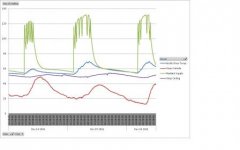
This is the second winter with the system. I have not really tuned it. I am actually not sure how to tune it yet so I am still learning.
I thought I would share the last few days of temp readings. The green line is the supply temp and you can easily see when the boiler/pump comes on. The blue line is one of the sensors in the floor. The purple line is the ceiling temp. Lastly is the outside temp.
If anyone is interested in the return temps, I can share that as well.
The thermostat is set at 50 F.
stingry
Well-known member
Interesting graph, thanks for sharing!!!
Cheers
Steve
Cheers
Steve
Sureshot
ALLIANCE MEMBER
My system has a temp sensor tied to a mixing valve that is on the return line so the system tries to maintain an even return temp. I used to have large trucks pulling in and dropping snow and ice on the floor trying to cool it down. I have had much better luck with that than maintaining the input temp. My pump runs continuously.
I also run ceiling fans to heep the condensation off the windows and to dry the floor when equiptment moves in and out. I adjust the speed depending on the situation but normally run them as slow as they go.
Been doing it this way for ten years but the idea of turning the fans off and using them when required certainly has merit and would likely reduce the gas bill.
I think you are trying to reheat alot of ground hence the large temp difference. I also regret not insulating under the slab but have 4" of foam all the way around which certainly helps. You will see your heat loss when the snow all melts back from the bottom of the exterior wall and leaves a gap.
I also run ceiling fans to heep the condensation off the windows and to dry the floor when equiptment moves in and out. I adjust the speed depending on the situation but normally run them as slow as they go.
Been doing it this way for ten years but the idea of turning the fans off and using them when required certainly has merit and would likely reduce the gas bill.
I think you are trying to reheat alot of ground hence the large temp difference. I also regret not insulating under the slab but have 4" of foam all the way around which certainly helps. You will see your heat loss when the snow all melts back from the bottom of the exterior wall and leaves a gap.
Voi
Well-known member
Isn't floor heat convection heat, not radiant ?
The heat moves through the slab via conduction and then out of the slab via radiation. So ultimately you are heating the garage and objects in the garage with radiant heat.
Last edited:
Riverside
Well-known member
. . . too warm on the feet for me...room temp is fine if I was doing manual labor, but much of what I do is micro machining sitting in one place. . .
Since you are mostly in one place, could you put down a work mat to insulate your feet from the floor?
BadgerBoilerMN
Well-known member
Naturally your experienced radiant floor designer specified the design water temperature you would need to maintain the design indoor air temperature on the design day.
If you added to this, his suggestion for an outdoor reset control, you would be running exactly the right water temperature to create perfect comfort and economy by operating the radiant floor at the lowest possible water temperature (and the highest delta T for pump economy) that you can. No sweaty feet, ever.
You never want to move air when fighting cold (think, wind chill).
A little professional design help will save time and money.
All of the questions one might have about how a radiant heating system "might" work are readily available in a variety of books. One might even go so far as to say, it is wise to know these things before you bury the tube.
If the vendor that sells you radiant floor components does not or cannot provide a computer generated heat load analysis and perhaps even a CAD tube layout AND you don't have this knowledge yourself...walk away.
If you added to this, his suggestion for an outdoor reset control, you would be running exactly the right water temperature to create perfect comfort and economy by operating the radiant floor at the lowest possible water temperature (and the highest delta T for pump economy) that you can. No sweaty feet, ever.
You never want to move air when fighting cold (think, wind chill).
A little professional design help will save time and money.
All of the questions one might have about how a radiant heating system "might" work are readily available in a variety of books. One might even go so far as to say, it is wise to know these things before you bury the tube.
If the vendor that sells you radiant floor components does not or cannot provide a computer generated heat load analysis and perhaps even a CAD tube layout AND you don't have this knowledge yourself...walk away.
dirttracker18
Well-known member
My shop is well insulated, however my pad is not...I poured the pad before I did enough research..I had a concrete contractor/friend who did the pad, he told me insulating it was a waste of money ! LOL....I was soo busy with work at that time I didn't pay much attention, I was just happy to have the pour done before the frost came...... obviously a big mistake, and big reason I am thankfull to have this forum for advice..I wish I came here sooner.....I Am planning to dig out 2 sides in the spring and insulate the best I can, 2 other sides there is nothing I can do as there is a new walkway and a parking pad butted up to the shop....However in the end I do fear having a non insulated pad is going to leave me with a very expensive heating system to run....
Your fears are correct, I think you are going to find that your bill is astronomical
I hate to put the fear into you but what you are doing is heating the ground under your shop, as well as all around it. Insulating around might help a bit but the big problem is the udnerside, which you cannot insulate now.
FWIW, a delta T of 30 is very common from what I found. For the other poster at a delta of 5, sounds like you need more work as your slab is barely pulling in any heat during circulation.
leeklm
Well-known member
I am new to the Hydronic thing this year, so do not take my 2 cents for anything more than just that... My slab surface temp (about 30 inches in from the exterior wall) is set for 60 degrees. I just checked, and the slab reading was 61.7, and the air temp in middle of shop is 60. My inlet water temp is about 120F, and once the system "levels out" when the pump is circulating, my inlet temp is about 98, and return temp is 78-80. I have done a fair amount of online research, and these numbers seem fairly typical.
Outside air temp has been hanging around 15-35 degrees these past few weeks with some wind. My pump does not kick in very often, maybe every 4 hours. I am rarely in the garage long enough for 2 heating cycles to take place. I have not looked too closely at the natural gas bill yet, but imagine it should be reasonable.
Regarding slab insulation, I did read that insulating the side of your slab/foundation is more important than insulating under the slab. I suppose taking care of your 2 side walls will help, but would not expect miracles... I insulated under my slab, and up the sides of 12" footing and the 9" block on top of slab, but no insulation under the slab "footing".
Although I am enjoying our "warm" weather, I am almost looking forward for some -20F temps and blizzard winds to give the system a good test!
Outside air temp has been hanging around 15-35 degrees these past few weeks with some wind. My pump does not kick in very often, maybe every 4 hours. I am rarely in the garage long enough for 2 heating cycles to take place. I have not looked too closely at the natural gas bill yet, but imagine it should be reasonable.
Regarding slab insulation, I did read that insulating the side of your slab/foundation is more important than insulating under the slab. I suppose taking care of your 2 side walls will help, but would not expect miracles... I insulated under my slab, and up the sides of 12" footing and the 9" block on top of slab, but no insulation under the slab "footing".
Although I am enjoying our "warm" weather, I am almost looking forward for some -20F temps and blizzard winds to give the system a good test!
CARS
Well-known member
Although I am enjoying our "warm" weather, I am almost looking forward for some -20F temps and blizzard winds to give the system a good test!
You are a sick man

Other than the 50 mph gusts today, I for one am going to enjoy highs near 50 today!
Strouty
Well-known member
Since you are mostly in one place, could you put down a work mat to insulate your feet from the floor?
I was thinking the same thing, maybe anti-fatigue matts would help.
kert
Well-known member
I am thinking that more air circulation across the floor might be the answer. Maybe a box fan on the floor would do the job. By doing this, you will increase the rate of heat transfer from the for to the air for a given floor temperature. If you aren't working for extended periods of time, you might even turn the fan off while you are working.
Novicaine
Well-known member
I am having the same issue on my newly fired up system. The delta is around 30*. Supply 100* and return 68*. I have been told that it is way to high but I cannot change it by speeding up or slowing down the pump.
JaxGarage - Can you post a picture of your setup?

Novicaine
Well-known member
Here it is.
If your supply temp is too high, you aren't moving enough water to carry away the BTU's the heat source generates.
Roughly there is this formula (from Taco's "How To Size a Circulator Pump") for GPM and temperature drop for in floor heating.
GPM = 0.002*BTU/DeltaTemp
The common sense simplification is you can move more BTUs with more GPM or a higher delta temperature, choose your poison.
Assume you're pushing X GPM now.
Assume your boiler is producing Y BTU.
To simplify the equations Assume Z = 0.002*Y
I'm going to assume your boiler is 85K BTU, so Z is roughly 170.
Your current situation shows that your boiler can raise the temp from 60 to 100 at the current GPM.
So your current GPM is Z/(100-60)=Z*0.025=4.25 GPM
For your floor to move the same BTU's but at a 20 Degree drop, it needs to flow GPM= Z/20=Z*0.050=8.5GPM through the secondary loop, so double the GPM it currently is moving.
If the boiler can raise the water temp 70 deg (see your boiler docs), it only needs to move GPM=Z/70=Z*0.014=2.5GPM, through the primary loop, roughly half the current GPM.
So you need to move more GPM through the floor, and possibly less through the boiler.
The real fix is to switch to a primary/secondary loop system. One circulator pushes water through the boiler and the other pushes the that many BTU's through the floor.
To switch would be pretty easy... just buy a small circulator to move 2.5GPM through boiler, your setup would be easy enough to change the way it's laid out. Your big loop now would be the secondary loop, just close it instead of going to boiler. Without the boiler back-pressure, your current circulator may be able to move twice the GPM through the floor. Then drop a couple pipes down from your boiler, stick a small circulator in there and hook into the lower horizontal part of your loop with 2 closely spaced tees. Make sure the flow is the right way of course.
Option 2: If you can turn your boiler down if it has a "force low" setting, then that'll reduce the delta temp with no changes, but longer runtime, which is no big deal.
Option 3:Live with the 40 degree temp drop, in a shop that's probably fine.
I have the same situation, but do have a primary/secondary loop. Really, my secondary loop needs a larger (more expensive) circulator. Instead, I set my boiler to run at low (a dip-switch setting), which is 50K BTU instead of 120K BTU, seems to work, keeps the delta temp lower.
today we had a rapid drop in outside temperature and a huge increase in the wind.... today I go into the shop to see my room temp at 61 , so the boiler is running.......... However the last few days the the temp has been rock solid at 62....... Is it normal for a hydronic system to take a day to catch up to a rapid weather change....
My shop is well insulated, however my pad is not...I poured the pad before I did enough research..I had a concrete contractor/friend who did the pad, he told me insulating it was a waste of money ! LOL....I was soo busy with work at that time I didn't pay much attention, I was just happy to have the pour done before the frost came...... obviously a big mistake, and big reason I am thankfull to have this forum for advice..I wish I came here sooner.....I Am planning to dig out 2 sides in the spring and insulate the best I can, 2 other sides there is nothing I can do as there is a new walkway and a parking pad butted up to the shop....However in the end I do fear having a non insulated pad is going to leave me with a very expensive heating system to run....
Plan 2...2 electric wall heaters will now be installed.....if the hydronic system proves to be struggling too much I will switch over to the heaters...In spring I will insulate the 2 sides I can get at and try again next winter.....If that doesn't work I am going to work extra hours to pay for the mistake ! Tell you guys what tho, if I built another shop I would save myself a pile of money and headache...as I know a pile more today then I knew when I first started...no small thanks to all the helpful members of GJ
You might want to figure on going with baseboard or Modine type
radiators. Your system is going to be to costly to run.
We had the same setup as you except ours was installed in 1979 when
their was not as much information on radiant heating systems.
Back then we used ABS black plastic pipe.
Last year we abandoned the whole setup and switched to Modine radiators,
the shop is at least 10 degrees warmer, with less than half the fire we
used to have. We have a wood fired boiler located in another building,
even with a wood fire its still to expensive to operate with the un-insulated slab.
My feet were always hot with are system as well, also we would have to
put something under all objects that were made out of wood because the
floor would dry the wood out and cause it to crack.
BadgerBoilerMN
Well-known member
Your feet are sweating because the surface of the floor is too warm.
We have known since the 80's that radiant floor heating in the slab will be more comfortable and cost less to operate than any other heating system.
However, a little professional design is needed if comfort and ecomony are to be optimized.
You seem to be missing some basic design parameters such as maximum design temperature, maximum operating temperature, weather sensitive controls. (A 10°F delta T is an abitrary number irrelelevent in most radiant slab senarios). If your heat source were a condensing gas boiler or an electric boiler with ODR you would be all set.
Naturally all of these parameters are determined by a proper heat load performed by an experienced radiant floor heating designer.
http://www.badgerboilerservice.com/hrf.html
We have known since the 80's that radiant floor heating in the slab will be more comfortable and cost less to operate than any other heating system.
However, a little professional design is needed if comfort and ecomony are to be optimized.
You seem to be missing some basic design parameters such as maximum design temperature, maximum operating temperature, weather sensitive controls. (A 10°F delta T is an abitrary number irrelelevent in most radiant slab senarios). If your heat source were a condensing gas boiler or an electric boiler with ODR you would be all set.
Naturally all of these parameters are determined by a proper heat load performed by an experienced radiant floor heating designer.
http://www.badgerboilerservice.com/hrf.html
Last edited:
Well a few months later and I am one happy camper.... my system seems to be working quite good..... even on nasty cold days -40F the systems has no issues heating my shop..... From time to time I do see a little lag if there is a rapid weather change, but other then that the sytems seems quite good... I have the thermostat set at 64 and most days my shop sits at 70 when the suns up and falls back to 64 during the night, sometimes if it gets really cold it will drop to 62 but it doesn't take long for the boiler to catch up...... I did some testing the other day...shop sitting at 64, I set the thermostat to 65 and it about 10 minutes...I then set the stat to 66, then I went to 67, ended up going all the way to 70....and it did not take long at all for the boiler to raise the heat up each time..it was actually much faster then I would have anticipated..... I Am running a Lion 8KW electric boiler.......
Another thing I am amazed at is how slow it takes for the shop to cool down when I open a door.... Temps is at 70 in shop during the day...boiler has not run all day..I have 2 windows and a door open and it does not shed heat that fast....the floor must store a massive amount of heat... I can pull a car in and out of the shop and temp doesn't drop a degree.... My shop is well insulated on the topside tho, I have closed cell foam ceiling and wall.....
Another thing I am amazed at is how slow it takes for the shop to cool down when I open a door.... Temps is at 70 in shop during the day...boiler has not run all day..I have 2 windows and a door open and it does not shed heat that fast....the floor must store a massive amount of heat... I can pull a car in and out of the shop and temp doesn't drop a degree.... My shop is well insulated on the topside tho, I have closed cell foam ceiling and wall.....
CARS
Well-known member
Do you have a ceiling fan?


Fans are a bad idea with radiant heat.