To avoid these ads, REGISTER NOW!

120v 1.8hp trips CB close to panel, but not further away, electrical q's

pipsters

Well-known member
Joined
Sep 1, 2010
Messages
4,899
Location
USA
Need some help...

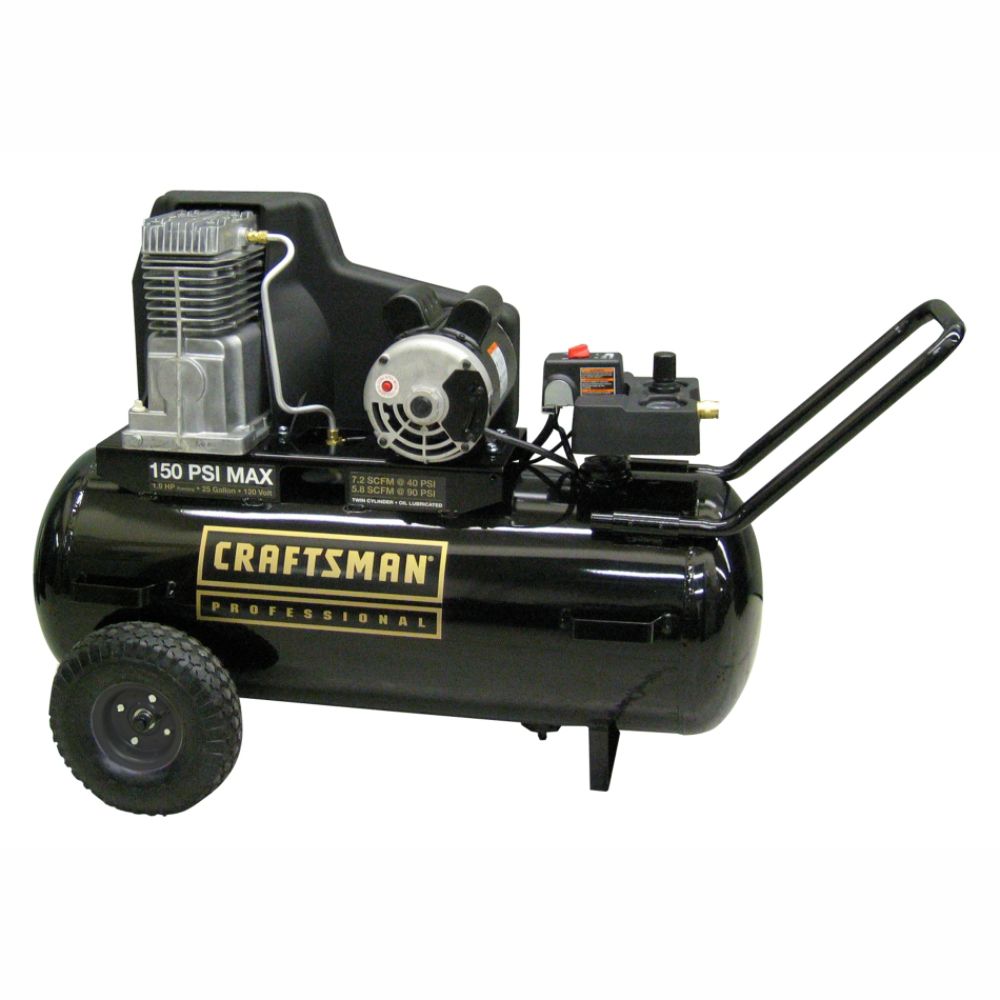
I own a 25 gal 1.8hp 120v compressor from Sears. It's the oiled belt driven kind.

I got tired of the compressor tripping my 15 amp breaker in my garage right below the CB panel, so I installed a 20 amp breaker with 12g wire run. I would estimate the breaker to the new outlet is about 2' of wire (if that). *EDIT* I also installed a 20 amp outlet.

It still pops the 20 amp breaker, albeit about 25% of the time now (much less).

Here's the rub. If I move the compressor further away from the CB panel, say to my back yard, on a 15 amp breaker and outlet, the compressor is fine and cycles on perfectly every time. WTF?

A temp solution might be to get a 10' long 12g extension cord and plug it in in the garage, but I'd really like to understand what is going on.

It's done it since new (2.5 years now), and hasn't gotten better or worse.
 
Last edited:
To avoid these ads, REGISTER NOW!

Outlawmws

Well-known member
Joined
Aug 9, 2011
Messages
39,285
Location
The Badlands
When you ran the new 12 G. did you replace the outlet? Many outlets, especially old ones, get corroded, or the contacts were simply made cheaply, and wind up being resistive.

Also, if you used the push in contacts, don't. Those also leave much to be desired for heavy loads.

Since you have a 20 A breaker, I'd make sure you also use a 20A outlet. There is a significant difference. You will even notice the difference just trying to push the plug in.
 
OP
P

pipsters

Well-known member
Joined
Sep 1, 2010
Messages
4,899
Location
USA
When you ran the new 12 G. did you replace the outlet? Many outlets, especially old ones, get corroded, or the contacts were simply made cheaply, and wind up being resistive.

Also, if you used the push in contacts, don't. Those also leave much to be desired for heavy loads.

Since you have a 20 A breaker, I'd make sure you also use a 20A outlet. There is a significant difference. You will even notice the difference just trying to push the plug in.
Yes I bought a 20 amp outlet as well.

But like I said, it pops on 15 and 20 amp when plugged in right next to the CB panel. But runs fine well away from it on various 15 amp circuits.

Even tried it in my washing machine outlet, which is 20 amp with a 20 amp breaker, maybe 4' from the CB panel, and it pops there too.
 

chickenhauler

Well-known member
Joined
May 31, 2011
Messages
473
Location
Pennsylvania
When you move it away from the panel, are you using the same breaker? Breakers do wear out. I had one in my old garage that trips if anything more than a drill was used on it.
 

Outlawmws

Well-known member
Joined
Aug 9, 2011
Messages
39,285
Location
The Badlands
Are you certain of the polarity of the outlets you are using, and that the compressor is polarized properly? I suspect one or the other is backwards, and the long run matches, and the short runs don't...

White to silver screw
Black to Brass screw
Green to ground (Doh)

(If something is backward, and it's blowing on the "correct" setup, then I suspect other issues inside the motor or switches, of the compressor. - I once had a DP with munged up wiring and I was getting shocked on devices plugged into that circuit that were WITHOUT issues, even with the DP turned off...)
 
OP
P

pipsters

Well-known member
Joined
Sep 1, 2010
Messages
4,899
Location
USA
Yes, everything is run perfectly. Brand new everything with the 20 amp stuff. Breaker, outlet, wires.

It doesn't blow all the time.

What is consistent is the closer to the CB panel itself, the more it pops the breaker.

What inside the compressor motor would be causing this?
 
OP
P

pipsters

Well-known member
Joined
Sep 1, 2010
Messages
4,899
Location
USA
When you move it away from the panel, are you using the same breaker? Breakers do wear out. I had one in my old garage that trips if anything more than a drill was used on it.

It's a brand new breaker. But no, all are different breakers on different circuits. But the 20 amp stuff is brand new. Everything on it is new except the CB panel itself.
 
OP
P

pipsters

Well-known member
Joined
Sep 1, 2010
Messages
4,899
Location
USA
:headscrat Try a 30 amp breaker lol. It's what I would do.

LOL I hear ya. What I will end up doing if I can't figure it out is just buy a 10' or 25' 12g extension cord and plug it in.

Almost seems like the compressor likes a "soft start" more than a huge inrush of power.

I'm not good with electric stuff so I really have no idea what to look for.
 

Hiball

Well-known member
Joined
Apr 30, 2009
Messages
14,031
Location
Missery
Have you checked to see what type of Amperage the Compressor is drawing on the Circuit closest to the Box? It might have issues..
 
Last edited:
OP
P

pipsters

Well-known member
Joined
Sep 1, 2010
Messages
4,899
Location
USA
Is the unloader valve on your compressor working correctly?

Yes it works perfectly.

The compressor works perfectly when plugged into an outlet far away from the CB panel. When plugged into an outlet very close to the CB panel (within several feet) , regardless of 15 amp or 20 amp, it will pop the breaker.
 
Last edited:
OP
P

pipsters

Well-known member
Joined
Sep 1, 2010
Messages
4,899
Location
USA
Have you checked to see what type of Amperage the Compressor is drawing? It might have issues..

Not sure.

Would drawing more amps mean it will pop a breaker closer to the CB panel vs. on the other side of the house?

To me, that means it would pop any breaker no matter what it's location to the CB panel.
 

Hiball

Well-known member
Joined
Apr 30, 2009
Messages
14,031
Location
Missery
Not sure.

Would drawing more amps mean it will pop a breaker closer to the CB panel vs. on the other side of the house?

To me, that means it would pop any breaker no matter what it's location to the CB panel.

Probably Not.. But it would indicate the possiblility of a Issue with the Circuit that is closest to the Box if the Amperage substantially higher. I suspect it could be a issue with the breaker itself, I once had lightning hit my house and it jacked up my Main breaker.
 
OP
P

pipsters

Well-known member
Joined
Sep 1, 2010
Messages
4,899
Location
USA
Probably Not.. But it would indicate the possiblility of a Issue with the Circuit that is closest to the Box if the Amperage substantially higher. I suspect it could be a issue with the breaker itself, I once had lightning hit my house and it jacked up my Main breaker.

Right but all THREE breakers, 2x 20 amp (one brand new) and one 15 amp blow. They are all located very close to the panel.

When I move the compressor to the side of my house, or around back, on different 15 amp circuits, it operates fine.

I appreciate the help but please...

If plugged into an outlet on various circuits NEAR the CB panel, the breakers pop. If moved to a circuit far away from the CB panel, regardless of amp rating (15 or 20), the compressor starts up just fine and cycles on/off with no issues.

^^^^^

This is what I'm wondering. What could be going on in the compressor's electric motor that would cause this?
 
Last edited:

Hiball

Well-known member
Joined
Apr 30, 2009
Messages
14,031
Location
Missery
Right but all THREE breakers, 2x 20 amp (one brand new) and one 15 amp blow. They are all located very close to the panel.

When I move the compressor to the side of my house, or around back, on different 15 amp circuits, it operates fine.

Dunno... Just trying to eliminate things. Unfortunately im not much help in the Electrical Department. I know just enough to be Dangerous.
 

dwm

Well-known member
Joined
Aug 28, 2010
Messages
861
Location
Southeast Michigan
I'm not clear on your circuit layout, but...

Of importance here is the resistance between the transformer (owned by the utility, on the pole or wherever it is in your case) and the compressor. If the circuit breaker panel you're talking about in your garage is a subpanel run from the main panel, there is presumably a lot more wire (and hence resistance) from the transformer to the compressor when you're plugged into a circuit off of that subpanel versus an outlet that's run from your main panel. What happens: compressor kicks on, current flows, there's a big voltage drop in the wiring due to resistance, compressor draws more current than usual due to voltage drop, breaker trips. Very common for detached garages, for example, which are often long runs with too much resistance to run a device that needs high current for startup. My detached garage suffers this issue because it's a long way from the main panel. If I were planning to stay here long-term, I'd have it serviced separately with 240. Right now I'm OK with it because I don't do anything significant in my detached garage; park cars and lawn equipment. Real work happens in the attached garage which is less than 10' from my main panel.
 
OP
P

pipsters

Well-known member
Joined
Sep 1, 2010
Messages
4,899
Location
USA
I'm not clear on your circuit layout, but...

Of importance here is the resistance between the transformer (owned by the utility, on the pole or wherever it is in your case) and the compressor. If the circuit breaker panel you're talking about in your garage is a subpanel run from the main panel, there is presumably a lot more wire (and hence resistance) from the transformer to the compressor when you're plugged into a circuit off of that subpanel versus an outlet that's run from your main panel. What happens: compressor kicks on, current flows, there's a big voltage drop in the wiring due to resistance, compressor draws more current than usual due to voltage drop, breaker trips. Very common for detached garages, for example, which are often long runs with too much resistance to run a device that needs high current for startup. My detached garage suffers this issue because it's a long way from the main panel. If I were planning to stay here long-term, I'd have it serviced separately with 240. Right now I'm OK with it because I don't do anything significant in my detached garage; park cars and lawn equipment. Real work happens in the attached garage which is less than 10' from my main panel.

Basically the house is run by the sub panel. Every outlet I've plugged the compressor into is off of the sub panel.

So main panel goes to sub panel, of which there are various circuits (and outlets) off of. The outlets/circuits that are near to the sub panel (I reference it just as CB panel in my posts) pop, where as the outlets that are further away do not cause an over amp situation.

Almost like the compressor needs to be plugged into an outlet far away from the CB panel itself...which is against all advice when talking about compressors. Typically "the experts" as well as the compressor manual itself tell you to plug it in as close as you can to the outlet with no extension cord.

So basically the opposite of what you are saying, if I'm reading it right.

It would make sense if it was that way, but unfortunately it seems to be exactly opposite.
 

dwm

Well-known member
Joined
Aug 28, 2010
Messages
861
Location
Southeast Michigan
Well, I sure hope your whole house isn't run off of a subpanel. If it is, that's part of your problem (many other loads on those breakers). :)

Distance in and of itself is only one variable. It's resistance that matters. If the wire is all the same gauge and all the connections are near 0 ohms, then distance is the only variable and more distance would equal more resistance.

The obvious remaining variables: all connections (compressor plug to outlet, outlet to wiring, wiring to breaker, breaker to panel, etc.), and the other loads on the circuits. What other loads are on the breakers you keep tripping? Lighting? Sump pump? HVAC stuff? Refrigerator? When you put a voltmeter on the outlet(s) in question (hot to neutral), what's the voltage read?
 
OP
P

pipsters

Well-known member
Joined
Sep 1, 2010
Messages
4,899
Location
USA
Well, I sure hope your whole house isn't run off of a subpanel. If it is, that's part of your problem (many other loads on those breakers). :)

Distance in and of itself is only one variable. It's resistance that matters. If the wire is all the same gauge and all the connections are near 0 ohms, then distance is the only variable and more distance would equal more resistance.

The obvious remaining variables: all connections (compressor plug to outlet, outlet to wiring, wiring to breaker, breaker to panel, etc.), and the other loads on the circuits. What other loads are on the breakers you keep tripping? Lighting? Sump pump? HVAC stuff? Refrigerator? When you put a voltmeter on the outlet(s) in question (hot to neutral), what's the voltage read?

OK.

Here's the deal.

Why would more resistance (distance) make the compressor run FINE, while less resistance (distance) make it trip the breaker? It makes no sense. See what I'm getting at?

Just logically, I don't understand what is going on. It must be the compressor.
 
To avoid these ads, REGISTER NOW!

dwm

Well-known member
Joined
Aug 28, 2010
Messages
861
Location
Southeast Michigan
OK.

Here's the deal.

Why would more resistance (distance) make the compressor run FINE, while less resistance (distance) make it trip the breaker? It makes no sense. See what I'm getting at?

Just logically, I don't understand what is going on. It must be the compressor.

More resistance will generally not make the compressor run fine. Note that you don't know the resistance; you're assuming it based on what you think is the wiring length, but in general that's a bad assumption. Most resistance in home circuits is at the connections, not in the wiring itself, except in the case of very long runs. I don't have the NEC here at home, but I think it calls out 5% voltage drop from nominal as acceptable.

When is it tripping the breaker? Nearly instantly or several seconds later? More resistance WILL increase the time constant created by the resistance in the wiring and the starter capacitor (and hence reduce the inrush current to charge the starter capacitor), but it should be a negligible difference unless these other outlets you're talking about (that don't trip the breakers) have a lot more resistance. I'd be looking at the other loads on the breakers in question before thinking time constant effects are the cause. Common household breakers are either thermal devices (bimetal strip) or electromagnetic, but in either case they don't trip instantly and that's why they don't trip from brief inrush currents. The current vs. time profile for a common household breaker isn't linear, but I don't have a profile here at home to post.
 
OP
P

pipsters

Well-known member
Joined
Sep 1, 2010
Messages
4,899
Location
USA
The breakers trip instantly.

Starter capacitor! That is what I was looking for. I couldn't remember it. I'm thinking that is the issue...only thing that would make sense I would think.
 

humber2

Well-known member
Joined
Feb 13, 2011
Messages
1,768
Location
Downunder
What's the motor nameplate amps? Say 12 to 15amps. At start the inrush will be 5 or 6 times that. Adding distance adds resistance which reduces current by increasing voltage drop the more current that is taken. In effect one form of "soft-start" but running any motor with reduced voltage isn't healthy. Going to a 30amp breaker could be the next step but I assume the motor has its own internal thermal overload trip. The thermal time lag of a 20amp sealed fuse is another option of staying within the ratings of cable and outlet etc :beer:
 
OP
P

pipsters

Well-known member
Joined
Sep 1, 2010
Messages
4,899
Location
USA
What's the motor nameplate amps? Say 12 to 15amps. At start the inrush will be 5 or 6 times that. Adding distance adds resistance which reduces current by increasing voltage drop the more current that is taken. In effect one form of "soft-start" but running any motor with reduced voltage isn't healthy. Going to a 30amp breaker could be the next step but I assume the motor has its own internal thermal overload trip. The thermal time lag of a 20amp sealed fuse is another option of staying within the ratings of cable and outlet etc :beer:

OK that makes sense. Anything I can do, say replace something in/on the motor, that would fix the issue? Cost effective?

I'd be leery about putting a 30 amp breaker in, not even sure if they come in 120v do they?
 

dwm

Well-known member
Joined
Aug 28, 2010
Messages
861
Location
Southeast Michigan
While you're at it, make sure the outlets are correctly wired. A fairly significant number of them are not, especially in garages where they're replaced more often. Hot versus neutral swaps are somewhat common. Most devices with 3-prong plugs don't care a whole lot, but there are plenty of devices that make some design assumptions about grounded neutral and will wind up with leakage paths to ground (hopefully not through the user touching the device :)) if neutral and hot are swapped. Said devices will generally not pass UL testing, and will trip GFCI outlets if the leakage is above GFCI threshold, but there are plenty of devices on the market without UL or ETL certification and many homes with non-GFCI outlets in the garage. And if the cord of the device has ever been replaced, all bets are off. I assume your outlets are GFCI?

I currently work on EV chargers and cordsets, and miswired garage outlets seem to be much more common than the statistics I've seen. We've seen more than the 1% often quoted, including in service garages (one of our customers had some where ground was hot!). I've personally yet to live in a home that didn't have at least one outlet miswired. There are quite a few garages with poorly grounded outlets and other issues. Many homeowners don't know until they plug in one of our devices and it indicates faulty wiring and won't let them charge their EV.
 
OP
P

pipsters

Well-known member
Joined
Sep 1, 2010
Messages
4,899
Location
USA
dwm, OK I will check, get home in a few days, thanks for the info and headsup.

The new one is GFCI but the older ones are not IIRC.
 

Outlawmws

Well-known member
Joined
Aug 9, 2011
Messages
39,285
Location
The Badlands
Two things to check:

try swapping the "good" CB with one of the "bad" CB's. if it follows the CB, its the CB's that are at issue

If nothing changes, THEN RECHECK EVERY PLUG IN THE CIRCUITS FOR POLARITY.

you are right about this not making sense, so you have to make sure the basics are correct. one jacked up plug connection, or other miswired device can be the cause.

(I was asked to look at my neighbors "blown circuit" Someone had managed to wire a plug so that unless something was wired into a particular plug, NOTHING ELSE past that plug worked. it had been wired in series instead of paralleled...

BASICS
 
OP
P

pipsters

Well-known member
Joined
Sep 1, 2010
Messages
4,899
Location
USA
12 Ga is normally run for a max of 20A on 120V circuits. What's not to be leery of dumping 50% more juice into it? if a fire started, and the insurance Co. found out, no insurance...

Plus it doesn't address the actual problem.
 

hofferwood

Well-known member
Joined
May 8, 2010
Messages
922
Location
DownRiver Michigan
pipsters,
I read what you wrote, and the comp. has done it since new.
The start capacitor is out of tolerance (it tells the motor which way to turn) and is out of the circuit by centrifugal weights when up to a certain speed.
The closer you are to the panel, the less "cushion" (slight voltage/current drop). I will catch hell for this, but think like a spring, the closer you are the harder it "hits" the breaker on start.
If you're pulling proper amps while running, replace the cap.
Cheap route, put a longer cord on it.
Chuck

for the thread jumpers
Read the original post,
"It's done it since new (2.5 years now), and hasn't gotten better or worse. "
 

sberry

Banned
Joined
Jun 18, 2005
Messages
35,747
Location
Brethren, Michigan
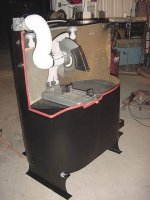
I would say the short wire is just allowing it to dump that much more current at an instant, motors of this type can be problematic on these types of circuits, my chop saw does it. I wire a dedicated circuit and put in a 30, make sure other stuff cant be used on this circuit, this is done all the time. This bench has 2 cords go to it, one just for the saw and the other for lights and general plugs connected to circuit with proper breaker of 20.
 

Attachments

  • 338.JPG
    338.JPG
    36.8 KB · Views: 22
  • 337.JPG
    337.JPG
    40 KB · Views: 18
Last edited:

Alchymist

Well-known member
Joined
Mar 1, 2009
Messages
4,423
Location
Central PA
Complete reset:

1) Measure current AND Voltage at both the working and non working outlets.
(Both no load and running).

2) Make sure you measure the voltage (at the circuit that has the breaker that pops) as you turn the compressor on (or plug it in to start it).

3) Post the readings here.
 
OP
P

pipsters

Well-known member
Joined
Sep 1, 2010
Messages
4,899
Location
USA
pipsters,
I read what you wrote, and the comp. has done it since new.
The start capacitor is out of tolerance (it tells the motor which way to turn) and is out of the circuit by centrifugal weights when up to a certain speed.
The closer you are to the panel, the less "cushion" (slight voltage/current drop). I will catch hell for this, but think like a spring, the closer you are the harder it "hits" the breaker on start.
If you're pulling proper amps while running, replace the cap.
Cheap route, put a longer cord on it.
Chuck

for the thread jumpers
Read the original post,
"It's done it since new (2.5 years now), and hasn't gotten better or worse. "

OK this is good info. When I get home I'm going to take some shots of the compressor, are these things fairly easy to replace? Expense wise? I looked on Grainger and they are running around $10-$15, seems fairly easy. Looks like there are two of them on the top?

Looks like this:

00916475000
 

larry_g

Well-known member
Joined
Apr 28, 2007
Messages
16,888
Location
oregon
I have one of those same compressors and it runs at ~19A full load. I have also experienced the same symptoms you describe, tho not to the extent you have. I really notice it on a cold startup like if the compressor has been sitting for days and it's >40f. When I had an electrician out he mentioned that you could legally install a larger breaker to handle the load as SBERRY said. I also think that the word some are trying to come up with on the longer wire runs is 'inductance'. Inductance in the wire will also dampen out the inrush current.

lg
no neat sig line
 

kythri

Well-known member
Joined
Jan 3, 2007
Messages
6,330
Location
Lebanon, OR
I had similar issues occasionally with my smaller compressor (30 gallon model). I ran a dedicated 30A circuit for it, zero issues (used 10/3 wire instead of the 12/2 on the original outlet/circuit).

Of course, that's wired into a 5-20R outlet, since the plug type is different for a 5-30R. I'm not horrible worried about it, because it's just the initial surge when it kicks on that was popping the breaker.

Dunno how legit that is, but I know that I've seen similar setups (5-20R outlet on a 30A breaker) in commercial locations...
 

sberry

Banned
Joined
Jun 18, 2005
Messages
35,747
Location
Brethren, Michigan
The 12 wire and the outlet will be fine, it just needs a heavier breaker for starts, you are not the first with this problem and won't be the last. Its just the nature of the machine, you can fool with it till you are blue and then some and have the same problem. Code issues usually limit this kind of a set up to a single outlet on this kind of circuit so someone cannot come along and plug other devices in that were designed for a max of 20A over current protection, as you can see in the pic I didn't have a single outlet so put a ********* tape over the other side of the duplex, while this doesn't follow the letter of the code to a T it follows the intent, single outlet on dedicated circuit. As I recall,, and this is only memory so take it with a grain of salt they actually don't want an increase in wire size in this situation. Some small 120V wire feeds need this on occasion, you can easily run above 20A on occasion.
 

gorilla

Well-known member
Joined
Dec 13, 2007
Messages
1,653
Can you rewire your compressor motor to run on 220 volts? this will cut your current draw in half. In industrial applications motors are often set up with slow blow fuses to allow for inrush current You could run a 30 amp breaker to a fused outlet with a 20 amp slow blow fuse to protect your compressor. If you install a 30 amp breaker you should use 10 gauge wire.
 

TheGrooveking

Well-known member
Joined
Dec 30, 2007
Messages
3,233
Location
An alternate reality in a parallel universe.
Another fact, not all 12 ga. wire can carry 20 amps, of course distance is a factor too, refer to NEC on this. If it is like the other user mentioned running at 19 amps, then that is to close to the 20 amp rating of the breaker. IF it is I'd recommend 10 ga. wire and a 30 amp breaker. What is the total amperage capacity of your sub-panel? Same question for your main panel? What else may be on when this compressor it trying to run? I've seen guys run a 60 amp sub panel off of a 60 or 100 amp panel in their homes and have issue when trying to run the furnace, washer & dryer, all of the lights and other appliances while trying to arc weld, again this will result in voltage drop.

TheGrooveking
 
To avoid these ads, REGISTER NOW!
Top Bottom