To avoid these ads, REGISTER NOW!

120v 1.8hp trips CB close to panel, but not further away, electrical q's

OP
P

pipsters

Well-known member
Joined
Sep 1, 2010
Messages
4,899
Location
USA
Another fact, not all 12 ga. wire can carry 20 amps, of course distance is a factor too, refer to NEC on this. If it is like the other user mentioned running at 19 amps, then that is to close to the 20 amp rating of the breaker. IF it is I'd recommend 10 ga. wire and a 30 amp breaker. What is the total amperage capacity of your sub-panel? Same question for your main panel? What else may be on when this compressor it trying to run? I've seen guys run a 60 amp sub panel off of a 60 or 100 amp panel in their homes and have issue when trying to run the furnace, washer & dryer, all of the lights and other appliances while trying to arc weld, again this will result in voltage drop.

TheGrooveking

The problem is too much power not "not enough".
 
To avoid these ads, REGISTER NOW!

Alchymist

Well-known member
Joined
Mar 1, 2009
Messages
4,423
Location
Central PA
Complete reset:

1) Measure current AND Voltage at both the working and non working outlets.
(Both no load and running).

2) Make sure you measure the voltage (at the circuit that has the breaker that pops) as you turn the compressor on (or plug it in to start it).

3) Post the readings here.

I don't understand the reluctance to actually measure anything instead of groping in the dark with all kinds of "possibilities. A few simple measurements could resolve this easily.:headscrat
 
OP
P

pipsters

Well-known member
Joined
Sep 1, 2010
Messages
4,899
Location
USA
I don't understand the reluctance to actually measure anything instead of groping in the dark with all kinds of "possibilities. A few simple measurements could resolve this easily.:headscrat

I'll be honest I'm not sure how to measure those. That being said, the possibility that 3 outlets are out of tolerance but 2, further away, are not, strikes me as unlikely.

I only have a cheap (free) Harbor Freight multi meter, is that able to measure the things you mention? I do know how to measure the voltage at the outlet but not sure how to do it while the compressor is running, and not sure how to measure the amps.
 

Alchymist

Well-known member
Joined
Mar 1, 2009
Messages
4,423
Location
Central PA
I'll be honest I'm not sure how to measure those. That being said, the possibility that 3 outlets are out of tolerance but 2, further away, are not, strikes me as unlikely.

I only have a cheap (free) Harbor Freight multi meter, is that able to measure the things you mention? I do know how to measure the voltage at the outlet but not sure how to do it while the compressor is running, and not sure how to measure the amps.

Yeah, without the tools or the process, it's difficult. Was only pointing out that knowing the parameters at each socket would make diagnosing easy. If you knew the starting and running currents as well as the voltages at those readings, it becomes a simple matter to determine problem. Like anything else, having all the info makes life a lot easier.
 
OP
P

pipsters

Well-known member
Joined
Sep 1, 2010
Messages
4,899
Location
USA
Its also hard to help some people, they going to complicate it. For several reasons it is a common problem.

Your solution of putting a 30 amp breaker on a 20 amp circuit isn't what I would call "help" IMO. Yes, it would probably stop the issue from happening but that is like borrowing more money when the problem is spending too much.
 

sberry

Banned
Joined
Jun 18, 2005
Messages
35,747
Location
Brethren, Michigan
The only reason I hit my head with a brick here is that it is so common the NEC allows an exception for it. These units are designed up to the legal nema maximum to run on this legal circuit, a 20A. In a perfect world with every part hand polished and fine tuned it might be fine, or often these are used with cords or long circuits, etc where the user never knows. This unit in question has done this since new and seems to work in every other way, it has one issue, on starts, hence the allowance for breaker changes.
With this circuit and a 30 it will not overheat a 12 wire, the motor has its own thermal to protect it under run and is sized where it will not draw enough for this to occur, similar to hooking a 100 watt lamp on a 16 fixture wire to a 20A circuit. (some cases may allow up to 40A breaker on a 12) but no one thinks this is a great idea and isn't needed, no point in going more than necessary. In this type of circuit the breaker does not really protect the wire as it would in a general use circuit with several outlets where plugging in multiple appliances could overload and overheat the wire, its there to protect against short circuits.
Wouldn't surprise me this comp has a 14 cord, no matter what it wont overheat the 12 wire, all a larger wire will do is deliver a bit more current again during start adding back to the problem. You might reman this comp, tune every little part, change cap, clean check valve, etc, next week, some little glitch throws it out again. If a guy puts in a 30 and has same problem then,,,, there is reason to look more careful.
 
OP
P

pipsters

Well-known member
Joined
Sep 1, 2010
Messages
4,899
Location
USA
sberry I understand the logic you are using in selecting the 30 amp. Would it cause a problem? No I doubt it. I completely 100% agree with you. I understand that the compressor motor itself, being the only thing running on that circuit, will shut itself off before overloading the breaker.

But it's like everyone (besides a few) are ignoring what I am writing. The compressor works fine on other 15 amp circuits further away from the panel. Only the 15 amp and 20 amp circuits within several feet (there are 3 different circuits) of the CB panel trip the compressor. The problem lies not with the breaker, the wiring, the CB panel, or the outlet. The problem lies with the compressor motor itself.

If I can't sort it out, I will just add a 10' or 25' 12 gauge extension cord on the compressor. Simple and easy with no worries about code or insurance.
 

sberry

Banned
Joined
Jun 18, 2005
Messages
35,747
Location
Brethren, Michigan
The problem lies with the compressor motor itself.
The problem lies not with the breaker, the wiring, the CB panel, or the outlet.
I will agree The the problem is with the motor AND the comp. As for the circuit, yes and no, basically the circuit is fundamentally correct just cant handle the start.
If I can't sort it out, I will just add a 10' or 25' 12 gauge extension cord on the compressor. Simple and easy with no worries about code or insurance.
Now as for all this,,, the change IS an acceptable code legal and insurance legal solution. A cord might work, might not, might be back to the same thing and is kind of a cobble job. While its probably not an issue adding a couple more connectors in a hi draw circuit is never an asset. Hard to beat appliance to plug for safety.
 

sberry

Banned
Joined
Jun 18, 2005
Messages
35,747
Location
Brethren, Michigan
The the problem is with the motor AND the comp.
The issue isnt just the motor, take the belt off and no issue, its a combination of the motor and the applied load, I really doubt the cause of all this IS the motor, more likely check valve or unloader, etc.
 

sberry

Banned
Joined
Jun 18, 2005
Messages
35,747
Location
Brethren, Michigan
There are 2 basic reasons they make Cb's above 20A for 120V, one is specialized light circuits and the other is motor start circuits.
 
OP
P

pipsters

Well-known member
Joined
Sep 1, 2010
Messages
4,899
Location
USA
The issue isnt just the motor, take the belt off and no issue, its a combination of the motor and the applied load, I really doubt the cause of all this IS the motor, more likely check valve or unloader, etc.

So why does it work flawlessly on a 15 amp circuit far away but not close by the CB panel? Logically you are not making sense.

Sure more load is placed on a compressor that is hooked up to the motor, but I am not running the motor by itself plugged in at the back of my house. If what you say was the issue then it would be popping MORE on the 15 amp circuit far away from the CB panel.
 

sberry

Banned
Joined
Jun 18, 2005
Messages
35,747
Location
Brethren, Michigan
An engineer or real electrician could likely explain the dynamics but most likely the distance and smaller wire adds some reluctance (if thats what its called) to the circuit, just like a smaller long garden hose, open it up quickly and while the pressure does drop the resistance of the hose also slows down the delivery of the water, takes longer to fill the bucket and doesn't drop the pressure at the hydrant as far, put big short hose on, dumps way more water, pressure at the hydrant or main falls farther.
 

sberry

Banned
Joined
Jun 18, 2005
Messages
35,747
Location
Brethren, Michigan
Same reason a ground wire needs to be up sized, etc, needs to be able to deliver the current in a hurry for trip speed. Too small, trips too slow. There could be small difference in individual breakers too I spose, especially with ones that have been subjected to repeated trips.
 
Last edited:

Charles (in GA)

Well-known member
Joined
Jan 11, 2006
Messages
12,489
Location
50 mi south of Atlanta
If the outlets are duplex type, just stick the meter probes in the other receptacle to measure the voltage. It will be the same as the compressor is seeing, you can see the drop when it starts up (best to use an analog meter with a needle meter movement to see what is happening)

Another item you can use is a line current splitter or separator, Home Depot or Lowes carries them, cannot find them on the web site, because I don't know exactly what they call them, and their search engine isn't the best. Here is a pic from Grainger.

Three-Wire-AC-Line-Separator-3ZH94_AS01.JPG


You plug this in, and plug the compressor into the other end of it. It has holes for test lead probes to measure voltage, and you can use a clamp on amp meter on the x1 or x10 part of it to measure amps going into the compressor.

A good clamp on amp meter is not all that expensive, and they double as a multimeter too as they have test leads and measure volts, amps, etc. Get one that measures DC current also (more expensive and harder to find) and you will have something you can use on your cars and such, testing alternator output, starter draw, and so forth.

You can also cheat and simply split open a cord and pull out the individual wires to get the clamp on amp meter over them. I've done this with the flat molded dryer cords, used a razor to split the cord between the wires and spread it to measure current.

Charles
 
OP
P

pipsters

Well-known member
Joined
Sep 1, 2010
Messages
4,899
Location
USA
An engineer or real electrician could likely explain the dynamics but most likely the distance and smaller wire adds some reluctance (if thats what its called) to the circuit, just like a smaller long garden hose, open it up quickly and while the pressure does drop the resistance of the hose also slows down the delivery of the water, takes longer to fill the bucket and doesn't drop the pressure at the hydrant as far, put big short hose on, dumps way more water, pressure at the hydrant or main falls farther.

Exactly...this is what I was trying to get across. Seems to me, logically, the start capacitor is the piece of equipment that would deal with this, is it not?
 

sberry

Banned
Joined
Jun 18, 2005
Messages
35,747
Location
Brethren, Michigan
It is but like I said before, these are built on a fine line to meet standards which they can slide under, would take way more effort than its worth. I will agree that an am probe is well worth having but again, if it tripped a 30 I would start worrying. They are built to slide into a certain class, if they used anymore power they would need to up size all the components, wire sizes, all of it. Like the 210 compact welders, 23.8 A or something, slides under a class by .2A.
As for a solution I can pretty much say this, there are several masters on this forum, a couple real code experts and they would be all over this like flies on **** if I recommend something that stray far from codes and common practice, they live for it and ain't gonna cut me much slack.
 
OP
P

pipsters

Well-known member
Joined
Sep 1, 2010
Messages
4,899
Location
USA
OK I was thinking replacing the start capacitor was an easy thing, I guess it's not? I haven't looked it up. I was hoping it was plug and play haha. If not I'm going with the extension cord.
 

MBfreak

MEMBER EMERITUS
Joined
Dec 10, 2010
Messages
2,301
Location
Linkoping , Sweden
Pipster.
Let me see if I got you right:
From a CB you have an outlet quite close. When you try to run the compressor off of this outlet, you trip the CB most of the time when starting.

You then use the same CB but plug in the compressor at the end of a substantially longer cable feed. Compressor starts OK every time and runs OK.

And this is quite logical. The longer feed cable will add impedance ( Z= sqrt( xl*xl+r*r) into the circuit which will reduce the starting surge from the compressor motor.
And it does not take much impedance to soften the peak.

The starting current of your 110 V , 1,2 kW compressor motor may be as high as 60 Amps ( sorry, do not know what type of motor it is, can vary widely) for a very short period, but enough to trip the breaker.

A longer feeder cable introduces enough impdance ( most of which comes from the r part in typical house wiring sizes) to reduce the peak below tripping limit.
I am totally ignorant when it comes to the inverse time overcurrent characteristics for US type MCB´s, and also most other aspects like wire sizes ( AWG´s , circ mil etc) but here goes anyway:
The solution if you want to run the compressor on the close outlet is to get another MCB which allows a higher/longer initial peak while retaining the 1 s RMS value which is important for the thermal protection of the house wiring.

In Europe we have MCBs with A, B, C and Z characteristics to cater for this type of situation.
We also have 3 phase 400/230 V which removes a lot of headaches :D

Best regards

Ola
 

hofferwood

Well-known member
Joined
May 8, 2010
Messages
922
Location
DownRiver Michigan
Pipster.
Let me see if I got you right:
From a CB you have an outlet quite close. When you try to run the compressor off of this outlet, you trip the CB most of the time when starting.

You then use the same CB but plug in the compressor at the end of a substantially longer cable feed. Compressor starts OK every time and runs OK.

And this is quite logical. The longer feed cable will add impedance ( Z= sqrt( xl*xl+r*r) into the circuit which will reduce the starting surge from the compressor motor.
And it does not take much impedance to soften the peak.

The starting current of your 110 V , 1,2 kW compressor motor may be as high as 60 Amps ( sorry, do not know what type of motor it is, can vary widely) for a very short period, but enough to trip the breaker.

A longer feeder cable introduces enough impdance ( most of which comes from the r part in typical house wiring sizes) to reduce the peak below tripping limit.

Best regards

Ola

Thanks MB,
The "spring" I referred to. ^^^^^^^^^^^^^
The start cap will have a higher MFD(above 70mfd) and usually a lower voltage than the "Run" cap.
I suggest take the covers off the caps and check the numbers (MFD and Voltage) of each.
My problem is you said it has done it since it was "new" (no way it could have been assembled wrong at the factory). With 2 run(below 70mfd) caps:dunno:

Report back:lol_hitti:lol_hitti
 
To avoid these ads, REGISTER NOW!

Provincial

Well-known member
Joined
Sep 21, 2011
Messages
6,872
Location
Near Salem, OR
Are any of the breakers involved GFCI's? GFCI breakers (or outlets) are required in garages. If it trips on the GFCI, substitute a regular 20A breaker to test.

It it is a consumer-grade panel, you may be limited in your breaker choices, but some panels will accept industrial-grade breakers and you may be able to find a motor-rated breaker that will fit that has a longer and higher current limit for motor starting surges. Some industrial type breakers have an adjustment screw on the breaker for setting this delay.
 

MrMark

Well-known member
Joined
Jan 25, 2010
Messages
4,626
Location
Southern Cal.
sberry is right. The NEC allows you to go up to 250 percent (and more in certain cases) of normal ampacity on motor circuits to deal with nuisance tripping due to high inrush current. Have you ever looked at the breakers at Home Depot and wondered what the 30 amp 120V breaker was for? It is mainly for motor circuits. The motor's thermal protection protects the wires and short circuit protection is always available via the magnetic response trip portion the the breaker curve.

According to this Square D 20 amp breaker trip curve, you must be pulling more than 6 times rated current or 120 amps at startup to trip instantaneously. In other words you are into the short circuit instantaneous response portion of the trip curve. This response portion is handled not be the thermal bimetalic strip in the breaker but by a separate magnetic solenoid that instantly opens the circuit when current exceeds 6 times rating for this particular breaker.

That inrush seems somewhat high but not out of this world.

http://static.schneider-electric.us...it Breakers/QO-QOB Circuit Breakers/730-3.pdf

Since it has done it since new I would put the 30 on it if it were mine.
 

MrMark

Well-known member
Joined
Jan 25, 2010
Messages
4,626
Location
Southern Cal.
That's a great explanation by MBFreak of WHY the cord is damping your inrush current. You could simply look at it as the cord is choking the current flow as a resistor and knocking down the inrush to below the instantaneous trip point. Cobbling a system with an extension cord is NOT the way to go. You will be limiting the current to your machine and obviously causing some voltage drop. Use the 30 amp breaker and if that trips then you need to investigate further.
 

porcupine73

Well-known member
Joined
Jan 22, 2008
Messages
576
Location
Buffalo, NY USA
A 20A T-M breaker might not allow much more short term or instantaneous current draw than a 15A T-M breaker. Most of the big manufacturers you can get the curves on their web site.
 

MBfreak

MEMBER EMERITUS
Joined
Dec 10, 2010
Messages
2,301
Location
Linkoping , Sweden
Hi again.
Sorry to go too electrical on yáll, but:eyecrazy:
The inrush current peak has a high frequency content, much above 60 Hz. And in the strange world of electrcal calculations this high frequency content is reduced a lot by the inductive reactance ( which is increasing at a higher frequency (Xl = 2*pi*L*f)) of a longer cable run. Once the fundamental frequency is the major part ( ie after the inrush) the r of the conductor is the main source of conductor voltage drop for "household wire sizes"

So , the actual running of the motor is not much affected by the longer cable, but the amplitude of the inrush current is!.

Ola
 

sberry

Banned
Joined
Jun 18, 2005
Messages
35,747
Location
Brethren, Michigan
Ya,,, what he said,,, hahaha
Ok, dampening effect was the phrase I was looking for. Its been a while since I read all this but its a reason why I suggest it might not be a good idea to up the wire size, just the breaker.
 
Last edited:

kythri

Well-known member
Joined
Jan 3, 2007
Messages
6,330
Location
Lebanon, OR
OK I was thinking replacing the start capacitor was an easy thing, I guess it's not? I haven't looked it up. I was hoping it was plug and play haha. If not I'm going with the extension cord.

Gotta say, man, you can't get much more plug-and-play than a breaker swap on a 120V service. Incredibly simple, incredibly quick, and the breakers don't really cost that much.
 

ndoran

Well-known member
Joined
Jun 23, 2011
Messages
496
BFREAK is correct the problem is inrush current. Adding additional cable introduces additional resistance which damps the resonant frequeny of the reactive circuit impedance of the motor winddings and the start capacitor. The reason the inrush current can be so high is when the compressor is turned on there is no magnetic field in the motor and it is basically a small resistor in parallel with the start cap. As the magnetic field builds the impedance of the motor winding increases which reduces the current, unfortunately this takes a number of periods of the 60Hz waveform and depending on the damping can result in some very high transient currents. Performing a step response analysis of the circuit will provide the time domain transient response, mapping this into the frequency domain using a a half sided fourier transform provides the harmonic frequency content. It will contain a high od order harmonic content which you will never measure with a standard meter. this also gives you the phase relationship between the current and voltage - this is a reactive circuit so they are not in phase. This is also important because a normal meter will under read the current if there is any significant phase difference which is quite probable on a residential compressor.

The solutions include: the use of a soft start circuit to limit the current at start up, the use of a breaker intended for inductive loads with the appropriate time/current response - a challange because you probably do not have the motor and capacitor details to allow this analysis to be performed. Another possibility is there is a short between two windings inside the motor, if the short is close to one end of the winding it will reduce the number of turns, reducing the inductance, increasing the steady state and transient current but can still provide enough magnetic field for the motor to run admitedly with reduced torque and higher temp. The clue being it pops the breaker and you may see some sparking inside the motor. This can and does happen on new motors.
 

porcupine73

Well-known member
Joined
Jan 22, 2008
Messages
576
Location
Buffalo, NY USA
Soft starters can help. Usually it's best if the equipment is doing an unloaded start. Otherwise sometimes the motor doesn't have enough torque to get up to speed.
 
OP
P

pipsters

Well-known member
Joined
Sep 1, 2010
Messages
4,899
Location
USA
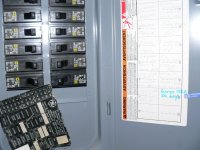
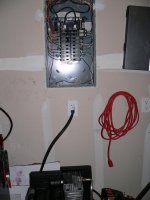
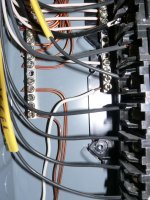
Finally got back home, here are some pictures.

Please go easy it was my first ever wiring job.

The breaker for the dedicated 20 amp GFCI outlet that the compressor is plugged into is on the bottom right, slot #18. I used 12 gauge wire, shrouded in yellow.
 

Attachments

  • P1040657.jpg
    P1040657.jpg
    137.6 KB · Views: 21
  • P1040656.jpg
    P1040656.jpg
    143.6 KB · Views: 23
  • P1040658.jpg
    P1040658.jpg
    139.3 KB · Views: 28
  • P1040659.jpg
    P1040659.jpg
    142.1 KB · Views: 20

Outlawmws

Well-known member
Joined
Aug 9, 2011
Messages
39,281
Location
The Badlands
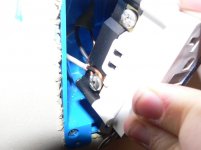
Can you show a better close up of the open panel, and can you verify that on the receptacle, the black wire is on the brass screw, and the white is on the silver screw? (It matters)
 

Alchymist

Well-known member
Joined
Mar 1, 2009
Messages
4,423
Location
Central PA
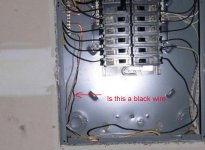
Can't tell for sure but in the 3rd picture it looks like there is a black wire on the ground bar on the left side of the box?
 

Attachments

  • BLKWIRE.JPG
    BLKWIRE.JPG
    52.1 KB · Views: 30
Last edited:
OP
P

pipsters

Well-known member
Joined
Sep 1, 2010
Messages
4,899
Location
USA
OK here are some more I tried to trace as needed. I did put the neutral on the opposite side but only for ease of access, I wouldn't think it should matter. Especially not when all three DIFFERENT circuits are doing the same thing.
 

Attachments

  • P1040667.jpg
    P1040667.jpg
    138 KB · Views: 14
  • P1040666.jpg
    P1040666.jpg
    144 KB · Views: 20
  • P1040665.jpg
    P1040665.jpg
    122.9 KB · Views: 14
  • P1040664.jpg
    P1040664.jpg
    124.1 KB · Views: 14
  • P1040663.jpg
    P1040663.jpg
    138 KB · Views: 16
  • P1040668.jpg
    P1040668.jpg
    142.2 KB · Views: 16
OP
P

pipsters

Well-known member
Joined
Sep 1, 2010
Messages
4,899
Location
USA
Also what's up with CB-16, second up from the bottom on the right, looks like only the black wire coming out of the sheath?

I dunno they kept it in the white protective cover until close to the end where it just came out. I wouldn't think that is an issue though, do you?
 

sberry

Banned
Joined
Jun 18, 2005
Messages
35,747
Location
Brethren, Michigan
Just personnel preference but would toss the gfci for the comp and put in a common recept if I modified this circuit. Plug the other half of the duplex or get a single outlet recept.
 
OP
P

pipsters

Well-known member
Joined
Sep 1, 2010
Messages
4,899
Location
USA
I was thinking that per code doesn't garage units have to be GFCI? I dunno. Thought it was a good safe way to go too. That part isn't tripping though.

Can I swap in a 30 amp 120v breaker without changing anything else or do I need to replace the wiring (currently 12g), recep, and buy a different plug (30 amp) to match up to my compressor? I didn't think you could put 30 amp breakers on 20 amp wiring/recep circuits, although you mentioned that I could do it under certain situations. I'm in NC, no idea how to look up local elec laws.
 

Gary S

Well-known member
Joined
Dec 27, 2008
Messages
2,972
Location
Bismarck, ND
:headscrat Try a 30 amp breaker lol. It's what I would do.


That's as backwards as you can get. Instead of installing a 30 amp breaker, you keep the 20 amp breaker and install #10 wire to replace the #12.

My small compressor would trip the 20amp breaker in cold weather occasionally. I replaced the #12 wire with #10 wire, keeping the 20amp breaker. Then I changed the compressor oil to synthetic. It hasn't tripped the breaker again for over 10 years.
 

sberry

Banned
Joined
Jun 18, 2005
Messages
35,747
Location
Brethren, Michigan
Leave the 12 wire a common recept is fine. Now that you made this a dedicated circuit gfci is no big deal, this is a grounded piece of equipment you are plugging in to and this recept is not available for general use. Write on the cover plate,,,, air comp only! GFCI certainly isn't going to hurt anything, just kind of expensive recept and down the line could be problematic, if it makes you feel all warm and fuzzy leave it. I have circuits for special use I have wired without it where they are used for dedicated grounded equipment.
 
OP
P

pipsters

Well-known member
Joined
Sep 1, 2010
Messages
4,899
Location
USA
Putting a 30 amp breaker on there just goes against everything I have read though in regards to using 12 gauge wire and a 20 amp receptacle. Do we have any citations that allow for this so I can feel better about doing it?

Again, I don't want to burn my house down and if something does ever happen I don't want it to ever get denied...this garage is in my house not separate, with a wife and dog inside...

If it's OK I will just keep the 20 amp breaker and when it comes time to sell I'll put it back in so no "questions" come up.
 
Last edited:
To avoid these ads, REGISTER NOW!
Top Bottom