To avoid these ads, REGISTER NOW!

Melted outlet (pics)

Need4racin

Banned
Joined
Oct 22, 2008
Messages
1,320
Location
SE Georgia / Dallas TX
outlet015.jpg


outlet009.jpg


Something happened when the previous owner had this house. A couple of the outlets have smoke stains on the wall in the master bedroom. But when I take the cover off those outlets stil look fine. This is the only outlet that is melted.

I'm wondering crappy outlet or chinese drywall? I see some rust, but then again it could be from the melting action. outlet/house is from 2005.
 
Last edited:
To avoid these ads, REGISTER NOW!

Charles (in GA)

Well-known member
Joined
Jan 11, 2006
Messages
12,489
Location
50 mi south of Atlanta
From the wires I see, that receptacle is in the middle of a circuit. Two black wires, power in, power out to the next receptacle. Probably the same on the other side with the white wires.

This is common in houses and I hate it, puts a heavy load on receptacles that in some cases, don't even have anything plugged into them.

I also suspect those are cheap receptacles. Personally I'd replace them with good commercial quality receptacles that accept backwiring and the wire is pinched/secured by the side screws. I would replace every receptacle in the house.

Charles
 

Gooch

Well-known member
Joined
May 30, 2009
Messages
676
Location
Petersberg, IA
outlet015.jpg


outlet009.jpg


Something happened when the previous owner had this house. A couple of the outlets have smoke stains on the wall in the master bedroom. But when I take the cover off those outlets stil look fine. This is the only outlet that is melted. ''

I'm wondering crappy outlet or chinese drywall? I see some rust, but then again it could be from the melting action. Oh outlet is and house is from 2005.


thats why you don't feed through receptacles, possible loose screw. it is a cheap receptacle, but all residential grade receptacles are.
 

Docholiday

Well-known member
Joined
May 14, 2012
Messages
72
Just a typical example of an outlet install an the installer failed to make sure the terminal screws were very tight. Outlets thoughout should be checked to make sure ALL terminations r tight! It is possible the outlet just failed
 

PRH44

Well-known member
Joined
Dec 25, 2009
Messages
563
Location
Indiana
Feed through on a device is risky business. If the device is cheap its even worse. Put a large load down stream and you get what the OP has.
Always use a quality device as performance is what you seek.
One thing that most overlook is under or over torque on the set screw.
under torque you get arcing because of a loose connection.
Over torque and the screw strips and comes loose, or you actually crack the chassis on the device.
Another issue is many times the box is too shallow. Then coupled with solid wire improperly folded then crammed back into the box breaking the cheap device or loosening the connections.
 

superdel

Active member
Joined
May 3, 2012
Messages
38
Looks like heat damage from the connection being loose. When the connection is not tight, it acts as a resistor instead of a single point of wire. When you carry current through this "resistor", it creates heat. Replace the receptacle in question, and if you have to wire it the same way, make sure the connections are snug and correct.
 

bassman

Well-known member
Joined
Feb 13, 2005
Messages
198
Location
florida
If you look closely, you can see one wire is rapped around the screw the wrong way, and the other has the insulation under the screw, obviously an amature installtion. They were loose, that's all. But do cut each wire back enough so you have a nice unheat damaged copper, you know, not discolored, if it's too short to reach the outlet, just put a pigtail on it to reach the outlet
 

ddawg16

Well-known member
Joined
Jul 11, 2008
Messages
21,005
Location
S. California
The good news is that you caught it before it became a bigger issue.

As the guys noted above, using an outlet at the 'go between' device when it's a cheap one can cause problems.....as you have found out.

I prefer to use a pig tail at all boxes.

Instead of using the outlet as the 'bridging' connection, I take the In and Out wires...then add a pigtail about 6" long to the bundle and wire nut that together...you end up with 3 wires on the wirenut.....take the mess and stuff it into the back of the box with the pigtail sticking out. Now you have only the 3 wires to hook up to the outlet....it's a lot easier to move the outlet and you have a more solid connection on your bridging connection.
 

bassman

Well-known member
Joined
Feb 13, 2005
Messages
198
Location
florida
That's another way to do it, myself, I would. Just connect to the outlet, unless it's a multiwire branch circuit, running neutral through device like that is a violation. But keep in mind, a guy that can't properly connect wires to an outlet surely won't be able to make a good spice.lol I know the poster didn't do that, just rambling
 

Kevin C

Well-known member
Joined
Aug 4, 2011
Messages
1,653
Location
Portland OR
The one thing I dont like with using a wire nut to make the splice / jump connection in a box is that with 12 gauge, the box ends up a bit over packed.

The other problem with screw lug type connections is that as you put the socket in and compress the wire, the wire is restrained by the lug. The wire can / will put a torque on the screw as it gets compressed. When the wire is wrapped the wrong way, the force of compressing the wires in the box tries to loosen the screw.

Even terminals that are wrapped the correct way can have this happen, depending on how the wires are dressed as you push the socket in.

As someone else suggested using the back wire clamping type sockets. That's my preference as well. I dont see any issue bridging a circuit through those. Especially if you use the type that can clamp two wires under one screw.

I noticed that those types of sockets are harder to find in the newer child proof versions. The only ones I found at the big box that was child proof and used back wire clamps were the weather resistant rated sockets. If I remember right, they are about six dollars each.

The non child proof heavy duty back clamp sockets were a lot more reasonable.
 
Last edited:

PRH44

Well-known member
Joined
Dec 25, 2009
Messages
563
Location
Indiana
I agree with Kevin C Back wire with a pressure plate is the best way to make a connection IMO. Any set screw that twist on the conductor is not the best situation. However UL allows this practice and it is popular.
When preparing to rough in a receptacle one needs to size the box appropriately. If you plan to pig tail then you need to consider this when choosing a box. A 3" x 2" x 2.5" box just makes the cut for in and out and one device according to NEC 314.14(16). The code does not recognize pigtails as box fill according to 314.16(B)(1). so they are not counted :dunno:. However an unbroken length looped through a box longer tha 6" shall be counted as 2 conductors.This is a flaw IMO because a pigtail takes considerable space as much if not more than a loop. I always allow for this because you need it. Remember the NEC is a minimum requirement. 3.5" deep boxes are my choice anytime I can.
The OP has an existing box not sure how deep it is, but using a Quality back wired device and feed through should allow for easy install of the device. Pig tailing in a shallow box could make matters worse.
When we say back wire this is a clamping style with a set screw. Not a "quick stab" tension style that is always a bad idea.
 

FunkyfullWidth

Well-known member
Joined
Oct 3, 2011
Messages
1,238
Location
Three Rivers, ma
The other problem with screw lug type connections is that as you put the socket in and compress the wire, the wire is restrained by the lug. The wire can / will put a torque on the screw as it gets compressed. When the wire in wrapped the wrong way, the force of compressing the wires in the box tries to loosen the screw.

Just to clarify. What is proper direction to wrap a wire. I'm on the automotive end of things and i'm used to strand wires. When tightening a connection I wrap the wire around so that when i'm tightening the screw i'm not pushing back on the wires. In other words wrap the wire in the direction of tightening the screw.

Would the opposite be true for a solid wire in a box so that when you put tension on the wire it goes in the direction of tightening the screw instead of loosening it?
 

FunkyfullWidth

Well-known member
Joined
Oct 3, 2011
Messages
1,238
Location
Three Rivers, ma
That's what I thought. But heard mention of tension on the wires wanting to loosen the screw. Basically if there's tension on the wire when installing the box then somethings wrong anyway?
 

GirlnAgarage

Well-known member
Joined
Jan 21, 2011
Messages
4,669
Location
Texas
That's what I thought. But heard mention of tension on the wires wanting to loosen the screw. Basically if there's tension on the wire when installing the box then somethings wrong anyway?


It would seem so. If there's plenty of slack available, the tension seems like it would be a matter of how the wires were folded and pushed back into the box.
 

torqueman2002

Well-known member
Joined
Jun 3, 2009
Messages
6,144
Location
SE Michigan
I have used an Ideal brand SureTest Branch Circuit Analyzer ST-1D to load test circuits on new and old work since 1998.

Ideal has updated their line of circuit analyzers.

If I were to buy again, and I'm starting to think I should update; I'd get one that tests for Arc Faults.

61-165.jpg

Model: 61-165
Features

Arc Fault Tester
Tests AFCIs for proper operation
Tests for shared neutrals
High accuracies
Measures voltage drop under full load (12A, 15A, 20A load tests)
True RMS
Line Voltage
Peak Voltage
Frequency
Ground to neutral voltage
Ground Impedance
Hot and neutral conductor impedances
Identifies proper wiring in 3-wire receptacles
Identifies false (bootleg) grounds
Tests GFCIs and EPDs for proper operation
Conducts testing without disturbing sensitive loads
Verified isolated grounds (with 61-176 adapter)
 

tribbles

Well-known member
Joined
Apr 23, 2012
Messages
290
Location
Las Cruces, NM
I kept that picture in mind while I was wiring up some additional receptacles on a 15A branch last Sunday. Come to find out that the receptacle I was going to tie into was a 20A unit with the ceiling lights wired through it, so the box got a pigtailed 15A outlet in its place. Makes me wonder what other surprises this place has.
 
To avoid these ads, REGISTER NOW!

Speedy Petey

Well-known member
Joined
Apr 22, 2012
Messages
1,430
Location
NY State
I kept that picture in mind while I was wiring up some additional receptacles on a 15A branch last Sunday. Come to find out that the receptacle I was going to tie into was a 20A unit with the ceiling lights wired through it, so the box got a pigtailed 15A outlet in its place. Makes me wonder what other surprises this place has.
15A duplex receptacles ARE 20A feed-thru rated.

What most people forget, or don't know, is that a 15A duplex receptacle is TWO 15A receptacles on one device yoke. So the 20A feed-thru is logical.
 

PRH44

Well-known member
Joined
Dec 25, 2009
Messages
563
Location
Indiana
20 amp receptacles on a 15 amp circuit is a NO. However more than one 15 amp receptacle on a 20 amp circuit is fine.

Speedy is correct as long as the device you are using has a UL listing for 20 amp feed through.
 

rburke65

Well-known member
Joined
Nov 10, 2007
Messages
12,349
Location
Canfield, Ohio
If you are attaching stranded wire to a screw type terminal, try this: first twist the wire strands in a CCW direction, then install the wire in a CW direction, as normal, under the screw. The strands will be pulled in and under the screw head and you will have no splaying of the stranded wire ends. A tip from an old electrician!
 
Last edited:

MrMark

Well-known member
Joined
Jan 25, 2010
Messages
4,626
Location
Southern Cal.
Please enlighten us non-pro's as to how the pro installs stranded under the side screw terminals, something the pro should know better than to do in the first place.
 
Last edited:

PRH44

Well-known member
Joined
Dec 25, 2009
Messages
563
Location
Indiana
Only with a Sta-kon. would I put stranded wire under a post binding screw on anything. If you look at the UL listing on some devices they are not rated for stranded.

Some devices will be marked Str. /Sol meaning both. But some have no markings at all. According to the UL link attached non marked receptacles are rated for stranded. I disagree with UL on this but to each his own.
You wont find me doing it.
http://database.ul.com/cgi-bin/XYV/template/LISEXT/1FRAME/showpage.html?name=RTRT.GuideInfo&ccnshorttitle=Receptacles+for+Plugs+and+Attachment+Plugs&objid=1074120002&cfgid=1073741824&version=versionless&parent_id=1073992975&sequence=1] UL Guide Information for Receptacles for Plugs and Attachment Plugs (RTRT).
 
Last edited:

MrMark

Well-known member
Joined
Jan 25, 2010
Messages
4,626
Location
Southern Cal.
Do you buy those with the pig tail or just the terminal? If just the terminal, what do you crimp with? I have some stranded wire and basically ended up using the premium recepts that have the pressure clamp. Do you think those premium recepts are worth the money over the std ones?
 

PRH44

Well-known member
Joined
Dec 25, 2009
Messages
563
Location
Indiana
Yes I buy the better devices typically, its a lot faster. Once you factor in the time it takes to crimp and the cost of the crimp its better to get a back wired device. Or even worse fiddle faddle with twisting up the stranded leaving some insulation on the end of the wire. What ever trick you use its slower and inferior to the better device. Time is money

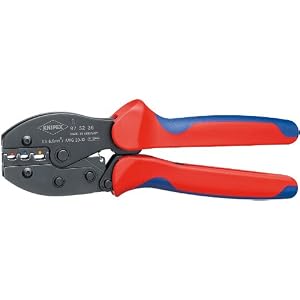
When I do crimp I use a ratchet style like this knipex.
41BDZyM7iOL._SL500_AA300_.jpg
 

rburke65

Well-known member
Joined
Nov 10, 2007
Messages
12,349
Location
Canfield, Ohio
A retired electrician here....we had 5 or 6 plugs through out the house that we use more than the rest....running the sweeper every week...and these outlets would get loose and the sweeper cord would fall out, so I changed them out with the heavier...read more $....and yes there is a difference. The internals are a lot stronger.
 

MrMark

Well-known member
Joined
Jan 25, 2010
Messages
4,626
Location
Southern Cal.
Yes I buy the better devices typically, its a lot faster. Once you factor in the time it takes to crimp and the cost of the crimp its better to get a back wired device. Or even worse fiddle faddle with twisting up the stranded leaving some insulation on the end of the wire. What ever trick you use its slower and inferior to the better device. Time is money

When I do crimp I use a ratchet style like this knipex.
41BDZyM7iOL._SL500_AA300_.jpg

I think I know that trick you are talking about leaving a little insulation on the end of the stranded wire. Might work, somewhat dubious, but I suppose better than nothing.

I like those crimpers. How do you know which die to use for which terminal?
 

MrMark

Well-known member
Joined
Jan 25, 2010
Messages
4,626
Location
Southern Cal.
A retired electrician here....we had 5 or 6 plugs through out the house that we use more than the rest....running the sweeper every week...and these outlets would get loose and the sweeper cord would fall out, so I changed them out with the heavier...read more $....and yes there is a difference. The internals are a lot stronger.

That's what I try to do too. On the high use ones switch to the premium with the heavy metal backstrap.
 

Mmfh

MEMBER EMERITUS
Joined
Oct 8, 2011
Messages
1,423
Location
Portland Oregon
I'm still wondering about the OP saying there are two other outlets that had smoked. The one in the middle of the circuit you are all talking about has seen way to much current, or a bad connection, right?? Why are the other two outlets showing smoke up the wall? Should they be checked or replaced as well?

I've seen something in the past and I'm wondering if it might apply here. In a bedroom a neckless or a coin dropped down and over the end of a cord, shorting across the spades of the cord, therefore smoking the wall. Could a situation like this have caused the melted outlet downstream of the others?

I've also seen a quarter fall down exactly so it landed on the partially sticking out cord spades and short out the outlet that way.

Just thinking out loud here.

Mm
 

Coolerman

Well-known member
Joined
May 2, 2012
Messages
133
Location
Paint Lick, KY
Hello all. Totally new here. I have a shop that I recently had built and came here looking for wiring/lighting advice. Have been reading all the old posts to glean information and this one caught my eye.

"In a bedroom a neckless or a coin dropped down and over the end of a cord, shorting across the spades of the cord"

I'm not an electrician, (electronics and computers is my vocation) but can't you mount the outlet so that the ground hole is "up" to prevent just such a thing from happening?

When I wire my shop I will make sure to get those good outlets with the wire clamps as I will be pulling stranded wire through PVC for everything.
 
To avoid these ads, REGISTER NOW!
Top Bottom