To avoid these ads, REGISTER NOW!

saw or not to saw?

supermerle

Active member
Joined
Aug 25, 2010
Messages
44
Location
Arkansas
Building a 24 x 30 metal building and fixing to pour slab my finisher says a slab that small he would not saw cut slab? I've done a search but couldn't find any opinion on sawing concrete one way or the other; so, what does the garage journal folks think one way or the other?

Should I saw, keyway it, etc, etc?
 
To avoid these ads, REGISTER NOW!

djkeev

Well-known member
Joined
Feb 8, 2012
Messages
1,223
Location
North Western New Jersey
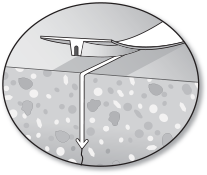
A concrete slab WILL crack no matter the size, at least it seems this way in my experience. The saw cuts simply create a weak line in the slab with the hopes that the crack will follow the saw cut and not make its own path through the slab. By all means, cut the slab and control the crack / cracks.

Dave
 

larry_g

Well-known member
Joined
Apr 28, 2007
Messages
16,917
Location
oregon
Zip strips are an option. I've used them in two shops and I am pleased with the results.

lg
no neat sig line
 

Gary S

Well-known member
Joined
Dec 27, 2008
Messages
2,972
Location
Bismarck, ND
I built two garages in my day. The first one was 18x24. I didn't cut relief cuts in that one and it didn't crack, but it was small. The second one was 24x48. I did the relief cuts on that larger slab, and it cracked along every relief cut like it was supposed to do.

I'd say when in doubt, CUT.
 

PRH44

Well-known member
Joined
Dec 25, 2009
Messages
563
Location
Indiana
My 24 X 30 cracked not long after we moved in. Save your self some trouble and do it up front.
 
Joined
Apr 12, 2007
Messages
461
The up side is if you cut it, hopefully it will crack there. If you don't It will crack where ever. Cut it now
 

ConCretin

Well-known member
Joined
Jan 20, 2011
Messages
3,381
Location
Central Maine
It is entirely possible to construct a crack free, 24 x 30 slab. Actually you can build them a lot larger than that.

There's more to it but basically you need to design the slab to avoid details like re-entrant corners and restraints against movement. Keep the aggregate size up, the slump low (use a mid range water reducer) and cure properly to minimize the possibility of shrinkage cracks. A solid base will prevent structural cracks.

Saw cut control joints are an admission that you're not willing or able to avoid cracks so you're going to hide them under nice straight saw cuts. Don't get me wrong, there is nothing wrong with that. It's a lot more work to do it the other way and if you don't nail it, you could end up with a random crack that will ruin your day.
 
Last edited:

ConCretin

Well-known member
Joined
Jan 20, 2011
Messages
3,381
Location
Central Maine
Make a deal with the concrete guy. You pay him to do it without any cuts. If it cracks, he tears it out and replaces it.

I'd take that bet but you need to pay me for the work necessary to avoid the cracks.

At the end of the day, control joints are a less expensive way to deal with potential cracks.
 

WVBrady

Well-known member
Joined
May 5, 2005
Messages
1,679
Location
WV
It is entirely possible to construct a crack free, 24 x 30 slab. Actually you can build them a lot larger than that.

There's more to it but basically you need to design the slab to avoid details like re-entrant corners and restraints against movement. Keep the aggregate size up, the slump low (use a mid range water reducer) and cure properly to minimize the possibility of shrinkage cracks. A solid base will prevent structural cracks...

I knew a guy with a slaughterhouse (abattoir). He said he was required by law to have no cracks in the concrete. The installer guaranteed it and would replace it if it did crack. I moved shortly thereafter, so I don't know how it came out.
 

chief ben

Well-known member
Joined
Sep 7, 2010
Messages
618
Location
Hot Springs, Arkansas
we built our welding shop in 1994 and it is 26 X 50 with 6 inch concret with the fiber in it and I put down rebar and wire NO Cracks And NO Cuts, And I have had a lot of big things in the shop, when I bring anything with tracks on it I put down plywood,
Shops2003.jpg
 

BWS

Well-known member
Joined
Sep 3, 2006
Messages
923
Location
Mnts of Va
One section of our shop,30X50 is no cuts,no cracks.But engineering and execution wasn't for the faint.


But suggestion posted above(Gary S),should be the default."When in doubt,CUT".
 

darkk

Well-known member
Joined
Dec 24, 2009
Messages
3,361
Location
Willimantic, Ct.
I did a 30'x30'x6" 3500 psi with fiber hair and 6" mesh with 6 mil plastic under slab, kept it almost submerged in water for 8 days while curing in 95 deg heat 3 years ago. No cuts, no cracks so far. I live in eastern Ct. so the weather isn't the most hospitable, have had my fingers crossed hoping it won't crack...good so far.:thumbup:
 

Cryptic1911

Well-known member
Joined
May 24, 2008
Messages
2,884
Location
Willimantic, CT
With a properly done base, and correctly poured (and cured) slab, there shouldn't be any cracks. Everyone that harps on the saw cuts as the only way to prevent cracks is just in denial, and is accepting a quick hack as the solution for sloppy work
 
To avoid these ads, REGISTER NOW!

BWS

Well-known member
Joined
Sep 3, 2006
Messages
923
Location
Mnts of Va
Depends on the slab's shape............

Certainly not an expert,got a few engineering books on the subject.Mainly to know how it's 'sposed to be done.IOW's,what to look out for when money's and quality is on the line.

Inside corners........think "L" shaped sections.Is one glowing reason for cuts.Its a stress riser thing.Also,big or large sections connected,via small sections....to other large sections will almost always have shrink problems.

The funny part is everybody has the reasons for why concrete cracks.....after the fact.Which is sort of,DUH.

Concrete.....specifically its install,is a metric ton of work.Those that stand back and point fingers and spout a bunch of engineering BS......might just need to get in there and "push" some around?The easier you can make the install the more likely you'll get a quality job....just sayin.
 

willymakeit

Well-known member
Joined
Apr 27, 2009
Messages
1,250
Location
Springfield Mo.
There's always opions and options.
As mentioned cut,tool or zip strips on a pattern and out of entrant corners.
When complete use a backer rod and caulk ( sonneborne ect) in the cuts to keep debris out. Your option.
 

2manytoyz

Well-known member
Joined
Sep 20, 2011
Messages
419
Location
Central FL
In central FL, ALL slabs crack. Never seen one, or heard of one that didn't. Score it, and the crack will be "neat". Don't, it'll spider crack anyway. It's cheap insurance to score it.

Your location might differ...
 
OP
S

supermerle

Active member
Joined
Aug 25, 2010
Messages
44
Location
Arkansas
First, thanks to all for your response. I've poured a couple slabs and laid rebar 24" oc each way and believe it or not I had zero cracks. Rebar has gotten so expensive that its making it beyond my budget :(. Can a person use a circular saw with a masonry blade to cut the slab? I'll be putting rebar @ the perimter with 10 mil. visking then 6x6 10/10 wwm and hope for the best. I'll cover the slab with plastic and keep it watered to help slow down the curing process. I'll watch and make sure the finisher doesn't put very much water in the concrete or over work the slab before the trowel machine. If anybody as anything to add to this approch on the slab, bring it on, please!
 

willymakeit

Well-known member
Joined
Apr 27, 2009
Messages
1,250
Location
Springfield Mo.
First, thanks to all for your response. I've poured a couple slabs and laid rebar 24" oc each way and believe it or not I had zero cracks. Rebar has gotten so expensive that its making it beyond my budget :(. Can a person use a circular saw with a masonry blade to cut the slab? I'll be putting rebar @ the perimter with 10 mil. visking then 6x6 10/10 wwm and hope for the best. I'll cover the slab with plastic and keep it watered to help slow down the curing process. I'll watch and make sure the finisher doesn't put very much water in the concrete or over work the slab before the trowel machine. If anybody as anything to add to this approch on the slab, bring it on, please!

The problem with the skil saw is the blade gets hot,warps,and then you have a extremely crooked line. Most concrete co. will include the slab cut in their price.
I don't know the final covering on your slab but you can put a vapor retarder/ curing sealer on right after the finish but before the cut. I hate sealed in chalk lines on a clear finish floor.
 
OP
S

supermerle

Active member
Joined
Aug 25, 2010
Messages
44
Location
Arkansas
Willy
I was going to cut it while its still pretty green? Oh, and the concrete co. is me:D? Can't afford to pay anybody since material is so expensive anymore. I'm hoping everything will be paid for when I'm finished.
 

Falcon67

Well-known member
Joined
Jun 11, 2009
Messages
18,371
Location
Merkel, TX
Make sure you are pricing the steel at a bulk metal supplier and not Home Depot. There is a HUGE difference in cost at the supplier end. You might also contact the concrete company you are going to use and see if they have a contact. Retail is probably double or worse on 10' joints.
 

willymakeit

Well-known member
Joined
Apr 27, 2009
Messages
1,250
Location
Springfield Mo.
First, thanks to all for your response. I've poured a couple slabs and laid rebar 24" oc each way and believe it or not I had zero cracks. Rebar has gotten so expensive that its making it beyond my budget :(. Can a person use a circular saw with a masonry blade to cut the slab? I'll be putting rebar @ the perimter with 10 mil. visking then 6x6 10/10 wwm and hope for the best. I'll cover the slab with plastic and keep it watered to help slow down the curing process. I'll watch and make sure the finisher doesn't put very much water in the concrete or over work the slab before the trowel machine. If anybody as anything to add to this approch on the slab, bring it on, please!

Willy
I was going to cut it while its still pretty green? Oh, and the concrete co. is me:D? Can't afford to pay anybody since material is so expensive anymore. I'm hoping everything will be paid for when I'm finished.
See if you can rent a soft cut saw in your area. They work good. I understand doing it yourself.
 

jvitez

Well-known member
Joined
Nov 30, 2009
Messages
2,429
Location
Big Sky Country, Canada
My garage pad is L-shaped, 4" thick, poured in the middle of -25C winter, but hoarded/insulated/heated for a day before the pour, and for days thereafter. I have several long hairline cracks, but nothing has shifted, no spalling, no sinking. Overall, a job well done.
 

ctgoodman

Well-known member
Joined
Mar 1, 2010
Messages
315
Location
Salisbury, NC
I personally would cut it. You may be able to get a crack free slab depending on a lot of factors. It's cheap insurance in case it does and it should make the crack follow along the saw cut.
 

Dajn

Banned
Joined
Apr 14, 2014
Messages
278
Probably shouldn't bump this but it may help someone. I have worked road construction for 17 years mainly sawing concrete. The base is very important of course but concrete with expand when it heats up and contract when it cools down. Nothing can stop that. Thickness of the slab and more steal in it helps but it will still move. A 50 year old concrete slab will still move as it heats up or cools down. Most concrete paved roads that are 24 feet wide and 10 inch thick will have a centerline sawed in at 12 feet and a cross joint sawed in every 15 feet. So you have a 12' ×15' panel. Usually the green saw cut is 1/3 of the thickness of the slab depending on the state. Minnesota is 1/4. Of course a garage slab is different but same rules should apply. For instance, a pole shed with poles on 8 foot center should have joints from pole to pole leaving 8×8 panels. If done correctly it looks nice. You can seal the joints and make it look nice. By the way, do not use a softcut. They are worthless. I only use them in emergency situations. If anyone does use a softcut, make sure you don't hit it to green or you will have tiny shrinkage cracks all along the joint. Sorry, long post. I could right a book on concrete sawing
 

boobag

Well-known member
Joined
Aug 15, 2010
Messages
397
Probably shouldn't bump this but it may help someone. I have worked road construction for 17 years mainly sawing concrete. The base is very important of course but concrete with expand when it heats up and contract when it cools down. Nothing can stop that. Thickness of the slab and more steal in it helps but it will still move. A 50 year old concrete slab will still move as it heats up or cools down. Most concrete paved roads that are 24 feet wide and 10 inch thick will have a centerline sawed in at 12 feet and a cross joint sawed in every 15 feet. So you have a 12' ×15' panel. Usually the green saw cut is 1/3 of the thickness of the slab depending on the state. Minnesota is 1/4. Of course a garage slab is different but same rules should apply. For instance, a pole shed with poles on 8 foot center should have joints from pole to pole leaving 8×8 panels. If done correctly it looks nice. You can seal the joints and make it look nice. By the way, do not use a softcut. They are worthless. I only use them in emergency situations. If anyone does use a softcut, make sure you don't hit it to green or you will have tiny shrinkage cracks all along the joint. Sorry, long post. I could right a book on concrete sawing

yes, there is a reason roads are cut like you said. and that has to do with lots of engineering and studies. so for someone to say not to cut a floor, is kinda silly in my opinion.
i've been in construction all my life, and when i see basement and garage floors not cut, they almost always crack at random.

by the way, when you say "softcut", do you mean "soff cut"? usually my guys use a walk behind gas powered saw. how do you recommend to cut the lines?
 

Dajn

Banned
Joined
Apr 14, 2014
Messages
278
For residential, a smaller gas powered walk behind saw is what I would recommend with a 1/8 inch blade (125) for green cutting. I always use a 14 inch blade for any joint that will be three inch deep or less. One pass. If I want or need a joint wider than the initial green saw cut, I will widen the joint much later to avoid chips. I believe husqvarna bought out Soff cut a few years ago but it's still the same style saw. They really serve no purpose in my opinion. Of course there are varying sizes of soffcuts It's really difficult to get a nice joint with a soffcut. The whole point of them was to supposedly be able to get the joint in as green as possible but you end up with a ****** joint that way. Blade technology has come a long ways. I always saw with water but with the proper setup, dry sawing works fine. Wish I had a picture of it, but the saw I put the most hours on is a new husqvarna rider saw. Has a 4 cylinder 90 horse diesal. They are about 40 thousand dollars a piece. Obviously over kill for residential but a must have when on the road.
 
Last edited:

Dajn

Banned
Joined
Apr 14, 2014
Messages
278
A proper silicone sealed cross joint on a main highway would go like this. Say it's 12 inch mainline pavement. The green saw cut would be 3 inches deep and no more than 1/8 inch wide directly over an 18 inch wide steal basket. Then after more cure time, the joint would be widened out to 3/8 inch but only an inch and a quarter deep. Later, the joint will be blown out first and then sandblasted. Next, backer rod. Then silicone to be tooled for a perfectly sealed joint. The state has not much tolerance on silicone thickness. They usually want about a 1/2 inch bead. They gives the silicone it maximum ability to stretch and compress and the roads goes through its never ended cycle of expanding and contracting. Minnesota quit silicone. Some states still use it. If it's done right, it can last many years. But, most things in road construction are not done right because of incompetence and people not giving a ****. Taxpayers get screwed again. Sorry for the needless information. I still have a few beers left to drink and not tired yet
 

GYPSY400

Well-known member
Joined
Mar 21, 2013
Messages
517
Location
Naughton Ontario
My slab came with an "engineered" floor plan.. Which also included saw cuts.. I wouldn't pay my builder the last payment until the cuts were done. Imo, it doesn't look too bad and can always be filled in.. A spider crack is guaranteed to look like $hit


Sent from my iPhone using Tapatalk
 

txvwnut

Well-known member
Joined
Jan 1, 2015
Messages
7,707
Location
Bedford, Texas
Mine is 20x26 been down for 12 years on sandy loam soil and has no cracks. I went a little over on what the suggested beams were needed for my building and what I was goign to be doing. The key to it is as mentioned before, planning engineering and execution when doing the pour.
The actual dimensions for mine are 20'x26' with 18"x18" perimeter beams and 18"x18" cross beams with a 6" deck. Number 5 rebar in the beams with number 3 rebar "U" ties and then number 4 rebar on 12" centers for the deck with 6"x6" welded wire mesh on top of that. During the whole pour a concrete ******** was run through all of the beams and across the flat, took just around 27 yards for the whole thing.
 
To avoid these ads, REGISTER NOW!
Top Bottom