To avoid these ads, REGISTER NOW!

Blown-in Celluose causes metal ceiling to rust?

shamrock12

Well-known member
Joined
Dec 26, 2007
Messages
959
Location
South Dakota
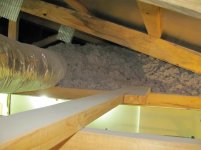
We just made a phone call to Menard's to order over a hundred bags of blown-in cellulose. While talking to the guy in the building department, he asked if this is for a pole barn. Told him yep. He then strongly emphasized to NOT use blown-in cellulose above the metal ceiling because the flame retardant material will rust and eat up the ceiling. This is the first I have heard of, so I did a quick search online and it looks like they have some kind of acid that act as flame retardant.

Right now, our 30x48 gambrel pole barn with loft are being built. The shop will be finished with R-19 fiberglass in the walls and then T1-11 panelings will be installed. The ceiling is going to be a metal liner, obviously. The loft will be used for storage and man cave, so half of the loft would be finished in the future. There will be Low-E condensation barrier below the roofing, so the contractor told me there is no need for vapor barrier in the shop ceiling where I would be blowing in the cellulose.

Now I am not sure what to think. Several months ago I did some researching and have decided to plan on a blown-in cellulose. Is this something I should be concerned about? What should I do to avoid the rusting issue the guy told me about? BTW, he told me to instead use blown in fiberglass which is something I am not thrilled about. Thanks
 
To avoid these ads, REGISTER NOW!

timewarp

Well-known member
Joined
Feb 24, 2008
Messages
272
Location
Silverdale, WA
If the metal liner isn't up yet I would put a 4-6mil vapor barier above it so that your insulation would not be in contact with the metal. If it's already been placed what about lining each bay in the ceiling with plastic stapled to the ceiling joists, making a tray to blow the insulation in and keeping it physically separated from the metal.
 

trbomax

Well-known member
Joined
Mar 21, 2010
Messages
2,556
Location
starvation lake,mi.
Put up a 3/8" reflective house wrap first,then metal. You need to seal the ceiling up because the metal will let air pour thu all the seams and edges,reducing the efectiveness of your insulation by 50% or more. Air intrusion is the enemy of insulation.Be sure to tape all joints in the wrap and caulk all around the edges before you put the J channel up.
 

Attachments

  • IMG_1719.jpg
    IMG_1719.jpg
    133 KB · Views: 144
  • IMG_0748.jpg
    IMG_0748.jpg
    139.5 KB · Views: 139

skeletonizer

Well-known member
Joined
Sep 25, 2008
Messages
1,320
Location
Michigan
I used the attic cat pink stuff. I have done a few attics with cellulose in the past. After using the attic cat I will never go back to cellulose. The attic cat is cleaner, i.e. no dust at all. It is lighter. It is non absorbant. Inherently fire retardant
 

Gary S

Well-known member
Joined
Dec 27, 2008
Messages
2,972
Location
Bismarck, ND
He is likely right. Cellulose needs serious chemicals added as fire retardants. Metal doesn't handle chemicals well.
 
To avoid these ads, REGISTER NOW!

trbomax

Well-known member
Joined
Mar 21, 2010
Messages
2,556
Location
starvation lake,mi.
Thanks everyone. It sounds like I do need to put some kind of a barrier between the metal ceiling and cellulose. Would this 1/2" foil faced insulation sheet work well to address this potential issue?

http://www.menards.com/main/buildin...-2-foil-faced-insulation/p-1356987-c-5779.htm

That would be fine,just tape the seams and caulk the edges.I use 1/4" x 2" fender washers and deck screws to hold it up,much easier than trying to drive cap nails upside down.Dont blow the whatever you use untill the steel is in place,the foam board wont support it alone.The foil side faces the inside.

edit) think of it as the foil/foam is the "drywall" and it seals up the room. The steel is the "finish" except in this case the "finish" is also the structural part.
 
Last edited:

Norcal

Well-known member
Joined
Mar 16, 2008
Messages
13,758
Why all the hatred for blown in fiberglass?

Any one using blown fiberglass should be shot & ask any questions later.:evil:
I hate the stuff. If my memory serves me, the retardant used in cellulose is boric acid. It is strange that rodents will nest in fiberglass but will not in cellulose insulation, though.
 

Gary S

Well-known member
Joined
Dec 27, 2008
Messages
2,972
Location
Bismarck, ND
Why all the hatred for blown in fiberglass?


I don't hate blown in fiberglass, but I hate working with it, or working later in an area that has it. The itching drives me crazy.
Fiberglass is a great insulation. It just isn't fun to be around.
 

Twiggss

Well-known member
Joined
Jul 3, 2011
Messages
425
Location
middle
I don't hate blown in fiberglass, but I hate working with it, or working later in an area that has it. The itching drives me crazy.
Fiberglass is a great insulation. It just isn't fun to be around.

FWIW the new style of blown in fiberglass isn't as itchy as it once was. I did my attic over the past winter with the artic cat insulation and had no itching afterwards.
 

Slick111

Well-known member
Joined
Feb 6, 2012
Messages
249
Location
Everett Wa
Have a insulation question I own a house built in 1959 no insulation in the walls thinking about foam as I don't want to disturb the interior as they are freshly painted with lots of stained clear VG fir trim was told it was easy just drill a hole on top and bottom on the out side pump it in however I have used the small spay cans of foam and it expands a lot is this the same stuff just wondering if it will bulge the sheetrock inside.Any one ever done this.
 

magnusk750

Well-known member
Joined
Nov 6, 2010
Messages
501
Location
Estonia
Cellulose insulation can also be blown into empty walls, like the foam. Differnce is that cellulose can mover with the building while the foam is stiff when dry. Cellulose also can absorb and more important evaporate moisture, while foam forms a barrier and can cause moisture to accumulate locally. For example along the sills.
 
To avoid these ads, REGISTER NOW!
Top Bottom