To avoid these ads, REGISTER NOW!

Building a new Do-All band saw variable drive

OP
A

A_Pmech

Well-known member
Joined
May 8, 2007
Messages
8,002
Location
IL
Time for another update!

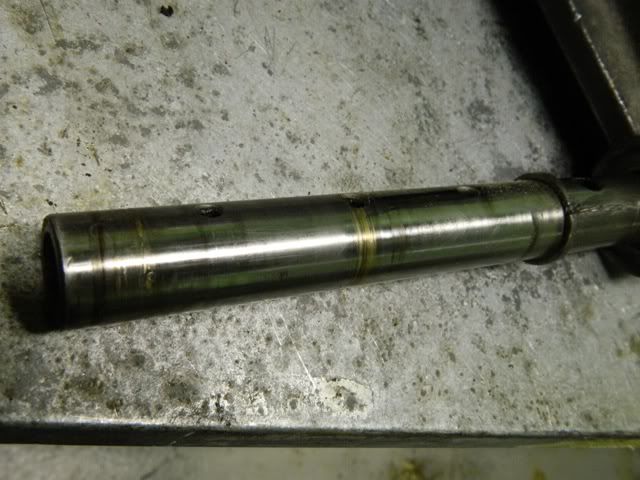
Before starting the hub and boring it's bushings I needed to repair the axle. The axle is a heat treated and ground hollow rod about 8" long and 1.000" dia. which is press fit into the speed change arm. It has probably run decades without oil and has suffered the consequences. The bearing surfaces are badly galled:

vari29.jpg


Repairing the axle involves grinding it with a toolpost grinder on the lathe. By rights, I should be using the tailstock here. However, I won't be removing much material and I know the headstock of the lathe is in exceptional alignment. (About .0002" per foot)

Here I'm preparing to spark off. The lathe is tented to keep abrasive grit off the machine:

vari30.jpg


The job partially complete:

vari31.jpg


Sparking out:

vari32.jpg


Finished!

vari33.jpg


I was able to remove all the damage except for a couple little gouges near the retention bolt, which won't affect the bearings at all. Total material removed was about .0058" Taper over the length of the bearing is about .0001" That'll work!
 
To avoid these ads, REGISTER NOW!

coldfusion21

Well-known member
Joined
Jul 7, 2005
Messages
404
Location
portland, oregon
Super neat, figuring out those slots and how to set them up on the mill is very impressive.
I always look forward to reading your threads!

That tool post grinder is slick, could see how that could be very handy to have around.
 

Trucky

Well-known member
Joined
Apr 26, 2011
Messages
1,747
As always, good work from the man himself. Keep it up. Good thinking with the collet business... I'll have to write that down. As well as a quick purchase of an accurate rotary table and sine bar set up. Better start saving now!
 

NASTYZEN

Well-known member
Joined
Jun 11, 2010
Messages
2,823
Location
St-Colomban,Que. Canada
Nice. As usual...Could we see more of your grinder setup? Is it home made?
I always find it a little freaky to use the lathe tented, can't help but think what may happen should it get pulled into the chuck.
I sorta stand a little further from the machine when I do that.:)
 
OP
A

A_Pmech

Well-known member
Joined
May 8, 2007
Messages
8,002
Location
IL
Thanks guys!

And you're going to bury this in the bowels of a machine where it can't be seen. That's just not right. I think you really should consider a plexiglass door on that saw.

Some of the best machine work in the world is buried where nobody can ever see it. I like it that way. :)

Trucky said:
As always, good work from the man himself. Keep it up. Good thinking with the collet business... I'll have to write that down. As well as a quick purchase of an accurate rotary table and sine bar set up. Better start saving now!

I get most of my workholding ideas from the old textbooks and "Machinery" magazine. LOTS of good ideas hiding in there and best of all, it's all free on Google Books. :)

NASTYZEN said:
Nice. As usual...Could we see more of your grinder setup? Is it home made?
I always find it a little freaky to use the lathe tented, can't help but think what may happen should it get pulled into the chuck.
I sorta stand a little further from the machine when I do that.

Hi Zen,

I'll take some more photos when I grind the hub, which will be shortly. I'm making it from 4140HT.

The grinder is a Themac J-45 I recently purchased, although the grinding wheel guard is a shop-brew accessory. It's a nice unit! Supposedly, Themac invented the toolpost grinder.

Here's their catalog:

http://www.themacinc-us.com/catelog.pdf
 
OP
A

A_Pmech

Well-known member
Joined
May 8, 2007
Messages
8,002
Location
IL
Time for another update..

Making the hub involved starting with a 2 1/2" round of 4140HTSR, which is hardened to about 30 HRC. After skimming the OD, the ID is drilled, bored and honed.

vari34.jpg


Then, the part is installed between centers using a shop-built interchangeable pipe center and the OD brought to final size:

vari37.jpg


As an aside, there was a discussion some time back about drilling and the kind of chips the drill should produce. Usually, a broken chip is preferred. However, when drilling deep holes in the lathe I prefer a continuous spiral. The helical chip clears the flutes easily and eliminates the need for pecking in some applications.

Two flutes, two chips, 7" deep:

vari35.jpg


I don't have any photos of finishing the hub as I ran out of batteries for the camera. However, here's the finished hub with some of the other parts. On the far left is a stick of bronze tube which will be turned into the sleeve bearings for the hub tomorrow. The hub is concentric with .002" and the outer surface is cylindrical within .0002". Concentricity of the inner and outer bores isn't critical, as the bronze bearings will be finish bored in place.

vari36.jpg
 

Trucky

Well-known member
Joined
Apr 26, 2011
Messages
1,747
Did you polish that axle a bit more after grinding it?

Also, plain bronze for the bearing or some sort of aluminium/nickel bronze variant?
 
Last edited:
OP
A

A_Pmech

Well-known member
Joined
May 8, 2007
Messages
8,002
Location
IL
Did you polish that axle a bit more after grinding it?

Also, plain bronze for the bearing or some sort of aluminium/nickel bronze variant?

Yeah, it's been hit with 400 and 600 sandpaper after grinding.

This bearing is made from SAE 660 bronze.
 

Trucky

Well-known member
Joined
Apr 26, 2011
Messages
1,747
Why would you hit it with sandpaper? I usually just chuck the piece and run it at like 500 and go from there, but what does hitting the part have to do with it? I would think that would do more harm than good.

Just kidding. Nice work. Now make the whole thing work :D
 
OP
A

A_Pmech

Well-known member
Joined
May 8, 2007
Messages
8,002
Location
IL
Next on the to-do list is making and installing the bronze bushings. These will be made from SAE 660 leaded bronze tube. Work begins by drilling out the ID to rough size and turning the OD to final size. By cleaning out the majority of the excess stock before final sizing, any stresses in the stock have been relaxed and it's possible to hold closer tolerances. Bearing OD is an FN2 fit, +-.0003. Bearing ID is axle OD plus .0025 running clearance plus a shrinkage allowance to account for bore shrinkage when the outer pulley sections are pressed into place.

Here's the finish cut underway:

vari38.jpg


After parting off the individual bearings they're faced to length and chamfered:

vari39.jpg


Here are the finished bearings ready to go, along with an installation tool I made out of some scrap to set the bearings at the correct depths:

vari40.jpg


One of the bearings being pressed to final depth:

vari41.jpg


The hub is then set up back in the lathe until it runs true within a few tenths and the bearings bored to final size. The result:

vari42.jpg


Next up is fitting the nylon center bushing and pressing the outer halves onto the hub.
 
OP
A

A_Pmech

Well-known member
Joined
May 8, 2007
Messages
8,002
Location
IL
Why would you hit it with sandpaper? I usually just chuck the piece and run it at like 500 and go from there, but what does hitting the part have to do with it? I would think that would do more harm than good.

Just kidding. Nice work. Now make the whole thing work :D

It wasn't really needed, but plain bearing life is directly related to the surface finish of the harder part. It only takes a few moments to bring it up to a 600 grit finish so I usually do that as a matter of course.

I haven't fumbled, dropped something and put a "ground finish" on anything yet. Don't jinx me!

:willy_nil
 

Trucky

Well-known member
Joined
Apr 26, 2011
Messages
1,747
One more thing! (I must keep bothering you.) Is that bronze of the "Oilite" variety, or more of a plain leaded bronze?

Alsooo (Last one, I promise.) Is that Kennametal tooling I spy?
 
OP
A

A_Pmech

Well-known member
Joined
May 8, 2007
Messages
8,002
Location
IL
One more thing! (I must keep bothering you.) Is that bronze of the "Oilite" variety, or more of a plain leaded bronze?

Alsooo (Last one, I promise.) Is that Kennametal tooling I spy?

SAE 660 is a lead/tin cast bronze. It's one of the most common bearing bronzes and is used often in pump bearings and valve components. Sintered bronze AKA "Oilite" would be something like SAE 841 or similar. Oilite bearings aren't needed in this application as the hollow axle has a reservoir to feed the hub bearings.

That's a Kyocera toolholder. Made in USA. Kennametal stuff is hit or miss and when they miss it's always China so I tend to shy away from them. Although I do have some USA Kennametal stuff.
 

Jim Johnstone

Well-known member
Joined
Apr 11, 2011
Messages
1,841
Location
Brantford, Ontario
Awesome work AP! So that's the project you could have used my cylindrical grinder on. ;)

Great looking machining work, I am too spoiled these days, and anything like that would be tossed on the CNC and done in 30 minutes haha.
 
OP
A

A_Pmech

Well-known member
Joined
May 8, 2007
Messages
8,002
Location
IL
Awesome work AP! So that's the project you could have used my cylindrical grinder on. ;)

Great looking machining work, I am too spoiled these days, and anything like that would be tossed on the CNC and done in 30 minutes haha.

That's the one!

LOL *snore* Where's the fun in that?
 
OP
A

A_Pmech

Well-known member
Joined
May 8, 2007
Messages
8,002
Location
IL
Nylon is an interesting material to work with. It teaches you a lot about movement as it is usually full of stresses. To keep the material movement in check it's a good idea to begin by releasing the stresses at the core, then rough and finish the OD. To that end I began by drilling out the ID and rough boring it .050" undersize. With most of the stresses relaxed I turned the OD to size and turned the locking collar on the OD of the bearing.

One of the other difficult things about working with nylon is it will not chip. Instead, it comes of in a continuous string no matter what you do. The solution to this is to use a vacuum to **** up the chip as it's made to prevent a rat's nest wrapped around your part:

vari43.jpg


After turning was complete the bearing was parted off, ready for installation. The bearing is sized to have .0015 of press to the hub. Considering the shell thickness, that's basically a tight hand press fit. A few solid hits with a mallet and a block of wood got the locking collar seated into it's groove. The collar is sized so that it is three times as thick as the bearing running clearance. The bearing has to wear substantially out of spec before there's enough assembly clearance for the locking collar to slip the groove.

Here's the assembly. What appears to be clearance between the hub and bearing is actually just the chamfer on the hub fingers from deburring. There's a heavy chamfer on the top of the fingers to help collapse the bearing shell enough to allow the collar to pass the outer portion of the fingers. Once the hub is installed in the bearing, it won't allow the shell to collapse enough to let the collar slip by the fingers, thus making the bearing a permanent assembly:

vari44.jpg


Final boring of the bearing was made with this setup. The center section was installed in the lathe and adjusted to run true with a face runout of less than .001" and a radial runout of less than .002", then the bearing was bored with a slightly radiused HSS toolbit. The ends of the bearing were also turned flush with the fingers:

vari45.jpg


Here's the finished result:

vari46.jpg


Next work will be making and installing the two felt seal backup rings in the hub and pressing the outer sections on the hub.
 

Hephaestus29

Well-known member
Joined
Mar 13, 2011
Messages
2,969
Location
Indianapolis
I was wondering how accurate that peice had to be to work good/right ? could you just make a pattern & cast that piece out of Aluminum or cast or ductile iron ? would it hold up ?
 

hunter1151

Well-known member
Joined
Jun 19, 2011
Messages
202
Location
Kansas
Awesome work AP! So that's the project you could have used my cylindrical grinder on. ;)

Great looking machining work, I am too spoiled these days, and anything like that would be tossed on the CNC and done in 30 minutes haha.[/QUOTE

Does that 30 minutes include reverse engineering, programming, set-up, and run time, on not just one cnc, but at least 2. Maybe if you were setting up to run production you could get there.............

You are an excellent machinist A_P there just aren't that many left like you anymore that can run em all..............
 
To avoid these ads, REGISTER NOW!

Jim Johnstone

Well-known member
Joined
Apr 11, 2011
Messages
1,841
Location
Brantford, Ontario
Awesome work AP! So that's the project you could have used my cylindrical grinder on. ;)

Great looking machining work, I am too spoiled these days, and anything like that would be tossed on the CNC and done in 30 minutes haha.[/QUOTE

Does that 30 minutes include reverse engineering, programming, set-up, and run time, on not just one cnc, but at least 2. Maybe if you were setting up to run production you could get there.............

You are an excellent machinist A_P there just aren't that many left like you anymore that can run em all..............

Nope 30 minutes of setup/cut. I tend to forget about the reverse engineering part since I never reverse engineer at my jobs, just engineer new stuff for the shop.

And I certainly agree, there aren't that many that can run all machines with such proficiency!
 

Trucky

Well-known member
Joined
Apr 26, 2011
Messages
1,747
I was wondering how accurate that peice had to be to work good/right ? could you just make a pattern & cast that piece out of Aluminum or cast or ductile iron ? would it hold up ?

I imagine you could cast it but of course it would need to be bored and machined properly and everything before use.

I also imagine that cast metals would need to be carefully done to make sure there aren't any voids near the "fins" that could possibly fail.

It might save some time but a solid chunk is guarenteed to work and I am a firm believer that machining billet is much more fun than cast.. iron excluded. The little "fracture" chips are just soooo fun to clean from lathe ways..
 

kidatari

Well-known member
Joined
Jan 14, 2007
Messages
104
Location
So. NH
Man, your attention to detail and precision are second to none. Each one of your projects reinforces this fact. Thank you for the time that you take to document and share these projects!

Josh
 

MBfreak

MEMBER EMERITUS
Joined
Dec 10, 2010
Messages
2,301
Location
Linkoping , Sweden
Hi there A Pmech.
Great thread, fantastic work and I love the refabrication idea. Your part is likely going to be better than the original part. Fantastic.

Being a self taught "machinist", kind of, I find great interest in the chuck of your lathe. The chuck has a normal set of three reversible jaws, but then there is a second set of low profile jaws as well. I have never ever seen anything like that. Can you please post a link or an explanation?

Thanks a lot for a bvery interesting thread!


Ola
 

Trucky

Well-known member
Joined
Apr 26, 2011
Messages
1,747
MBfreak, I believe you're thinking of a reversible jaw chuck. The jaws on his have gripping areas on both the "inside" and outside of the jaws, and you can take them off and turn them around to do larger pieces like on the first page. Google is your friend for that one :)

Yeah that A_P guy is pretty cool from what I hear :D
 
OP
A

A_Pmech

Well-known member
Joined
May 8, 2007
Messages
8,002
Location
IL
I was wondering how accurate that peice had to be to work good/right ? could you just make a pattern & cast that piece out of Aluminum or cast or ductile iron ? would it hold up ?

Accuracy depends on the feature in question. OD of the pulley halves is pretty much whatever. The bearing fit needs to be within a few ten thousandths, as do the press fits. The face runout of the pulley halves needs to be kept to within .005" TIR or better to prevent belt flap.

The pulley halves could start out as a sand casting and then be machined. Or, they could probably be made as a die casting which would require very little to no machining. Both methods would be for quantities much higher than what I'm producing.

You are an excellent machinist A_P there just aren't that many left like you anymore that can run em all..............

Thanks Hunter. I strive to always produce my best work. Some days I do, some days I'm mid-pack and every now and then I just have to throw it in the scrap bin and try again.

I think what separates experienced machinists from the rest is the ability to recover from a mistake without scrapping the part. (And sometimes not making the mistake in the first place.)

The more I learn about this trade the more I realize I don't know. The art and science of manufacturing is something that takes at least a lifetime to master, probably closer to 3 or 4 lifetimes. I'm trying to do it in one. :thumbup:

Man, your attention to detail and precision are second to none. Each one of your projects reinforces this fact. Thank you for the time that you take to document and share these projects!

Josh

Thanks Josh! I have a habit of driving people up the wall with my nitpicky nature. Sometimes the person I drive up the wall is me. I'm somewhat looking forward to being a grumpy, deaf, ****-retentive old codger with a scowl that makes apprentices scatter like roaches in the light. Typical machinist... :lol_hitti

Hi there A Pmech.
Great thread, fantastic work and I love the refabrication idea. Your part is likely going to be better than the original part. Fantastic.

Being a self taught "machinist", kind of, I find great interest in the chuck of your lathe. The chuck has a normal set of three reversible jaws, but then there is a second set of low profile jaws as well. I have never ever seen anything like that. Can you please post a link or an explanation?

Thanks a lot for a bvery interesting thread!


Ola

Thanks MB,

That's the idea, it should outlast the original.

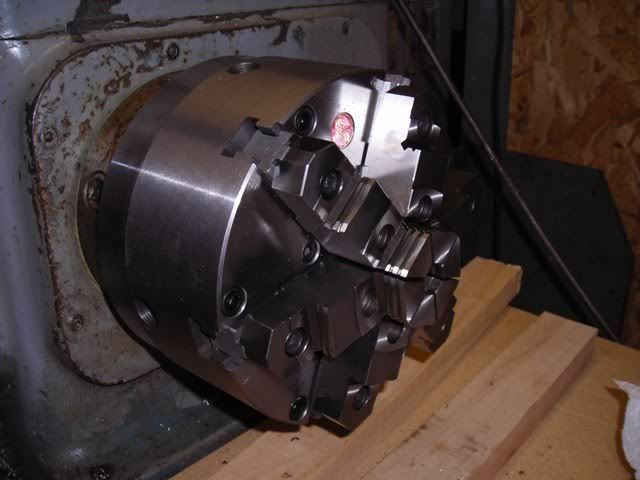
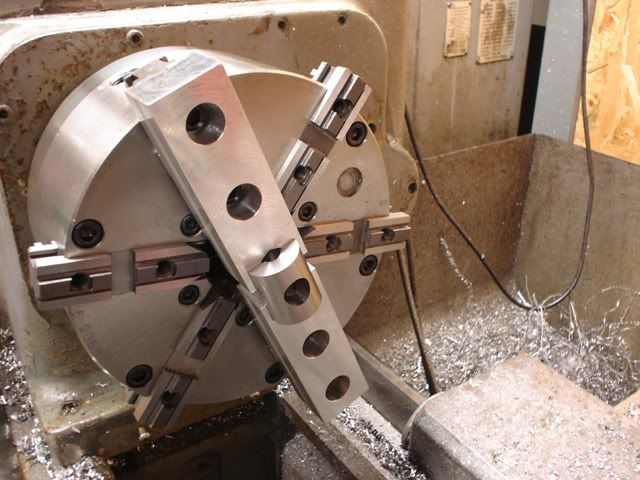
That particular chuck is a 6-jaw removable jaw unit. It allows me to use two jaws, three jaws or all six when I'm working with thin parts or rings with or without soft jaws. The "small jaws" you see are the spaces for the unused jaws.

Here it is in 6-jaw configuration:

chuck5.jpg


And here in 2-jaw configuration using custom-made soft jaws to hold the head of one of the hammers I make:

2-jaw.jpg


I imagine you could cast it but of course it would need to be bored and machined properly and everything before use.

I also imagine that cast metals would need to be carefully done to make sure there aren't any voids near the "fins" that could possibly fail.

Yup! Castings should also be stress relieved before machining to reduce the chance of the casting warping as metal is removed. Hot rolled bars also have stresses but they tend to be symmetrical and relieve evenly on round parts. Cold rolled bars have TONS of stress and go egg noodle when you take the bark off.

Yeah that A_P guy is pretty cool from what I hear :D

I've always thought of myself as pretty boring, but that's just me.

:dunno::lol:
 

Trucky

Well-known member
Joined
Apr 26, 2011
Messages
1,747
Cold rolled bars have TONS of stress and go egg noodle when you take the bark off.

honestly, that made me laugh wayyy too much :lol_hitti

But seriously, cold rolled 1018... NEVER again! I cut 718 inco all day at work and I prefer that over 1018, even though I'll use an edge of an insert for one pass with the Inco... still finishes like a mirror. Maybe that's why the spindle load is always at 60%+? :lol_hitti
 

MBfreak

MEMBER EMERITUS
Joined
Dec 10, 2010
Messages
2,301
Location
Linkoping , Sweden
A Pmech.
Thanks a lot for the explanation of what a 6 jaw chuck is and how it can be used. I have never seen one or even heard of one . 3 jaw and 4 jaw for odd shaped parts or turning inside and outside non coaxial yes, but 6 jaw?

I would love to get hold of one, will start scouting around.


Ola
 

hunter1151

Well-known member
Joined
Jun 19, 2011
Messages
202
Location
Kansas
I guess a lot of these guys that are suggesting that you make a casting have never actually put any wood on a match plate.........figured the shrinkage..........on and on and on..........
 

Spencyg

Active member
Joined
Mar 25, 2009
Messages
40
Boy oh boy....for the amount of machine time you've got into this repair setup, presumably at a respectable shop rate, this Do-All saw better be otherwise in mint condition. I'm not sure how somebody could justify hiring out this kind of work to repair a saw that could be purchased new (no, not as fine a quality, but good enough for any working shop) for under $10k. At my shop rate (and with CNC equipment), I certainly wouldn't be building what you've built here for anything less than maybe $2500....

Beautiful work though, seriously.
 

Hephaestus29

Well-known member
Joined
Mar 13, 2011
Messages
2,969
Location
Indianapolis
I guess a lot of these guys that are suggesting that you make a casting have never actually put any wood on a match plate.........figured the shrinkage..........on and on and on..........
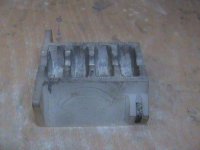
You mean like this miniature engine block pattern I made ? I know there's shrinkage & i'm capable of doing the math if I have the formula. I'm looking for a big saw myself & if I find one cheap enough & i needed that part I would buy one from him if he had one available.
 

Attachments

  • DSC02352.JPG
    DSC02352.JPG
    128.5 KB · Views: 64
  • DSC02355.JPG
    DSC02355.JPG
    128.2 KB · Views: 58
  • DSC00820.JPG
    DSC00820.JPG
    135.2 KB · Views: 64
  • DSC00822.JPG
    DSC00822.JPG
    139.1 KB · Views: 66

hunter1151

Well-known member
Joined
Jun 19, 2011
Messages
202
Location
Kansas
You mean like this miniature engine block pattern I made ? I know there's shrinkage & i'm capable of doing the math if I have the formula. I'm looking for a big saw myself & if I find one cheap enough & i needed that part I would buy one from him if he had one available.

Excellent job.........my point being there is as much work in making the match plate as there is in just machining out the part plus machining it after you cast it. The only way you save with a casting is if you are doing some volume or you have to replicate some original casting...............
 
OP
A

A_Pmech

Well-known member
Joined
May 8, 2007
Messages
8,002
Location
IL
Time to finish this thing!

For this post, I thought I'd show a little of the math that goes on in the background to make a job like this possible. We'll begin with the bearing fits.

Most journal bearings, operate in hydrodynamic suspension. That is, the shaft "floats" inside the bearing on a cushion of oil. The shaft only touches the bearing when it "lands" as the assembly comes to a stop. There are a number of conditions that must be met to make this possible including bearing and shaft surface finish, lubricant viscosity, shaft speed and shaft to journal clearance.

For the purposes of this discussion, the variable I'm interested in is shaft to journal clearance. While there are several excellent books on journal bearing design, Machinery's Handbook provides a good overview. On page 2210 they provide a handy chart plotting suggested bearing diametral clearance against shaft speed and diameter:

vari47.jpg


From the chart, I chose a diametral clearance of 2.5 thousandths which, you'll note, is at the boundary between above and below 600 RPM for a 1" diameter shaft. I chose this number as the variable drive sheave operates in both ranges of the chart. So, 2.5 thousandths is the design diametral clearance for the finished assembly of hub and pulley halves.

As previously discussed in this thread, the pulley halves will be pressed onto the hub. This will secure a better fit, reduce wear, provide a more accurate assembly and generally result in a better finished product. Pressing the parts together with an interference fit will expand the diameter of the pulley half and reduce the hub diameter and thus, the diameter of the bearing inside it. Since we're working in the ten-thousandths range, knowing how much the bore will contract is important!

To that end, I chose a bearing diametral clearance allowance of .0006", which means a total as-machined but before assembly diametral clearance of 3.2 thousandths. I made this choice based upon the Machinery's Handbook table 12, which indicates that even at 3.2 thousandths the bearing fit is still acceptable, should the fit for some reason fail to collapse the bearing bore by substantially more or less than the expected amount.

With the bore collapse set at .0006 on diameter, I needed to determine just how much interference fit between the pulley half and hub is necessary to cause the hub bore to collapse by that amount.

Using a formula derived from the hoop stress formula for thick walled vessels I was able to determine the collapse. Here's my shop notebook entry for that. The formula can be found in "Formulas for Stress and Strain"5th edition by Roark and Young, Table 32-1c. I rearranged it to solve for q:

vari48.jpg


vari49.jpg


So, a uniform radial force of 3,149 PSI is required to collapse the bore of the cylinder .0003" on radius or .0006" on diameter.

The next question to answer is do I have enough press to assemble that kind of fit. To answer that question I used the formula for friction, which anybody who has done high school physics should remember:

(force per unit area)(coefficient of static friction)(contact area) = static friction

vari50.jpg


The answer is the press fit will require about 7 tons +-. Well within the limits of my little 20-ton press.

Now, the final question to answer is how much interference between the two parts is necessary to cause a uniform radial pressure of 3,149 PSI on the hub OD?

To answer that I used another equation. This one is from "Fundamentals of Machine Elements" by Hamrock, equation 10.51:

vari51.jpg


vari52.jpg


The answer: A diametral interference fit of 1.5 thousandths will yield a bearing bore collapse of .0006" on diameter and a press fit of approximately 7 tons. With the fit information in-hand, I set up the pulley halves and bored them out to a final dimension 1.5 thousandths smaller than the hub.

Once the halves were finished I needed to make an installation tool to mount them. Keeping them aligned to the hub is critical to ensuring the press fit goes together without galling. Starting from a piece of 3" diameter 1018, I turned off a bunch of unnecessary metal:

vari53.jpg


To create:

vari54.jpg


The tool as you can probably guess uses the hub bearings to pilot the tool and keep everything square.

Here's a photo of the press work. In this photo I'm pressing the second pulley half onto the hub. I used a special gage pin to time the slots in the three sections together just before this photo was taken:

vari55.jpg


As expected, the bearing bore shrank by exactly .0006" on diameter. Perfect!

Since I'm a belt-and-suspenders kinda guy, 7 tons of press isn't enough! I made the decision to go one step further and use Dutch Keys to secure the halves to the hub. In this way, both friction and the keys hold the assembly together. A Dutch Key is basically a bolt, or in this case a set screw, which is threaded into both parts at the radial parting line between them. A Dutch key transmits both torque forces and longitudinal forces between the two parts.

Here's a test piece which may help illustrate how it works. I'd never done a Dutch Key between such a hard and soft metal before so I did a test. It turned out a drill will wander into the soft metal when an endmill won't, so obviously I used the endmill to make the holes. The set screw shown is shorter than what I used in the actual part:

vari58.jpg


Treating the project as a bolt circle I started by finding the hub center:

vari56.jpg


Then I calculated the moves necessary to make the three holes. Here's the first one after threading:

vari57.jpg


Assembly finished! The Dutch Keys were installed until they interfered with the partial threads at the bottom of each hole and torqued to about 15 ft. lbs. As extra insurance they were assembled with blue Loctite:

vari59.jpg


A close-up of the keys:

vari60.jpg


There are a couple little details to finish up and this job can be kicked out the door (and then I can finish my set.)

:rocker:

Somebody is going to comment on my exponents of exponents. It's a typo and it's supposed to be scientific notation. It was 105F in the shop when I wrote that and I wasn't thinking 100% I looked at it today and had a good laugh while scanning the pages before making a bunch of scribbled corrections. :lol:
 
Last edited:

NASTYZEN

Well-known member
Joined
Jun 11, 2010
Messages
2,823
Location
St-Colomban,Que. Canada
Holy calculations batman!:scared:
I'm glad I hacked mine A_Pmech.:)
Hope it's worth your while to make it so darn nice. Real nice NASA type work there though.
How many hours are you into it so far?
 
OP
A

A_Pmech

Well-known member
Joined
May 8, 2007
Messages
8,002
Location
IL
NEVER again! I cut 718 inco all day at work and I prefer that over 1018, even though I'll use an edge of an insert for one pass with the Inco... still finishes like a mirror. Maybe that's why the spindle load is always at 60%+? :lol_hitti

Only 60%? Production man! Needle in the red ALL THE TIME!

That is unless you only have squirrels in a hamster wheel (certain machine tool brands) in which case you burn up the spindle drive and kill the squirrels. What's that smell? :p

A Pmech.
Thanks a lot for the explanation of what a 6 jaw chuck is and how it can be used.

You're welcome.

6-jaw scroll chucks are harder to find than the usual 3-jaw scroll chucks but well worth it for the versatility.

I guess a lot of these guys that are suggesting that you make a casting have never actually put any wood on a match plate.........figured the shrinkage..........on and on and on..........

And then shaving or filling when the first casting turns out weird. :D

Boy oh boy....for the amount of machine time you've got into this repair setup, presumably at a respectable shop rate, this Do-All saw better be otherwise in mint condition. I'm not sure how somebody could justify hiring out this kind of work to repair a saw that could be purchased new (no, not as fine a quality, but good enough for any working shop) for under $10k. At my shop rate (and with CNC equipment), I certainly wouldn't be building what you've built here for anything less than maybe $2500....

Beautiful work though, seriously.

Thanks.

Sometimes, it's just worth repairing the old iron. This is one of them.

:thumbup:

NASTYZEN said:
Holy calculations batman!
I'm glad I hacked mine A_Pmech.
Hope it's worth your while to make it so darn nice. Real nice NASA type work there though.
How many hours are you into it so far?

There's LOTS more where that came from. It will be the subject of a forthcoming blog, actually. ;)

Nothing wrong with hacks as long as they work!

Don't know actually... I've worked on it during free time for several months now and never really kept track of the time. It's been a fun project and fun projects are supposed to be... Fun.

:)
 

Hephaestus29

Well-known member
Joined
Mar 13, 2011
Messages
2,969
Location
Indianapolis
Time to finish this thing!

For this post, I thought I'd show a little of the math that goes on in the background to make a job like this possible. We'll begin with the bearing fits.

Most journal bearings, operate in hydrodynamic suspension. That is, the shaft "floats" inside the bearing on a cushion of oil. The shaft only touches the bearing when it "lands" as the assembly comes to a stop. There are a number of conditions that must be met to make this possible including bearing and shaft surface finish, lubricant viscosity, shaft speed and shaft to journal clearance.

For the purposes of this discussion, the variable I'm interested in is shaft to journal clearance. While there are several excellent books on journal bearing design, Machinery's Handbook provides a good overview. On page 2210 they provide a handy chart plotting suggested bearing diametral clearance against shaft speed and diameter:

vari47.jpg


From the chart, I chose a diametral clearance of 2.5 thousandths which, you'll note, is at the boundary between above and below 600 RPM for a 1" diameter shaft. I chose this number as the variable drive sheave operates in both ranges of the chart. So, 2.5 thousandths is the design diametral clearance for the finished assembly of hub and pulley halves.

As previously discussed in this thread, the pulley halves will be pressed onto the hub. This will secure a better fit, reduce wear, provide a more accurate assembly and generally result in a better finished product. Pressing the parts together with an interference fit will expand the diameter of the pulley half and reduce the hub diameter and thus, the diameter of the bearing inside it. Since we're working in the ten-thousandths range, knowing how much the bore will contract is important!

To that end, I chose a bearing diametral clearance allowance of .0006", which means a total as-machined but before assembly diametral clearance of 3.2 thousandths. I made this choice based upon the Machinery's Handbook table 12, which indicates that even at 3.2 thousandths the bearing fit is still acceptable, should the fit for some reason fail to collapse the bearing bore by substantially more or less than the expected amount.

With the bore collapse set at .0006 on diameter, I needed to determine just how much interference fit between the pulley half and hub is necessary to cause the hub bore to collapse by that amount.

Using a formula derived from the hoop stress formula for thick walled vessels I was able to determine the collapse. Here's my shop notebook entry for that. The formula can be found in "Formulas for Stress and Strain"5th edition by Roark and Young, Table 32-1c. I rearranged it to solve for q:

vari48.jpg


vari49.jpg


So, a uniform radial force of 3,149 PSI is required to collapse the bore of the cylinder .0003" on radius or .0006" on diameter.

The next question to answer is do I have enough press to assemble that kind of fit. To answer that question I used the formula for friction, which anybody who has done high school physics should remember:

(force per unit area)(coefficient of static friction)(contact area) = static friction

vari50.jpg


The answer is the press fit will require about 7 tons +-. Well within the limits of my little 20-ton press.

Now, the final question to answer is how much interference between the two parts is necessary to cause a uniform radial pressure of 3,149 PSI on the hub OD?

To answer that I used another equation. This one is from "Fundamentals of Machine Elements" by Hamrock, equation 10.51:

vari51.jpg


vari52.jpg


The answer: A diametral interference fit of 1.5 thousandths will yield a bearing bore collapse of .0006" on diameter and a press fit of approximately 7 tons. With the fit information in-hand, I set up the pulley halves and bored them out to a final dimension 1.5 thousandths smaller than the hub.

Once the halves were finished I needed to make an installation tool to mount them. Keeping them aligned to the hub is critical to ensuring the press fit goes together without galling. Starting from a piece of 3" diameter 1018, I turned off a bunch of unnecessary metal:

vari53.jpg


To create:

vari54.jpg


The tool as you can probably guess uses the hub bearings to pilot the tool and keep everything square.

Here's a photo of the press work. In this photo I'm pressing the second pulley half onto the hub. I used a special gage pin to time the slots in the three sections together just before this photo was taken:

vari55.jpg


As expected, the bearing bore shrank by exactly .0006" on diameter. Perfect!

Since I'm a belt-and-suspenders kinda guy, 7 tons of press isn't enough! I made the decision to go one step further and use Dutch Keys to secure the halves to the hub. In this way, both friction and the keys hold the assembly together. A Dutch Key is basically a bolt, or in this case a set screw, which is threaded into both parts at the radial parting line between them. A Dutch key transmits both torque forces and longitudinal forces between the two parts.

Here's a test piece which may help illustrate how it works. I'd never done a Dutch Key between such a hard and soft metal before so I did a test. It turned out a drill will wander into the soft metal when an endmill won't, so obviously I used the endmill to make the holes. The set screw shown is shorter than what I used in the actual part:

vari58.jpg


Treating the project as a bolt circle I started by finding the hub center:

vari56.jpg


Then I calculated the moves necessary to make the three holes. Here's the first one after threading:

vari57.jpg


Assembly finished! The Dutch Keys were installed until they interfered with the partial threads at the bottom of each hole and torqued to about 15 ft. lbs. As extra insurance they were assembled with blue Loctite:

vari59.jpg


A close-up of the keys:

vari60.jpg


There are a couple little details to finish up and this job can be kicked out the door (and then I can finish my set.)

:rocker:

Somebody is going to comment on my exponents of exponents. It's a typo and it's supposed to be scientific notation. It was 105F in the shop when I wrote that and I wasn't thinking 100% I looked at it today and had a good laugh while scanning the pages before making a bunch of scribbled corrections. :lol:
I don't think you need to worry about typos or scribbling, I havn't seen any finer machine work on the forum.
 

Trucky

Well-known member
Joined
Apr 26, 2011
Messages
1,747
See, now that's why I need to come work with you. You'll actually do the number work.. around here, it's "Oh damn it.. just drill the thing, it'll be close enough!"

5 weeks later when inspection or the stress lab kicks it back, it's my *** that gets grilled for not getting the hole concentric within .0002" on an old and abused Bridgeport copy :lol:

I have to agree about the Machinery Handbook... absolutely indespensible in the hands of even a novice machinist.

I do wish they would expand the speed and feeds section to include superalloys.. (Rene comes to mind.. that stuff ***** with a capital S)

Might I ask what brand of tap that is? My preference is OSG but only if the company is shelling out the dough for it.
 

bggrnchvy

Well-known member
Joined
Nov 14, 2011
Messages
579
Location
Pleasant Hill, CA
I call out 'scotch keys' (why they have two names based on nationalities I don't know) for precision acme nuts on some assemblies where they thread into the bottom of a counterbore. I usually use dowel pins though, instead of set screws like yourself.

As one might imagine trying to achieve a light interference fit for a .250 round pin goes all to hell when the guys at the shop give the 'easy' assembly to the newb who tries to drill, with a twist drill, and ream a bronze and 1018 intersection instead of interpolate it (or just plunge with an end mill) much as you found.

One of the interesting things you learn to callout on prints I guess.

First rate work, I hope you're well compensated for your talented efforts!
 
To avoid these ads, REGISTER NOW!
Top Bottom