To avoid these ads, REGISTER NOW!

Removing seized screws.

metaleltr

Well-known member
Joined
Sep 4, 2009
Messages
2,680
Location
Western Ohio
Not necessarily, you just don't understand the finer points of a precision process. For example it would be virtually impossible to do the same with mig.
 
To avoid these ads, REGISTER NOW!

jrlp

Well-known member
Joined
Mar 20, 2012
Messages
459
Location
Laredo, Texas
Heat works miracles. It's called "Dimensional Upset". The heating and cooling causes different parts to expand and contract at different rates, breaking the bond of rust and what ever else is on the threads. Tig is great for this, even at power levels below what is required to get metal melted, because I can blast a bolt with heat and turn it off so fast, nothing around it even gets remotely warm. I usually run a low power bead around the edges of the bolt to burn off any oil / thread sealant / rust, and then when it's still hot spray it with PB blaster. After it cools, I spray it with acetone to get rid of the PB on the surface, do it again. Then I weld the bolt to it, and I can usually back them out by hand without a ratchet.
 

lynam

Well-known member
Joined
Jan 19, 2010
Messages
165
Location
CANADA
Personally, I'd use a battery powered impact driver to try and break them free. Failing that, a screw knocker in an air hammer (at 20-30psi air pressure). If that fails, drill/shear the heads off, get it disassembled, then deal with the stud by either drilling them out, more soaking, or vice grips. One last thing I try when everything else fails, is get the screws REAL hot with a torch, then touch a piece of candle wax to it. It will **** the wax in deep into the threads. Then try an impact driver / screw knocker again.

Do this :bowdown:
 
OP
B

BHH

Well-known member
Joined
Apr 1, 2011
Messages
1,086
Ok so lets say I chose the route of drilling. What happens if this method does not work? I now have holes in the screws (hopefully just one haha) and no where further along.
 

evintho

Well-known member
Joined
Apr 6, 2006
Messages
1,358
Location
Santa Rosa, CA.
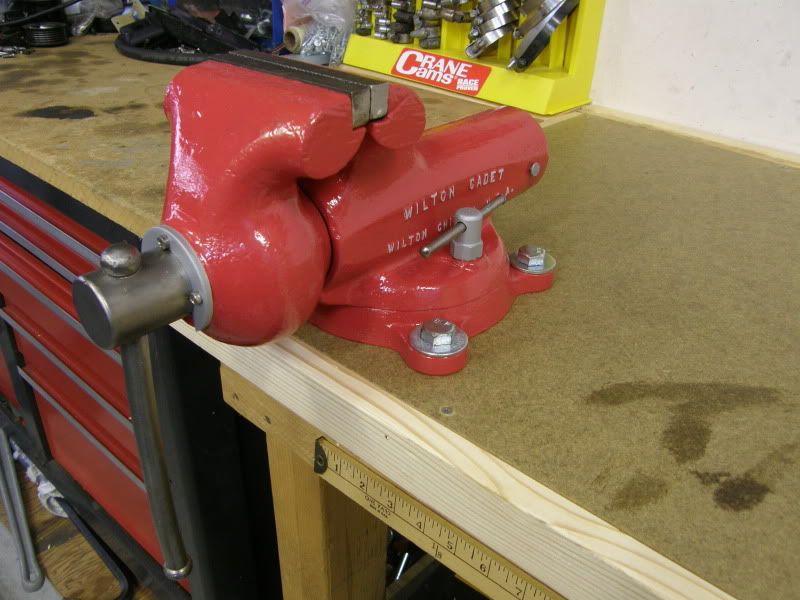
I ran into this issue while restoring my '56 Wilton Cadet. As you can see the jaw screwheads were completely stripped and pretty much toast. In addition, they hadn't been removed in over a half century!

P8240006.jpg


P8240009.jpg


First thing I did was soak 'em in PB Blaster. Then put a phillips screwdriver in the screwhead and banged it with a hammer a couple of times. Repeat 2 or 3 times, soak 'em again and come back the next day. Repeat process one more time and come back the next day. Then I went and picked up these for $9 at Sears.

P8300001.jpg


Chuck it in a quality reversable drill. Nothing less than a 1/2" drill, and start torquing in reverse - slowly!

P8300003.jpg


Couldn't believe how easily they came out!

Finished product.

P9050021.jpg
 

skruft

Well-known member
Joined
May 9, 2011
Messages
759
Here is a method I have used with success on machine screws. After using the penetrating oil, heating red hot with a torch, and cooling, chuck the proper screwdriver bit into a hand brace. (This is about the only good use I have ever found for the screwdriver bits that have the square shanks for braces). Hold the bit in as hard as you can and yank on the brace. I have found that this will usually break the threads loose so that you can remove the screw.
 

EOC_Jason

Well-known member
Joined
Jun 25, 2012
Messages
11,388
Location
Bentonville, AR
Ok so lets say I chose the route of drilling. What happens if this method does not work? I now have holes in the screws (hopefully just one haha) and no where further along.

You keep drilling them out until you are right at the edge of the threads. Then you take a pick and pick out what's left of the screw. Finally you re-tap the holes to clean them up.
 

Notwerk

Well-known member
Joined
May 11, 2011
Messages
329
Never had luck with screw extractors, but the drill-out method has worked for me. You have to be careful to get the drill going straight down the middle of the screw. Go real slow and use cutting fluid or at least the occasional spray of lubricant to keep the drill bit cool (I also cycled between three bits, just in case). I'd go with Cobalt bits, preferably left-hand bits. You can get away with just using regular drill bits and drilling off the head of the screw, if it's just the head that's damaged. Just removing the head of the screw gets rid of a lot of the tension that holds it in place.

But obviously, that won't help with rusty threads. Penetrating fluid (Kroil, PB Buster) will help, as will the wax/heat method others have mentioned.
 

BlindViper

Well-known member
Joined
Dec 1, 2009
Messages
1,304
Location
York, PA
I would drill off the heads of the screws. Then heat the left overs with a torch and remove with vise grips.
 
OP
B

BHH

Well-known member
Joined
Apr 1, 2011
Messages
1,086
Well ****. After 72 hours of soaking in PB Blaster and hitting the screws every few hours with a screw driver. Drilled a pilot hole in the screw. Used a fine tip torch and got the screw near read hot and tapped an Ez out in the hole. Slowly trying to back it out and SNAP now I have about 1/4" of a hardened steel EZ Out stuck in one screw.

Tried drilling the head off the other screw, nope no luck, the thing just will not budge.

I just really hope I can now find a good machine shop to fix this **** I have created.
 
To avoid these ads, REGISTER NOW!

jrlp

Well-known member
Joined
Mar 20, 2012
Messages
459
Location
Laredo, Texas
No-go on the ez-out when red hot. When the screw shrunk, it shrink-fit on the ez-out, and you jammed it against the threads even harder! Yikes! Goodluck!
 
OP
B

BHH

Well-known member
Joined
Apr 1, 2011
Messages
1,086
No-go on the ez-out when red hot. When the screw shrunk, it shrink-fit on the ez-out, and you jammed it against the threads even harder! Yikes! Goodluck!

Is this something a good machine shop can fix?
 

ephotrod

Well-known member
Joined
Jun 24, 2006
Messages
1,162
Location
Texas
The method i use has worked for me almost every time. Take an old nut and place it over the broken screw. Weld the nut making sure you penetrate to the remainder of the screw. While its still hot from the heat produced through the welding process melt a bit of 100% bees wax onto the broken screw (all you have to do is let the wax make contact with the hot screw and it will wick into the threads). Let is cool thuroghly and then slowly back out the screw a bit and then run it in a bit and then back out more and run in a bit, until your screw is complete off. This is a slow process specially backing out the screw, so have patience eat first and make sure you don't have to use the john.
Josh
 

Outlawmws

Well-known member
Joined
Aug 9, 2011
Messages
39,244
Location
The Badlands
Pics of your disaster will help.

ephotrod's process is a good option, but first lets see if we can get the EZ out out agian..
 

jrlp

Well-known member
Joined
Mar 20, 2012
Messages
459
Location
Laredo, Texas
Is this something a good machine shop can fix?

Yeah, not a big deal. They'll either shatter the ez-out with a good punch, or heat it up to anneal it since you most likely used a HSS Ez-Out. They'll weld a nut to the screws like ephotrods said, and remove them with a ratchet in about 10 minutes. I like welding a washer to screws first, then a nut to the washer for more surface area and leverage. If you brought me the vise, you'd have it back in 15 minutes or less. Before taking it to a machine shop, see if you can find a performance car place around your town. They usually have a weldor, or someone at least mildly proficient in welding, and it would probably be cheaper than a machine shop.

:beer::beer:
 

Gert

Well-known member
Joined
Feb 21, 2012
Messages
139
Location
Netherlands
Removing stuck bolts or srews is always frustrating.
Keep trying, never give up!
Sooner or later it will get out.
 

EOC_Jason

Well-known member
Joined
Jun 25, 2012
Messages
11,388
Location
Bentonville, AR
Is this something a good machine shop can fix?

Yes, they can drill that out with a carbide endmill... If it's a common thread (I'm sure it is) they can probably even run a tap through the threads to clean them up if you ask nicely...

One of the machine shops near me, they get parts from a near-by oil tool company. They keep stripping out these set screws (allen head) so the shop has to drill them out... I swear they end up doing dozens at a time, poor guy probably has nightmares about never ending piles of parts to drill out... At least they get paid by the hole... ;)
 

MrRocket

Well-known member
Joined
Jan 24, 2010
Messages
46
Location
Jefferson City, Mo.
The same thing happened to my 5 in. Columbian vise. Drilled the head off to remove the jaws and then used a pair of vise grips to remove the screws. I did try using P Blaster on it first but that didn't work (broke a big screwdriver). Once the jaws came off it seemed loose. Like someone mentioned earlier, the tension of the jaws might be alot of the problem. Once they were off the screws came right out.
 

WVBrady

Well-known member
Joined
May 5, 2005
Messages
1,679
Location
WV
..., poor guy probably has nightmares about never ending piles of parts to drill out... At least they get paid by the hole... ;)

Don't feel sorry for him. He's probably pretty good at by now and that's JOB SECURITY!
 

jrlp

Well-known member
Joined
Mar 20, 2012
Messages
459
Location
Laredo, Texas
Don't feel sorry for him. He's probably pretty good at by now and that's JOB SECURITY!

Truthfully, once you've done a few (hundred) it becomes second nature and you know exactly how buggered it is, and the least amount of work to remove it. Bet ya he sets up his machine and kicks out a hole or two a minute! Piecemeal work gets boring, until you start thinking about ways to streamline the process and work smarter not harder!
 

EOC_Jason

Well-known member
Joined
Jun 25, 2012
Messages
11,388
Location
Bentonville, AR
Couldn't they be removed with a EDM?

Actually, they do have a portable device to burn out broken carbide taps. I forgot what they are called or how they work. I wonder if it could be used for regular metal.
 

GRX

Well-known member
Joined
Dec 4, 2006
Messages
2,032
Location
MD
Actually, they do have a portable device to burn out broken carbide taps. I forgot what they are called or how they work. I wonder if it could be used for regular metal.
Regular metal ... Yes, it can be used for most any metal, and there are set ups for ceramics too. I used a portable EDM when I worked for Caterpillar quite often. It could bolt to the side of equipment or engine block to remove various broken bolts. Cannot remember the brand. You basically burn a hole through the broken piece, it shrinks upon cooling, then it often comes right out hardly damaging the threads if at all.

As you may know, EDM = electrical discharge machine. Also called "spark erosion", which is an apt name for it. Works not unlike a welding rod which burns away the material. The same technique is used for machining as well.
 
To avoid these ads, REGISTER NOW!
Top Bottom