To avoid these ads, REGISTER NOW!

Routing air in the Garage

Joined
Dec 15, 2005
Messages
24
Location
Midland, GA
I am a new guy here. I have a lot to learn based on what I have read.

What is the best way to route "hard" compressed air lines around in my garage? Buy a kit or fabricate yourself?
 
To avoid these ads, REGISTER NOW!

MXtras

Well-known member
Joined
Aug 17, 2005
Messages
1,356
Location
On the Right Coast
Fabbing yourself will cost less in my opinion. The air system components are a bit pricey.

Copper is one way, iron pipe is another. Copper is expensive but can be soldered together easily while iron is relatively less cash but might require threading.

I went with iron.

The first person to suggest PVC gets an internet beating....... (don't use PVC).

Scott
 

1320stang

Well-known member
Joined
Dec 28, 2006
Messages
4,573
Location
Edmond, OK
I just got to thinking, using PVC mock up your iron pipe system might not be a bad idea. Then you have your lengths and can have the pieces threaded at the store. I'm 15 miles from a store, I may end up doing this instead of the copper I want to run as I'm hoping to build a shop in the future, I'll use copper there. Although I could take this down and reuse it in the shop..... (decisions, decisions, decisions.....)
 

xtremes

Active member
Joined
May 20, 2006
Messages
30
Location
Stuyvesant, NY
I used 1/2" brake lines. The kind they used in tractor trailer trucks. It's rated at 2000 pounds and is flexable and uses standard compression fittings.
It's easy to work with.
 

RacerX

Well-known member
Joined
Mar 27, 2007
Messages
377
Location
Caldwell, Tx
What was your cost per ft? Where do you purchase the material? Tractor Supply or online somewhere? Pics?


xtremes said:
I used 1/2" brake lines. The kind they used in tractor trailer trucks. It's rated at 2000 pounds and is flexable and uses standard compression fittings.
It's easy to work with.
 

xtremes

Active member
Joined
May 20, 2006
Messages
30
Location
Stuyvesant, NY
I bought the tubing from NAPA. It was $50.00 for a 100 foot roll. I bought the compression fitting from a local hardware store. I set up two outlets in my garage. One in the front and one in the rear. I spent around $25 for the fittings.
I can get some pics tomorrow if you'd like.
 

BADSBRD

New member
Joined
Jun 21, 2005
Messages
3
Location
Joliet, IL
Has anyone used PEX for their air lines? Just curious. From what I have read it will not explode in the same manner as PVC. SInce it is not brittle like PVC, when it fails it will not explode. My neighbor works on heavy trucks, and tells me they use it ont those. The stuff we looked at in the store was only rated for 100 PSI, but that was at 180 degrees.
 

VintageGarage

Member
Joined
Jan 29, 2007
Messages
8
I went with black iron pipe. Had to visit the hardware store for a lot of threading, but it is a very solid installation.
 

jeep63

Well-known member
Joined
Feb 8, 2006
Messages
264
Location
Maryland, USA
I ran copper. 3/4 for the main runs and each spur is 1/2" down to the outlet. Simple and no worries about shattering.
:beer:
 

maa139

Well-known member
Joined
Feb 24, 2006
Messages
175
Location
West Chester PA
I used black Iron - cheap/easy/changable. I also never installed an elbow. Every place that is currently the end of the run has a t with one side plugged. This way if I ever need to expand it, I can simply remove the plug and add another piece of pipe to route air somewhere else. I also had all of my measurements on paper, so any threading that needed to be done was done at lowes when I bought the pipe....Just make sure to use a sealant on the threads.

Matt
 

Uncle Buck

Banned
Joined
Mar 7, 2005
Messages
9,120
Location
Kansas
Fabbing yourself will cost less in my opinion. The air system components are a bit pricey.

Copper is one way, iron pipe is another. Copper is expensive but can be soldered together easily while iron is relatively less cash but might require threading.

I went with iron.

The first person to suggest PVC gets an internet beating....... (don't use PVC).

Scott


PVC! :lol_hitti :willy_nil :eyecrazy: :shoot5: :rocketwho :rant: :deathmeta :banhim: :uzi: :boxer: :deadhorse
 

MustangRick

Well-known member
Joined
Dec 26, 2006
Messages
308
Location
KC
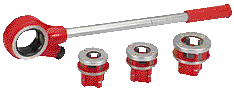
If that is the ~$45 set, then yes I used it on my installation. I threaded about 50 or so ends. You need to go slow other wise it will nic up the threads a little.
 

Uncle Buck

Banned
Joined
Mar 7, 2005
Messages
9,120
Location
Kansas

JB740i

Well-known member
Joined
Jan 3, 2007
Messages
615
Location
Central Florida
I used black Iron - cheap/easy/changable. I also never installed an elbow. Every place that is currently the end of the run has a t with one side plugged. This way if I ever need to expand it, I can simply remove the plug and add another piece of pipe to route air somewhere else. I also had all of my measurements on paper, so any threading that needed to be done was done at lowes when I bought the pipe....Just make sure to use a sealant on the threads.

Matt

Bringing the thread back from the dead. Anyone else took in their measurements to Lowes and let them fool with it? I guess the only problem would be when you got home and realized that they screwed up it up and it leaks.

Wonder if they'd let you just drop off the list and come back and pick it up when done.
 

dmh_sr

Member
Joined
Mar 31, 2005
Messages
9
Location
texas
I was wondering what kind of brackets are used to mount the black pipe (or other pipe) to the wall?

Seems like I saw a bracket somewhere with a threaded end, so you have some adjustment for how far or close the pipe is to the wall.

That might help where you have a U shaped section.
 

alberto

Well-known member
Joined
May 28, 2007
Messages
756
Would you guys recommend against putting it in the wall (for new build)? I would prefer to hide the piping, but am afraid that putting it into the wall would make it inaccessible should I need to expand the system, reposition something, etc.

Thoughts?

Alberto
 

Itzkwik

Well-known member
Joined
Mar 19, 2006
Messages
539
Location
Montpelier, VA
I was wondering what kind of brackets are used to mount the black pipe (or other pipe) to the wall?

Seems like I saw a bracket somewhere with a threaded end, so you have some adjustment for how far or close the pipe is to the wall.

That might help where you have a U shaped section.
Go to a plumbing supply house and get some split ring hangers, some all-thread and some stand off plates. You can cut the all thread to any length you need. The picture is of the hanger. The stand off plate mounts to the wall and the all thread screws into it.
 

Attachments

  • 3023tc1s.gif
    3023tc1s.gif
    2.7 KB · Views: 654
To avoid these ads, REGISTER NOW!

JB740i

Well-known member
Joined
Jan 3, 2007
Messages
615
Location
Central Florida

In that diagram, how do you go up from the T fitting and then back down? Does the horizontal pipe stay off the wall so you can do the drops between the wall and the pipe or do you put the down pipe outside of the horizontal pipe? How do you then fasten it to the wall?

Just seems like it would be easier to secure everything from vibrating if the downpipe came straight down from the t-fitting. Although I'm aware that would cause more water in your lines that would need draining.

Who's got a picture of that kind of setup in real life?
 

kbs2244

Well-known member
Joined
Nov 11, 2006
Messages
14,065
“F” is a flex metal hose.
I do prefer to rout it into a “tee” with a drip leg and valve so the moisture doesn’t drain back into the tank.
It takes 3 elbows to go up, over, and down.
They don’t show the hanging hardware. But I like the all thread and pipe hangers idea. I would hang it from the joists.
 

flesburg

Well-known member
Joined
Aug 15, 2006
Messages
105
Location
Pontiac, IL
Hello:

I have been working on my hobby garage for a long time now, and just this past weekend finished the install of the compressor. Mine is a 5hp 80gal Quincy 2 stage
that is set for shut off at somewhat over 150 psi. The gauge is reading 162 or so pounds.

I installed 1/2 inch copper and buried it in the walls. I have soldered a lot of plumbing (water) lines but it was years ago, and I had used just a little of the "no lead" solder and found it difficult, but after some practice got pretty good at it. I mounted my compressor on anti-vibration feet that I bought on line from Enco, and used an 18 inch high pressure piece of air hose from McMaster Carr as an anti vibration link between the compressor and the hard lines

Once I had mastered the soldering, it went well. I have 5 outlets in my car bay (20' x 36' x 12') and one in my wood shop (17' x 30' x 9') one in my wifes hobby room (20' x 27' x 8') and two outside (one for my future sand blasting cabinet . . . spring/summer/fall use only . . and one for an air hose to blow off lawn mowers etc.)

Each outlet is equipt with a quick disconnect, except one in the car shop ceiling for a hose reel, and guess what?

I started the compressor up, and it pumped up to 165 pounds. After 2 days it was reading 162 pounds. I certainly would use copper again and I get plenty of air flow with 1/2 id tubing.

I spent more on the quick disconnects than I did on the tubing.
 

ovilla

Well-known member
Joined
Dec 18, 2005
Messages
2,342
Location
Plainfield, IL
Use PVC at your own risk. If a line explodes on you, PVC turns into shrapnel as it flies all over the room. Metal or copper will not do that.
 

wantedabiggergarage

Member Emeritus
Joined
Feb 25, 2006
Messages
3,897
Location
Independence, MO, USA.
ok, I'll bite. What's wrong with PVC?

Oh no.

Basically - PVC will splinter violently when it ruptures. It is not suited for use in compressed air systems.

Scott

PVC/CPVC isn't rated for air. In a commercial setting, OSHA can fine you for using it. But if you want plastic, there are two types that are rated for air. One is a type of ABS ( colored differently then the plumbing stuff), and the other is a type of pex (Pex-AL-Pex if I remember correctly). I looked for the ABS a few years ago, due in part to someone wanting inexpensive plastic, and part bet. It made copper seem inexpensive.
 

Steve in Mi

Well-known member
Joined
Mar 13, 2007
Messages
1,042
Location
Mid Michigan
Would you guys recommend against putting it in the wall (for new build)? I would prefer to hide the piping, but am afraid that putting it into the wall would make it inaccessible should I need to expand the system, reposition something, etc.

Thoughts?

Alberto

I don't see any against posts so far. I ran my air lines in the walls and like having them out of the way.

This is the way I installed my copper air lines, fwiw.
http://www.garagejournal.com/forum/s...ers#post116465
<!-- / message --><!-- sig -->
 

trainer

Well-known member
Joined
Nov 28, 2005
Messages
2,019
Location
Northern Ontario, Canada
I did mine with soldered copper, exposed on the wall.
A few minutes with brasso polish on each secton, followed by a quick hit of rattlecan clearcoat, and it looks awesome.
 

e-tek

Well-known member
Joined
Dec 19, 2007
Messages
10,690
Location
Saskatoon, SK
You can see some of my set up in this pic, but not much. The important parts are: have a flex hose from compressor to hard line, build in a slope so that any condensate runs towards a filter/drain, build in a drop before a connection.
 

rubadub

Well-known member
Joined
Mar 30, 2008
Messages
75
Location
two rivers, wi.
Heres this. --------------------------------------------------------------------------------

I wrote this up a couple of days ago on another forum, anyway.


With galvanized pipe you have galvinization inside the pipe, that could plug up a regulator or filters.

Also black pipe will rust inside, but I think the rust is the lesser of the two evils.

Whichever you use might be a wash, but my experience with black pipe has been really good.

So lets get down to the basics here, the heat from the compressor heats the air going into the pipe, as it cools it turns to water, so, we know have either rusty water or pieces of galvinized flakes going with it.

Our main concern here is trying to get long life out of our air pressure regulator, and most important is to keep rust or flakes or water out of our paint gun or air tool, or keeping the moisture out of our sandblaster pot.

Water will take the rust and flakes with it, and this is one of the things that will eventually do an air tool in.

So, we plumb our air lines on a taper so we don't have any flat spots, (where water can lay in the pipe).

At the bottom of these lines we put in drains to get rid of the rusty water or flakes.

In order to cool the hot air you put in a minimum of 50' of pipe, 75 to 100' would be better, then your pretty sure of your air coming out at more of a room temperature if possible, I probably shouldn't use room temperature.

At the end of this long run of pipe, thats where you put your filters. You will still have some water and rust or flakes or whatever coming into this first filter.

I use an f-88 sharpe filter, but no doubt there might be some out there a lot better then the f-88s, but these work good.

At the end of my long pipe run, I have three f-88s one after the other right in line.

These f-88s have a white stone type filter in them.

A couple of years ago my compressor bit the big one, so I changed it out.

So I took out the stone filter in all three of them, the first filter was pretty brown looking, the second one was a little tinge of brown coloring to it, and the third one was almost snow white, and mind you they have been in three quite a long time, I never have to change them out, only did because the compressor let go.

Now if i would have had galvanized pipe, would the flakes have gotten through to it, I don't have a clue on that, maybe or maybe not.

Heres another thing, I have been buying air tools since 1980, anyway I bought a bunch of them that year, thats 28 years ago, some of these air tools are just average priced air tools, not expensive but not the cheapest either, anyway, the only air tool i have ever replaced was a metal crimper and a couple of good napa air ratchets, worked them to death, they were good ratchets.

I counted my air tools the other day, because I haven't been working in the garage, I would give each one about three drops of air tool oil every 3 or 4 moths, and run them a few seconds, this is a good thing to do if you don't use them on a regular basis.

Anyway a couple of times I oiled them I forgot about one in my regular tool box, so I count them now, theres 23 of them and they all work just fine.

Did these 3 f-88s filters and a good set of tapered air lines keep these tools this good for that long, maybe, I'm not out there every day, but they have gotten a lot of use over the years.

Would galvanized or copper or whatever air lines have been better, maybe.

I'm 66 years old and can still work pretty good, so i still use these tools today. As you get older you don't get any smarter, maybe you get dumber, probably, buy older guys have seen more s**t happen, so you learn over the years if something works really good, its best to leave it alone, in most circumstances anyway.

I've set here and beat the drum on the black iron pipe and how i like it, but if something works good, you know the deal.

Hooking up a good set of air lines takes some planning and a little researching, the extra time looking at different setups will save you time and I would bet a good amount of money, in air tool life and wasted paint.

I'm not real sure on copper lines and how they cool compared to black pipe, maybe there better and probably rust free, but there are other things with copper that need to be looked at, but the galvanized or black pipe will take a little more punishment then the copper.

Running long lines of pipe and keeping it from leaking is a job. If you take a small wire brush and clean all your pipe connections with that and some lacquer thinner, you will have a lot less chance of a leak.

I use pipe dope or tape, it doesn't matter, I probably have about 150 or 175' feet of pipe run in all different directions, with zero leaks, but it took me a while to get it that way.

Its going to take you a while to run it, but once its in you can forget about it, and if you run it right you don't need an air dryer, I run a couple of sand blasters and a fairly large bead blaster, and I don't have a moisture problem with silica sand, and thats the worst stuff you can run if you have any moisture in your lines.

The air line drawing I put up a couple of post before this, gives a decent overview on how to run your lines without flat spots, hopefully somebody can get some good out of it.

You will see some mention of automatic drains on filters, for a commercial body shop thats probably a good deal, but as a hobbist, you might want to get the ones with the little wingnut, drain it at the end of the day, and check your finger tips, if it feels slippery something let loose in your compressor, and this could save you some major airline redoing to get the oil out, don't ask me how I know this.

I was pretty long winded on this, sorry about that, but if just one of you read it and get anything out of it, I guess it was worth it.

I will say this though, galvanized or copper might be better, but this black pipe works good for me.

Heres that drawing again, its about four feet long, thats the reason for the sections. http://www.1969supersport.com/draw1.html

Rob

http//www.1969supersport.com
 

Kevin54

MEMBER EMERITUS
Joined
Jan 12, 2005
Messages
29,341
Location
Urbana, Ohio
With galvanized pipe you have galvinization inside the pipe, that could plug up a regulator or filters.

Also black pipe will rust inside, but I think the rust is the lesser of the two evils.

That's the two things that you hear all the time, but those two types of pipe has been used since air compressors first came about. My fathers setup is over 50 years old with black pipe. In his other shop before that, he had both. Never had a problem. I know, I asked him. Personally, if affordable, I would go copper just for the ease of installation.
 

PAToyota

Well-known member
Joined
Jan 20, 2006
Messages
4,366
Location
South Central Pennsylvania, USA
Would you guys recommend against putting it in the wall (for new build)?

I think you brought up the one issue - if you want to expand or change something you're either going to have that part outside of the wall while the rest is inside or you're going to be tearing the walls apart to put the new stuff inside the walls.

Also, I had a joint that developed a leak over time. Exposed, it was a fairly simple matter to cut it out and do it again. If it was inside a wall the first issue would have been finding the leak...
 
To avoid these ads, REGISTER NOW!
Top Bottom