To avoid these ads, REGISTER NOW!

Adding a ceiling junction box from a wall outlet?

NewShockerGuy

Well-known member
Joined
Oct 12, 2010
Messages
2,481
Location
Northern Virginia / DC
I don't even know if this is possible to do so I figured I'd ask.

I am in the process of making my modding room. Pretty much it's my work room that I have my computer in, will have another computer at the work benches and my tv/counch.. it's big enough for me to do pretty much any project I want to do in the house. Good space actually.. So I bought two work benches from Sam's club since people liked them here. (THANK YOU!), got a good score on wood wall cabinet and hung it above the work bench.

Ordered some LED strip lighting and now have that undernethe the cabinets... problem is I still can't see what I am doing. There are 3 over head lights.. two fans , on the left, and one on the right with three 15a light bulbs.. In between the two fans there is a small dome light that is dimmable.

There are two electical outlets, one under each of my work benches. I will connect a power strip to each one so the main workbench I will have 12 outlets and that is mainly to plug in say my dremel, battery charger..etc. Nothing like a grinder or anything big.

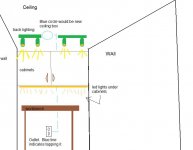
What I would like to do to get light to project down directly above me is either some type of strip lights or something... My main question is can I somehow tap power from the electrical outlet and put in a ceiling fixture so that I can run maybe 3-4 pod type track lighting to shine directly down on me/my work area?

I am starting to dabble more into electical, I'm pretty inclined when it comes to doing most stuff around the house. The only thing I have not done was install the outlets in the garage and that's mainly because I didn't know how, so I had an electrican install 8 outlets which cost me around $500... I personally don't want to pay for the electrician to come out again just for something that I can see him, taking the outlet out, adding wire, cutting a hole pulling the wire up and then cutting the hole in the ceiling...etc.

I've made a VERY crude drawing of what I am talking about.

I will take pictures as soon as I get home to upload them. Also if it IS possible to tab off the outlet what does one do since there is no switch to turn the light on /off or would I tap into the existing switch that is on the other wall that controlls the fans/light and dimmible light? We are talking maybe from where I want to install the light figure to the switch 15', And if I tapped the outlet below the workbench probably 12'.. so it's not far at all..
I have all the necessary tools to pull wire/cut drywall, fix drywall...etc. I'm just unsure but can't see spending what will cost me here over a couple hundred...easy..

Thanks for the help, again I'll get real pictures today when I get home so you can see the layout.

-Nigel
 

Attachments

  • crude drawing.jpg
    crude drawing.jpg
    36 KB · Views: 98
To avoid these ads, REGISTER NOW!

pattenp

Well-known member
Joined
Jun 4, 2008
Messages
10,175
Location
Virginia - USA
It should be no issue to add a ceiling box as you described. Use the same size wire that is feeding the outlet. If the outlet is on a 20A circuit then use #12 wire to the ceiling box, if it's on a 15A circuit then use #14 wire. Put in a wall switch in line above the work bench to control the light.
 
Last edited:
OP
N

NewShockerGuy

Well-known member
Joined
Oct 12, 2010
Messages
2,481
Location
Northern Virginia / DC
Pictures as promissed.

Light switch from across the room, again only about 15' from my work bench.
20120917_164603.jpg


Fans and middle light. Just not enough DOWNWARD light.. the entire room is light up fine, just my area at the work bench. I thought the led under cabinet lighting would help but that lights up the pegboard but nothing past it so to speak so there is dead black space when I am working on the bench and I have to use a flash light to see small areas... I don't like it at all.

20120917_164613.jpg


Workbench with outlet. You can see the ceiling, it's not high, I think 9-10' ceilings.

20120917_164623.jpg


LEDs on under cabinets.
20120917_164647.jpg


How would I tap off an existing outlet and add a switch?

As far as how many things are on it.. no clue.. I think just the 4 outlets in the room are all linked together... When I shut the one break off only the top light shut off but the outlets were still active.

Thanks,
-Nigel
 

csp

Well-known member
Joined
Mar 23, 2010
Messages
5,719
Location
Franktown, CO
As far as how many things are on it.. no clue.. I think just the 4 outlets in the room are all linked together... When I shut the one break off only the top light shut off but the outlets were still active.

Kill the breaker that powers that outlet and then figure out what else has no power with that breaker off.
 
To avoid these ads, REGISTER NOW!
OP
N

NewShockerGuy

Well-known member
Joined
Oct 12, 2010
Messages
2,481
Location
Northern Virginia / DC
The basement is finished. There is a small access panel on the right side by my computer that I can stick my head through and see the concrete/walls, then the drywall and studs... Not big enoughfor me to actually fit mind you but I can stick my head in and hand and feel around and use a flashlight to see. I'm know the rafters on the main floor go from left to right so in the picture above I'd have to check.

How does one tap off an exsisting outlet and then add the switch?

I know if this was say, DC power I could just run a +/- line and wire and inline switch somewhere..etc. AC power, still learning...lol

Thanks,
-Nigel
 

scutty83

Well-known member
Joined
Apr 25, 2011
Messages
56
Location
Southwest Missouri
First off, ac power is somewhat like dc in the sense there is power and ground. The difference is the black is power, white is neutral (or what you think of as a ground), and if in most situations, a third wire that is bare and is considered the ground.
Now in your situation, there is more than one way to skin a cat. Some like to run power through the switch, and some prefer to run the power to the fixture first and "break" the circuit there. The latter is my preferred method.
First, MAKE SURE THE BREAKER TO THE OUTLET IS OFF.
Second, take the outlet out that will be the easiest to tap off of and figure out if it is the last outlet on that circuit or one in the middle of the cicuit. If it has power running in AND out 2 whites, 2 blacks, and grounds then it is a mid-circuit outlet and you will need to make a pigtail connection. If it just has a single black, white and neutral (one white, one black, and one bare copper) it is the last outlet on the circuit and you could simply tie in to the open terminals on the outlet and continue on to your new fixture box.
Third, make another run of wire from the fixture box to the switch box and install switch. Black or white does not matter at the switch end, just make sure the switch reads correctly (on-switch up, off-switch down).
Now, to be able to switch the light on and off, you new to "break the circuit". At the fixture end, mark the white wire running from the fixture to the switch with a piece of black electrical tape. Now, at the fixture box tie the black wire coming from the source to the the white wire relabled as black. Think of that run as two black wires or "positives". You are simply taking the power before it feeds the fixture, running it back to the switch, so it can can be interrupted (on and off) then you complete the circuit by running power back up the other wire (in your case the black) to complete the circuit. So, you should end up connecting one white wire to one terminal and one black to the other terminal. Tie all bare wires (grounds) together.
Like I said there is more than one way to do this, there may be others who tell you to run power to the switch first which is also acceptable.
 
Last edited:

wyliesdiesels

Well-known member
Joined
Aug 14, 2012
Messages
20,014
Location
Modesto, CA
The basement is finished. There is a small access panel on the right side by my computer that I can stick my head through and see the concrete/walls, then the drywall and studs... Not big enoughfor me to actually fit mind you but I can stick my head in and hand and feel around and use a flashlight to see. I'm know the rafters on the main floor go from left to right so in the picture above I'd have to check.

How does one tap off an existing outlet and then add the switch?

I know if this was say, DC power I could just run a +/- line and wire and inline switch somewhere..etc. AC power, still learning...lol

Thanks,
-Nigel

What u can do is install a metal surface mount junction box with threaded KOs. Then get some metal raceway(I forget the brand name- its a little wider than romex) and surface mount this going up the wall to another SM junction box. Put ur switch in this box and continue with more raceway up to the ceiling! All types of fittings are made for this raceway including the necessary fitting with threads to connect the raceway to junction boxes. You can re-install the outlet below your desk in the new SM junction box!

As far as how to do the wiring, u either connect the romex for your light to the empty terminals on the back of the outlet or make pig tails. I suggest getting a basic wiring book to help with the actual wiring!
 
Last edited:

Wholesum

Member
Joined
Sep 20, 2012
Messages
8
Lamps need to be either plugged into an outlet or wired into a switch by code (and it is a good idea anyway to avoid a house fire from a wiring problem in a lamp). You can run power from an outlet to a switch and from the switch to pancake boxes mounted on the ceiling. This is not all that difficult but you do need to make a couple holes in the sheetrock to pull the wire through and then patch them when you are done.

Before you start you should verify everything that is on the wall outlet circuit. If it goes to a 15 amp breaker in the panel that limits the circuit to 1800 watts maximum at any one time. It is not likely you have power to spare for light fixtures unless you stick to CFL or LED lamps. I would avoid CFL on a ceiling as they overheat and fail when "upside down" in a relatively short period of time and the light is marginal anyway. Halogen will require the most power to run off the circuit.
 

eljefino

Well-known member
Joined
Feb 21, 2008
Messages
336
I would pull the fixture in the ceiling closest to where you plan to make your hole for your track lighting. Fan or light, doesn't matter, though the fan should be on a heavier dutier box that's harder to pull. Just get a look at what you have up there. Hopefully the electrical box can also come out with a few inches of slack in the wire so you can see up in the cavity.

Does it matter if the new light is switched along with the light you have? Some circumstances may require it, IE if it only sees a switched feed.

Do you know what's above your sheetrock ceiling and whether you'll have the joists parallel to your wire (easy) or perpindicular (pita)? I'm thinking if you lived a lucky life you can just toss/ fish a few feet of romex through the cavity in your ceiling.
 

wyliesdiesels

Well-known member
Joined
Aug 14, 2012
Messages
20,014
Location
Modesto, CA
Lamps need to be either plugged into an outlet or wired into a switch by code (and it is a good idea anyway to avoid a house fire from a wiring problem in a lamp). You can run power from an outlet to a switch and from the switch to pancake boxes mounted on the ceiling. This is not all that difficult but you do need to make a couple holes in the sheetrock to pull the wire through and then patch them when you are done.

What are u talking about? The OP said nothing about cord and plug lamps! Also, surface mounted metal raceway is easier and you don't have to cut holes in the sheetrock!


Before you start you should verify everything that is on the wall outlet circuit. If it goes to a 15 amp breaker in the panel that limits the circuit to 1800 watts maximum at any one time. It is not likely you have power to spare for light fixtures unless you stick to CFL or LED lamps. I would avoid CFL on a ceiling as they overheat and fail when "upside down" in a relatively short period of time and the light is marginal anyway. Halogen will require the most power to run off the circuit.

"Not enough power to spare for light fixtures"? This is a finished basement used for small projects. Its not like he has a welder or air compressor plugged in. And I'm sure he could easily move things around to another circuit if he had to. And CFLs take hardly any power so I doubt that's even an issue. Also, u can get fixtures that have the socket pointing horizontally if premature burn out is a concern, though I doubt it. BTW, I have CFLs in my ceiling fan, which are pointed downward and not one has failed in the year they've been there. So, I'm not sure where you're coming up with that issue.
 
To avoid these ads, REGISTER NOW!
Top Bottom