To avoid these ads, REGISTER NOW!

I'm too stupid to drill a hole!

Tanshanomi

Well-known member
Joined
Sep 10, 2009
Messages
218
Location
Missouri
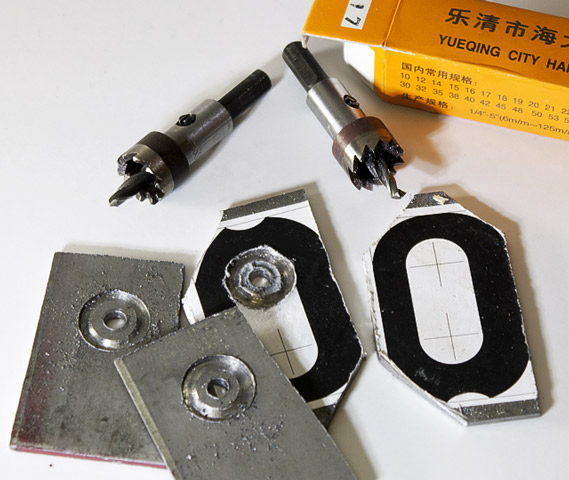
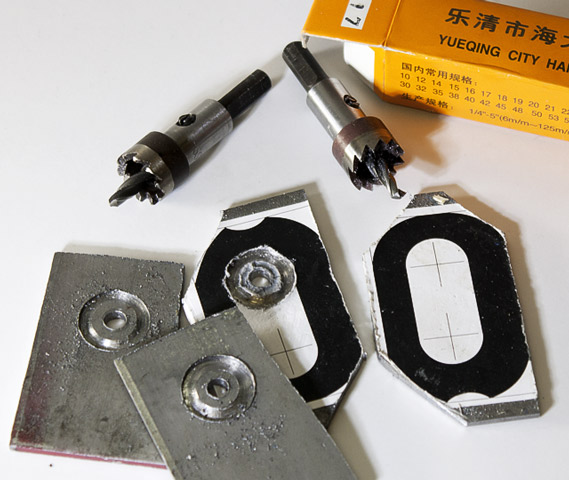
I'm trying to make two simple spacer plates out of ordinary 1/8" mild steel. I just need to drill a couple of 17mm holes and shape it a little with a grinder. Really, really, simple stuff. Well, here are my first three failed attempts:
spacer-plate-holes-screwed.jpg%20

spacer-plate-holes-screwed.jpg


I ordered a couple of "precision" metric hole saws online that ended up being shipped directly from Hong Kong, which scared me a bit. I chucked one in the drill press and gave it a shot. The runout was terrible and since my drill press doesn't have a slow enough speed, it was worn dull before it got halfway through, even though I used a little 3-in-1 household oil to lube the teeth.

So, I tried again with my 14.4V hand drill, trying to keep the speed where it was making the biggest chips. By the time I was half-way through, the center hole was so egged out that it was ruined.

I asked a friend of mine what I was doing wrong, and he said, "just pay a shop to cut them with a waterjet." That's not the only right answer and certainly not the one I was looking for. I'm trying to build a bike from scratch, as an experiment [http://www.caferacer.net/forum/topic.asp?TOPIC_ID=20019. I THOUGHT I was pretty savvy in the garage. I've been riding and maintaining bikes for over 30 years, but my only previous exposure with any sort of really serious custom fabrication was many years ago, when I was putting myself through college at a bike shop, which gave me access to all sorts of tools and equipment and mechanic friends to help me. Doing stupid little stuff like this alone in my garage is turning out to be a whole lot more difficult than I expected. I know there are guys without lathes and milling machines who do this kind of stuff. Am I really this stupid, or do I just not have decent tools?
 
Last edited:
To avoid these ads, REGISTER NOW!

Jagmandave

Well-known member
Joined
Nov 6, 2011
Messages
6,305
Location
Overland Park, Ks.
1) You need a slower speed for your drill press.

2) Drill the 1/4" hole, then use a small piece of 1/4" rod to guide the saw, then it won't egg out.

You need a lot of steady pressure on the saw and slow speed to get a good clean hole, also I'm not sure 3 in 1 is the right oil to use, I'd use cutting oil.
 
Joined
Feb 16, 2012
Messages
899
Location
A.C.A.B.
Buy a good quality (not Chi-wanese) bi-metal hole saw. Go slow. Used motor oil is fine, as it is used more for lubricity than cooling.
 

alan camby

Well-known member
Joined
Dec 3, 2011
Messages
1,566
Location
South of Indianapolis, Indiana
You need a good quality cutting tool and the proper speed. My craftsman DP only goes down to 250 rpm and i can drill holes like yours with no problem.

I drilled 36 holes in this c channel that had a thickness of over 1/4" all with one carbide tipped hole saw. The holes are 1-1/4"
2011057.jpg
 

antinym

Well-known member
Joined
Jan 19, 2010
Messages
298
like everyone else said. You need to go much slower. When I'm cutting metal I use a lot of lube. Too much maybe messy, but way better than too little. I even built a pseudo portable coolant system.
 

jrlp

Well-known member
Joined
Mar 20, 2012
Messages
459
Location
Laredo, Texas
Rapid Tap is the best cutting fluid I've come across. I bought a small USA made piston oiler with a flexible nozzle, and use it on everything. I use it whether I'm sawing something with the portable bandsaw (especially SS), sawzall, drilling tapping holesawing.. It makes a huge difference. It's thick enough to not get flung everywhere and sticks rather well to both the cutting tip and the stock. For the parts you're trying to make, someone with a plasma can kick them out for you in a few minutes. Have them cut it a bit large and use a die grinder to clean the edges up.
 

larry_g

Well-known member
Joined
Apr 28, 2007
Messages
16,893
Location
oregon
I notice a couple of things with the cutter you posted a picture of. The teeth seem to have a negative rake which is not good for what your doing. The second is that the od of the cutter straight with no relief for the cutter shank to not rub on the od of the hole your cutting. You need some clearance between the cutter and the hole being cut, both on the od and id of the cutter.
Take a file and see if you can cut, file the tool that you have destroyed. If you can then you have a tool that is not hardened which could be from the material it is made of or not heat treated correctly. I would suspect that is a wood cutting tool, but I'm not familiar with the geometry of wood cutting tools of that nature.

Also investigate the difference between cutting fluid and lubricating oil. Lubricating oil is designed to keep metal parts separated so they have no friction or wear. Cutting oil or fluid is of low shear strength and will allow the cutter to contact the material it is supposed to cut. In the big box store go to the plumbing section and get some light or heavy cutting oil and try it. There is some advise above that I would take with a grain of salt.

lg
no neat sig line
 
Last edited:

Dick in Wisconsin

Well-known member
Joined
Mar 3, 2012
Messages
3,048
Location
Shawano, Wisconsin
You need a good quality cutting tool and the proper speed. My craftsman DP only goes down to 250 rpm and i can drill holes like yours with no problem.

I drilled 36 holes in this c channel that had a thickness of over 1/4" all with one carbide tipped hole saw. The holes are 1-1/4"

What did you use the finished C-Channel for?
 

bad_idea

Well-known member
Joined
Jun 11, 2011
Messages
4,335
Location
Pasquotank, NC
I work in ship repair and have to routinely drill holes upwards of 4" with a hand drill through 1/2" steel.

Drill the 1/4" hole, then use a piece of 1/4 stock as a guide instead of the drill bit. The shaft from a phillips screwdriver will work with some cutting.

Bimetal holesaw is good enough, morse or lenox are good.

Slow speed and steady pressure.

Anchorlube is a great cutting paste, lot less messy.

No need to buy a new drill press, 400 rpms will get it done. Plenty of cutting paste or fluid and lift the handle routinely to clear the shavings. The biggest thing I have found that dulls the holesaw are the shavings from the cutting operation. Once the hole saw cuts below the depth of the teeth it slows down quite a bit. This is only an issue on metals thicker than say 1/4". If it is thicker plate I usually drill a relief hole right in the path of the hole saw.

Don't worry, I work with plenty of jackasses that can't use a holesaw. It takes a little getting use to and some finesse. If using an electric drill, be careful it doesn't take you for a ride! If it catches it will ****** hard! I prefer a air drill if I have to drill it by hand, they stall instead of spinning.
 

Jack Olsen

Super Moderator
Staff member
Joined
Mar 22, 2009
Messages
6,678
Location
Los Angeles
There's really no getting around the slow speed part. You can buy a low-RPM hand-held drill at Harbor Freight, even.
 

Olafur

Well-known member
Joined
Jun 2, 2011
Messages
2,578
Location
Iceland
Even at way to fast rpm a decent hole saw should last several holes - and many with good cutting fluid. These drills are probably junk.

A decent step drill should do the trick also.
 

darkk

Well-known member
Joined
Dec 24, 2009
Messages
3,361
Location
Willimantic, Ct.
Your first problem is those are not precision hole saws. Those are spot weld cutters and were never designed to cut a thru hole in metal of any thickness. They were designed to cut through thin sheet metal around a factory spot weld. We used them *a lot* in the body shop........
 
OP
T

Tanshanomi

Well-known member
Joined
Sep 10, 2009
Messages
218
Location
Missouri
The lowest speed on my drill press is 620 RPM, so I'm definitely going to have to use my hand drill to get down to the 250-400 range. I'd actually thought about using a section of rod in the pilot hole. I might also back it with a thicker chunk of steel with a 1/4" hole.
 
OP
T

Tanshanomi

Well-known member
Joined
Sep 10, 2009
Messages
218
Location
Missouri
Anybody know where I can find quality bimetal hole saws in metric sizes? In this particular case there's no need for exact tolerance, so an 11/16" will work, but I will eventually need to make some fairly precise 15mm and 19mm holes...or do holes that accurate, that big really need to be milled?

EDIT: found this on Ebay — anybody know if this will do what I want?

Blair Rotobroach Metric Hole Cutter Hole Saw Kit 11092

http://www.ebay.com/itm/190696469529
 
Last edited:

Jack Burton

Well-known member
Joined
May 22, 2009
Messages
105
If you have a drill press, I'm assuming you can chuck up to a 1/2". So why not buy an 11/16" bit with a 1/2" reduced shank? Beats the hell out of any sweet & sour hole saw.

EDIT: McMaster has 17mm bits with 1/2" shanks.
 
Last edited:

larry_g

Well-known member
Joined
Apr 28, 2007
Messages
16,893
Location
oregon
Anybody know where I can find quality bimetal hole saws in metric sizes? In this particular case there's no need for exact tolerance, so an 11/16" will work, but I will eventually need to make some fairly precise 15mm and 19mm holes...or do holes that accurate, that big really need to be milled?

EDIT: found this on Ebay — anybody know if this will do what I want?

Blair Rotobroach Metric Hole Cutter Hole Saw Kit 11092

http://www.ebay.com/itm/190696469529

That looks to be what you need, other than it contain no 17mm cutter. You can get the 17mm here http://blairequipment.com/Kits/Cutter_Kits.html and also research the difference between the cutters you have and what you need.

lg
no neat sig line.
 
To avoid these ads, REGISTER NOW!

bad_idea

Well-known member
Joined
Jun 11, 2011
Messages
4,335
Location
Pasquotank, NC
If you want precision, then a hole saw on a hand drill is not what you are looking for. Hole saws wobble some when used and hand drills compound the issue. If precision is an issue, I would send it to a machine shop. I don't think it is worth the money to invest in the equipment to achieve precision at home unless you are making a shitpot of them. For basic things I buy lenox hole saws from home depot.
 

Provincial

Well-known member
Joined
Sep 21, 2011
Messages
6,874
Location
Near Salem, OR
I have a Blair Rotobroach set in inch sizes up to 3/4" that I have used for thirty years. I only use it occasionaly, but it has held up very well. I always use a slow speed and plenty of lubricant. Since they are made from High Speed Steel, they can't stand too much RPM.

Most any good industrial supply store can sell you a bimetal hole saw blade. Starrett, and Lenox are very good ones. You will not be able to make a precision size hole with a hole saw, but you can rough one out a little undersize and have it bored to size. If the part is small enough to chuck in a lathe, it is often quicker to bore it that way.
 

HeelSpur

Well-known member
Joined
May 12, 2012
Messages
1,539
Location
WV
Think you can't drill a hole, I got distracted and grabbed a 1/2" concrete bit and started drilling on some angle iron. Didn't realize it until the bit started breaking apart.
 
OP
T

Tanshanomi

Well-known member
Joined
Sep 10, 2009
Messages
218
Location
Missouri
Thanks for all the advice, guys. With the helpful instructions, I actually managed to use a hole saw (somewhat) successfully. Using a garden-variety bimetal hole saw from the local Ace hardware store and an aerosol can of Tri-Flow allowed me to drill through 3/8" mild steel plate two separate times, using my drill press's lowest speed of 620 RPM. It only took around 30-40 seconds to go through each plate.

swingarm-plate-hole-saw.png

The debris around the upper edge of the hole is just rough bits of the paper template glued to the top of the metal plate.

Unfortunately, the hole saw didn't run true at all. (the pattern of paint wear on the saw attests to that). I knew that before I started because it visibly wobbled on the arbor, but I went ahead and tried it to see what sort of hole size I'd end up with.

Roundness is remarkably good and both holes are similar, but the nominally 7/8" (.875) diameter ended up being 0.89" at the bottom of each hole and about 0.96 at the top, or about 2% to 10% over. That's pretty sloppy, even for welding fit-up (this will be welded onto a 7/8" steel tube).

I'm going to try again with a better-quality Lenox hole saw with a screw-in arbor, and undersize it by 1/16" from what I need. I'll report back on how that turns out.
 

dayid

Well-known member
Joined
Jun 13, 2010
Messages
84
Just curious - but I didn't notice where anyone else asked: What drill press were you using? Many you can swap pulley kits to get the lower-than-stock speeds.
 
OP
T

Tanshanomi

Well-known member
Joined
Sep 10, 2009
Messages
218
Location
Missouri
Just curious - but I didn't notice where anyone else asked: What drill press were you using? Many you can swap pulley kits to get the lower-than-stock speeds.

I doubt it. It's a Chinese-made 10" Craftsman I got for $130.

SHC-921900_JY.jpg
 
OP
T

Tanshanomi

Well-known member
Joined
Sep 10, 2009
Messages
218
Location
Missouri
Do you have a dimensioned drawing of what you need? I could bore them to whatever size you want on my mill with the boring head. Keith

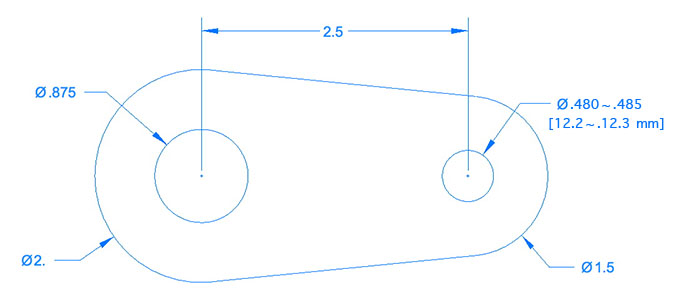
This is the drawing I am working. the outside shape is pretty arbitrary; I just need to locate a 12mm swingarm pivot 2.5" to the rear of a 7/8" (nom. OD) frame tube.

swingarm-mount-plate-v05.jpg


A_Pmech

Well-known member
Joined
May 8, 2007
Messages
8,002
Location
IL
Hole saws do not produce round or accurately sized holes, no matter the brand.

If you want an accurately sized hole use an annular cutter. On a weak and wobbly drill press you should still stay within about +.015 of nominal. Use proper cutting oil to keep the cutter working.

Don't buy cheap cutting tools from China either.

Your .480" to .485" hole should be reamed or bored.

Drill and ream the small holes and run a tight fitting pin though the holes. Then drill the large holes so both plates have the same hole pitch.
 
OP
T

Tanshanomi

Well-known member
Joined
Sep 10, 2009
Messages
218
Location
Missouri
What is the thickness? Im guessing hot roll steel?

3/8", which is probably thicker than I need, but I figured it's better to overbuild than under-build. Now that I've made all my calculations based on that thickness, I'll stick with it, but there's nothing terribly precise about it—so yea, hot rolled would be fine. The piece I started with was a 4"x5" chunk of out of the by-the-pound odd scrap bin at the local metal shop, and I am fairly certain it's hot-rolled.
 
OP
T

Tanshanomi

Well-known member
Joined
Sep 10, 2009
Messages
218
Location
Missouri
If your not in a hurry I'll cut you a pair of them, I think I have some of that stock here in my shop.

I'm in the middle of an engine swap right now.Keith

That would be fantastic! And there is certainly no rush — I started collecting parts for this bike last October, and I'm just now cutting metal.
 
OP
T

Tanshanomi

Well-known member
Joined
Sep 10, 2009
Messages
218
Location
Missouri
What is the tolerance? Keith

Would ±0.01" be too much to ask? I could go ±0.02-0.03 without much issue. After all, it's not as if we're talking internal engine parts here. But less slop would be nice to help facilitate accurate alignment during fit-up and welding.

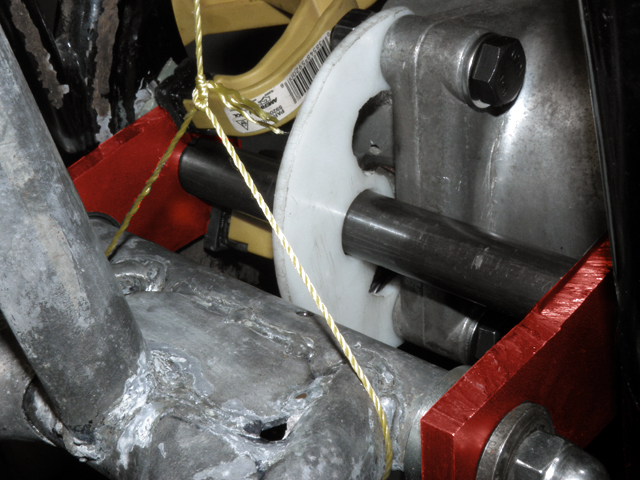
Here's a mock-up using my crappy hole-sawed plates, showing how they'll be used. I tinted them to make them more obvious.

P9280099_cropped_web.png


By the way, the globby welds on the swingarm aren't mine — that's genuine production Yamaha weld quality, circa 1976.
 
OP
T

Tanshanomi

Well-known member
Joined
Sep 10, 2009
Messages
218
Location
Missouri
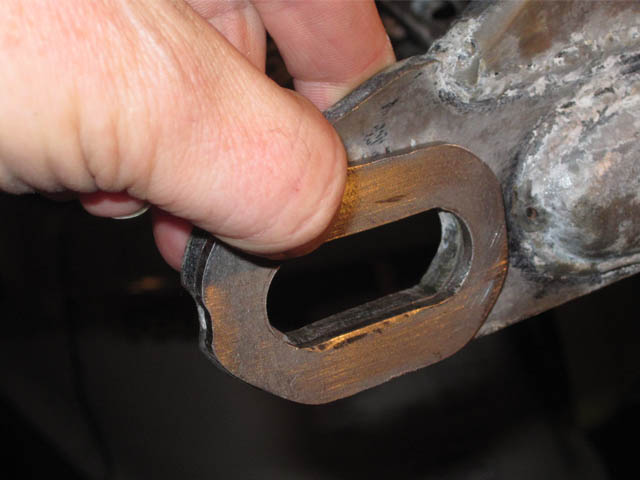
I thought I should follow up and show you the successful completion of my original attempt, thanks to a nice quality Lenox bimetal hole saw and some cutting oil. My drill press's 620 RPM lowest speed worked fine.

Once I got the holes drilled, I finished shaping them with a hack saw, a couple of files, and a dremel tool.

Thanks to all who gave me much-need advice!

axle-beef-plates-02web.jpg
 
OP
T

Tanshanomi

Well-known member
Joined
Sep 10, 2009
Messages
218
Location
Missouri
My old machine can hold 0.005" The operator however might be another story. I should be able to free up some machine time here late next week. Keith
That would be very cool. Send me a private message with what I owe you and your contact info; I'll send you a check or paypal you (whatever's easier).
 

e-tek

Well-known member
Joined
Dec 19, 2007
Messages
10,690
Location
Saskatoon, SK
Glad top see you got 'er done!! Although no-one had said it exactly, but those look like spot-weld cutters to me. Someone mentioned the negative rake, which is what they have. You could also have done it with a regular drill bit - I make stuff like that all the time.

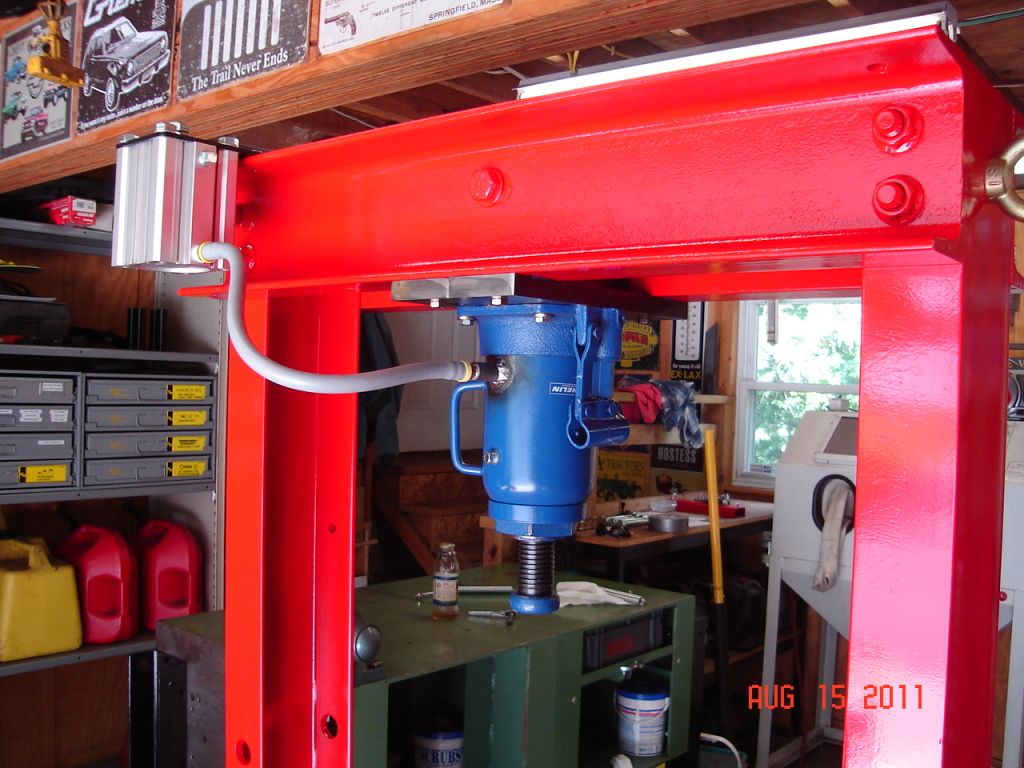
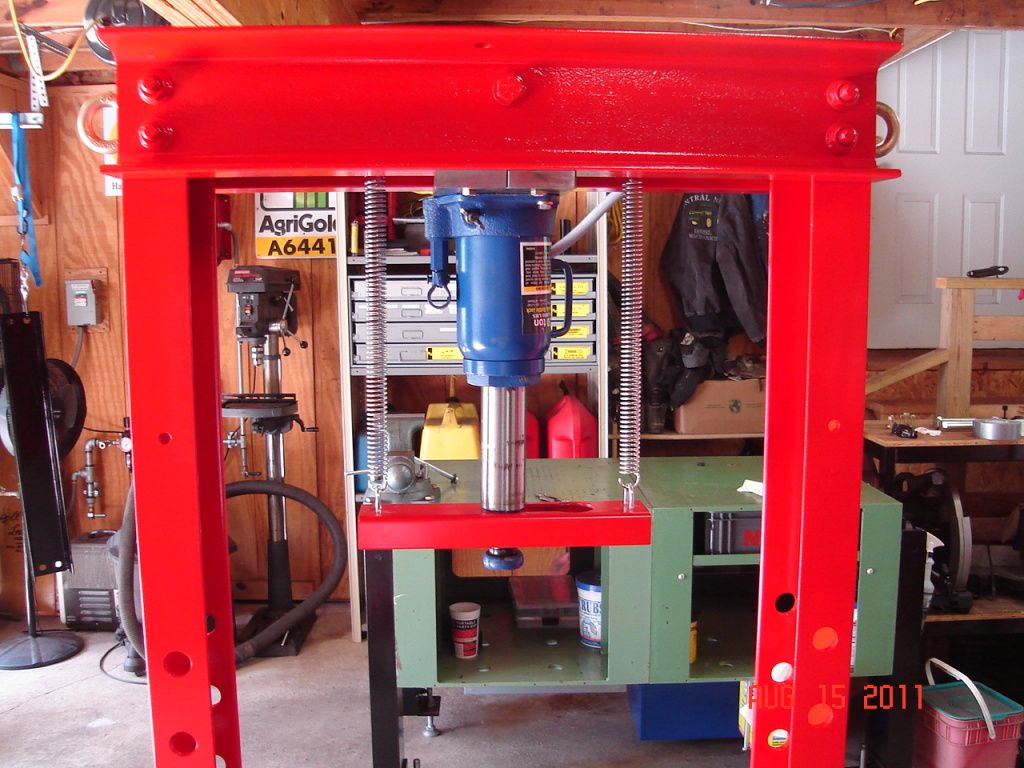
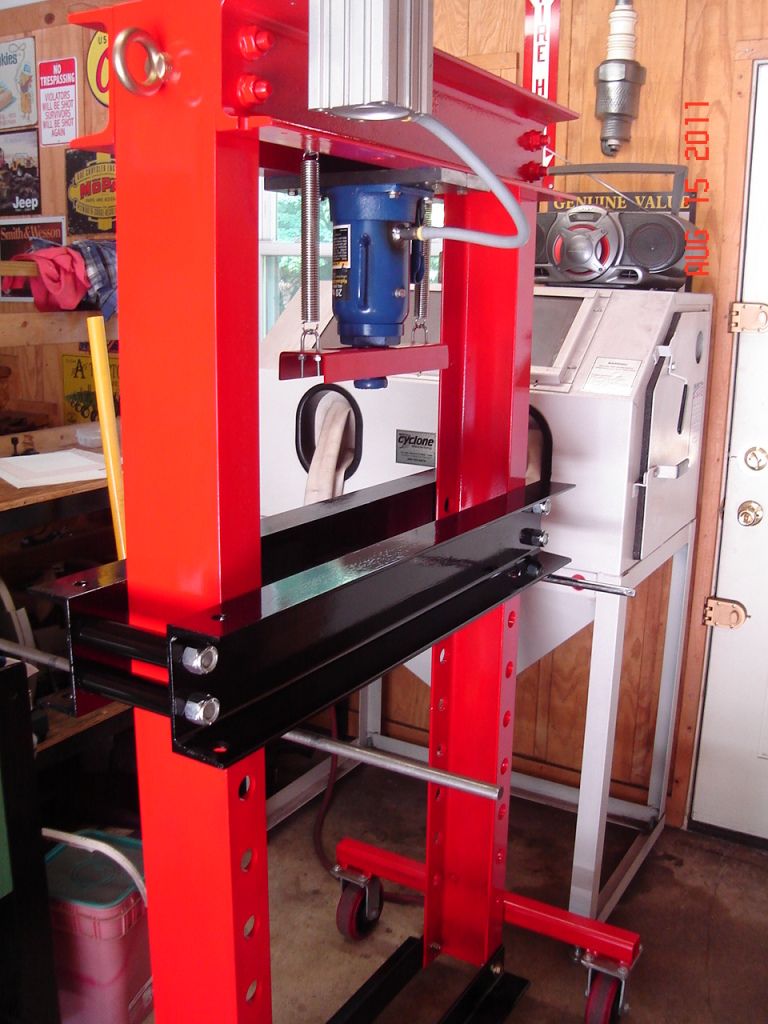
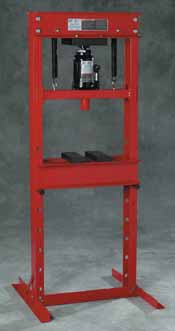
As for Alan Camby - I think you've mounted the bottle jack upside down. I have seen a LOT of presses and never seen one mounted like that. Surprised it's not leaking fluid.

images


images


ATD-7454_std.jpg
 
To avoid these ads, REGISTER NOW!
Top Bottom