To avoid these ads, REGISTER NOW!

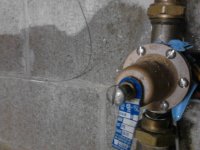
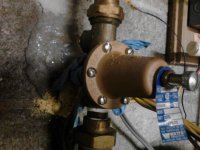
what is this brass plumbing part?

luvit

Well-known member
Joined
Jul 11, 2011
Messages
1,580
i've owned this property for several months and have not yet chased down all the plumbing.

i was lucky to discover a pinhole leak stream this morning. all within 24hrs of when it started, no damage done :rocker:
i have a blue nitril glove to help the leak stop spraying and to allow the water to drip into a bucket.

i have not turned-off the curb key, yet, but i think i've tested/turned off/closed enough valves and things to point me to it's from my water main and not from my well.

also, i will be moving the ball valve from consumer-side of the brass item to the first-thing out of the wall.

so what is this brass part that i need to replace?? a regulator??

attachment.php

attachment.php

attachment.php
 

Attachments

  • 0928120842a.jpg
    0928120842a.jpg
    124 KB · Views: 443
  • 0928120842b.jpg
    0928120842b.jpg
    130.2 KB · Views: 443
  • 0928120842.jpg
    0928120842.jpg
    133.4 KB · Views: 444
To avoid these ads, REGISTER NOW!

forced induction

Active member
Joined
Aug 16, 2012
Messages
28
Location
NJ
Not sure which one you are talking about but it looks like a regulator and check valve/backflow preventer. Atleast there are unions there so replacement shouldn't be too bad. And I think that regulator is pretty common. Although unless you have high press or need low pressure I'm not sure why you would need it.
 

Super Scout

Well-known member
Joined
Jun 23, 2012
Messages
142
Location
Latrobe PA
Pressure regulator, you probably have high pressure. Where is it leaking, some watts regulators are repairable. I can't make out the model on that so I am not sure. Its a fairly simple repair.
 
OP
L

luvit

Well-known member
Joined
Jul 11, 2011
Messages
1,580
it's leaking a pin hole out of the brass "pipe-side" on back of that circle.
hose clamp and rubber may not stop it too well due to the shape of this thing, but a c-clamp and rubber could do it.

i don't have time to do any experimenting, so i'll probably just replace it for like-for-like.

i would actually love to add the following from the main, ball valve first, pressure gauge, pressure regulator, and then another pressure gauge...
this house has cpvc.. home-grown by the previous owner. I'd really like to eventually go to pex like my other home.
 

rlitman

Well-known member
Joined
Oct 18, 2010
Messages
24,793
Location
Long Island
Those are typically installed horizontally, with the adjusting screw up.
The pipe connection facing the wall should be facing down, with a pipe running from that to a drain. The backflow prevention of this device will drip a little, if the pressure in the house gets above the pressure in the main. This can happen when the pipes hammer, or when the water heater is heating (which causes the water in the tank to expand).

If there is a steady stream of water coming out of it, then yeah, it needs replacing.
An occasional drip just means that it wasn't properly plumbed to a drain.
 
OP
L

luvit

Well-known member
Joined
Jul 11, 2011
Messages
1,580
yeah, it was squirting out of the brass wall.
when i first saw it, i was hoping it was one of the back end pieces.
thanks for the info on properly hanging it.
.
 

rlitman

Well-known member
Joined
Oct 18, 2010
Messages
24,793
Location
Long Island
You could probably rotate it so that the hole is out the side, and now you have access to run it out to a drain.
Offhand, I can't think of why it couldn't be mounted vertically, I've just never seen that done.
 
OP
L

luvit

Well-known member
Joined
Jul 11, 2011
Messages
1,580
.
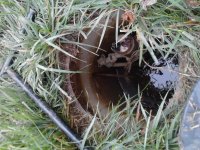
time to turn off the water.. hello Mr. 5-sided bolt head, meat Mr. Sledgehammer.
mm k.. the L-shaped curb key left in the hole is a better fit than my big $10 T-shaped curb key.
i was able to remove the bad plumbing by unscrewing a few fittings, i did not have a wrench to fit the larger union, but i should check my other tool stash before i buy the proper-sized wrench.
 

Attachments

  • 0928121211.jpg
    0928121211.jpg
    128 KB · Views: 75
  • 0928121141a.jpg
    0928121141a.jpg
    153.2 KB · Views: 72
  • 0928121140.jpg
    0928121140.jpg
    159.7 KB · Views: 66
OP
L

luvit

Well-known member
Joined
Jul 11, 2011
Messages
1,580
You could probably rotate it so that the hole is out the side, and now you have access to run it out to a drain.
Offhand, I can't think of why it couldn't be mounted vertically, I've just never seen that done.
no, no, this hole was not meant to be there. it streamed out like a really drunk mouse.
in the attached pic you will see a little green and red area upper-left to the letter "O" in the word "OUT". -- it squirted from that pin hole.
.
attachment.php
 

Attachments

  • 0928121213.jpg
    0928121213.jpg
    135 KB · Views: 374
Last edited:
OP
L

luvit

Well-known member
Joined
Jul 11, 2011
Messages
1,580
.
I think i'm going to be re-routing this pluming,
-- adding the ball valve directly off the main (instead of curb keying my water off).
-- adding the two pressure gauges for in and out pressure knowledge
-- adding another T with a ball valve at the bottom as a whole house plumbing drain.
any better ideas?
.
attachment.php
 

Attachments

  • 0928121213b.jpg
    0928121213b.jpg
    145.8 KB · Views: 373
  • 0928121213a.jpg
    0928121213a.jpg
    147.4 KB · Views: 19
To avoid these ads, REGISTER NOW!
OP
L

luvit

Well-known member
Joined
Jul 11, 2011
Messages
1,580
Pressure regulator silly!
lol. yeah, man. i've never had one before.. even on my other home with public water.
i usually have a well, and plan to make the well on this property my main source of water some day.
.
 

Charles (in GA)

Well-known member
Joined
Jan 11, 2006
Messages
12,489
Location
50 mi south of Atlanta
I think all public water systems today require a dual inline check valve to protect them, from you, and most also require a regulator to protect you from them. Some locations have towers on hills and the guy in the valley may have extremely high pressure. Its become virtually a national policy. You never know when the pressure may change significantly, due to a switch in tanks supplying you.

Where I grew up, for years, we were supplied from a surface mounted tank on a slight rise. The pressure was 18 to 22 lbs most of the time. One day, due to road construction, the water system announced (in the newspaper) that they were switching our area to a different supply and might see a higher pressure. They hooked us to two elevated tanks, and within a week, every water heater on the block (and most of the rest of the neighborhood) was sitting at the curb to be picked up.

Charles
 

rwhite692

Well-known member
Joined
Mar 4, 2008
Messages
1,850
Location
Central Valley, CA
The body of that regulator is corroded from the inside out. Probably there is not much wall thickness left of the casting. You can disassemble the regulator and you will quickly see. Post up some pics when you do.

You are lucky that you caught it quickly / while you were home.

The check valve is the item mounted beneath the regulator. You may find that it is badly corroded inside as well. Replacement of the check valve while you are at it, may be a good idea.
 

nehog

Well-known member
Joined
Jan 2, 2010
Messages
7,935
Location
Jaffrey, NH
it's leaking a pin hole out of the brass "pipe-side" on back of that circle.
hose clamp and rubber may not stop it too well due to the shape of this thing, ...

As other say, it's bad. A regulator needs a 'standard' to regulate to, that's the hole's purpose: it lets the regulator know what the atmospheric pressure is. If it is leaking out the hole then the diaphragm is probably bad.
 

jhelrey

Well-known member
Joined
Sep 15, 2010
Messages
7,293
Location
MN
I do have a few gate valves. Beats shutting down the water to the whole house when something happens.
 
OP
L

luvit

Well-known member
Joined
Jul 11, 2011
Messages
1,580
I think all public water systems today require a dual inline check valve to protect them, from you, and most also require a regulator to protect you from them.
...every water heater on the block (and most of the rest of the neighborhood) was sitting at the curb to be picked up.
My last house had public water, no check valves, no regulator, pressure was originally 120 until they improved the water service, then it lowered to 90.
I'm lucky every fixture did not blow.

The body of that regulator is corroded from the inside out. Probably there is not much wall thickness left of the casting. You can disassemble the regulator and you will quickly see. Post up some pics when you do.

You are lucky that you caught it quickly / while you were home.

The check valve is the item mounted beneath the regulator. You may find that it is badly corroded inside as well. Replacement of the check valve while you are at it, may be a good idea.
I fixed this friday night, and didn't catch your post soon enough.
I did not replace the check valve, and I'll get some pics.
I had about $200 in plumbing parts... ugh.

As other say, it's bad. A regulator needs a 'standard' to regulate to, that's the hole's purpose: it lets the regulator know what the atmospheric pressure is. If it is leaking out the hole then the diaphragm is probably bad.
this pin hole isn't even visible. it was a micro squirt.
no one would know it was there until the water squirts out.

I do have a few gate valves. Beats shutting down the water to the whole house when something happens.
Gate Valves are good, my problem is that all this failed prior to the main valve.
so i put the main valve first, as it should have been.


mm, k.
the following is not good plumbing practices. -- here is what i did friday night, over $200 later, 1 hr prior to date night.
yes, when i hookup my well, i will be adding other things and turning off the public main valve.

attachment.php
 

Attachments

  • plumbingd.jpg
    plumbingd.jpg
    141.1 KB · Views: 164
Last edited:

Kevin54

MEMBER EMERITUS
Joined
Jan 12, 2005
Messages
29,341
Location
Urbana, Ohio
If you are hooked to city water, I don't think it's a pressure regulator, but it's a "Backflow Preventer" It's used to keep municipal water systems from becoming contaminated by changes in pressure where the water would backflow into the main water line. Quite a few cities make it mandatory. IIRC, our town made it mandatory a few years back.
 

stingry

Well-known member
Joined
Oct 14, 2006
Messages
737
Location
Western Nebraska
If you are hooked to city water, I don't think it's a pressure regulator, but it's a "Backflow Preventer" It's used to keep municipal water systems from becoming contaminated by changes in pressure where the water would backflow into the main water line. Quite a few cities make it mandatory. IIRC, our town made it mandatory a few years back.

Water regulator, NOT a backflow preventer! Google the part number from the tag on the valve.

Cheers
Steve
 
OP
L

luvit

Well-known member
Joined
Jul 11, 2011
Messages
1,580
If you are hooked to city water, I don't think it's a pressure regulator, but it's a "Backflow Preventer" ...
hey, kev. checkout my pic..
i placed a pressure gauge on each side of my regulator..
i was curious how it performed and it's weird that it's always 50% lower on my side, like 92 on service-side, 46 on my side.
.
 

Attachments

  • plumbingd.jpg
    plumbingd.jpg
    141.1 KB · Views: 11

Kevin54

MEMBER EMERITUS
Joined
Jan 12, 2005
Messages
29,341
Location
Urbana, Ohio
hey, kev. checkout my pic..
i placed a pressure gauge on each side of my regulator..
i was curious how it performed and it's weird that it's always 50% lower on my side, like 92 on service-side, 46 on my side.
.


I know the one part is a regulator, I thought you were asking what the other part is underneath it. Miscommunication on my part. The other part though is what I thought it was a Backflow Preventer. http://www.watts.com/pages/_products_details.asp?pid=877

Series 7 Dual Check Valves prevent the reverse flow of polluted water from entering into the drinking water supply at the service entrance or at individual outlets. It consists of a bronze body construction, with two plastic replaceable check valves, and stainless steel springs. Series 7 is designed for non-health hazard residential water system containment, continuous pressure applications. It is installed immediately downstream of the residential water meter, in a vertical or horizontal position. Check with local inspection authorities for installation requirements. Minimum Working Pressure: 10psi (69 kPa) Maximum Working Pressure: 150psi (10 bar).

7.jpg
 
To avoid these ads, REGISTER NOW!
Top Bottom