Like many others here, I have been trying to decide what to do with my new shop floor - didn't really want to go the epoxy route because of the prep/ work/expense involved, plus the risk of problems - didn't seem to be worth the trouble. not to mention , ending up with a beautiful floor that is too nice to use; I live 1/4 mile down a gravel road and then have to drive across 75 ft of grass to get to the shop so not much point in having a showroom quality floor. I originally decided on using a densifier with a coloring agent added to be sealed with some type of sealer but after having bought 5 gal of Consolideck LS,(densifier) I ended up returning it when I got so pissed off trying to get the other products to go with it. I live in the third largest city in the country and they don't have a single distributor that carries more than one or two of their products at a time, as well as not having any direct internet sales. I had picked the Consolideck line because their sealer (Polish Guard)claimed to have the chemical resistance I was looking for and was easy to apply.
Anyways, I changed course and decided to try an acid stain and started to consider going ahead and sealing it with one on the many epoxies on the market. Well, after doing the acid stain, I now wish I had gone with my original plan. Not that the acid stain turned out that bad, but it is alot of work! It is also definitely not a look that will appeal to everybody. I picked a color called Harvest Wheat, but after applying it to my new slab it looked exactly like what you would get if you drained the rusty radiator water from about 10 old junkers sitting in a farmers field and then smeared a little dog **** in for good measure.
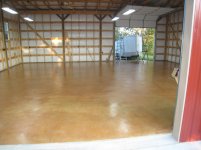
Actually, it acts like a base coat/clear coat paint system - it is dull and flat until you apply the clear coat (sealer) and then the color pops and it comes alive. It definitely highlights any variations in the surface and there are a few spots where the stain didn't take. In reality, it has kind of grown on me - it gives it that "patina" that is all the rage now...........
The hard part though, is the neutralizing and rinsing. My shop is right at 1600 sq ft and I am doing it all my self. It takes a thorough scrubbing and rinsing to remove all the residue after the stain dries. I can't imagine trying to do this in an enclosed space - between the fumes of applying the acid and then the rinse afterwards I don't see how one could do it in a residential building without all kinds of help and equipment.
Anyways, after almost deciding to go ahead and bite the bullet and go with some type of polyaspartic coating, I came to my senses and went back to my original plan of sealing it with Consolideck Polish Guard. I finally found a source without having to pay ridiculous shipping charges and ordered 5 gallons at a cost of about $400.
When I started applying the Polish Guard with a deck sprayer, I soon realized that it didn't seem to be giving anywhere near the coverage estimated. The directions say to spray it on and then use a microfiber mop to spread it before it becomes tacky, but my slab was soaking the stuff up like a sponge. Well, I barely got the whole floor coated using a little over 4 gallons, and still needed to apply a second coat. Luckily, once you have the first coat down, the second coat goes vastly farther and easier! I ended up getting the whole floor covered in two coats with about a pint to spare.
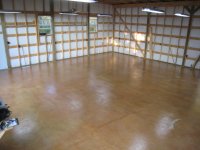
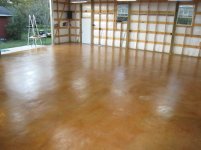
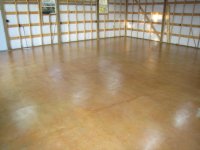
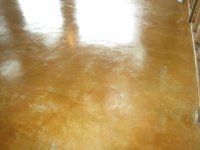
The final appearance as applied with a sprayer and microfiber mop is really more of a satin finish. The directions say it can be burnished with a floor buffer to bring out a higher gloss and I have no doubt that it would, but I will leave it as is. The shinier it is , the more it will show defects and scratches. According to the tech sheet, it is resistant to gasoline, oil, brake fluid, trans fluid, etc. About the only things that will damage it are acetone and several types of acids. Time will tell how accurate their claims are as I am sure to spill some of all of those from time to time.
Anyways, just thought I would throw this out there as another option. The guys looking for the beautiful inch deep gloss showroom type finish probably won't be interested, but for those who are looking for something serviceable where you are doing real work in the shop may want to give it some consideration. I'll post updates six months or a year from now on how it holds up.
Anyways, I changed course and decided to try an acid stain and started to consider going ahead and sealing it with one on the many epoxies on the market. Well, after doing the acid stain, I now wish I had gone with my original plan. Not that the acid stain turned out that bad, but it is alot of work! It is also definitely not a look that will appeal to everybody. I picked a color called Harvest Wheat, but after applying it to my new slab it looked exactly like what you would get if you drained the rusty radiator water from about 10 old junkers sitting in a farmers field and then smeared a little dog **** in for good measure.
Actually, it acts like a base coat/clear coat paint system - it is dull and flat until you apply the clear coat (sealer) and then the color pops and it comes alive. It definitely highlights any variations in the surface and there are a few spots where the stain didn't take. In reality, it has kind of grown on me - it gives it that "patina" that is all the rage now...........
The hard part though, is the neutralizing and rinsing. My shop is right at 1600 sq ft and I am doing it all my self. It takes a thorough scrubbing and rinsing to remove all the residue after the stain dries. I can't imagine trying to do this in an enclosed space - between the fumes of applying the acid and then the rinse afterwards I don't see how one could do it in a residential building without all kinds of help and equipment.
Anyways, after almost deciding to go ahead and bite the bullet and go with some type of polyaspartic coating, I came to my senses and went back to my original plan of sealing it with Consolideck Polish Guard. I finally found a source without having to pay ridiculous shipping charges and ordered 5 gallons at a cost of about $400.
When I started applying the Polish Guard with a deck sprayer, I soon realized that it didn't seem to be giving anywhere near the coverage estimated. The directions say to spray it on and then use a microfiber mop to spread it before it becomes tacky, but my slab was soaking the stuff up like a sponge. Well, I barely got the whole floor coated using a little over 4 gallons, and still needed to apply a second coat. Luckily, once you have the first coat down, the second coat goes vastly farther and easier! I ended up getting the whole floor covered in two coats with about a pint to spare.
The final appearance as applied with a sprayer and microfiber mop is really more of a satin finish. The directions say it can be burnished with a floor buffer to bring out a higher gloss and I have no doubt that it would, but I will leave it as is. The shinier it is , the more it will show defects and scratches. According to the tech sheet, it is resistant to gasoline, oil, brake fluid, trans fluid, etc. About the only things that will damage it are acetone and several types of acids. Time will tell how accurate their claims are as I am sure to spill some of all of those from time to time.
Anyways, just thought I would throw this out there as another option. The guys looking for the beautiful inch deep gloss showroom type finish probably won't be interested, but for those who are looking for something serviceable where you are doing real work in the shop may want to give it some consideration. I'll post updates six months or a year from now on how it holds up.