To avoid these ads, REGISTER NOW!

Water in garage sub-panel

cooliorz

Well-known member
Joined
Sep 3, 2009
Messages
47
Location
Portland, Oregon
Hi folks,

I've recently noticed a problem with water inside my garage sub-panel.
When I say there's water in there, I mean there's a puddle at the bottom of the panel and each breaker has water dripping off of it.
This sub-panel is about 4 months old and it was professionally installed with the main panel when I bought house a few months ago.
The water appears to be coming down inside the conduit/ riser pipe that was installed. A few weeks ago, I applied some tar-caulk around the rubber doughnut and surrounds shingles of the riser. I just checked and I'm still having a problem with all this water coming down the riser pipe.
It hasn't rained that hard, but it rains consistently out here (Portland, OR).

Does anyone have any ideas on what might be causing this or how to fix it?

Thanks, Tom
 
To avoid these ads, REGISTER NOW!

pitterpat

Well-known member
Joined
Jun 30, 2011
Messages
686
Location
Indianapolis
Hi folks,

I've recently noticed a problem with water inside my garage sub-panel.
When I say there's water in there, I mean there's a puddle at the bottom of the panel and each breaker has water dripping off of it.
This sub-panel is about 4 months old and it was professionally installed with the main panel when I bought house a few months ago.
The water appears to be coming down inside the conduit/ riser pipe that was installed. A few weeks ago, I applied some tar-caulk around the rubber doughnut and surrounds shingles of the riser. I just checked and I'm still having a problem with all this water coming down the riser pipe.
It hasn't rained that hard, but it rains consistently out here (Portland, OR).

Does anyone have any ideas on what might be causing this or how to fix it?

Thanks, Tom
Yeah, if it was professionally installed call the electrician that installed it and have him fix the problem. There should be some kind of warranty.
 

frankush

Well-known member
Joined
Oct 23, 2011
Messages
1,156
Location
IL
If your garage is heated, it may be condensate. Warm air travels up the cold riser and condensate forms. Duct seal, which is a pliable putty is made for just this purpose. It gets pushed in the pipe and around the wires preventing the warm air from getting in the pipe. Should have been part of the original install.
 

RECox286

Well-known member
Joined
Apr 11, 2012
Messages
1,399
Location
South Joisey (yeah, that is part of the USA)
We had a problem like that. It was with an underground service.

Water was getting into the cables at the pole, traveling inside the

insulation jacket and just like a garden hose, was allowing the water

to flow into the main disconnect. Made an awful mess. Finally,

the lineman sliced the insulation jacket on the bottom of each drip

loop at the pole connections. The water finally stopped coming

into the panel. Funny what electrical stuff will do.

Uncle Bob
 

wyliesdiesels

Well-known member
Joined
Aug 14, 2012
Messages
20,006
Location
Modesto, CA
We had a problem like that. It was with an underground service.

Water was getting into the cables at the pole, traveling inside the

insulation jacket and just like a garden hose, was allowing the water

to flow into the main disconnect. Made an awful mess. Finally,

the lineman sliced the insulation jacket on the bottom of each drip

loop at the pole connections. The water finally stopped coming

into the panel. Funny what electrical stuff will do.

Uncle Bob

This doesn't make sense. If the service is underground, there wouldn't be a pole. Second of all, if the service is underground, how would water go UP into the disconnect? Unless water flows against gravity, I'm missing something! And how would slicing insulation prevent water from flowing down a wire? None of what u said makes sense! And removing insulation from an energized secondary service drop would not only be against code, but also makes for a potentially dangerous situation! I highly doubt a lineman would remove insulation from wire that needs it!

To the OP, I would call the electrician to fix it since the install is new! Most contractors provide a warranty.
 

ishiboo

Well-known member
Joined
Oct 27, 2010
Messages
9,481
Location
Oshkosh, WI
This doesn't make sense. If the service is underground, there wouldn't be a pole. Second of all, if the service is underground, how would water go UP into the disconnect? Unless water flows against gravity, I'm missing something! And how would slicing insulation prevent water from flowing down a wire? None of what u said makes sense! And removing insulation from an energized secondary service drop would not only be against code, but also makes for a potentially dangerous situation! I highly doubt a lineman would remove insulation from wire that needs it!

To the OP, I would call the electrician to fix it since the install is new! Most contractors provide a warranty.

An underground service still starts at a pole in many areas, since HV is so expensive to bury.

It's pretty simple... the panel could easily be in the basement as well so it does not have to flow "up" against gravity, though since he is referring to the space between the conductor and the insulator (small!) capillary action could easily move the water against gravity. Plus, with the water getting in at the pole, this water would have a "head" of 20+ feet, so if the panel is mounted anywhere below 20' it's still possible with gravity!

Seems like this is quite improbable and would be a small amount of water vs a conduit issue where water can just pour in :)
 

Kevin54

MEMBER EMERITUS
Joined
Jan 12, 2005
Messages
29,341
Location
Urbana, Ohio
This doesn't make sense. If the service is underground, there wouldn't be a pole. Second of all, if the service is underground, how would water go UP into the disconnect? Unless water flows against gravity, I'm missing something! And how would slicing insulation prevent water from flowing down a wire? None of what u said makes sense! And removing insulation from an energized secondary service drop would not only be against code, but also makes for a potentially dangerous situation! I highly doubt a lineman would remove insulation from wire that needs it!

To the OP, I would call the electrician to fix it since the install is new! Most contractors provide a warranty.

An underground service still starts at a pole in many areas, since HV is so expensive to bury.

It's pretty simple... the panel could easily be in the basement as well so it does not have to flow "up" against gravity, though since he is referring to the space between the conductor and the insulator (small!) capillary action could easily move the water against gravity. Plus, with the water getting in at the pole, this water would have a "head" of 20+ feet, so if the panel is mounted anywhere below 20' it's still possible with gravity!

Seems like this is quite improbable and would be a small amount of water vs a conduit issue where water can just pour in :)

We have a pole on the property line but have underground service to the house.

Putting tar around the pipe at the roof may not solve anything. Look at your meter box. Chances are the water is coming in through it. Although the boxes are SUPPOSED to be weathertight, not all are completely weathertight. If you are getting water in the meter box, it is getting high enough that it is running down your conduit from there. I had the same problem with an outside disconnect I had to put in on my old house.

You have a tag lock on your meter box. Just cut it off and keep it. Flip the lid up and see if you have water laying in there. If so, get with an electrician, or get with your local Power Provider and have them put a fix on it. And just tell them why you cut the tag and they will put a new tag back on.
 

wyliesdiesels

Well-known member
Joined
Aug 14, 2012
Messages
20,006
Location
Modesto, CA
An underground service still starts at a pole in many areas, since HV is so expensive to bury.

It's pretty simple... the panel could easily be in the basement as well so it does not have to flow "up" against gravity, though since he is referring to the space between the conductor and the insulator (small!) capillary action could easily move the water against gravity. Plus, with the water getting in at the pole, this water would have a "head" of 20+ feet, so if the panel is mounted anywhere below 20' it's still possible with gravity!

Seems like this is quite improbable and would be a small amount of water vs a conduit issue where water can just pour in :)

Yeah, that's a good point. I was thinking of full underground service, ie. no pole! All the underground services I've ever worked on did not originate from a pole. In Santa Cruz, the bay area, and central valley, all underground service is fully underground- HV, transformers and all. I guess we're just spoiled! Or ripped off on overpriced services!
 
To avoid these ads, REGISTER NOW!
OP
C

cooliorz

Well-known member
Joined
Sep 3, 2009
Messages
47
Location
Portland, Oregon
Hi guys,

I should have been more clear. The sub-panel is INSIDE my garage and the meter is about 20 feet away, attached to my house. Water is still traveling down the riser pipe. I'm not sure how. The garage is not heated.
I took a few people's advice and the electrician is coming out to look at it tomorrow. I'll keep everyone posted.

-Tom
 

Kevin54

MEMBER EMERITUS
Joined
Jan 12, 2005
Messages
29,341
Location
Urbana, Ohio
Hi guys,

I should have been more clear. The sub-panel is INSIDE my garage and the meter is about 20 feet away, attached to my house. Water is still traveling down the riser pipe. I'm not sure how. The garage is not heated.
I took a few people's advice and the electrician is coming out to look at it tomorrow. I'll keep everyone posted.

-Tom

Normally, the mast pipes are made so water cannot get in them hence the weatherhead connector that is rubber and leakproof, and one of the reasons it bends down at an angle. I'd still venture to guess that water is entering the meter box where the mast pipe is screwed into it and it hasn't been sealed.

If you are getting water in your subpanel, isn't that coming off of your main panel? And if it is, how much water are you getting in the main?

I'd like to see a pic of your meter box and how they are coming off of it to your main panel. In thinking about it, I'm guessing that your main panel and your meter box are directly adjacent to one another, meaning one is on the outside and one is on the inside, and your sub is 20' away from both.
 
Last edited:

RKA

Well-known member
Joined
Jun 9, 2010
Messages
1,744
Location
NJ
Hi guys,

I should have been more clear. The sub-panel is INSIDE my garage and the meter is about 20 feet away, attached to my house. Water is still traveling down the riser pipe. I'm not sure how. The garage is not heated.
I took a few people's advice and the electrician is coming out to look at it tomorrow. I'll keep everyone posted.

-Tom

Get an inexpensive meter to check garage humidity, and report back on inside and outside temps when you see water pooling. Or just connect a dehumidifier and see if that improves things.
 

Gooch

Well-known member
Joined
May 30, 2009
Messages
676
Location
Petersberg, IA
Seal the conduit that comes from the outside, it's allowing cold air in and causing condensation. even if the building isn't heated, the breakers in the panel work on heating, a 20 amp breaker with 15 amps worth of load will be significantly warmer.
 
OP
C

cooliorz

Well-known member
Joined
Sep 3, 2009
Messages
47
Location
Portland, Oregon
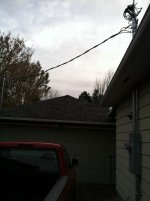
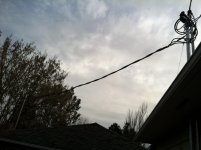
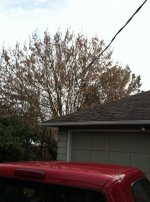
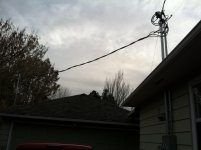
I've attached some pictures of my garage sub-panel (on the left) and the meter going to my house (on the right). It hasn't rained since the electrician came out to look at the problem. He repositioned the weather head and re-sealed the same gaskets that I sealed. He seems real good about honoring his warranty. Hopefully this does the trick.

011.jpg

012.jpg

014.jpg

015.jpg
 

frankush

Well-known member
Joined
Oct 23, 2011
Messages
1,156
Location
IL
Interesting install. What they allow in Portland would not be allowed in Chicago. I posted prior to this because I thought you might have a condensate problem. By not having heat in your garage, I doubt that's the issue. You stated that it looks like the water is entering the panel from the riser. You have a huge drip leg at the service head that is well below it. Are sure that the rain is not coming in from a roof leak somewhere, running down the exterior wall and entering via the top of the panel? Is the top of the panel exposed and if it is, is it wet?
 

Kevin54

MEMBER EMERITUS
Joined
Jan 12, 2005
Messages
29,341
Location
Urbana, Ohio
Did the electrician make it there yet, and if so, what did he have to say?

I went back and reread this again. You should post a pic of your subpanel and mastpipe instead of the box on the house, seeing that the problem in in the garage. It makes a little more sense now.

Is the mastpipe at the garage on the outside of the garage, or is it running down through a wall cavity and into the subpanel, or is your subpanel mounted on the wall and not in the wall cavity itself, leaving the mastpipe exposed going up through the ceiling where you can see it.

If it is coming down through the roof and soffit, and mounted to an outside box first, then wires going into the subpanel, you are more than likely getting water in where the mastpipe screws into the box.

If the mastpipe is coming through the roof and ceiling and into the subpanel, then either the weatherhead is flawed and allowing it to leak, or water is running down the pipe, you don't have a good seal or flashing on the roof, and water is running into the box where it is screwed in.

If the box is mounted on the wall itself and not in the wall cavity, and the mastpipe is exposed, you would see water running down the pipe and into the subpanel.

Is your walls finished off, or just bare studs? If the walls are finished off, I think I would cut out a section so you can actually see what's going on. Remember....water and electricity do not mix.

Take a look at the quick sketch and see if it's either A,B, or C that your box is mounted.
 

Attachments

  • mast.pdf
    60.6 KB · Views: 27
OP
C

cooliorz

Well-known member
Joined
Sep 3, 2009
Messages
47
Location
Portland, Oregon
Did the electrician make it there yet, and if so, what did he have to say?
Take a look at the quick sketch and see if it's either A,B, or C that your box is mounted.


First off, I'd like to thank everybody for their input.
Kevin, I looked at your diagrams and my subpanel fits in the "B" category.
I did drywall and insulate after the panel installation. I made a piece of drywall removable above the panel for future wiring if needed. I'll have to remove it and take a look above the panel.

I wasn't home when the electrician came out, but my wife was. He re-sealed the flashing around the main pipe coming out the roof, repositioned the weatherhead and created a bigger drip loop. He also aggressively shook the pipe to remove any residual water.

The problem is it hasn't rained since he's been out, which is unusual for Portland. I plan on pulling the panel cover as soon as it rains for a day or so.

I'll keep everyone posted and thanks for all the help!
-Tom
 

Kevin54

MEMBER EMERITUS
Joined
Jan 12, 2005
Messages
29,341
Location
Urbana, Ohio
It all makes more sense now.

You could always turn the garden hose on it. And hopefully he shook the pipe BEFORE he caulked it and not afterwards.
 
To avoid these ads, REGISTER NOW!
Top Bottom