To avoid these ads, REGISTER NOW!

220v Air compressor t0 3 pin dryer outlet

anu143

Member
Joined
Jan 17, 2013
Messages
7
Hi,
I have bought 220V air compressor and I would like to use my dryer outlet which is 30Amp and more than enough to run my compressor. But problem I have is that dryer outlet has hot, hot and neutral but compressor requires hot, hot and ground. I checked the service panel and all the neutral and ground wires are connected to same bus. So my question is that can I connect my compressor’s ground to neutral in dryer socket? Any help is much appreciated, thanks in advance.
 
To avoid these ads, REGISTER NOW!

Higgins

Well-known member
Joined
Dec 25, 2009
Messages
1,954
Location
Shepheardsville, KY
Before that, the question is, what does the compressor require. Smaller 220v compressors are 15 Amp, 20 Amp draws, or 25 Amp draws!
 

joe_padavano

Well-known member
Joined
Feb 26, 2011
Messages
1,788
Location
Northern VA
So my question is that can I connect my compressor’s ground to neutral in dryer socket? Any help is much appreciated, thanks in advance.

Yes, if your dryer outlet is three wire and not four wire. I've done this many times. Just build a short jumper harness with a dryer plug on one end and the correct receptacle on the other end. If your dryer outlet is four wire, use the two hot and ground and just don't wire the neutral in the jumper harness.
 

Alchymist

Well-known member
Joined
Mar 1, 2009
Messages
4,423
Location
Central PA
Not a wise move to use the neutral as a ground in the three wire system The compressor should be correctly grounded with a separate EGC. On the other hand - it's your **** hanging out there.
 

budman1964

Active member
Joined
Sep 20, 2012
Messages
37
Location
Pittsboro, NC
Along the same lines, I saw a reply in yet another compressor thread which stated:

"The receptacle has two hots and a ground, it's the white neutral wire you will not use. Cap it off when it enters the panel with a wire nut, and place a wire nut on it behind the outlet."

So whats the deal about not using the neutral wire for the outlet plug, and using your ground wire, when they both terminate at the same bar in the main panel? Especially on a dedicated circuit/breaker for the 240v?

For example, when you wire up a regular 110 outlet, you wire the black/hot, and white/neutral, and also the ground to the green lug. So in a 240v outlet situation, even though you have 2 hots, you don't use the neutral AND ground?

And does this same no use of the neutral apply to a 220v welder outlet/circuit, and or 240v outlets in general?

Thanks in advance for the clarification!!!
 

pottsie454

Well-known member
Joined
May 1, 2012
Messages
61
There isnt a "neutral" per say in 220 motors. The alternating current of the two hots is all that it needs to run. The ground is the safety link if the motor or wiring shorts of to the casing. Could be wrong, but this is what my understanding is.

On a 120 outlet, you use a neutral to send back the unbalanced current. The ground is only for fault protection.
 

pattenp

Well-known member
Joined
Jun 4, 2008
Messages
10,175
Location
Virginia - USA
Technically you can use the wire that is a neutral on a three wire dryer circuit as the ground as long as the neutral and ground are bonded in the panel where the circuit originates. The issue is the 10-30R is the old style ungrounded 120v/240v dryer outlet and the L prong is suppose to be used as a neutral. Just use the L prong as the ground on the compressor plug. Doing this is just not the by the book way.
 

aandpdan

Well-known member
Joined
Nov 12, 2009
Messages
849
Location
In between MA and PA
Make up a jumper plug like Joe said.

There is NO difference with what you are trying to do and how the dryer is connected now.
Your dryer is using the neutral/ground prong as the equipment ground and it was CODE COMPLIANT until a few years ago.

Scare tactics. You're perfectly safe doing this - I've done it.
 

Alchymist

Well-known member
Joined
Mar 1, 2009
Messages
4,423
Location
Central PA
Make up a jumper plug like Joe said.

There is NO difference with what you are trying to do and how the dryer is connected now.
Your dryer is using the neutral/ground prong as the equipment ground and it was CODE COMPLIANT until a few years ago.

Scare tactics. You're perfectly safe doing this - I've done it.

My post was not intended as a scare tactic. It is not a code approved way to hook up a compressor. One issue that immediately sticks up is if there is any other ground connection to the compressor - and it can be something simple - such as copper pipes touching a metal frame on another piece of equipment, or ran next to a conduit, etc, etc...just a couple examples. When this happens, your ground and neutral are now bonded at a place other than the main panel. I'll not go into the ramifications of that....

Suffice it to say what's proposed will work, and probably not pose any problem, but 1) it's not right, and 2) no guarantees something bizzare will not happen.

Do as you will.......
 

aandpdan

Well-known member
Joined
Nov 12, 2009
Messages
849
Location
In between MA and PA
Dare I say that there are tens of thousands of dryers (and electric stoves/ovens) connected to a 3 prong outlets and there have been for many years. Yes, the neutral and ground are bonded, just like at the panel. It was code for years.

Basically he's plugging a device into a UL approved 3 prong 30 amp dryer outlet. It's not unsafe.

It would be no different than having an electric dryer touch a washing machine, or an electric stove being near a sink.

Ultimately, there would need to be a fault in the motor that would electrify the case then there would need to be a fault in the neutral/ground before things get "dicey."

Yes there are legitimate reasons for a 4 wire plug but Code does not require him to change that existing receptacle.
 

Alchymist

Well-known member
Joined
Mar 1, 2009
Messages
4,423
Location
Central PA
Dare I say that there are tens of thousands of dryers (and electric stoves/ovens) connected to a 3 prong outlets and there have been for many years. Yes, the neutral and ground are bonded, just like at the panel. It was code for years.

Basically he's plugging a device into a UL approved 3 prong 30 amp dryer outlet. It's not unsafe.

It would be no different than having an electric dryer touch a washing machine, or an electric stove being near a sink.

Ultimately, there would need to be a fault in the motor that would electrify the case then there would need to be a fault in the neutral/ground before things get "dicey."

Yes there are legitimate reasons for a 4 wire plug but Code does not require him to change that existing receptacle.

You can argue it any way you want; the code approved (grandfathered) dryers, NOT air compressors. The new code prohibits the 3 wire dryer connection. For a reason, ya think?

One last comment and then I'm done - run the idea by your local electrical inspector, and see what he says.
 

Larwyn

Well-known member
Joined
Oct 10, 2011
Messages
378
Location
Texas
Technically you can use the wire that is a neutral on a three wire dryer circuit as the ground as long as the neutral and ground are bonded in the panel where the circuit originates. The issue is the 10-30R is the old style ungrounded 120v/240v dryer outlet and the L prong is suppose to be used as a neutral. Just use the L prong as the ground on the compressor plug. Doing this is just not the by the book way.


Thank you pattenp! I spent most of a week trying to get someone on this forum to say that!! The only difference between the 3 wire dryer circuit and a "normal" 240 volt would be the color of that third wire (unless a sub panel were involved). Electrically there is absolutely no difference (once the dryer is unplugged from the receptacle).
 
Last edited:

aandpdan

Well-known member
Joined
Nov 12, 2009
Messages
849
Location
In between MA and PA
You can argue it any way you want; the code approved (grandfathered) dryers, NOT air compressors. The new code prohibits the 3 wire dryer connection. For a reason, ya think?

One last comment and then I'm done - run the idea by your local electrical inspector, and see what he says.

Umm, the Code applies to the outlet. It likely passed inspection when it was installed. That's it as far as the inspector is concerned.

Do you call him when you plug in new lamp?

What you plug into it is something else entirely. He's not doing ANY modifications to the wiring in the residence, why would the electrical inspector care?
 

pattenp

Well-known member
Joined
Jun 4, 2008
Messages
10,175
Location
Virginia - USA
Thank you pattenp! I spent most of a week trying to get someone on this forum to say that!! The only difference between the 3 wire dryer circuit and a "normal" 240 volt would be the color of that third wire (unless a sub panel were involved). Electrically there is absolutely no difference (once the dryer is unplugged from the receptacle).

Oh my god, I fell into your trap. :lol_hitti
 
OP
A

anu143

Member
Joined
Jan 17, 2013
Messages
7
What if I run separate ground wire and use that instead of neutral? But the thing I am not able to understand is how if is going to be different than neutral if neutral and ground end up in same bus at panel?
 

Worldpowerlabs

Well-known member
Joined
Jul 3, 2011
Messages
73
You can argue it any way you want; the code approved (grandfathered) dryers, NOT air compressors. The new code prohibits the 3 wire dryer connection. For a reason, ya think?

One last comment and then I'm done - run the idea by your local electrical inspector, and see what he says.

One of the driving factors for the new 4-wire code change is that stoves and dryers are including more 120-volt loads internally that are not transformer-isolated (control electronics, etc.) With a 3-wire 240v setup, these loads would get their 120v by being connected from one of the hot "legs" to what is effectively the safety ground -- and *that* is what is not quite kosher (the safety ground is not supposed to carry any current under normal conditions). It's not so much a safety thing -- the third prong was always considered a safety ground more so than a neutral since a 240v load doesn't *need* a neutral (the two hots are 180 degrees out of phase, so they act as each other's returns).

My 240v shop equipment is connected with the third prong as the chassis ground, since my house is too old to have the separate ground and neutral. As an electrical engineer, I don't feel that I'm taking an unnecessary risk. I DO unplug ALL my electrical devices when they are not in use, but that's a separate issue having to do with the quality of some far-eastern components...
 

pattenp

Well-known member
Joined
Jun 4, 2008
Messages
10,175
Location
Virginia - USA
What if I run separate ground wire and use that instead of neutral? But the thing I am not able to understand is how if is going to be different than neutral if neutral and ground end up in same bus at panel?

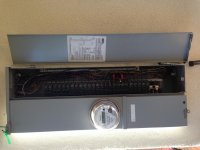
I don't see that's necessary. But if you can take a couple pictures of the inside of the panel where the dryer circuit originates so we can see the wiring would help. All I can do is assume the circuit is from a main panel and the ground and neutral are bonded.
 
To avoid these ads, REGISTER NOW!

Norcal

Well-known member
Joined
Mar 16, 2008
Messages
13,792
The only equipment that was allowed to ground to the neutral & is still allowed in existing installations is clothes dryers & cooking equipment, not air compressors, the dryer receptacle is a dual voltage non-grounding device. That is how UL® listed them.

BTW, UL does not approve anything, they list them.
 

Larwyn

Well-known member
Joined
Oct 10, 2011
Messages
378
Location
Texas
What if I run separate ground wire and use that instead of neutral? But the thing I am not able to understand is how if is going to be different than neutral if neutral and ground end up in same bus at panel?

I agree with you completely. I plan to do the same thing in near future, after the dryer is relocated out of the garage.

My intention is to simply rename the third conductor. I suppose I will have to name it "Ground" as "The Wire Formerly Known As Neutral" will not fit on a wire marker easily, and I have been informed that "George" is right out.

I may or may not swap the receptacle out to a 6-50R so I can plug my mig welder or plasma cutter in on that side of the garage if needed. Don't worry, my mig tops out at 21 amps, the plasma at 16 and they both came factory equipped with 6-50P plugs.

If you die or your house burns down it will no likely be because you used the existing wire (of proper size) from your ground/neutral buss rather than running a new one to the same blasted point.
 

aandpdan

Well-known member
Joined
Nov 12, 2009
Messages
849
Location
In between MA and PA
All I'm saying is that anyone who understands how a 3 prong, UL listed, dryer outlet is wired will realize that there is no difference "electrically" as to how a 20 amp NEMA 6-20 is wired.

Since the neutral and ground are bonded in the panel, there is no issue. Nothing "bad" will happen just because he uses the dryer outlet.

I'm not suggesting he modify the house wiring in any way.

I may or may not swap the receptacle out to a 6-50R so I can plug my mig welder or plasma cutter in on that side of the garage if needed. Don't worry, my mig tops out at 21 amps, the plasma at 16 and they both came factory equipped with 6-50P plugs.

But, you can't put a 6-50R on a 30 amp (dryer) circuit per NEC. That's a clear code violation.
 

Larwyn

Well-known member
Joined
Oct 10, 2011
Messages
378
Location
Texas
But, you can't put a 6-50R on a 30 amp (dryer) circuit per NEC. That's a clear code violation.


Well, it damned well will not be a dryer circuit once the dryer receptacle is removed now will it? At what point in time did the NEC "outlaw" a 30 amp breaker, 10 gauge wire, and 6-50R receptacle? Actually, for a welder I understand that they still allow a 50 amp breaker, 10 gauge wire and a 6-50R receptacle.

Sounds like a good way to utilize an existing 3 wire 240 volt circuit to me. And the best part for all the NEC priest out there, the new dryer will be equipped with a 4 prong receptacle. So I should be protected forever more from sudden death by inceneration.......:lol_hitti
 

aandpdan

Well-known member
Joined
Nov 12, 2009
Messages
849
Location
In between MA and PA
Well, it damned well will not be a dryer circuit once the dryer receptacle is removed now will it? At what point in time did the NEC "outlaw" a 30 amp breaker, 10 gauge wire, and 6-50R receptacle? Actually, for a welder I understand that they still allow a 50 amp breaker, 10 gauge wire and a 6-50R receptacle.

What do the instruction on the welder say?

1. 10 gauge is only rated for 30 amps.

2. You can not install receptacle with a rating higher than the breaker feeding the circuit.

Yes there are exceptions...
 
Last edited:

Larwyn

Well-known member
Joined
Oct 10, 2011
Messages
378
Location
Texas
With the exception of the welder:

1. 10 gauge is only rated for 30 amps.

2. You can not install receptacle with a rating higher than the breaker feeding the circuit.

Actually I think that 10 gauge wire (90 C) is rated at 40 amps, but the NEC requires that it be fused at 30 amps or less except in the case of welders and some other equipment. Maximum fuse/breaker by NEC is not the same as wire rating.

As far as I know there is no restriction on installing receptacles rated higher the the breaker or wire that it is connected to. What would be the point? And why would equipment such as my plasma cutter come from the factory equipped with a 50 amp plug and spec a minimum 20 amp circuit?
In fact I recently had an electrician install a 6-50R on 10 gauge wire and 30 amp breaker while he was here to upgrade the main service panel to my house. He nor the inspector blinked an eye at the use of a 50 amp receptacle on a 30 amp circuit.
 

Norcal

Well-known member
Joined
Mar 16, 2008
Messages
13,792
Larwyn, just because a inspector passes something does not mean it passed code. It just means it passed.
 

Higgins

Well-known member
Joined
Dec 25, 2009
Messages
1,954
Location
Shepheardsville, KY
Both my welders came with the big 3 prong 50 Amp plugs. One takes 20 Amps, the other 25 Amps.

So I go with what ever the MFG says. I thing the reason they go with a larger plug is 1. It's easier to find a mateing plug, 2. the molded plugs are difficult to break!
 

Larwyn

Well-known member
Joined
Oct 10, 2011
Messages
378
Location
Texas
Larwyn, just because a inspector passes something does not mean it passed code. It just means it passed.

So how does that apply to this discussion?

So far what the inspector told me is more important to me than anything I have heard here.
 
OP
A

anu143

Member
Joined
Jan 17, 2013
Messages
7
I don't see that's necessary. But if you can take a couple pictures of the inside of the panel where the dryer circuit originates so we can see the wiring would help. All I can do is assume the circuit is from a main panel and the ground and neutral are bonded.

See the attached pic of 30 amp breaker
 

Attachments

  • image.jpg
    image.jpg
    141.8 KB · Views: 36

pattenp

Well-known member
Joined
Jun 4, 2008
Messages
10,175
Location
Virginia - USA
The picture helps a little. I was hoping to see some more of the cable, to see if it's NM, SE-R, or SE-U. Just curious though, is the neutral/ground bare or insulated? Not that any of this matters. I still believe you're safe plugging your compressor into that circuit.

Edit: I don't know what I was thinking about the wire. Being #10 it isn't going to be SE.
 
Last edited:

Norcal

Well-known member
Joined
Mar 16, 2008
Messages
13,792
So how does that apply to this discussion?


Actually I think that 10 gauge wire (90 C) is rated at 40 amps, but the NEC requires that it be fused at 30 amps or less except in the case of welders and some other equipment. Maximum fuse/breaker by NEC is not the same as wire rating.

As far as I know there is no restriction on installing receptacles rated higher the the breaker or wire that it is connected to. What would be the point? And why would equipment such as my plasma cutter come from the factory equipped with a 50 amp plug and spec a minimum 20 amp circuit?
In fact I recently had an electrician install a 6-50R on 10 gauge wire and 30 amp breaker while he was here to upgrade the main service panel to my house. He nor the inspector blinked an eye at the use of a 50 amp receptacle on a 30 amp circuit.

Your own words....

Table 210.21(B)(3)

Circuit Rating Receptacle Rating
(Amperes) (Amperes)
_____________________________________
15 Not over 15
20 15 or 20
30 30
40 40 or 50
50 50

From 2011 edition NEC. Notice that it does not say it's OK to use a 50A on a 30A circuit but it does say that a 50A on a 40A circuit is fine.
 

Larwyn

Well-known member
Joined
Oct 10, 2011
Messages
378
Location
Texas
Table 210.21(B)(3)

Circuit Rating Receptacle Rating
(Amperes) (Amperes)
_____________________________________
15 Not over 15
20 15 or 20
30 30
40 40 or 50
50 50

From 2011 edition NEC. Notice that it does not say it's OK to use a 50A on a 30A circuit but it does say that a 50A on a 40A circuit is fine.

Well okay then, I reckon I am an "outlaw".

I doubt I will be cutting the molded plugs off my welding machines to make them fit a 30 amp receptacle. Especially in the case of my plasma cutter which is a dual voltage setup with interchangeable 5-15p and 6-50p plugs (voltage is selected by whichever plug is installed). And I think I would rather keep the 30 amp breaker on that 10 gauge wire. So it appears that even though I may be in non compliance with the NEC, I have complete confidence in the safety of my present setup and will not be changing it anytime soon. As soon as a couple hundred feet of 6 gauge wire falls out of the sky I'll just upgrade them to 50 amp circuits like the one out in the shed.

Or would you suggest that I just slap a 40 amp breaker on that #10 wire? I know that is reportedly legal on a welder circuit. And I may just hardwire the air compressor with a safety switch.
 
Last edited:
OP
A

anu143

Member
Joined
Jan 17, 2013
Messages
7
The picture helps a little. I was hoping to see some more of the cable, to see if it's NM, SE-R, or SE-U. Just curious though, is the neutral/ground bare or insulated? Not that any of this matters. I still believe you're safe plugging your compressor into that circuit.

Edit: I don't know what I was thinking about the wire. Being #10 it isn't going to be SE.

Neutral/ground is insulated white color wire terminated in ground/neutral bar as there in only one bar, see the attached pic for service entrance cables if that is what you wanted to see
 

Attachments

  • image.jpg
    image.jpg
    137.3 KB · Views: 35

pattenp

Well-known member
Joined
Jun 4, 2008
Messages
10,175
Location
Virginia - USA
Yes there are some technical things that are not to code if using the circuit as an outlet to plug in your compressor. The plug and outlet type are wrong, which has been beat to death. And that the neutral wire which will be serving as a ground is white and should be green or bare. Since you are dual purposing the outlet there is noway to make it be to code by the letter under both uses. If it's still primarily to serve as the dryer outlet I wouldn't change anything. Bottom line, I wouldn't lose any sleep over using the dryer outlet to plug in the compressor as it is. I know you will be scratching your head as to what to do because you'll get a lot of opposing opinions.
 

Norcal

Well-known member
Joined
Mar 16, 2008
Messages
13,792
There is a simple solution, if the feed is 10/3 NM w/ground, remove the existing dryer receptacle & cap off the white conductor, then use the 2 hot legs & grounding conductor to install a 30A 250V locking or straight blade receptacle, and the whole issue is moot. If the existing box is 2 gang then staying with a straight blade device is best due to difficulty of finding a wall plate.
 

aandpdan

Well-known member
Joined
Nov 12, 2009
Messages
849
Location
In between MA and PA
As far as I know there is no restriction on installing receptacles rated higher the the breaker or wire that it is connected to. What would be the point? And why would equipment such as my plasma cutter come from the factory equipped with a 50 amp plug and spec a minimum 20 amp circuit?

As I said there are "exceptions"...

NEC 210.21(b)(1)

(B) Receptacles.
(1) Single Receptacle on an Individual Branch Circuit.
A single receptacle installed on an individual branch circuit
shall have an ampere rating not less than that of the branch
circuit.

Exception No. 2: A receptacle installed exclusively for
the use of a cord-and-plug-connected arc welder shall be
permitted to have an ampere rating not less than the
minimum branch-circuit conductor ampacity determined
by 630.11(A) for arc welders.
 
To avoid these ads, REGISTER NOW!
Top Bottom