To avoid these ads, REGISTER NOW!

Patch question for under porcelain tiles

jofinneg

Member
Joined
Jan 4, 2013
Messages
15
Hi all, I found this forum just in time!

I'm renovating my garage in order to have a work space for my small business. Based on the images and experiences of the forum members, I will be joining the porcelain tile team.

So far, I've emptied the garage and completed the insulation, drywall, and priming (phew!).

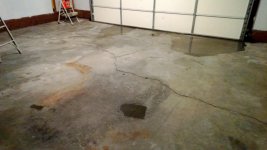
I'm attaching a picture of the state of the garage after two degrease scrubdowns.

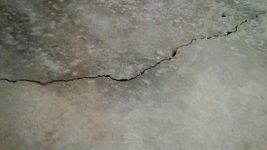
I'm concerned about how to handle the 1/4" wide crack that runs a 'T' across the garage (it rises about 1/4" in the center, also). There are also a couple 3' x 3' low spots where the water is pooling... only maybe 3/8" low.

In your opinions, are these two things something that can be handled with a quikcrete vinyl patch cement, or are they too severe?

I'm really excited to have found this site - thanks for your time.

Thanks,
John in Greenville, SC
 

Attachments

  • WP_20130117_004.jpg
    WP_20130117_004.jpg
    88.8 KB · Views: 64
  • WP_20130117_003.jpg
    WP_20130117_003.jpg
    83.8 KB · Views: 56
To avoid these ads, REGISTER NOW!

mayday0017

Well-known member
Joined
Oct 20, 2010
Messages
1,715
Location
Houston Texas
I'm going to give you what others will consider bad advise and maybe it is.... Though I have never done a crack that is this big I still think it would work. I take and put a strip of duct tape over the crack. Then stick my tile over it like normal... Never had a crack show up in any of my tile jobs.... The idea is the same as the membrane, the tile isn't stuck directly to the concrete and the glue in the tape will give and stretch before it allows the tile to crack.

Just an idea...
 

slickgt1

Well-known member
Joined
Oct 11, 2010
Messages
1,674
Click on my garage reno link. You will see how I dealt with a crack, and a section that actually moved when walked on. The fix is holding well at nearly 3 years. And a 5000lb truck goes in the garage every night.
 
OP
J

jofinneg

Member
Joined
Jan 4, 2013
Messages
15
Thanks for your replies.
Do you have any suggestions on how to begin to best deal with the crack?
Is this something I should or could grind down and fill?
Will I then need to look at a membrane under the thinset?

Thank you very much for the advice. I'm really a newbie when it comes to concrete and tile.

John in Greenville, SC
 

mobiledynamics

Well-known member
Joined
Mar 14, 2010
Messages
5,075
Location
Gotham City
duct tape over the crack...

How do you get a good mortar bond in that area.

-----
OP. Diagnose the problem at hand.
Laying mud, tile and or reverse - breaking it up is not fun.

Was the crack there when you moved it.
Is it progressively getting bigger.
It's not a surface crack coming from a control joint....ya know.
 
OP
J

jofinneg

Member
Joined
Jan 4, 2013
Messages
15
-----
OP. Diagnose the problem at hand.
Laying mud, tile and or reverse - breaking it up is not fun.

Was the crack there when you moved it.
Is it progressively getting bigger.
It's not a surface crack coming from a control joint....ya know.

The crack is stable and has not gotten bigger since we moved in 5 years ago (as far as I can tell). The home is 32 years old, and I hope the worst of the settling has occurred. Drainage around the home is good and water isn't pooling up anywhere.

I can't afford to replace the garage slab, so I'm trying to find a feasible solution that will give the best chance of success.

I've attached closeup photos of the crack at its worst in height and width.

Thanks for your help.

John in Greenville, SC
 

Attachments

  • WP_20130118_056.jpg
    WP_20130118_056.jpg
    150.5 KB · Views: 23
  • WP_20130118_062.jpg
    WP_20130118_062.jpg
    76.4 KB · Views: 28
OP
J

jofinneg

Member
Joined
Jan 4, 2013
Messages
15
Click on my garage reno link. You will see how I dealt with a crack, and a section that actually moved when walked on. The fix is holding well at nearly 3 years. And a 5000lb truck goes in the garage every night.

Thanks - I was actually looking at this last night before I posted my question. Your garage looks fantastic - a complete transformation.

It, unfortunately, is not within my budget to do a whole concrete job in the garage. I really wish I could, but my funds are maxed out. The garage is just part of a number of major small side business purchases.

I hope I can get some 'what would you do in my shoes' answers if complete replacement is not an option and the porcelain tiles have already been purchased.

Again, I really appreciate your garage documentation. I'll do the same as I go, in the event it can help someone down the road.

Thanks,
John in Greenville, SC
 

KPSquared

Well-known member
Joined
Aug 18, 2010
Messages
2,750
Location
Wetaskiwin, Alberta, Canada
I'm just throwing it out there, but could a product like Ditra work in this situation? Would allow the tile to essentially float above the concrete.

I know a lot of guys aren't sold on Ditra, but it has it's place. . .I'm just not sure if it would work here or not. It also would be probably crazy expensive to do. . .
 

Dakota00

Well-known member
Joined
Mar 9, 2008
Messages
1,078
Location
Woodbridge, Ontario
I'm just throwing it out there, but could a product like Ditra work in this situation? Would allow the tile to essentially float above the concrete.

I know a lot of guys aren't sold on Ditra, but it has it's place. . .I'm just not sure if it would work here or not. It also would be probably crazy expensive to do. . .

In this situation Ditra wouldn't do anything for this floor. As the cracking and settling is already completed. Any vertical movement would still pop or crack the tiles if Ditra was used.
 
OP
J

jofinneg

Member
Joined
Jan 4, 2013
Messages
15
I just realized something. We have a full size adult pine tree about 8 feet from the left side of the garage. I walk through there to get to the back yard and remember there are some large roots coming to the surface along that path. The roots run parallel to the main crack in the slab and the crack points straight to the tree.

Knowing nothing about the characteristics of pine tree roots and their strength, could the encroachment be causing the shift in the floor?

Would cutting them stabilize the slab or would the future decomposition of the cut roots just cause more problems?

I can't believe I never thought of that.

John
 
Last edited:

Tims Arrow

Active member
Joined
Oct 19, 2011
Messages
37
Location
Melton Vic
Hi I have had exelent results with much larger cracks. All I did was to grind the high spots level and then lay Resaflex by Dunlop its a rubber impregnated adhesive for the low spots lay a coat of the tile adhesive and leave it to dry. The Guys at work were not happy while working around my repaire sections for a week, while I was building up the low spots, but afterward it was great. This was on a concree slab with no metal reo in it only glassfiber, built over land fill.
I hope this helps
Tims Arrow
 
OP
J

jofinneg

Member
Joined
Jan 4, 2013
Messages
15
Hi I have had exelent results with much larger cracks. All I did was to grind the high spots level and then lay Resaflex by Dunlop

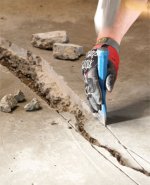
If going with a 'patch' type solution on the cracks, can I use the attached image as a guide? It looks like cutting a guide and chiseling out around 4" of the crack is what they are doing.
Thoughts?
Would you fill with concrete, or a concrete/vinyl patch material? Would you reinforce with rebar?

Thanks,
John in Greenville, SC
 

Attachments

  • cutting concrete.jpg
    cutting concrete.jpg
    25.3 KB · Views: 27

mobiledynamics

Well-known member
Joined
Mar 14, 2010
Messages
5,075
Location
Gotham City
Couple of other questions ....how are you planning to level the substrate for the tile *regardless* of the crack. Level or pitched flat. One or the other, you still need that for a successful tile install. You crack area makes both directional pitches..
 
OP
J

jofinneg

Member
Joined
Jan 4, 2013
Messages
15
Couple of other questions ....how are you planning to level the substrate for the tile *regardless* of the crack. Level or pitched flat. One or the other, you still need that for a successful tile install. You crack area makes both directional pitches..

I'll try to check the overall deflection of that the cracking/shifting has caused and I'll get back to you. I only have a 48" level currently, but I'll try to come up with some way to check.
 
To avoid these ads, REGISTER NOW!

cbracer

Well-known member
Joined
Feb 27, 2012
Messages
645
Location
Costa Mesa, CA
Roadwear Crack Repair is what I'm going to use. $75 for the tool and $77 for the material. Do a you tube search or go to their web site. The company never responded to my message so I found a place near me that sells it:
http://www.restoracrete.com/our-concrete-restoration-store/products

I'll use a concrete cleaner first, then fill the cracks, then grind the cracks smooth, then leveler over the top, then tile.
 

darkk

Well-known member
Joined
Dec 24, 2009
Messages
3,361
Location
Willimantic, Ct.
After reading this whole post so far, it appears no one is really addressing the root cause of the problem or I missed it. The floor is raised/lifted at the crack and the floor lifted for a reason. You mentioned a large pine tree close to the garage, I'm going to go out on a limb here..*pun intended* and guess that there is a tree root under the floor pushing it up. It ain't going to go away by itself and any repairs short of tearing up the floor and cutting out the root are going to be a temporary solution and a waste of hard earned cash.:(
 
OP
J

jofinneg

Member
Joined
Jan 4, 2013
Messages
15
After reading this whole post so far, it appears no one is really addressing the root cause of the problem or I missed it. The floor is raised/lifted at the crack and the floor lifted for a reason. You mentioned a large pine tree close to the garage, I'm going to go out on a limb here..*pun intended* and guess that there is a tree root under the floor pushing it up. (

Upon closer review, I don't think I have a root problem. I believe this is just a 30 year old slab that has settled towards the front right side of the garage.

I spoke to a very experienced tile guy yesterday and he said how he would handle it. He said the slab is old enough to be stable, so he would grind down/cut out the high spots created by the crack. Then he would fill the crack and open area and apply a repair 'mesh' (I'm guessing this is some type of fiberglass) over it while wet.

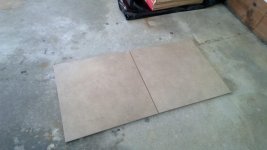
I'm still insecure about it. Anyway, I'm attaching a picture of the 24" tiles I'll be putting in.

John in Greenville, SC
 

Attachments

  • WP_20130120_001.jpg
    WP_20130120_001.jpg
    77.1 KB · Views: 23
OP
J

jofinneg

Member
Joined
Jan 4, 2013
Messages
15
Hmmmm... Anyone know of any concrete guys in Greenville, SC?

I was out measuring and it looks like from left to right my floor has a bit of a 'cupping' effect. It seems that it is the same height at the left and right sides, but then gradually dips to about .75" lower in the middle. This occurs over a 22' left-to-right span. Front-to-back there is a very slight downward slope, but not the cupping effect. The 'cupping' is not at the entrance of the garage, but begins a couple feet in.

Are there any concrete specific forums out there? I think I need a consultation to see what my options are. I'm still not ruling out just cutting down the high spots, applying the tile, and hoping for the best.
 
Last edited:

cbracer

Well-known member
Joined
Feb 27, 2012
Messages
645
Location
Costa Mesa, CA
Are there any concrete specific forums out there? I think I need a consultation to see what my options are. I'm still not ruling out just cutting down the high spots, applying the tile, and hoping for the best.

There are some concrete forums. I've seen epoxy crack over existing cracks but haven't heard of tile cracking over existing cracks. There is thinset with the ability to handle some movement. More expensive but nothing in comparison to the overall cost. What's the cost to tear it out and pour a new one? I hear everything from $4 sq/ft to $10 sq/ft because there are so many variables. I don't see spending $2k and having a normal concrete floor compared to $600 for a nice tile floor that should last your life time over the old floor.
 
OP
J

jofinneg

Member
Joined
Jan 4, 2013
Messages
15
jofinneg,

Are you planning to tile the garage yourself?

Yes, I'll be doing it myself. I'm a fairly hands-on guy and have done many dyi projects with success. My tile experience has only been 16" x 16" interior tiles in about 800 square feet, but it went very well.
 
OP
J

jofinneg

Member
Joined
Jan 4, 2013
Messages
15
What's the cost to tear it out and pour a new one? I hear everything from $4 sq/ft to $10 sq/ft because there are so many variables. I don't see spending $2k and having a normal concrete floor compared to $600 for a nice tile floor that should last your life time over the old floor.

I'm not sure, but I'm not optimistic. I've tried to contact a few folks to come over to evaluate it. I know I can't afford a whole new pour.

I see posts like this:
http://www.garagejournal.com/forum/showpost.php?p=1278798&postcount=15

and I just want to do the same.

But I'm inexperienced and then have questions like:

-If I grind it down the crack ledge, do I fill with vinyl patching material, or hydraulic cement, or epoxy?

-Do I take care of the 'cupping' that runs across the width by compensating with the thickness of the thinset, or do I do a self-leveling solution like this: http://www.garagejournal.com/forum/showpost.php?p=1211249&postcount=3

Or do I just live with it?

Too many questions, I know...

Thanks,
John
 
Last edited:

Herb67SS

Well-known member
Joined
May 18, 2009
Messages
158
Location
Northern Virginia
darkk; You mentioned a large pine tree close to the garage said:
Don't "THINK" this isn't the cause, make certain. Small effort for much peace of mind. Hire a day laborer, on a Saturday to dig down 18" or so along the outside wall adjacent to the nearest pine tree and see if there are any roots running under the slab. If so cut them. Mature pines can handle a little "root pruning". I have to do that along the edge of my driveway every couple 3 or 4 yrs as I have 75 ft pines near it that try to push up the asphalt occasionally. That's just part of having them that close to the driveway. It will be a decade or two before it reoccurs, if ever. If that is what caused the lifting, you will have eliminated future lifting for a decade or so.

In many parts of the Eastern Carolinas pouring slabs on grade was/is common due to the sandy composition of the soil. It's possible the builder of that house never cut below 12" under that slab before it was poured. It won't take much to make sure a root isn't the cause.
 

mobiledynamics

Well-known member
Joined
Mar 14, 2010
Messages
5,075
Location
Gotham City
John -

The reason I asking how much deviation you have, is to have a SUCCESSFUL tile install (regardless of your cracks and telepgrahing) that I mentioned, while you don't need a level surface, you do need a FLAT surface.

So put that that into equation, and figure out a correct action plan to have the PROPER SUBSTRATE before you even consider to mix mud.
 

slickgt1

Well-known member
Joined
Oct 11, 2010
Messages
1,674
Thanks - I was actually looking at this last night before I posted my question. Your garage looks fantastic - a complete transformation.

It, unfortunately, is not within my budget to do a whole concrete job in the garage. I really wish I could, but my funds are maxed out. The garage is just part of a number of major small side business purchases.

I hope I can get some 'what would you do in my shoes' answers if complete replacement is not an option and the porcelain tiles have already been purchased.

Again, I really appreciate your garage documentation. I'll do the same as I go, in the event it can help someone down the road.

Thanks,
John in Greenville, SC

That's the thing. I didn't pour new concrete. I did it by hand, mixing bags of sand and cement inside my garage. I mixed just enough to get through what I could cover with tile right away. It was not easy, and I was glad for the help. I need to have the floor pitch out the main door. I just didn't want to screw around with standing water, or dripping snow. I had that for years before, and every winter would make my garage smell like piss. I figure I do it once, and never do it again. And if I ever sell the house, I can guarantee this will add value.

That being said, I would just break that high edge of yours off. Screw cutting it. Jack hammer that **** off. Dig some dirt out, and fill with concrete and rebar posts. Then the shifted slab, drill holes in that, 4" or so, and dig them out about a foot. Fill with rebar and concrete. If you look at my thread, I did that to a section of slab that was actually moving. It does not move anymore.

After that, stop over thinking it. Lay the tile. If something does look too terrible, it really is a little sledge, and a chisel to remove a few tiles and fix it. In the end, you need to not lose sight of what you have, a garage, not your living room. Although my garage is nicer that some peoples living rooms. lol.
 

dcs Inc

Well-known member
Joined
Dec 13, 2010
Messages
803
Location
Indianapolis, Indiana
I was going to answer your email but thought I'd throw it out here. Same as the other thread. Use a crack chase blade and open the crack. Mix a strong epoxy and wet the edges then thicken with your choice of thickeners. (silica sand). Make it thick and force all the way down into the crack. Over fill and grind smooth when dry. Get a good walk behind saw and deep cut NEW crack control joints. When the powers that be caused the original random crack it will now follow the straight crack relief joint you cut. Does it work every time? It has for me because I wont cut a corner. I make sure the the walls of the crack are clean and dry. I force the thickened epoxy deep into the crack.

A crack will follow the patch of least resistance. If you glue the random crack back together with some really high strength psi epoxy and do it correctly, when the stresses show their ugly head again, it will relieve itself along the weakest path.

If you are worried about tree roots then dig a trench just outside the wall nearest the tree. Find a surface root? Cut all the way through it. Shallow roots will move concrete.

You have also the issue of leveling. Grinding the high side to get the fill down and then use a good surface filler on the low side of the crack. I'd call a tile supplier and ask them. Follow their instruction on how to fill and level.

Another thing I would do if I were going to lay tile in this situation. I would make my "NEW" saw cut relief cuts on the 90. this will be your starting points laying tile. In other words, place your grout lines right on the new cut lines. If they do what they are suppose to do and crack, you will only have cracked grout lines. If do a non grout install you shouldn't even see the movement.... if it moves.
 
OP
J

jofinneg

Member
Joined
Jan 4, 2013
Messages
15
I was going to answer your email but thought I'd throw it out here. Same as the other thread. Use a crack chase blade and open the crack....

Thank you very, very much - that is very helpful and greatly appreciated.

- John in Greenville, SC
 

freeds12

New member
Joined
Sep 10, 2009
Messages
1
John,

I like the tile you picked - what is the brand/color and how much does that go for?

Thanks.
 

dcs Inc

Well-known member
Joined
Dec 13, 2010
Messages
803
Location
Indianapolis, Indiana
Here's a visual of a crack treatment. The white lines represent a deep saw cut. These can be filled with a flexable joint filler.

crackedgarage_zps16ddd6ef.jpg
 
OP
J

jofinneg

Member
Joined
Jan 4, 2013
Messages
15
Here's a visual of a crack treatment. The white lines represent a deep saw cut. These can be filled with a flexable joint filler.

Thank you very much for the visual - now it makes perfect sense.

How deep should I go with the two relief cuts?

slickgt1 was kind enough to share his bonded mortar technique, so I'll be using that under the tiles.
 
OP
J

jofinneg

Member
Joined
Jan 4, 2013
Messages
15
John,

I like the tile you picked - what is the brand/color and how much does that go for?

Thanks.

It was a Craigslist find.

They are Pamesa brand 'Beta Vison' and cost me $1.60 per square foot. They are first-quality and exhibit no bowing or warping at all. I think retail they are $5.50 or so a square foot (that's why I really don't want to mess this up!).

The guy I bought them from was a professional tile setter and had done 3,000 square feet of these for a Designer Shoe Warehouse. Apparently, there was a change order and these were left-overs that he was able to purchase from the GC.

-John
 

dcs Inc

Well-known member
Joined
Dec 13, 2010
Messages
803
Location
Indianapolis, Indiana
Thank you very much for the visual - now it makes perfect sense.

How deep should I go with the two relief cuts?

slickgt1 was kind enough to share his bonded mortar technique, so I'll be using that under the tiles.

I cut all the through. Most residential slabs are 3.5-4" thick. Easy to do with the correct equipment. Wet cut! When using a higher HP walk behund saw, make your initial cut 2" deep. Cutting at 4" takes a lot longer and the saw sometimes wants to wonder.
 
To avoid these ads, REGISTER NOW!
Top Bottom