Hey guys, I am new here and I am starting to plan a detached garage at my house. I plan on installing a 2 post lift in one bay of the garage and I am want to make sure my ceiling is high enough and my concrete pad will work well for a lift. Mostly what I am looking at are cheap 9-10k lb two post lifts, what I am finding is that most of them say the minimum concrete thickness should be 4" w/ 3000 psi concrete(from reading threads around here it seems that 6" is a popular thickness). I plan on building a 36x48 building and if I had to pour thicker concrete for the lift I would only want to do it where necessiary since it's expensive. Can anyone here give me insight on ceiling and floor requirements for a standard two post lift? I want to lift to be installed as safely as possible. I am not looking to cut corners, I just don't want to waste money. *I have also emailed two companies asking them the same thing I am just waiting to hear back* Thanks for any suggestions.


You are using an out of date browser. It may not display this or other websites correctly.
You should upgrade or use an alternative browser.
You should upgrade or use an alternative browser.
Concrete thickness and strength for 2 post lift
- Thread starter cardana24
- Start date
cyamaha2007
Well-known member
It sounds like a 4in floor would be enough Id add a 2ftx2ft sump under each lift column bringing your total thickness to 8in under the lift. It would add minimal cost and overkill is good when your life's at stake. 12ft will be close if possible go 13. It was actually cheaper for me to raise the entire building to 14 than have a 13ft ceiling height. 13 ft was odd and would have wasted alot of materials.
NHBandit
Well-known member
With mine the lift requirements were 3 1/2" thick 3000psi concrete. We went with 4" thick 4000psi with 4x4 square areas where the lift posts that are 6" thick reinforced with rebar just to be sure. My building is going to have 12' walls with scissor trusses giving me well over 12' at the peak.
Claytonfarms
New member
- Joined
- Feb 19, 2013
- Messages
- 3
I would consult the lift manufacturer for the concrete then add a little for safety.
I addition to height, you may want to check the length from door / walls to lift.
Make sure you have 2-3 feet on sides so you can walk around it with tires etc.
Make sure the lift is far enough inside the door. It may seem silly but I rent a shop, looked good when I walked thru but if I try to lift a crew cab truck, the bed is 1 foot outside the door. A pain in the winter!!
If you ever want to lift a van, 14ft high is better.
Also the garage door opener is mounted such that it can hit the hood on some cars if the hood is open and the car is all the way up on the lift!!
I addition to height, you may want to check the length from door / walls to lift.
Make sure you have 2-3 feet on sides so you can walk around it with tires etc.
Make sure the lift is far enough inside the door. It may seem silly but I rent a shop, looked good when I walked thru but if I try to lift a crew cab truck, the bed is 1 foot outside the door. A pain in the winter!!
If you ever want to lift a van, 14ft high is better.
Also the garage door opener is mounted such that it can hit the hood on some cars if the hood is open and the car is all the way up on the lift!!
wssix99
Well-known member
If you get a two post lift with a clear floor, you'll have a top bar. That will be your max height and you should be able to get that out of the instructions.
If you want extra strength, just go with a thicker slab. Don't over-think it. A flat slab will give you the least amount of grief. "Footers" or other contraption won't do anything for you structurally and may lead to unintended consequences like creating additional shrinkage stresses, which can lead to cracking.
Cracking is your enemy, here. The thicker the slab, the greater more prone it will be to cracking for a given amount of reinforcing. Likewise, you'll want to properly plan your control joints to control where the cracking is. The slab acts like a beam, (between the posts and front-to-back) so you don't want to compromise its strength with cracks.
If you want extra strength, just go with a thicker slab. Don't over-think it. A flat slab will give you the least amount of grief. "Footers" or other contraption won't do anything for you structurally and may lead to unintended consequences like creating additional shrinkage stresses, which can lead to cracking.
Cracking is your enemy, here. The thicker the slab, the greater more prone it will be to cracking for a given amount of reinforcing. Likewise, you'll want to properly plan your control joints to control where the cracking is. The slab acts like a beam, (between the posts and front-to-back) so you don't want to compromise its strength with cracks.
I heard back from one of the lift companies today and they said 12' is fine for a 9k lift but I should do at least 12.5' if I do a 10k lift. They also recomended that I use 6" reinforced 3000 psi concrete in the are the lift will be in. So I am thinking I will go with 6" in the 1/3 of the garge where the lift will be and 4" everywhere else. *I am only looking at 2 post lifts that have a smooth floor*
It sounds like a 4in floor would be enough Id add a 2ftx2ft sump under each lift column bringing your total thickness to 8in under the lift. It would add minimal cost and overkill is good when your life's at stake. 12ft will be close if possible go 13. It was actually cheaper for me to raise the entire building to 14 than have a 13ft ceiling height. 13 ft was odd and would have wasted alot of materials.
The building that I am planning on having built will have a second floor, but by raising the ceiling to 14' I will either loose space upstairs or the roof will be even higher. I would like to do 12' if I can but I am still researching it.
With mine the lift requirements were 3 1/2" thick 3000psi concrete. We went with 4" thick 4000psi with 4x4 square areas where the lift posts that are 6" thick reinforced with rebar just to be sure. My building is going to have 12' walls with scissor trusses giving me well over 12' at the peak.
Which lift do you have?
I would consult the lift manufacturer for the concrete then add a little for safety.
I addition to height, you may want to check the length from door / walls to lift.
Make sure you have 2-3 feet on sides so you can walk around it with tires etc.
Make sure the lift is far enough inside the door. It may seem silly but I rent a shop, looked good when I walked thru but if I try to lift a crew cab truck, the bed is 1 foot outside the door. A pain in the winter!!
If you ever want to lift a van, 14ft high is better.
Also the garage door opener is mounted such that it can hit the hood on some cars if the hood is open and the car is all the way up on the lift!!
Yeah, all of those measurements will be taken into account before I do the lift. The building will be mostly finished before I put a lift in it. I just want to make sure the building will work well with the lift once it's time to put the lift in.
Since all of the lifts I am looking at have a top bar, I don't think the van thing will be an issue I will just have to duck down

If you get a two post lift with a clear floor, you'll have a top bar. That will be your max height and you should be able to get that out of the instructions.
If you want extra strength, just go with a thicker slab. Don't over-think it. A flat slab will give you the least amount of grief. "Footers" or other contraption won't do anything for you structurally and may lead to unintended consequences like creating additional shrinkage stresses, which can lead to cracking.
Cracking is your enemy, here. The thicker the slab, the greater more prone it will be to cracking for a given amount of reinforcing. Likewise, you'll want to properly plan your control joints to control where the cracking is. The slab acts like a beam, (between the posts and front-to-back) so you don't want to compromise its strength with cracks.
What are you thoughts on only getting the slab thicker on the 1/3 of the garage where the lift will be?
supra90turbo
Well-known member
What are you thoughts on only getting the slab thicker on the 1/3 of the garage where the lift will be?
My neighbor did that, no issues if you're telling the floor guys what you intend to do.
NHBandit
Well-known member
I know some of the self proclaimed experts are saying that digging "footers" where the posts go won't help and so on... buttt.. I chose to listen to what my concrete contractor (who has been in the concrete business for 40 years) told me as well as the people who sell lifts for a living. That's why I did mine the way I did. The lift is scheduled to be delivered today or tomorrow. The concrete was poured today so the lift will be set aside until I'm ready to install it in a couple of weeks. This is what I bought. It's surely not the best, most likely made in China, but it's what I can afford and I had 2 of these exact same lifts at an auto salvage yard I managed for 5 years and they gave me no trouble so I think it will get me by for my home "hobby shop" http://www.nationalautotools.com/index.php?route=product/product&product_id=181Which lift do you have?
I know some of the self proclaimed experts are saying that digging "footers" where the posts go won't help and so on... buttt.. I chose to listen to what my concrete contractor (who has been in the concrete business for 40 years) told me as well as the people who sell lifts for a living. That's why I did mine the way I did. The lift is scheduled to be delivered today or tomorrow. The concrete was poured today so the lift will be set aside until I'm ready to install it in a couple of weeks. This is what I bought. It's surely not the best, most likely made in China, but it's what I can afford and I had 2 of these exact same lifts at an auto salvage yard I managed for 5 years and they gave me no trouble so I think it will get me by for my home "hobby shop" http://www.nationalautotools.com/index.php?route=product/product&product_id=181
Gotcha....I am looking at similar lifts, eagle and greg smith equipment are around the same price. From looking around it seems that mostly everything comes from China other than Mohawk
NHBandit
Well-known member
Yeah the price seems to be pretty consistant with the low end lifts. What got me to buy this one was the free shipping.Gotcha....I am looking at similar lifts, eagle and greg smith equipment are around the same price. From looking around it seems that mostly everything comes from China other than Mohawk
dadsEH
Well-known member
as the girl said to the sailor.... 6" is good.
I built my garage with the plans of a 4 post lift. A few months later I find a deal on a used rotary 2 post. I had 4" of concrete annd Rotary speced 4.5. I ended up cutting out 2x3ft squares where each post would sit. I went down 12" with mesh in the bottom and rebar drilled and epoxied to the existing slab 5k psi .
Save yourself some time and hassle and do it right the first time.
Save yourself some time and hassle and do it right the first time.
Yeah the price seems to be pretty consistant with the low end lifts. What got me to buy this one was the free shipping.
Yeah, that's the first one I have seen that offers free shipping.
as the girl said to the sailor.... 6" is good.
hahahah

I built my garage with the plans of a 4 post lift. A few months later I find a deal on a used rotary 2 post. I had 4" of concrete annd Rotary speced 4.5. I ended up cutting out 2x3ft squares where each post would sit. I went down 12" with mesh in the bottom and rebar drilled and epoxied to the existing slab 5k psi .
Save yourself some time and hassle and do it right the first time.
That's what I am trying to do....that's why I started this thread.
wssix99
Well-known member
What are you thoughts on only getting the slab thicker on the 1/3 of the garage where the lift will be?
That's perfectly fine, but you'll want to isolate the sections with an expansion joint. (a full expansion joint - not a control joint) With similar reinforcement, the thicker slab and thinner slab will shrink (as they dry) differently, so an expansion joint will keep you from getting out-of-control cracks where the two meet.
Strouty
Well-known member
I built my garage with the plans of a 4 post lift. A few months later I find a deal on a used rotary 2 post. I had 4" of concrete annd Rotary speced 4.5. I ended up cutting out 2x3ft squares where each post would sit. I went down 12" with mesh in the bottom and rebar drilled and epoxied to the existing slab 5k psi .
Save yourself some time and hassle and do it right the first time.
Is that what rotary suggested?
wssix99
Well-known member
I know some of the self proclaimed experts are saying that digging "footers" where the posts go won't help and so on...
Making them deep won't help and is unnecessary. Making them large enough and/or pinning/keying them to the slab as BDAZSVT did is key for them to be safe and counteract the bending forces that a 2 post lift develops.
buttt.. I chose to listen to what my concrete contractor (who has been in the concrete business for 40 years) told me as well as the people who sell lifts for a living.
This is another key thing. The American Concrete institute also has a paper, which they refresh every couple of years, on floor slab design. In it they point out that it takes two to tango for a quality floor. The contractor needs to have the skill and experience for the install and the engineer (knowledge supplied by the lift manufacturer) is needed to end up with a floor that will perform well. If one of the two parties is missing from the job, its a **** shoot.
DAVE VAN
Well-known member
I cut and poured my footers 4ft x 4ft X 12in deep under the post on my Greg Smith 2 post lift. My old slab varied from 3in to 4in so I wanted no problems. Map out where to place your re-bar so the anchor bolts don't hit a re-bar. Lift works great and I am happy (and safe!)
I just put up my building in the fall and had a 6 inch slab poured. I extended this to 10-12 inches in a roughly 3*3 area under each post.
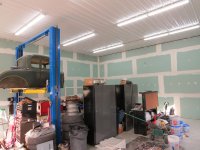
The decision I am happiest with is the ceiling height, 14'. I know some will say it is excessive but I am happy with mine. I can put the lift to max height and still have 2' of room to the ceiling. I also had high rise doors installed and they bring the opened doors to within about 10 inches of the ceiling.
Make sure you plan where you will take power (and that it will be 220v) from. Installing a lift was the best thing I did, very happy with it.
This photo was taken last week just after drywall went up. It has been painted now and looks different but you get the idea as to the ceiling height etc.
The decision I am happiest with is the ceiling height, 14'. I know some will say it is excessive but I am happy with mine. I can put the lift to max height and still have 2' of room to the ceiling. I also had high rise doors installed and they bring the opened doors to within about 10 inches of the ceiling.
Make sure you plan where you will take power (and that it will be 220v) from. Installing a lift was the best thing I did, very happy with it.
This photo was taken last week just after drywall went up. It has been painted now and looks different but you get the idea as to the ceiling height etc.
Attachments
I've got a new shop with a well done 5" concrete floor. No rebar was used, but the site was prepped top notch. As is standard, they also cut expansion slots an inch or so deep in a pattern that lines up with my 10' end column spacing. In other words I only have 120" of width per 'section'.
In order to install a two post surface lift, I would have to 'bridge' one of these slots, which means the two posts would be on different 'sections'. I could keep the 6" minimum spacing from slot to post, but I'm wondering about the strain because of this expansion slot.
Any thoughts or recommendations? BTW, the slab was poured in November, and that winter we experienced record cold with frost depths past 72" deep in some spots rather than our normal 36-48" frost depth. Even so, I have no cracks anywhere and it still looks as good as they day they poured it.
Thanks for the help, it's greatly appreciated!
In order to install a two post surface lift, I would have to 'bridge' one of these slots, which means the two posts would be on different 'sections'. I could keep the 6" minimum spacing from slot to post, but I'm wondering about the strain because of this expansion slot.
Any thoughts or recommendations? BTW, the slab was poured in November, and that winter we experienced record cold with frost depths past 72" deep in some spots rather than our normal 36-48" frost depth. Even so, I have no cracks anywhere and it still looks as good as they day they poured it.
Thanks for the help, it's greatly appreciated!
Last edited:
wssix99
Well-known member
No rebar was used, but the site was prepped top notch. As is standard, they also cut expansion slots an inch or so deep in a pattern that lines up with my 10' end column spacing.
The rebar and saw cuts do the same thing - control shrinkage cracking. At 10' spaced cuts, there should be no need for rebar at all. (You'd only need rebar if you wanted to space the cuts out further or buy more insurance that there wouldn't be cracking outside of the cuts. These cracks form in the first month of curing, so your floor should be great for the duration.)
In order to install a two post surface lift, I would have to 'bridge' one of these slots, which means the two posts would be on different 'sections'. I could keep the 6" minimum spacing from slot to post, but I'm wondering about the strain because of this expansion slot.
As long as you are within your lift manufacturer's specs, you should be fine. If they had a problem with bridging control joints, they would say so. I expect they will want you just be a certain distance away from them.
You will have cracking inside the areas where you have the saw cut joints. Even though the parts of the slab will (very slightly) pull away from each other, the cracks will form around the aggregates. That irregular surface of the crack on the different parts of the slab will interlock and continue to hold things together nicely for you. As long as you are within spec, you shouldn't stress them out beyond what they can handle.
VDubJoe
Well-known member
Mine is a 40 x 60 with cuts every 20 feet. 5 inches thick . No cracks in 6 years. I have a 7000 lb. Rotary 2 post.
Joe
Joe