To avoid these ads, REGISTER NOW!

Off Grid Solar Project - Insight Please

Teken

Well-known member
Joined
Jan 2, 2010
Messages
8,214
Location
The Bad Lands
I am on my next project and that is my off grid back up solar generation. One of the things I am in need of is a box. I understand there are some very specific box's for use with DC power.

Many people re purpose square D AC panels to do the same function. I have no real preference so long as it serves the end goal and allows me to grow the system and also has enough space to properly work with in the cabinet.

Now . . .

I require some DC breakers, I have always wanted to use DIN style breakers due to their form factor and ease of install / mounting. Does anyone know of a vendor who sells DIN style breakers in 10, 15, 20, 30, 60 amp capacity?

There are quite a few off grid solar guys who use equipment from the 12 volt world to provide the same level of protection in terms of fusing etc. I have no problem going this route, but would prefer to use a more purpose built product in my off grid solar system. :rocker:

Lastly, what is the name of the grey flexible tubing used to connect panels together? :headscrat

Teken . . .
 
To avoid these ads, REGISTER NOW!

ishiboo

Well-known member
Joined
Oct 27, 2010
Messages
9,481
Location
Oshkosh, WI
I am on my next project and that is my off grid back up solar generation. One of the things I am in need of is a box. I understand there are some very specific box's for use with DC power.

Many people re purpose square D AC panels to do the same function. I have no real preference so long as it serves the end goal and allows me to grow the system and also has enough space to properly work with in the cabinet.

Your local hardware store will have a number of steel and plastic boxes, otherwise as you said you can unscrew a load center from its enclosure and use that. Purpose-built enclosures like Hammond are quite expensive.

I require some DC breakers, I have always wanted to use DIN style breakers due to their form factor and ease of install / mounting. Does anyone know of a vendor who sells DIN style breakers in 10, 15, 20, 30, 60 amp capacity?

DIN breakers are great. DIN overall is great. You can use the same setup for Insteon, they just came out with an Insteon DIN module and I bought one to test :)

Also, DIN terminal blocks are fantastic too.

Anywhere sells them - eBay will be the cheapest - DIN breakers are almost always used for pricey industrial enclosures and are NOT cheap.

There are quite a few off grid solar guys who use equipment from the 12 volt world to provide the same level of protection in terms of fusing etc. I have no problem going this route, but would prefer to use a more purpose built product in my off grid solar system. :rocker:

What's your setup like? Most off grid stuff isn't 12v, as high amperage DC fed to inverters can easily be hundreds of amps at 12v... it is cheaper to power an inverter off a higher voltage like 48v. There is a lot of cheap telco equipment made for 48v as well.

Lastly, what is the name of the grey flexible tubing used to connect panels together? :headscrat

Teken . . .

Non-metallic liquid tight is what's available locally, for individual panels you wouldn't need much... perhaps 1/2 ENT or something?
 

rockwithjason

Well-known member
Joined
Jan 8, 2006
Messages
2,633
Location
Las Vegas
the gray tubing is probably non metallic liquid tight conduit, seal tite for short. you can get it at the home stores. as far as the breakers you need to be careful of voltage rating when repurposeing 12v stuff. most ac panels that are intended for commercial/industrial service have dc ratings on them. as far as din rail mounting, you can look up buss, littlefuse, and many others. here is one link that came up under "din rail mounted breaker"

https://www.asi-ez.com/member/x555-DC-Circuit-Breakers.asp
 
OP
T

Teken

Well-known member
Joined
Jan 2, 2010
Messages
8,214
Location
The Bad Lands
Your local hardware store will have a number of steel and plastic boxes, otherwise as you said you can unscrew a load center from its enclosure and use that. Purpose-built enclosures like Hammond are quite expensive.


DIN breakers are great. DIN overall is great. You can use the same setup for Insteon, they just came out with an Insteon DIN module and I bought one to test :)

Also, DIN terminal blocks are fantastic too.

Anywhere sells them - eBay will be the cheapest - DIN breakers are almost always used for pricey industrial enclosures and are NOT cheap.


What's your setup like? Most off grid stuff isn't 12v, as high amperage DC fed to inverters can easily be hundreds of amps at 12v... it is cheaper to power an inverter off a higher voltage like 48v. There is a lot of cheap telco equipment made for 48v as well.


Non-metallic liquid tight is what's available locally, for individual panels you wouldn't need much... perhaps 1/2 ENT or something?

the gray tubing is probably non metallic liquid tight conduit, seal tite for short. you can get it at the home stores. as far as the breakers you need to be careful of voltage rating when repurposeing 12v stuff. most ac panels that are intended for commercial/industrial service have dc ratings on them. as far as din rail mounting, you can look up buss, littlefuse, and many others. here is one link that came up under "din rail mounted breaker"

https://www.asi-ez.com/member/x555-DC-Circuit-Breakers.asp

For the (future) grid tie solar array it will be 48 volts. This system is intended for dual purpose at the moment. The first system is meant solely for portability and ease of use / placement.

I have a thread about it in the free parking: http://garagejournal.com/forum/showthread.php?t=186689

The other half of the system will be dedicated to the home alone. Both battery systems will be designed to (stack) and be able to recharge via the off grid solar array. Because this is two parts the portable system is 12 volts only so equipment and gear is designed around those elements.

The home unit will be designed around a 12 / 24 volt system to ensure stacking can happen and not interfere with my portable system. Because of the two systems being deployed extra costs and gear are being used to ensure a smooth cross over.

Most of the gear I have is rated at 600 volts, which realistically will never exceed 24 volts, but realize a margin of safety must be built in. I was really hoping to find DIN style DC breakers at a value price. :eek:

I really wanted to try something new and better looking! But, costs is a factor here so why buck the system and try to reinvent the wheel! :(

Much thanks for all the feed back . . .

Any other thoughts from GJ members are welcomed.

Teken . . .
 

where2

Well-known member
Joined
Dec 12, 2010
Messages
772
Location
South FL
I've been spec'ing the ASI DC breakers for projects at work for the last several months, but I don't know that anyone has built any of my projects yet.

WAGO lever nuts with DIN rail adapters are our other favorite product these days. I need to order up a variety of lever nuts for use around the house. Forget wire nuts...
 

madosta

Well-known member
Joined
Sep 4, 2012
Messages
807
Location
Michigan
I didn't realize there would be a difference in AC or DC breakers. Interesting reading some articles on the timing and arc jump for DC.

Just use fuses... lol JK.

I love DIN rail stuff. Maybe they have dual rated breakers for your needs more readily available. Also post some pics when you get started!
 
OP
T

Teken

Well-known member
Joined
Jan 2, 2010
Messages
8,214
Location
The Bad Lands
I've been spec'ing the ASI DC breakers for projects at work for the last several months, but I don't know that anyone has built any of my projects yet.

WAGO lever nuts with DIN rail adapters are our other favorite product these days. I need to order up a variety of lever nuts for use around the house. Forget wire nuts...

I love Wago lever nuts! :thumbup: I have been using them for a few years with great success. They are great in terms of fast install and future reno's. But, if you use the larger 4-6 wire units having more than 2 in a box gets pretty tight. :sad:

I didn't realize there would be a difference in AC or DC breakers. Interesting reading some articles on the timing and arc jump for DC.

Just use fuses... lol JK.

I love DIN rail stuff. Maybe they have dual rated breakers for your needs more readily available. Also post some pics when you get started!

My initial thoughts were to use fuses. But, after thinking about the long term use and reliability factor. I decided not to go that route for the entire system.

I would rather have a resettable breaker than to have to find, locate, and have on hand fuses. My luck would have it that I would be short a critical fuse than the whole shabang would be dead in the water.

This system is being designed to be as idiot, simple, and dumbed down as possible. If there is some sort of critical event I want the back up systems to be easy to use, repair, and trouble shoot.

I am currently looking at dual use breakers but a lot of them are insanely expensive! :sad:

Teken . . .
 

Stuart in MN

Well-known member
Joined
Sep 8, 2005
Messages
23,440
Location
Minneapolis
There was an article in the local newspaper a couple days ago about a Minnesota company named Silent Power that builds battery systems for energy storage on solar systems: http://www.silentpwr.com/ It combines the battery storage, solar inverter, switching equipment, etc. all in one enclosure. It looks like a neat solution.

The article is here: http://www.startribune.com/business/189752981.html
 
OP
T

Teken

Well-known member
Joined
Jan 2, 2010
Messages
8,214
Location
The Bad Lands
There was an article in the local newspaper a couple days ago about a Minnesota company named Silent Power that builds battery systems for energy storage on solar systems: http://www.silentpwr.com/ It combines the battery storage, solar inverter, switching equipment, etc. all in one enclosure. It looks like a neat solution.

The article is here: http://www.startribune.com/business/189752981.html

Stuart in MN,

As always I thank you for the insight and feed back. Time to do some more reading! :thumbup:

Teken . . .
 

where2

Well-known member
Joined
Dec 12, 2010
Messages
772
Location
South FL
Although not intended for DIN rail mounting, I picked up a pair of DC breakers intended for boats last night. They are intended to mount from the rear of a panel. They are termed "A series" and use two mounting screws and have a tripping lever that will fit through a ~1/2" hole. They are NOT sealed for use in flammable environments.
One was made by Airpax in Cambridge MD, the other by Carling Technologies (made in Mexico). The Carling Technologies unit also carries a Blue Sea Systems sticker

Both are rated for 65V DC or 250V AC.

These little guys go for $12 each at Boatersland. Get a DIN rail clip and a project box to hold several of them.
 

ishiboo

Well-known member
Joined
Oct 27, 2010
Messages
9,481
Location
Oshkosh, WI
The Carling Technologies unit also carries a Blue Sea Systems sticker

Speaking of which.

For your DC work Teken, you probably won't do better (at least for a reasonable cost) than Blue Sea Systems for panels, battery switches, distribution gear, etc.

If you want to buy some of their stuff, first send me the Blue Sea P/Ns... I can get most Blue Sea stuff near cost last I checked. I love their products!
 
OP
T

Teken

Well-known member
Joined
Jan 2, 2010
Messages
8,214
Location
The Bad Lands
Speaking of which.

For your DC work Teken, you probably won't do better (at least for a reasonable cost) than Blue Sea Systems for panels, battery switches, distribution gear, etc.

If you want to buy some of their stuff, first send me the Blue Sea P/Ns... I can get most Blue Sea stuff near cost last I checked. I love their products!

That would be fantastic of you! :beer: I will call upon you in the near future when I have all of the specifics as to what I need and PM you. :thumbup:


Also look at the Eaton UL1077 line of products on Automation Direct's website.

Much thanks and will start looking in those name brands. :beer:

Teken . . .
 

hh76

Well-known member
Joined
Nov 9, 2010
Messages
3,471
Location
NE Wisconsin
I am on my next project and that is my off grid back up solar generation. One of the things I am in need of is a box. I understand there are some very specific box's for use with DC power.

Many people re purpose square D AC panels to do the same function. I have no real preference so long as it serves the end goal and allows me to grow the system and also has enough space to properly work with in the cabinet.

Now . . .

I require some DC breakers, I have always wanted to use DIN style breakers due to their form factor and ease of install / mounting. Does anyone know of a vendor who sells DIN style breakers in 10, 15, 20, 30, 60 amp capacity?

There are quite a few off grid solar guys who use equipment from the 12 volt world to provide the same level of protection in terms of fusing etc. I have no problem going this route, but would prefer to use a more purpose built product in my off grid solar system. :rocker:

Lastly, what is the name of the grey flexible tubing used to connect panels together? :headscrat

Teken . . .

Look into Outback if you are looking into boxes designed for battery systems.

DIN mounted breakers:
http://webosolar.com/store/en/combiner-boxes/1043-outback-obb-150vdc-din-array-circuit-breaker-rail.html

Square D QOU breakers are also listed for up to 48vdc, and are din mounted
 
OP
T

Teken

Well-known member
Joined
Jan 2, 2010
Messages
8,214
Location
The Bad Lands
So a few of the items for my portable solar battery back up system arrived this week. Below is one of two Pelican 1500 cases.

2013-02-19T18-58-22_0_zpse0b7b1ce.jpg


2013-02-19T18-58-22_1_zpsa3c5ce31.jpg


The intent and plan for one of these box's is to hold and store one of three Xantrex 2000 watt pure sine wave inverters.

2013-02-19T18-58-22_2_zps2f95be15.jpg


2013-02-19T18-58-22_3_zps26a4a5e3.jpg


Below is the battery bulk head terminals I will be using to connect and terminate the 180 Ah LifePro4 battery cells to the back up solar system.

These terminals are made in the USA by a great company called VTE Inc. in MI. I was dealing with a young lady named Jennifer, and their customer service is simply first rate!

The quality and construction of these bulk head terminals are outstanding. One extra level of attention to high current output and long term reliability is that this terminal is sleeved with a copper ring. Other brands do not do this and simply rely on the bolt stud to transfer the power through the whole assembly.

The units I purchased can sustain 550 amps @ 12 volts. This is way and above what I will ever see or use through this portable battery system.

2013-02-19T18-58-22_4_zps8facee6f.jpg


As you can see there are four sets of these terminal blocks. My end goal is to have four units in various sizes to allow portability, and multi connections for various devices to attach to them.

2013-02-19T18-58-22_5_zps46e6e411.jpg


These are the two blue sea battery disconnects I have purchased for the home off grid tie system. I was able to snag this 3 position switch for $19.00 and the quality is first rate! :drool:

This unit can be either flush or surface mounted. My plan is to flush mount the switches and keep a clean look in the control room. Right now these are just one of many small pieces that are needed for my long term plan for this while project.

2013-02-19T18-58-22_6_zps5fb12310.jpg


In every project its the small nick knacks that add up and increase the cost of these projects. This is one of many reasons I opted to use and re purpose as many used items on hand, or purchase second hand items for 1/4 of the retail price.

The two Pelican cases you see above were both purchased, used via EBAY. A great gentleman from NC shipped both of these containers all across the nation to Canada for me! :rocker: :bowdown:

More things to come in the next few weeks I hope. I will update with more pictures as the items come rolling in. :beer:

Teken . . .
 
OP
T

Teken

Well-known member
Joined
Jan 2, 2010
Messages
8,214
Location
The Bad Lands
This is a picture of the first four 145 monocrytal solar panels for my little project. All told there will be 16 x 145 watt solar panels in the array. Potentially that is 2320 watts of solar generation.

With my first (test) stage set up the one panel has been able to produce 152 watts on a nice sunny day. So the worst case scenario for the first four units is 85 watts x 4= 340 watts for the four hours of sun time I have.

Prior to leaping into this whole solar project I was never really aware of how many sunny days there were in a day, week, month, year. :(

In my area we have gone through more than 7 days with out direct sun! :mad: The most the panel made was 25 watts! :mad: So hedging ones power supply and and how its made is something everyone need to consider when long term power is the goal.

I am still in the planning stages for my 21 kwh NG generator. It seems there is always something (big) that comes along and derails my plans to save up for this thing. :rocketwho


2013-02-19T19-02-15_10_zps6732cdca.jpg


2013-02-19T19-02-15_9_zps0b7818a8.jpg


Teken . . .
 

where2

Well-known member
Joined
Dec 12, 2010
Messages
772
Location
South FL
NICE! Picked out your charge controllers yet?

What's your plan for mounting those panels? Figured I could share wisdom from my 170MPH rated structural engineering plans for my array. :)

Overcast days rot for poly or mono-crystalline panels. I've seen that tinkering with my little 50W 17V experiment panel. (not to be confused with my 220W and 235W 36V panels for my grid-tie project) Clouds=bad. Direct sun=GREAT.
 
Last edited:
To avoid these ads, REGISTER NOW!
OP
T

Teken

Well-known member
Joined
Jan 2, 2010
Messages
8,214
Location
The Bad Lands
NICE! Picked out your charge controllers yet?

What's your plan for mounting those panels? Figured I could share wisdom from my 170MPH rated structural engineering plans for my array. :)

Overcast days rot for poly or mono-crystalline panels. I've seen that tinkering with my little 50W 17V experiment panel. (not to be confused with my 220W and 235W 36V panels for my grid-tie project) Clouds=bad. Direct sun=GREAT.

For the grid tie system I will be using Enphase M215 micro grid inverters at each panel. I will need to purchase 60 cell solar panels for this set up. Since this specific unit is for off grid application I purchased these 22 volt / 12 volt panels for this project.

My plans are to purchase a Morningstar MPPT controller for two of the systems and one B grade PWM charger for the other. I did receive a no name brand MPPT controller from EBAY a few weeks ago. I am very keen in seeing if it works as others have said so?

It didn't cost very much and if it works than I am further ahead ! If it doesn't than its another hard lesson learned about paying for quality the first go round.

I would love any feed back you or others could provide. I am always open to new ideas to be more efficient and doing it better. The major problem I have is trying to do some elements with a Kraft dinner budget.

I am trying to balance spending my money in the core systems while saving on other areas such as the Pelican (used) containers. As stated I was going to purchase some used 1/0 & 2/0 welding cable. But was able to find brand new cable for less than what some wanted for used!

I hope to have the first system complete by winters end. The other portion will have to wait until I can locate the other parts at a more reasonable price point.

Teken . . .
 
Last edited:
OP
T

Teken

Well-known member
Joined
Jan 2, 2010
Messages
8,214
Location
The Bad Lands
So over the week a few more items arrived. Below is one of two 200 feet of 10 awg dual sleeved solar cables.

I had to make a few connector pieces for my solar array and thought it would be a good day to complete this task.

Incidentally this stack of cable came from the same on line seller who sold me the solar panels and also provided free shipping. A lot of our American brothers can't even begin to appreciate how rare free shipping is within Canada! :bowdown:

2013-02-23T17-19-36_21_zps8c3a7565.jpg


So these little connectors will allow me to wire the first string in parallel to maintain the 18-22 volts I need for the solar array.

2013-02-23T17-19-36_18_zps69bf2ed8.jpg


The final product is male to female connector to connect to these parallel Y connectors which are on the next image.

2013-02-23T17-19-36_9_zps2d26e016.jpg


This is the photo of the Y connectors to allow me to connect the first solar array in parallel.

2013-02-23T17-19-36_10_zps256afdae.jpg


Below is the Z brackets I was able to purchase via EBAY. Its safe to say that EBAY has allowed me to acquire and purchase items on my KD budget.

I was initially going to purchase a Dewalt chop saw, drill press, and the aluminum channel to make my own brackets. All told it would have cost me over $1500.00 just to make these little brackets! :wtf:

In the future I do on planning to purchase the above equipment but right now it didn't make any sense when the same brackets could be purchased for $30.** for 16 brackets. :spit:

2013-02-23T17-19-36_13_zpsd9b39935.jpg


This same seller also included all of the SS bolts, washers, nuts, and tension clips. Having already sourced the same hardware was going to cost me another $30-40.** just for fasteners. Overall a great deal and find via EBAY and a fantastic Chinese seller. :thumbup:
2013-02-23T17-19-36_17_zpsc78de4ef.jpg


As I was about to install the Z brackets on to the solar panels I noticed the cut out on the rear of the panels were aprox 1/8" too big for the hardware that came with the Z brackets. :eek:

I called my GF and she was able to pick up 64 SS 1/2" washers to back plate the existing holes. Worked like a charm and it allowed me to temporarily install the first set of solar panels on the fence line. :3gears:

2013-02-23T17-19-35_5_zps93173a38.jpg


This is the first string of solar panels I was test fitting to ensure my wiring schema was correct. Having to lug around 4 feet solar panels in five feet worth of slow about 40 yards wasn't going to be fun. I was fortunate enough that the wind was low and the temperature was quite excellent.

It allowed me to install the first four solar panel strings onto the temporary fence line. In the future the plans are to automate the solar array so it pivots 90 degree's to track the sun. I am still in the planning stages and playing around with a racking system and piston assembly that will make the whole system operate as needed. :bigun2:

2013-02-23T17-19-36_8_zps1ffa4914.jpg


Here is the other Pelican 1500 water proof case. It had arrived separately from Canada Post for what ever reason?

2013-02-23T17-19-35_3_zps14a09422.jpg


All told the other four Pelican 1440 cases will arrive hopefully in the next few weeks from America.

1440_zps063faaee.png


At that point the 3.2 volt Lifepro4 cells should also arrive from main land China.

I am hoping that the cells will fit properly in the Pelican 1440, if not they will need to fit into the other 1460 cases.

1460_zps68128b49.png


As you can clearly see the 1440 case has a handle, wheels, and is also top loading. Ideal for a mobile unit and is easy to work with if you're not a guy etc.

The 1460 case has no wheels, or a telescoping handle, but does provide side and top handles. The benefit with the Lifepro4 batteries is the weight. They are 1/4 of the weight and also provide incredible DOD (depth of discharge) along with immense current output in a linear fashion.

More to come . . .

Teken . . .
 
Last edited:

where2

Well-known member
Joined
Dec 12, 2010
Messages
772
Location
South FL
Ah yes, the MC4 connector. Hope you have acquired a tool to disconnect them, squeezing the locking tabs with pliers to get them apart had me cursing the second connector I tried to disconnect. Then I noticed my Enphase tool had a pair of ears on it just for this purpose. They work well with tools.

For tracking apparatus, look for user TheKilog69 on uTube. Looks to me like he is using a gate opener as an actuator servo. He's got a video that shows the source he has for the $95 actuator. Then you need the electronics to make the gate opener think and follow the sun.
 
Last edited:
OP
T

Teken

Well-known member
Joined
Jan 2, 2010
Messages
8,214
Location
The Bad Lands
Ah yes, the MC4 connector. Hope you have acquired a tool to disconnect them, squeezing the locking tabs with pliers to get them apart had me cursing the second connector I tried to disconnect. Then I noticed my Enphase tool had a pair of ears on it just for this purpose. They work well with tools.

For tracking apparatus, look for user TheKilog69 on uTube. Looks to me like he is using a gate opener as an actuator servo. He's got a video that shows the source he has for the $95 actuator. Then you need the electronics to make the gate opener think and follow the sun.

Thank you so much! I will definitely look this person up on You Tube. :thumbup: I was on the fence about making a solar tracker and still might make one only to enjoy the efforts.

But, right now the same device can be bought for about $25.** so it might not be worth making one from scratch. If I do its only because I like to tinker and have more direct input in my projects.

The MC4 connectors aren't too hard to separate by hand as long as you squish the ends together properly! :D

I am hoping to see what kind of power I produce tomorrow and will supply the graph once the sun is up. I am hoping its not so cloudy as its been the last 15 days! :eek: :mad:

Teken . . .
 

mopar4wd

Well-known member
Joined
May 17, 2010
Messages
64
Location
East of the river CT
I work for a company that makes custom panels for Marine and specialty vehicles. We usually use Carling or airpax breakers (they have multiple series, for loads under 50 amps A frames are the most common but you can get C frames over 100 amps. These are usually configured as AC DC but they can also be set up for one or the other (see PDF's at carlingtech.com) These breakers are usually face mounted in the panels (different mounting options are available) We also do some DIN rail mount panels using Merlin Gerin breakers which tend to be fairly expensive but are cool to use. When I get to work on Monday I will post some pics of the different breakers. I will also post some pics of my demo case for work as it's built in a Pelican case and you might like it.
 
OP
T

Teken

Well-known member
Joined
Jan 2, 2010
Messages
8,214
Location
The Bad Lands
I work for a company that makes custom panels for Marine and specialty vehicles. We usually use Carling or airpax breakers (they have multiple series, for loads under 50 amps A frames are the most common but you can get C frames over 100 amps. These are usually configured as AC DC but they can also be set up for one or the other (see PDF's at carlingtech.com) These breakers are usually face mounted in the panels (different mounting options are available) We also do some DIN rail mount panels using Merlin Gerin breakers which tend to be fairly expensive but are cool to use. When I get to work on Monday I will post some pics of the different breakers. I will also post some pics of my demo case for work as it's built in a Pelican case and you might like it.

I look forward to seeing the demo case! :beer:

Teken . . .
 

ixlr8

Well-known member
Joined
Sep 15, 2009
Messages
439
Location
Eastern Shore Virginia
For the grid tie system I will be using Enphase M215 micro grid inverters at each panel.

Teken . . .
Wondering why you went with the Enphase micro inverters rather than a single inverter. I have been looking at doing a grid tied system and all the installers I have talked with say the Enphase is not worth the extra expense.

Thank you,
 
OP
T

Teken

Well-known member
Joined
Jan 2, 2010
Messages
8,214
Location
The Bad Lands
Wondering why you went with the Enphase micro inverters rather than a single inverter. I have been looking at doing a grid tied system and all the installers I have talked with say the Enphase is not worth the extra expense.

Thank you,

I am going this route as it ensures each panel is operating 100% to its capacity. Using the micro inverter at each solar panel also negates shadowing issues.

If one panel is shaded, it will not take down the rest of the solar string. You also have an extreme level of redundancy in place. With each solar panel with its own micro inverter if one should fail. It will not affect the remainders in place.

If your single inverter should fail than your entire solar array will be out of commission. The other aspects is that you have AC coming straight from the solar panel into your grid with little conversion and power loss.

The Enphase is also the highest rated and efficient system with a 25 year warranty on parts and labor.

Those are some of the top hitters in my mind.

P.S.

You also have the ability to see each panel power generation via their on line portal. This allows you to track power, and any failures that might be present or escalating. With a standard inverter that level of accuracy can not be obtained or seen in a base install.


Teken . . .
 
Last edited:

mopar4wd

Well-known member
Joined
May 17, 2010
Messages
64
Location
East of the river CT
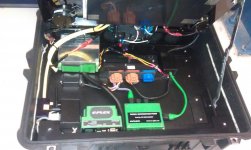
Here are the pics of our demo case. It has one conventional panel several loads (leds and a fan) as well as digital switching a touchscreen interface and an Ipad mount. Yeah it's a little tight in there but it works.
 

Attachments

  • IMAG0444.jpg
    IMAG0444.jpg
    139.5 KB · Views: 27
  • IMAG0446.jpg
    IMAG0446.jpg
    146.8 KB · Views: 26
  • IMAG0447.jpg
    IMAG0447.jpg
    144.3 KB · Views: 28
  • IMAG0448.jpg
    IMAG0448.jpg
    145 KB · Views: 21
  • IMAG0450.jpg
    IMAG0450.jpg
    144.8 KB · Views: 21
  • IMAG0451.jpg
    IMAG0451.jpg
    142.3 KB · Views: 31
  • IMAG0452.jpg
    IMAG0452.jpg
    138.5 KB · Views: 25
OP
T

Teken

Well-known member
Joined
Jan 2, 2010
Messages
8,214
Location
The Bad Lands
Here are the pics of our demo case. It has one conventional panel several loads (leds and a fan) as well as digital switching a touchscreen interface and an Ipad mount. Yeah it's a little tight in there but it works.

Very nice!:drool:

Teken . . .
 
OP
T

Teken

Well-known member
Joined
Jan 2, 2010
Messages
8,214
Location
The Bad Lands
Received some new items for my solar back up system. Four Blue Sea USB 2.1 amp dual outlets.

2013-02-28T16-15-43_1_zps4102b06c.jpg


I once again received great service from a fellow in Gainsvill GA. The company is called Llama Trails Inc. Marine Electronics. I dealt with Rick Calder who was more than happy to ship my item via USPS with out hassle or exorbitant shipping charges! :bowdown:

2013-02-28T16-15-43_4_zps10a68da5.jpg


I am currently waiting for a few sets of Blue Sea 12 volt car adapters to complete the I/O portion of this system. The only thing left is too source out some switches, relays, and distribution blocks.

2013-02-28T16-15-43_6_zps4b6a9350.jpg


Its been a slow process but this system is slowly coming together. During the whole waiting period I have installed the temporary solar array and its been making nice power in this ****** cloudy weather.

Some energy stats will follow as soon as I can screen capture them and have the images hosted on photobucket.

Teken . . .
 
OP
T

Teken

Well-known member
Joined
Jan 2, 2010
Messages
8,214
Location
The Bad Lands
OK so the four 12 volt Blue Sea adapter plugs arrived which also includes the male ends.

2013-03-16T17-05-55_0_zps8dad08f1.jpg


Blue Sea indicates this 12 volt outlet can sustain 15 amps. While the plug can sustain 10 amp steady duty.
2013-03-16T17-05-55_6_zpscd766776.jpg


Package comes with the securing ring terminal, flat case retainer, and the 12 volt locking plug outlet.

2013-03-16T17-05-55_5_zps66e9a9c2.jpg


I always find it funny yet impressed that people have to indicate which way to unlock a item? :lol:

Doesn't every body know righty tighty, lefty loosey?? :dunno: :lol_hitti Regardless I like the detail in writing out how to unlock the plug outlet.

2013-03-16T17-05-55_3_zps0c127274.jpg


OK, so I took the plug apart to see if I could get started on at least one thing this week end. Upon opening up this little gizmo I am embarrassed to say I have no clue where the wire is supposed to connect to? :dunno:

Am I blind . . . :sad:

Where does the single wire go to this device? Are you supposed to use a spade connector on he center Phillips screw head? :headscrat

2013-03-16T17-16-58_2_zps5a88d772.jpg


Here is a side view of this little gizmo . . .

2013-03-16T17-16-58_3_zps33da403f.jpg


This is the other side of the plug just in case I missed something. If anyone has some insight as to how this gizmo is supposed to be wired I would love to know.

2013-03-16T17-16-58_5_zpsdc971bd6.jpg


Teken . . .
 

where2

Well-known member
Joined
Dec 12, 2010
Messages
772
Location
South FL
Attach + wire to the screw nearest the tip, Attach - wire to the screw next to the green LED.

The fuse goes in through the nose and touches the hex nut below the screw nearest the tip. The LED works when you plug it in because you have + on the screw nearest the tip, a resistor under the red heat shrink, and it attaches to the - where you see it. The black heat shrink keeps any stray wire strands from shorting out in the plug.

Not sure why you're trying to use this as a single conductor connector? It's a two conductor connector. Tip positive, Ring/shield negative.
 
Last edited:
OP
T

Teken

Well-known member
Joined
Jan 2, 2010
Messages
8,214
Location
The Bad Lands
Attach + wire to the screw nearest the tip, Attach - wire to the screw next to the green LED.

The fuse goes in through the nose and touches the hex nut below the screw nearest the tip. The LED works when you plug it in because you have + on the screw nearest the tip, a resistor under the red heat shrink, and it attaches to the - where you see it. The black heat shrink keeps any stray wire strands from shorting out in the plug.

Not sure why you're trying to use this as a single conductor connector? It's a two conductor connector. Tip positive, Ring/shield negative.

Most awesome of you to confirm the wiring! :rocker:

Teken . . .
 

williaty

Well-known member
Joined
May 16, 2010
Messages
830
One thing that's not been covered here is safely fusing the battery bank. All breakers that I'm aware of on the market cannot safely be used with a battery bank due to the tremendous short circuit currents modern batteries can develop. A breaker than seems correctly rated (DC rated, under the voltage limit, correct trip point, etc) can easily fail to open simply due to the fact that a modest battery bank can still develop thousands of amps into a short (albeit for a very brief time). You need a overcurrent protection device with a huge interrupt capacity (called AIC). The most accessible, cheap, and usable thing I know of with a high enough AIC are the Blue Sea MRBFs. If you need a higher AIC than that, you're going to have to go to a Class T fuse.

Note that once you've fused the bank with a overcurrent protection device with a high AIC, subsequent devices for branch circuits can be "normal" things. For instance, in my system, the battery bank is fused with a MRBF. However, I then use a Square D QO panel to create the branch circuits and use the normal Square D QO breakers. If a device just draws too high of a sustained current, the QO breaker will trip and open properly. If the worst happens and a device fails into a dead short, the QO breaker will likely fail into a short itself, but the MRBF on the battery bank will open and a fire will be avoided.
 
OP
T

Teken

Well-known member
Joined
Jan 2, 2010
Messages
8,214
Location
The Bad Lands
One thing that's not been covered here is safely fusing the battery bank. All breakers that I'm aware of on the market cannot safely be used with a battery bank due to the tremendous short circuit currents modern batteries can develop. A breaker than seems correctly rated (DC rated, under the voltage limit, correct trip point, etc) can easily fail to open simply due to the fact that a modest battery bank can still develop thousands of amps into a short (albeit for a very brief time). You need a overcurrent protection device with a huge interrupt capacity (called AIC). The most accessible, cheap, and usable thing I know of with a high enough AIC are the Blue Sea MRBFs. If you need a higher AIC than that, you're going to have to go to a Class T fuse.

Note that once you've fused the bank with a overcurrent protection device with a high AIC, subsequent devices for branch circuits can be "normal" things. For instance, in my system, the battery bank is fused with a MRBF. However, I then use a Square D QO panel to create the branch circuits and use the normal Square D QO breakers. If a device just draws too high of a sustained current, the QO breaker will trip and open properly. If the worst happens and a device fails into a dead short, the QO breaker will likely fail into a short itself, but the MRBF on the battery bank will open and a fire will be avoided.

Yes, absolutely . . . The batteries will all be fused with with Blue Sea ANL quick blow fuses with in 6" of the wiring harnesses. That will be the first level of fusing.

Next will be a Blue Sea resettable fuse block. In line will be a over current protection circuit that will monitor and limit the output. The battery system will be more than 300% over built than what will actually be used.

The reason is to ensure no matter what gets hooked up the system can safely sustain and power the devices in and around the home. Of the four battery pack 3 will be the same ampacity. The fourth one will be dedicated to the home and much larger yet portable should it be required.

Still waiting for more parts from China, Austria, and USA. I hope to have all the pieces in place, tested, and deployed by this summer. :beer:

Teken . . .
 
To avoid these ads, REGISTER NOW!
Top Bottom