To avoid these ads, REGISTER NOW!

Old vs. New Tools

jbmorrey

Well-known member
Joined
Jan 8, 2013
Messages
155
Here is my question, obviously I know the obvious choices when it comes to quality tools, snap-on,Mac, Cornwell ect.. but what about older tools. It's my understanding that some of the older tools are made from a better quality metal. I know the cast iron top off of my 50's era table saw is better than today's "cast Iron" dewalt. How would that translate into hand tools. How does a Scheffield screwdriver with a boxwood handle compare to today's screwdrivers. Myself I have been collecting Woodworking tools and know that the older tools are just better made, at least on the chisels, old screwdrivers and such, mainly because the metal was more "Pure" and not mass produced. How does that although translate when it comes to Mechanics tools? Obviously today's Craftsman socket are far less quality than today's snap on, but how does an old Craftsman socket from the 50's compare to today's modern sockets? I appreciate everyone opinion on this.

Thanks!
James M
 
To avoid these ads, REGISTER NOW!

PatJ800

Well-known member
Joined
Dec 14, 2011
Messages
54
I am interested in this too so thanks for the post, I'll be watching it.

In my personal experience, I have mostly old Craftsman at home 1960's-early 1970's and I use mostly Proto at work (because we buy almost everything from Grainger.) In my opinion my old stuff is every bit as good or better than Proto, and that Proto stuff is very expensive. I am not very hard on stuff at work but I am not impressed even though it is USA made.

I have very limited experience with Snap On or the others. I have a few swap meet items over the years, but not much.
 

John in OH

Well-known member
Joined
Jun 2, 2007
Messages
2,444
Location
SE Ohio & Eastern Virginia
Here is my question, obviously I know the obvious choices when it comes to quality tools, snap-on,Mac, Cornwell ect.. but what about older tools. It's my understanding that some of the older tools are made from a better quality metal. I know the cast iron top off of my 50's era table saw is better than today's "cast Iron" dewalt. How would that translate into hand tools. How does a Scheffield screwdriver with a boxwood handle compare to today's screwdrivers. Myself I have been collecting Woodworking tools and know that the older tools are just better made, at least on the chisels, old screwdrivers and such, mainly because the metal was more "Pure" and not mass produced. How does that although translate when it comes to Mechanics tools? Obviously today's Craftsman socket are far less quality than today's snap on, but how does an old Craftsman socket from the 50's compare to today's modern sockets? I appreciate everyone opinion on this.

Thanks!
James M

Sorry, James, but I don't buy your premise.

IMHO, just because a tool is old does not necessarily mean it's better! Advances in alloy metallurgy, forging techniques, finite element analysis, machining, finishing, etc. all provide the POTENTIAL for new tools to be far better than those made in the past. Whether or not those advancements have been integrated into the new tool is another question.

Choose some known manufacturer with a good reputation ... say Wright ... and put an old Wright wrench up against a new Wright wrench. In fit, finish, performance and strength the new wrench will outperform the old. Likewise, put an old Craftsman ratchet up against a new "made in China" ratchet and, I suspect, the old will out perform the new.

Regarding woodworking tools, it may not follow the same pattern due to cost economies by the manufacturer ... an old Bailey plane from 1940 is, no doubt, far better than its present day Stanley descendant. Chisels and carving tools may follow the same pattern; although, there are some excellent (and expensive) woodworking tools being manufactured today.

Some things never change and a blanket statement that, "old is better than new" flies in the face of human nature. Some old tools are excellent, some old tools are **** .... some new tools are excellent, some new tools are ****.
 
OP
J

jbmorrey

Well-known member
Joined
Jan 8, 2013
Messages
155
IMHO, just because a tool is old does not necessarily mean it's better! Advances in alloy metallurgy, forging techniques, finite element analysis, machining, finishing, etc. all provide the POTENTIAL for new tools to be far better than those made in the past. Whether or not those advancements have been integrated into the new tool is another question.

Obviously those advancements have been intergrated in the new high quality, expensive tools, but to what level? We don't know! So this goes back to my question.And I agree, it's safe to say that in 1940 as well in 2013, there is good stuff made and bad stuff. What I am wondering is what does an old well made tool compare to when it comes to a new one today. I could get a vintage Stanley Bailey plane and compare it to todays lie-Nielsen plane and get very simular results and such, But a lie-Nielsen #5 Jack plane is going to put me back a few hundred dollars as compared to the Stanley plane for about 1/2 the cost.Then again that's just an opinion, So I am trying to translate that to the Mechanics tools, and I am not as familiar with Mechanics tools. you gave the example of the Craftsman Ratchet, if it does not compare to todays craftsman ratchet, what does it compare to when it comes to todays quality?
 

Texican

Well-known member
Joined
Jan 22, 2013
Messages
105
I believe older tools were more durable but not necessarily better. I have several older pieces of woodworking equipment that my grandfather bought new. The Oliver 232-D table saw is a beast of a machine, heavy and I bet my grandchildren will still be able to use it. But it sits in storage because it is hard to adjust and lacks the features of my much newer Unisaw. Newer saw blades are also much nicer than the old ones. Most of the time I don't even have to sand the edge and glue lines are practically invisible. Couldn't do that 10-30 years ago.
 

ddo

Well-known member
Joined
Oct 29, 2012
Messages
153
Location
Richland
I don't buy any of the hype about the good old days of tools. The modern age has tools not available to those of the past. This results in more repetitive processes and fewer lemons as well as higher capabilities for peak performance.

The only benefit of the good old days was what you could get away with environmentally. Quality control in the past was almost nonexistent because the technology to do it well did not exist at the time. Sure there were innovative tools and quality tools and most things were built like tanks, but metal quality was definitely lower and variation from tool to tool was much more.

The difference in the past was that tools were not cheap. None of them. It took a good deal of effort in the toolmaking process. There weren't corners to cut. There weren't CNC milling machines or water jets. 3D stress modeling wasn't available. The metal casting process was much less refined and parts couldn't be made thinner with lower weight and material cost. Now we can use numbers and modern technology to say that parts don't need to be that big....I doubt a modern cast iron table saw top will warp or wear in normal use.

Especially with mechanical equipment I put my money on the modern age. Precise clearances and tight tolerances are best done by a computer controlled device.

The reason modern tools get a bad rap is the availability of dirt cheap tools. Casual users will go to the $20 set of wrenches vs. the $100 set every time. There's a market for it and thats why they exist. The fact that we can make a set of wrenches for $10 or $20 is an achievement in itself, and it is an achievement that did not exist in the old days.

We have a spectrum of quality grades available today so a cheap chinese wrench might fall short of an old bonney wrench of your grandpas, but don't think for a minute that (inflation aside) the same money won't buy you a better wrench today than it would in the past.
 

kc-steve

Well-known member
Joined
Jun 22, 2010
Messages
4,240
Location
Kansas City
I wouldn't say ALL old tools are better made than today's. But when we look at specific brands we can see definite differences. Take Craftsman's Danaher-made tools for example. From the 1980s, comparing those to today's tools is very obvious in my opinion.

There have been many changes in our society in the last 20-years or so. The environmentalists have forced changes in manufacturing. The alloys used in tools have changed. Chroming and plating processes have changed. Some heat treating processes might have taken a back seat to making bigger profits. These processes are usually secret though. I'm speculating on what might have caused changes, but I can see it and feel it when I use some of the older tools.

I can even hear it. Try throwing a bunch of old wrenches in box and listen for the distinctive ring. Then toss in a cheap new one and listen.

Steve
 
Last edited:
OP
J

jbmorrey

Well-known member
Joined
Jan 8, 2013
Messages
155
Try throwing a bunch of old wrenches in box and listen for the distinctive ring. Then toss in a cheap new one and listen.

Funny you should say that.Ii noticed the same thing. They had a clear ring to them. I am by no means a professional mechanic of any kind. I would like to just get some good quality tools but I do not have the budget to do so. I have had some good luck finding vintage sets of tools at estate sales and such and I would like to know if I placed these tools side by side with a modern set...where would they stand? Let's make this simple, If we take an old "V" series socket set from the 60's made by craftsman , what set of todays sockets would you say would be comperable on strength, quality of steel, durability?

Maybe the title of this thread should be " Where do vintage tools rank against todays modern tools?" My mistake!

James M
 
Last edited:

CWP1616L

Banned
Joined
Aug 31, 2012
Messages
3,297
Location
USA
From my observation, the Snap-on wrenches are the heaviest for their given mass compared to any other wrench. Even as thin as they are, they're still the heaviest in terms of weight.
 

kc-steve

Well-known member
Joined
Jun 22, 2010
Messages
4,240
Location
Kansas City
. . . I have had some good luck finding vintage sets of tools at estate sales and such and I would like to know if I placed these tools side by side with a modern set...where would they stand? Let's make this simple, If we take an old "V" series socket set from the 60's made by craftsman , what set of todays sockets would you say would be comperable on strength, quality of steel, durability?

Maybe the title of this thread should be " Where do vintage tools rank against todays modern tools?" My mistake!

James M

Buying at Estate sales was how I found out about the distinctive ring of the older wrenches. I suspect we won't find a lot of differences between older quality wrenches and their newer versions. As an example, Wright wrenches have likely improved over their older counterpart.

But comparing older tools to newer, in general, would be difficult to do unless you stay within the specific brand. When you start crossing brands for comparison then objectivity changes to subjectivity, or opinion. :)

Steve
 
Last edited:

ganymede

Well-known member
Joined
Nov 29, 2012
Messages
2,332
Location
New England
One of my pairs of thin nose pliers. They are by Crescent and made i think in the 40s .
I bought them because the new made Channelock thin nose I bought last year bent. I've squeezed things harder with these crescent pliers than I have with the Channelocks and they do not bend.
I still use the C locks but I ground them down and don't expect much from them.

Just read the above post. :) If I see some old Channelocks at the flea market I'll buy them but I'm not going to test my theory by buying new crescent pliers.
 

Attachments

  • image.jpg
    image.jpg
    139.2 KB · Views: 48
Last edited:

Pantsfall_McFixit

Well-known member
Joined
Oct 8, 2012
Messages
167
I think we've figured out how to make tools of all qualities from cheap **** to excellent craftsmanship. The thing is, are people willing to pay for the good stuff? I am, but not many are.
 

gus1962

Well-known member
Joined
Dec 21, 2012
Messages
382
Location
Canton, Ohio
I own power tools and I own both new and used machine. If I think that I will not use a certain tool that much in my shop, I'd opt to buy used one.
 

demographic

Well-known member
Joined
Oct 24, 2010
Messages
824
Location
The Duchy of Grand Fenwick, otherwise known as Gre
There's good and bad from both ages but generally old woodworking handtools are often built to a better quality than new ones.

That's till you get to the very nice indeedy Veritas range of planes and so on which I feel exceeds the quality of the best of the old stuff.
Lie Nielson stuff is very nice but I'm not totally convinced that given a bit of time I couldn't fettle old tools up to be as good as they are more old designs well made instead of thought out again from the ground up like I feel Veritas stuff is.

I have quite a few old Sheffield made chisels and every time I go to the local secondhand place I get one or two more, its habit forming.:eek:
 

kc-steve

Well-known member
Joined
Jun 22, 2010
Messages
4,240
Location
Kansas City
I own power tools and I own both new and used machine. If I think that I will not use a certain tool that much in my shop, I'd opt to buy used one.

That's a good point. I have been buying used corded drills at garage sales usually from the 1980s and they are always made in the USA. I don't think you can find a new one of any brand made in the USA anymore.

I figure if it has lasted this long, 25+ years, the odds are good it is a quality built tool. :)

Steve
 

billymade

Well-known member
Joined
Apr 2, 2008
Messages
7,461
Location
New Mexico
I would say if you are concerned about buying used older hand tools; by all means do so! Obviously, when it comes to specific technology leaps (e.g. high tooth count ratchets, better ergonomics, special open end combo wrenches like FLANK DRIVE® Plus etc.) then buy the newer technology that will benefit you. Much of the basics are fine when it comes to older stuff; as others have said, when it comes to power, air tools etc.; the new tech usually will benefit you and is worth getting newer vintage. The emphases on "newer"; meaning you don't have to buy "new", as they say the moment you use a tool once, it is used. You can get so much older high quality tools for next to nothing at flea markets etc.; its certainly worth try them out and saving money. Pro grade tools for dirt cheap prices; whats not to like? :)
 

Man of Many Vices

Well-known member
Joined
Aug 23, 2012
Messages
366
Plomb, Proto, New Britain, S-K, Bonney, Barcalo, Armstrong, Herbrand, Blackhawk, Williams, Penens, are just a few names from the 1940s to 1970s tools that I think are top quality. Also, the truck brands and Craftsman from the same era are always good.

That distinctive ring is there, as is the quality of drop forging and finishing. Another indicator is the quality of the "engraving" by which I mean the manner in which the name brand, tool size, product number, etc., is imprinted into the tool. Also, the overall "architectual quality" of the tool -- pebble Plombs are the best. By the time I get 'em, the chrome finish is usually gone.

You can pick these wrenches up at any swap meet for $1 to $2 each or less. (That's why I have so damned many. Buy all the Kraeuter, Utica and Klein pliers you can get your hands on. Along with early Channelock and Petersen (not Irwin) Vice Grips.

Once you step away from the familiar brands, a wonderful world of quality tools awaits you. If you are not stuck on just one or two brands, you will find the tools that are right for you.
 

Davefr

Well-known member
Joined
Jan 7, 2010
Messages
11,845
Location
OR
Buy all the Kraeuter, Utica and Klein pliers you can get your hands on. Along with early Channelock and Petersen (not Irwin) Vice Grips.


I would also recommend buying any pliers made by Diamond/Diamalloy. They were really top notch.
 

Bryan Burns

Well-known member
Joined
Apr 3, 2010
Messages
1,243
Location
Grayslake, Illinois
Plomb, Proto, New Britain, S-K, Bonney, Barcalo, Armstrong, Herbrand, Blackhawk, Williams, Penens, are just a few names from the 1940s to 1970s tools that I think are top quality. Also, the truck brands and Craftsman from the same era are always good.

That distinctive ring is there, as is the quality of drop forging and finishing. Another indicator is the quality of the "engraving" by which I mean the manner in which the name brand, tool size, product number, etc., is imprinted into the tool. Also, the overall "architectual quality" of the tool -- pebble Plombs are the best. By the time I get 'em, the chrome finish is usually gone.

You can pick these wrenches up at any swap meet for $1 to $2 each or less. (That's why I have so damned many. Buy all the Kraeuter, Utica and Klein pliers you can get your hands on. Along with early Channelock and Petersen (not Irwin) Vice Grips.

Once you step away from the familiar brands, a wonderful world of quality tools awaits you. If you are not stuck on just one or two brands, you will find the tools that are right for you.

I've got every brand you've mentioned and want to point out that the really old Klein's are branded "M. Klein" and are far superior to modern day "Klein Tools". Not that there's anything wrong with modern day Klein Tools.

I sold my 90's vintage Klein Tools Linesman pliers, which I purchased at retail, at a flea market because they became second tier to my M. Klein linesman pliers, which I snap up whenever I see them, as you said. The typical estate sale employee, often female, usually doesn't have a clue as to what a fine tool an M. Klein tool is. (Helps a lot of their extremely dirty).

What baffles me is the low prices M.Klein's bring in on Ebay. A modern Klein Tools linesman pliers is around $30 retail but it'd be lucky to get $10 on Ebay for an M. Klein, which is a better tool.

Another good maker of pliers was H. Broker.
 
To avoid these ads, REGISTER NOW!

shoturtle

Well-known member
Joined
Jan 15, 2012
Messages
4,395
Location
Frankfurt AM
I would disagree with older screw drivers being better. As they are wear items and over time they cam out. A heavy used 1950 screw driver would be pretty ineffective taking off a posi drive screw.

and with pliers they wear also. And older pliers no longer grip as well when their teeth wear down. And do not cut as well.

And very unpopular advice for many here, but having dealt with industrial tools and shipping them off to auction after the job is down. I can tell you that any tool that is used hard, they all wear, socket, wrenches, you name it they wear down. So they do not grip as well, and can strip out bolts. Regardless of the "used better metal" that really does not mean anything, as newer steels are stronger and lighter. With modern superstructure steel form the 1950 compare to modern steel. The new alloys are stronger and lighter then the older steel.

To many people equate heavier is stronger and better, but that really is not the case.
 
Last edited:

GRX

Well-known member
Joined
Dec 4, 2006
Messages
2,032
Location
MD
Great subject. One I have pondered myself on occasion.

That distinctive ring. I certainly get that with my pre-WW2 vintage Plomb and Herbrand tools, which I use on a regular basis. Seems I read somewhere much of the top quality stuff from that era was melted down for the war effort to make bearings and the like.

A good question is ... who makes good Chrome Vanadium steel hand tools these days? Appears much of what we see now is Chrome Nickel steel then Chrome plated.
 

Gotmayhem

Well-known member
Joined
Feb 12, 2013
Messages
351
Location
CT
The new alloys are stronger and lighter then the older steel.

To many people equate heavier is stronger and better, but that really is not the case.

This is what it really comes down to. I think a good example that a lot of people could relate to would be the current line of Snap On wrenches. They're extremely thin and lightweight for what they are yet they still can take repeated abuse every day. Compare them in both performance and physical traits to older wrenches and it really becomes apparent how amazing it is how far technology has come in hand tools.

Old tools absolutely can perform very well if taken care of properly, but there are some technological gaps that would be foolish to ignore.
 

4xdog

Well-known member
Joined
Aug 18, 2012
Messages
5,624
Location
Santa Fe, NM
I would also recommend buying any pliers made by Diamond/Diamalloy. They were really top notch.

I bought some Diamond/Diamalloy tools in the 1980s as I was building my own set of tools, and looking back I wish I'd bought more. Pliers, adjustable wrenches, screwdrivers -- whatever they put their name on was very good stuff. If you run across any, grab it.

There have always been good tools and **** tools. It's harder to find old crappy tools because they've either broken or been thrown away by now. The natural selection process favors good things.
 

ganymede

Well-known member
Joined
Nov 29, 2012
Messages
2,332
Location
New England
Just because something can be done doesn't mean it will be.
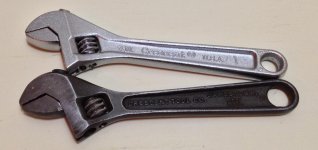
Here's 2 Crescent brand wrenches. The top is about 2 yrs old. The bottom is ww2 era and much thinner.
Laughably , the newer one is marked 'Crestoloy steel' like they were in the old days.
I guess modern alloy is so much better they had to make the wrench thicker, instead of the same size or thinner. :rolleyes:
 

Attachments

  • image.jpg
    image.jpg
    114.2 KB · Views: 65

shoturtle

Well-known member
Joined
Jan 15, 2012
Messages
4,395
Location
Frankfurt AM
Well you answered your own question. It is Crescent what do you expect. But have you done a hardness test or a strength test to compare the 2.
 

ganymede

Well-known member
Joined
Nov 29, 2012
Messages
2,332
Location
New England
Well you answered your own question. It is Crescent what do you expect. But have you done a hardness test or a strength test to compare the 2.

Nothing scientific. Just an automatic center punch and a file. Neither seems harder. The older one does feel lighter though.
Wish I could do some real tests .
 
OP
J

jbmorrey

Well-known member
Joined
Jan 8, 2013
Messages
155
I would disagree with older screw drivers being better. As they are wear items and over time they cam out. A heavy used 1950 screw driver would be pretty ineffective taking off a posi drive screw.

and with pliers they wear also. And older pliers no longer grip as well when their teeth wear down. And do not cut as well.

You are absolutely correct about a worn down old tool not being very good. i am not trying to compare something worn down. Besides, I don't think there is such thing as a good worn down tool, no matter the age or the brand. There is no question that there are significant advancements in today's tools, but I would like to know how a NOS 1950's wrench, pliers, chisel or hammer compares to today's quality? Items today are so mass produced, there is no workmanship to them or true craftsmanship to them( unless you go to the very well made, high dollar items). I am willing to bet that 40 years from now there will be very few people restoring a craftsman toolbox from 2013, but right now I think there are a few threads with people wanting to restore their 60's craftsman toolbox. This is because in my humble opinion, they were better made back then. So if I take my $20(Which is enough according to the 2013 Garage sale finds thread! hehe) and purchase some old tools in good useable condition, what would I have to buy in todays market, brand new, in order to get simular quality? Let's say to make things easy, they were all Proto.
 

woody 73

Well-known member
Joined
Apr 14, 2009
Messages
11,546
Location
The Great State Up North
Interesting in that that today I bought a load of old wrenches, they are rough in your hands and they are beefy in weight. By todays standars those same wrenches would be smooth as silk and lighter in weight; 50 of 1 or 50 of the other take your pick.
 

kc-steve

Well-known member
Joined
Jun 22, 2010
Messages
4,240
Location
Kansas City
I've got every brand you've mentioned and want to point out that the really old Klein's are branded "M. Klein" and are far superior to modern day "Klein Tools". Not that there's anything wrong with modern day Klein Tools.

I sold my 90's vintage Klein Tools Linesman pliers, which I purchased at retail, at a flea market because they became second tier to my M. Klein linesman pliers, which I snap up whenever I see them, as you said. The typical estate sale employee, often female, usually doesn't have a clue as to what a fine tool an M. Klein tool is. (Helps a lot of their extremely dirty).

What baffles me is the low prices M.Klein's bring in on Ebay. A modern Klein Tools linesman pliers is around $30 retail but it'd be lucky to get $10 on Ebay for an M. Klein, which is a better tool.

Another good maker of pliers was H. Broker.

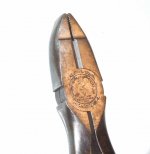
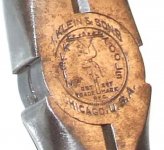
Thanks for the info! Correct me if I'm wrong but I believe I have one or more of those "M. Klein" lineman's pliers. I need to look through them all. It has "M. Klein & Sons" on it but would have never known it. In fact, the "M" is nearly worn off. The only wear on this one is purely cosmetic. The tool itself works as great if not better than newer lineman's I currently own. (see attached photos)

I can't imagine this tool was made before 1917 when Mathias Klein died. Anyone know when they changed the logo?

Steve
 

Attachments

  • m.klein-01b.jpg
    m.klein-01b.jpg
    37.6 KB · Views: 22
  • m.klein-02b.jpg
    m.klein-02b.jpg
    61.7 KB · Views: 26
Last edited:

shoturtle

Well-known member
Joined
Jan 15, 2012
Messages
4,395
Location
Frankfurt AM
Interesting in that that today I bought a load of old wrenches, they are rough in your hands and they are beefy in weight. By todays standars those same wrenches would be smooth as silk and lighter in weight; 50 of 1 or 50 of the other take your pick.

comparing what type of wrenches, the new snap combo on are super smooth wrenches and very light, and if are talking about adjustable. If you compare the irga they are lighter then my old wf adjustable form the 70's and much smoother. Even the newer wf adjustable are smoother then my older adjustable and a lighter even with the plastic and cushion wrap.
 

shoturtle

Well-known member
Joined
Jan 15, 2012
Messages
4,395
Location
Frankfurt AM
You are absolutely correct about a worn down old tool not being very good. i am not trying to compare something worn down. Besides, I don't think there is such thing as a good worn down tool, no matter the age or the brand. There is no question that there are significant advancements in today's tools, but I would like to know how a NOS 1950's wrench, pliers, chisel or hammer compares to today's quality? Items today are so mass produced, there is no workmanship to them or true craftsmanship to them( unless you go to the very well made, high dollar items). I am willing to bet that 40 years from now there will be very few people restoring a craftsman toolbox from 2013, but right now I think there are a few threads with people wanting to restore their 60's craftsman toolbox. This is because in my humble opinion, they were better made back then. So if I take my $20(Which is enough according to the 2013 Garage sale finds thread! hehe) and purchase some old tools in good useable condition, what would I have to buy in todays market, brand new, in order to get simular quality? Let's say to make things easy, they were all Proto.

craftsmanship is a very subjective way of judging a tool. Unless you are getting a hand made tools form the 1950's you are getting a mass produced tool as well. They made all those tools in a forge with machines, not a blacksmith pounding on the metal by hand. And hand made tools have more inconsistency then machine made ones.

Now if you are going with the nostalgic aspect, yeah older tools have more "character."

It is like comparing a 1960's vette to a modern vette, the older one has way more character and nostalgic interest, but the new vette is way faster, handle way better in the higher speed. But does not have the old time aspect about it.
 
Last edited:
OP
J

jbmorrey

Well-known member
Joined
Jan 8, 2013
Messages
155
I think it would be interesting to know just how many were made in the past Vs. Today. I guess when i mention craftsmanship I mean more like how they were made to last, put together well, with more attention to detail. Those old wrenches are still around if well taken care of, they were built right the first time around. Items today are built with more of a "Disposable" outlook to them, and I am talking about the cheaper tools, not the "truck" tools. I can got to walgreens and pickup a$10.99 socket set or I can find a $10.99 socket set at a swap meet, or estate sale that is 40 years old, of course as long as the old one I buy is in good condition, I would say it will be better quality and last me longer. Also I am not going with any nostalic respect, that's a whole different thing all together.


So with everything else aside, if I have a Wrench that is in great condition, NOS . Which is only fair because we are trying to compare it to a NEW wrench from today. And lets say it's a common item like a craftsman wrench from 195's, take away collectability, and all of those aspects, just based on how the item is put together, how it will hold up over the years ect. What wrench that I buy today would be comperable to it? That is the question I am asking.

Thanks for all the great discussion so far!!!
 

lowbucktruck

Well-known member
Joined
Aug 9, 2010
Messages
1,323
Location
Foothills, Northern California
You can pick these wrenches up at any swap meet for $1 to $2 each or less. (That's why I have so damned many. Buy all the Kraeuter, Utica and Klein pliers you can get your hands on. Along with early Channelock and Petersen (not Irwin) Vice Grips.
.

Yep, I couldn't agree more. Those vintage Krauter and Utica (along with Diamondalloy) pliers were top-notch tools. And the old Klein, Williams and Crescent linesman's pliers are solid tools. Wish I could find a vintage Diamond-alloy fence pliers. I keep looking.
Of all my pliers old and new, I find myself reaching for the Kraeuter needle-nose and old Utica pliers most. And I found them all at yard sales and estate sales.
 
Last edited:

tube_guy

Well-known member
Joined
Jan 21, 2009
Messages
749
I think that it all comes down to people. The people that make the tools and the people that buy the tools. Of course there have been significant technological improvements in the past sixty years, but in general, hand tools are not nearly as important to most people as they were 60 years ago. Sure, there are small subsets of people that view tools as important today. People that earn a living using their tools obviously view them as important. But in general, the population of today doesn’t really view hand tools as something that’s important to them. This means that most of the people that make tools today use the technological advantages of the past 60 years to primarily make tools less expensively today than they were made years ago. They are not really interested in making better quality, more expensive tools, because that is not really what most people today want and will pay for. That newer Crescent adjustable wrench that is thicker than the old one. Even if the material is identical, it’s probably thicker because forging a thin section of material is much more difficult and just plain costs more than forging a thicker wrench. There's also less finishing work done on the newer wrench so there’s less material removed after forging. Of course there are some brands, like the tool trucks, that still cater to people that view tools as important, and those brands make tools that are probably very close to the quality of tools they made years ago, and in some cases I’m sure they’re better. The cost of materials and labor required to make tools have risen much faster than inflation, so those high quality tools are probably going to cost more than they did years ago too when adjusted for inflation. If the people that make tools wanted to make a very high quality tool today because that is what their target customer wanted, the tool they could make today would far surpass the tools of years ago. However, most people that make tools today are not really interested in that. They want to reduce their costs as much as possible while satisfying the demands of their target customer.
 

kc-steve

Well-known member
Joined
Jun 22, 2010
Messages
4,240
Location
Kansas City
I think that it all comes down to people. The people that make the tools and the people that buy the tools. . . .

That's probably the best explanation of "Old vs. New" . . . from an economic point of view.

Some here are like another explanation called "Three blind men describing an elephant." There is a tendency to present their limited area of view as the ENTIRE elephant. That's why I think it is best to take one tool brand at a time. If we do that then maybe we'll start collaborating to "see" the entire elephant. :)

http://en.wikipedia.org/wiki/Blind_men_and_an_elephant

For starters, I think we all agree that older Craftsman's tools were better made than today's.
We can probably also add that Snap-On and Wright's tools are better made than in the past. (?)

Steve
 
Last edited:

Man of Many Vices

Well-known member
Joined
Aug 23, 2012
Messages
366
Bryan Burns, thanks for the info on M. Klein vs. Klein. I sensed there was a difference, but never realized it was plain as day on the tool itself. As you said, Boker & Co. is another great pliers. Picked up an 8-inch lineman today for $2. It is virtually an unknown brand now.

The vintage Crescent adjustable wrenches come in various thicknesses: thin and superthick. I like 'em both.
 

Wrenchette

Well-known member
Joined
Apr 11, 2010
Messages
302
Location
On the wrong side of the tracks.
I prefer tools older than myself as most of our tools range from the 20s to the 80s. Pick them out of pawn shop loose tool bins for pennies. There might not be a warranty if one breaks, all you do is go back and find another.
 

rick carpenter

Well-known member
Joined
Jan 20, 2011
Messages
3,786
Location
Huntsville, East Texas
Sometimes newer = better, and sometimes older = better. Depends on what. For newer, you have a lot of advances in metal quality, tooling, etc, but you also have value engineering to contend with.

I'd rather have my older Stanley planes than any new plane, and with the exception of my Rosco Two Fister screwdriver (can work with it on just about anything) and some Bell System collectables, I'd rather have new screwdrivers.
 
To avoid these ads, REGISTER NOW!
Top Bottom