To avoid these ads, REGISTER NOW!

Grounding

spam4us

Well-known member
Joined
Oct 12, 2011
Messages
135
Hello all.

I am installing a 100 amp sub panel inside my garage fed off a 90 amp breaker in my main house panel 2-2-2-4al. Is there a diagram available that shows how the sub panel get grounded?

I believe I need 2 grounding rods located 6 ft apart from each other. Can these rods be located inside the garage or do they need to be on the exterior of the garage?

Thanks
 
To avoid these ads, REGISTER NOW!

matt151617

Well-known member
Joined
Dec 17, 2011
Messages
488
Location
New Jersey
The 2 hots from the main panel go to the hots on the subpanel. The neutral goes to the neutral bar, and the ground goes to the ground bar. Be sure the neutral is isolated/not bonded in the subpanel. Usually there's a screw to either remove or just not install.

You are correct about the ground rods, assuming it's a detached garage. They can be located wherever you want but usually they need to be outside, it's rather hard to drive the rods and run wire between them through concrete. If it's a new pour, you can use the rebar/ufer ground as an alternative to the ground rods.
 

coolreed

Well-known member
Joined
Apr 10, 2012
Messages
595
Location
Oklahoma City, It's a Windy Heat.
It is best to locate your ground rods outside. There is a possibility that you may need more than two ground rods. It depends on the conductivity of the soil in your area. Normally, two is adequate. But your soil conductivity should be measured to be sure. Caldweld your connection to the grounding rod(s).

If your ground is inadequate you and/or your equipment will be more suseptible to damage from lightning strikes. Take the time to do it correctly even if it cost a few bucks more.

:3gears::3gears::3gears:
 

Aceman

Well-known member
Joined
Jan 28, 2007
Messages
2,513
Location
Eastern Oregon
I believe I need 2 grounding rods located 6 ft apart from each other. Can these rods be located inside the garage or do they need to be on the exterior of the garage?

Rods go outside a minimum of 6' apart. I usually make sure there is at least 75"+ between them so there is no question I meet the minimum.
 
OP
S

spam4us

Well-known member
Joined
Oct 12, 2011
Messages
135
Thanks for the replies. I will keep the ground and neutral isolated.

So does this mean there is only one ground wire coming from the ground bar in the sub panel that then attaches to both grounding rods?

Is there anything special that needs to be done with the neutral?

This is a detached garage.

Thanks
 

NHBandit

Well-known member
Joined
Jan 11, 2012
Messages
2,757
Location
East Tennessee
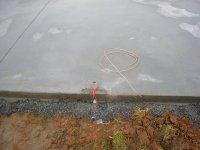
My concrete guy and my building inspector both agreed that one 20' piece of rebar embedded in the concrete slab was fine for my application. I am using a 100 amp sub panel, same wire from the house to the garage as you. I would suggest that you find out what is required in your location since what's allowed here in Tennessee may not be allowed someplace else. Here is a pic. Obviously you can't see the rod. Now 10 guys will reply that it's wrong but if it's ok with the guy signing my permit it's ok with me...
 

Attachments

  • slab ready for electric.JPG
    slab ready for electric.JPG
    94.3 KB · Views: 96
Last edited:

matt151617

Well-known member
Joined
Dec 17, 2011
Messages
488
Location
New Jersey
So does this mean there is only one ground wire coming from the ground bar in the sub panel that then attaches to both grounding rods?

Thanks

No, there's 2. One going to the grounding rods, one going back to the main panel.
 

Speedy Petey

Well-known member
Joined
Apr 22, 2012
Messages
1,430
Location
NY State
It is best to locate your ground rods outside. There is a possibility that you may need more than two ground rods. It depends on the conductivity of the soil in your area. Normally, two is adequate. But your soil conductivity should be measured to be sure. Caldweld your connection to the grounding rod(s).

If your ground is inadequate you and/or your equipment will be more suseptible to damage from lightning strikes. Take the time to do it correctly even if it cost a few bucks more.
You NEVER need more than two to meet code, and more does not necessarily mean better. As far as this goes two is more than enough.

And Cadaweld???? Seriously? You are recommending Cadwelding to a DIYer??
Acorn clamps are FINE.

Are you another an engineer? ;)
 

CNGsaves

Well-known member
Joined
Sep 26, 2012
Messages
13,233
Location
KS and OK
My concrete guy and my building inspector both agreed that one 20' piece of rebar embedded in the concrete slab was fine for my application. I am using a 100 amp sub panel, same wire from the house to the garage as you. I would suggest that you find out what is required in your location since what's allowed here in Tennessee may not be allowed someplace else. Here is a pic. Obviously you can't see the rod. Now 10 guys will reply that it's wrong but if it's ok with the guy signing my permit it's ok with me...

Gotta ask the obvious question . . . . WHY is it appropriate to Ground a garage subpanel to the rebar in concrete slab rebar???

Most every garage will have sand or gravel base under slab and often the rebar just "floats" in the concrete and never really tied back into the earth itself. Newer garages even have foam insulation under the slab so no interconnection of the slab to earth at all.

So what happens to big lightning strike that hits say your welder sitting just outside garage and plugged into 240v outlet?? Where is that lightning voltage going to go if your ground is in the slab?? Won't the force of that lightning strike also bust up the slab??
 
Last edited:

NHBandit

Well-known member
Joined
Jan 11, 2012
Messages
2,757
Location
East Tennessee
Gotta ask the obvious question . . . . WHY is it appropriate to Ground a garage subpanel to the rebar in concrete slab rebar???

Most every garage will have sand or gravel base under slab and often the rebar just "floats" in the concrete and never really tied back into the earth itself. Newer garages even have foam insulation under the slab so no interconnection of the slab to earth at all.

So what happens to big lightning strike that hits say your welder sitting just outside garage and plugged into 240v outlet?? Where is that lightning voltage going to go if your ground is in the slab?? Won't the force of that lightning strike also bust up the slab??
The end of the 20' piece of rebar opposite the wire is in the ground. It just wasn't possible to pound anything deep into the ground because my site is all Limestone ledge. It's not like the entire piece of rebar is just floating in the slab. My slab is sitting on crushed stone and the entire section of rebar is sitting on the stone with the end of it turning down into the ground. I am also using a 4 wire feed from the house panel and that ground will be connected to the sub panel in the garage as well. Hopefully I won't have any issues. The building inspector was fine with it. Sorry if my post was confusing.
 
Last edited:

CNGsaves

Well-known member
Joined
Sep 26, 2012
Messages
13,233
Location
KS and OK
Thanks NHBandit . . . sounds like your situation is unique and best/only solution was to ground it that way.

For me, when detached garage electrical is upgraded to it's own 100A subpanel, I'm planning normal ground rods driven into the earth on outside of garage. This is how I always thought ground rods should be done.
 
To avoid these ads, REGISTER NOW!

Charles (in GA)

Well-known member
Joined
Jan 11, 2006
Messages
12,489
Location
50 mi south of Atlanta
Many building inspectors will require you do do a ufer ground on a new slab pour. If the slab is separated from the dirt by insulation, plastic sheeting or other insulating methods however the slab is not considered to be in direct contact with the earth.

You need to make sure of what the building inspector wants or will accept before you pour.

Charles
 
OP
S

spam4us

Well-known member
Joined
Oct 12, 2011
Messages
135
No, there's 2. One going to the grounding rods, one going back to the main panel.

Ok, just so I understand this....the ground comes from the main to the sub panel and connects to the isolated ground bar in the sub panel. Then I would connect one ground wire to the isolated ground bar in the sub panel and run this wire to both ground rods.

Is this correct?

Also, this is a pole building with a floating slab already poured. Can I just drive the ground rods into the ground vertical?

Thanks
 

matt151617

Well-known member
Joined
Dec 17, 2011
Messages
488
Location
New Jersey
Ok, just so I understand this....the ground comes from the main to the sub panel and connects to the isolated ground bar in the sub panel. Then I would connect one ground wire to the isolated ground bar in the sub panel and run this wire to both ground rods.

Is this correct?

Also, this is a pole building with a floating slab already poured. Can I just drive the ground rods into the ground vertical?

Thanks

No. The ground bar is not isolated, the neutral bar is the one that is isolated. Other than that you have it right.

The ground wire coming off of the subpanel going to the ground rods needs to be #6 (you can use something smaller, but it needs to be in conduit then). Make sure you have enough for the entire run, because splicing is not allowed.

When I did mine, I ran the ground wire behind the conduit leaving the building, partially through the trench, and then drove the rods 6 1/2 feet apart. Make sure you connect the ground wire to the rods with an acorn nut before driving the rod, since the end will mushroom slightly. Also, dig a small hole where the rod will be driven so the inspector can see the top of the rods.
 

ishiboo

Well-known member
Joined
Oct 27, 2010
Messages
9,481
Location
Oshkosh, WI
Gotta ask the obvious question . . . . WHY is it appropriate to Ground a garage subpanel to the rebar in concrete slab rebar???

Most every garage will have sand or gravel base under slab and often the rebar just "floats" in the concrete and never really tied back into the earth itself. Newer garages even have foam insulation under the slab so no interconnection of the slab to earth at all.

So what happens to big lightning strike that hits say your welder sitting just outside garage and plugged into 240v outlet?? Where is that lightning voltage going to go if your ground is in the slab?? Won't the force of that lightning strike also bust up the slab??

You NEVER need more than two to meet code, and more does not necessarily mean better. As far as this goes two is more than enough.

I see CNG's point, and a silly part of the NEC. If the first rod is greater than 25 ohms resistance a second is required, even if the combined resistance is still greater than 25 you're good to go.

Same with the UFER, as long as you have it, it counts, even though a modern slab could provide no ground contact at all, especially if thermally broke from the footings/etc.

And Cadaweld???? Seriously? You are recommending Cadwelding to a DIYer??
Acorn clamps are FINE.

Are you another an engineer? ;)

What's more fun then finishing a project with fire? Haha. Yes, regular ground clamps are the way to go!
 

Aceman

Well-known member
Joined
Jan 28, 2007
Messages
2,513
Location
Eastern Oregon
For a service or feeder it IS required by code. That is IF there is rebar present.
What's nice is if you do a Ufer electrode NO other supplemental electrodes are required.

There is nothing in the NEC that requires attaching to bar in a slab. Just because concrete has rebar in it doesn't automatically qualify it as suitable as a ufer ground.

Around here, they read it to the letter of the code. If you don't have a footing or foundation with bar in it, then you don't have a ufer. Slabs don't cut it.
 

Norcal

Well-known member
Joined
Mar 16, 2008
Messages
13,758
Just realize that the proper testing equipment is required to prove 25 Ohms of resistance or less, and knowing how to use it. It much simpler to just drive 2 rods & be done with it, just because the equipment is costly.
 

ddawg16

Well-known member
Joined
Jul 11, 2008
Messages
21,005
Location
S. California
A little history on the Ufer ground....

http://en.wikipedia.org/wiki/Ufer_ground

During World War II, the U.S. Army required a grounding system for bomb storage vaults near Tucson and Flagstaff, Arizona. Conventional grounding systems did not work well in this location since the desert terrain had no water table and very little rainfall. The extremely dry soil conditions would have required hundreds of feet of copper rods to be inserted into the ground in order to create a low enough impedance ground to protect the buildings from lightning strikes.
In 1942, Herbert G. Ufer was a consultant working for the U.S. Army. Ufer was given the task of finding a lower cost and more practical alternative to traditional copper rod grounds for these dry locations. Ufer discovered that concrete had better conductivity than most types of soil. Ufer then developed a grounding scheme based on encasing the grounding conductors in concrete. This method proved to be very effective, and was implemented throughout the Arizona test site.
After the war, Ufer continued to test his grounding method, and his results were published in a paper presented at the IEEE Western Appliance Technical Conference in 1963.[1] The use of concrete enclosed grounding conductors was added to the U.S. National Electrical Code (NEC) in 1968. It was not required to be used if a water pipe or other grounding electrode was present. In 1978, the NEC required rebar to be used as a grounding electrode if present. The NEC refers to this type of ground as a "Concrete Encased Electrode" (CEE) instead of using the name Ufer ground.
Over the years, the term "Ufer Ground" has become synonymous with the use of any type of concrete enclosed grounding conductor, whether it conforms to Ufer's original grounding scheme or not.[2]

There is no NEC requirement for the rebar to be grounded....one of the reasons is that unless you weld the rebar pieces together, there is no way to insure you have electrical continuity....hence, the 20' piece of copper wire.

When I did my slab....I did both the 20' wire and bonded it to my rebar.....AND...I ran a ground rod....

Chances are, an Ufer ground is going to work better than 2 ground rods....

But getting back on topic....

The ground bus in your sub will have two ground wires going to it....one from your main panel...and one from your 2 ground rods and/or ufer.
 

Speedy Petey

Well-known member
Joined
Apr 22, 2012
Messages
1,430
Location
NY State
There is nothing in the NEC that requires attaching to bar in a slab. Just because concrete has rebar in it doesn't automatically qualify it as suitable as a ufer ground.

Around here, they read it to the letter of the code. If you don't have a footing or foundation with bar in it, then you don't have a ufer. Slabs don't cut it.
OK, put it this way:
IF the rebar qualifies as an electrode under 250.52(A)(3), it MUST be used according to 250.50 because it is "present" at the building.

This does not apply to an existing building being served by a feeder after the fact.

250.50 Grounding Electrode System.

All grounding electrodes as described in 250.52(A)(1) through (A)(7) that are present at each building or structure served shall be bonded together to form the grounding electrode system. Where none of these grounding electrodes exist, one or more of the grounding electrodes specified in 250.52(A)(4) through (A)(8) shall be installed and used.
250.52(A)
(3) Concrete-Encased Electrode.
A concrete-encased electrode shall consist of at least 6.0 m (20 ft) of either (1) or (2): See related ROP

(1) One or more bare or zinc galvanized or other electrically conductive coated steel reinforcing bars or rods of not less than 13 mm (½ in.) in diameter, installed in one continuous 6.0 m (20 ft) length, or if in multiple pieces connected together by the usual steel tie wires, exothermic welding, welding, or other effective means to create a 6.0 m (20 ft) or greater length; or

(2) Bare copper conductor not smaller than 4 AWG

Metallic components shall be encased by at least 50 mm (2 in.) of concrete and shall be located horizontally within that portion of a concrete foundation or footing that is in direct contact with the earth or within vertical foundations or structural components or members that are in direct contact with the earth. If multiple concrete-encased electrodes are present at a building or structure, it shall be permissible to bond only one into the grounding electrode system.
 

revamped

Well-known member
Joined
May 23, 2012
Messages
312
Location
Bremerton, WA
Sorry to regen this thread... SO my footing and stem walls have a ton of rebar all around and in between. Two separate verticals were marked as UFER's and the walls are 8ft tall and will be back filled. What confuses me is all of the rebar was suspended in the footer prior to the pour so even though it was all tied together in the footers and walls, I believe ZERO rebar comes in contact with actual dirt. Otherwise it would erode like crazy in a couple of years and be useless.

How does my UFER provide ground if all rebar is encapsulated in concrete? I know, ignorant question... but that's why Im here!
 

Attachments

  • attachment.jpg
    attachment.jpg
    138 KB · Views: 11

JohnX14

Well-known member
Joined
Jun 2, 2014
Messages
573
Location
Boston 'burbs
The rebar must be encased by at least 2 inches of concrete and within the portion of foundation or footing in direct contact with the earth.

NEC 250.52

Also the term CEE (Concrete Enclosed Electrode) is what is being discussed. I know it has often been referred to as a ufer ground.
 
To avoid these ads, REGISTER NOW!
Top Bottom