To avoid these ads, REGISTER NOW!

Bandsaw and VFD Help

Todd.Brock

Well-known member
Joined
Jul 15, 2008
Messages
4,250
Location
Cincinnati
Hello all,

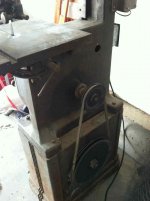
I bought a Walker Turner Bandsaw that has a 3 phase motor with a VFD. The guy I bought it from was a machinist and said he had it set up to cut metal. I am trying to figure out FPM with the VFD. I tried a photo tach from HF and it sucked. It also had a wheel attachment for both RPM and FPM. Should I set the VFD at 60 Hz to start with? What is the best way to measure FPM with a VFD? I am looking to cut up some 10 gA steel for welding practice. Any help would be greatly appreciated.
AB3C9AB2-AF81-4677-B40F-2304769ECEE9-2821-00000890412B93D6_zps9ea9ae6f.jpg

56B9369C-A4B5-442C-BCC6-450A81B7A2F8-2821-00000890366C8414_zps513d8a0b.jpg

E369E39D-9032-4ADA-9439-DA633E5CB7AB-2821-000008902789FE6C_zps5011500f.jpg

AB833816-6C4C-43DC-AC44-8CD4EDDA399E-2821-000008901CF45020_zps2de30977.jpg

D8048C27-71D3-4E86-B371-2FA6D5E37B40-2821-00000890160169A4_zpsd446a559.jpg


If anyone is interested, here is a 2 min video of the saw. You can see at 20hz, it runs really slowly. You can hear something rubbing but I could not put my finger on it. I bought the saw as you see it for 150ish bucks from CL last year an just now getting around to firing it up. Sad , I know.
 
Last edited:
To avoid these ads, REGISTER NOW!

rsanter

Well-known member
Joined
Dec 22, 2007
Messages
18,521
Location
visalia ca
Full speed is what RPM and what FPS?
At half RPM the FPS is also half
Not to over simplify but that's a starting point.
If you run that motor for long periods of time at greatly reduced RPMs you can overheat it. Think about having a secondary fan blowing over or thought the motor.

Bob
 
OP
T

Todd.Brock

Well-known member
Joined
Jul 15, 2008
Messages
4,250
Location
Cincinnati
I don't know any of the speeds, that's what I am trying to figure out how to do. There are calculations online but they do not take into account the VFD. I assumed 60 hz b/c is that what single phase 120 would run on? Does a VFD convert to a particular hz for 3 phase ?
 

HoosierBuddy

Well-known member
Joined
May 9, 2006
Messages
2,930
Location
Southern Indiana
I don't know any of the speeds, that's what I am trying to figure out how to do. There are calculations online but they do not take into account the VFD. I assumed 60 hz b/c is that what single phase 120 would run on? Does a VFD convert to a particular hz for 3 phase ?

The "VF" in "VFD" stands for "variable frequency".

The VFD's purpose is to take single phase AC power and convert it to 3 phase power AT ANY frequency you desire, within its capability and specifications.

The one I use on my old South Bend Lathe, for example, will output up to 120 HZ or as low as about 10 HZ.

SO...you can use it to overdrive your motor or underdrive your motor to adjust the speed proportionally to the HZ you output to the motor.

As the previous poster mentioned...3 phase motors are not typically designed to run at double speed or 1/10th speed, so to the extent you adjust away from 60HZ, you may damage your motor. That being said, I've run my lathe at varying RPM's for years with no ill effects. If I ever do blow my motor, I'll probably shell out the big-bucks for a replacement motor that is designed to work with a VFD...but in the meantime...it works great.

To your original question.

I would assume you can look at the nameplate on your motor and determine the output RPM at 60 HZ. From their, you could look at your pulley sizes and try to come up with a good estimate of the gear reduction. Then you could calculate the speed of the outside diameter of the blade drive-pulley. Your saw blade will move at that speed as long as it isn't slipping.

Then...you could adjust that speed based on the ratio of your VFD output in HZ divided by 60. I.E. if you are outputting 90HZ, 90/60 =1.5 so you'd multiply the "base" fpm X 1.5 for a good estimate of your actual FPM.

Good luck!

Phil
 

Pumpman1968

Well-known member
Joined
Oct 21, 2012
Messages
1,520
Location
Upstate, NY
I don't know any of the speeds, that's what I am trying to figure out how to do. There are calculations online but they do not take into account the VFD. I assumed 60 hz b/c is that what single phase 120 would run on? Does a VFD convert to a particular hz for 3 phase ?

If its a for US use, I'm sure its a 60 cycle motor.....but it will be marked. In the US, 60 cycle(hz) is full speed.......30 is 1/2, 20 is 1/3....I would assume that's the reason for the 3ph motor and the drive. You ramp the drive up and down to achieve the motor speed you want. I would also think the manufacturer would tell you how many FBM the unit would run with a single phase motor..........again if its for the US market.

If you say 100FBM at 60hz...........then 50FBM at 30 hz.

That help?
 

zkling

Well-known member
Joined
Jan 23, 2007
Messages
16,939
Hey Todd, feel free to shoot me a PM, we've talked before, another Cinci guy here.

I have converted a few band saws from wood to metal. Those WT's are nice saws. That looks like a 14" saw?

First, it looks like you need to switch the saw and motor pulley, you are actually increasing speed as it sits, exactly the opposite of what you want to do (Conditional to next sentence). What is the bottom / motor pulley connected to? Directly to the motor shaft? Remember to decrease speed you want to go from a small pulley to a large pulley. To increase speed, large pulley to a small pulley.

For metal cutting you want to shoot for around 80 SFPM for steel. It is really difficult to get a saw down to metal speeds with just a VFD, because you end up running the motor too slow.

FPM is calculated from wheel diameter and RPM, FPM is a velocity, similar to MPH.

FPM at the wheel = ((Outside dia of bansdasw wheel in inches)/12)*Pi*RPM of wheel.

On a 14" saw you want ~22 RPM at the wheel. So if you have a 1725 RPM motor you would need a reduction of ~75:1 between the motor and the drive wheel. Due to the large ratio a gear box or multiple step pulleys are needed. You simply cannot dial a 1725 motor down with a VFD that far as it will have cooling problems.
 
Last edited:

Pumpman1968

Well-known member
Joined
Oct 21, 2012
Messages
1,520
Location
Upstate, NY
I would also like to add a little..........the motor.......if its just a standard motor, is NOT designed to run over 60hz. If you did try to run it that way, you will create excess heat and that will destroy the motor. Ive never had an issue running them right down to almost zero........never ran them on a saw, my experience is on a pump.........but HP required is still HP required.........my understanding is it doesn't matter if its on a pump, running a conveyer.......whatever. I will say we always used TEFC (fan cooled) motors on everything with a drive.
 
OP
T

Todd.Brock

Well-known member
Joined
Jul 15, 2008
Messages
4,250
Location
Cincinnati
Thanks everyone. I will check to see what it is connected to. I understand the VFD part, I just wasnt sure about if 3 phase was still 60hz. I figured it was, but not 100%. Zkling PM incoming.
 

454ragtop

Well-known member
Joined
Mar 24, 2008
Messages
5,011
Location
Carver, MA
Not sure where this idea that you can't run a motor over 60 hz comes from, but it's not true. I have installed and used many VFD's on machines ranging from 1 HP 60"s drill presses to 7.5 HP 60's lathes to 1.5 HP van Norman mill from 1936, and many more in between. Currently have 5 machines in my shop on dedicated VFD's. All were set at a max frequency of 120 hz, effectively doubling the speed of the motor, and machine, with no ill effects. The bandsaw shown above needs to have the pulleys swapped as mentioned, as setup it is overdriving the wheel and blade. If you haven't actually seen a motor fail from being used at 60-120 hz, I think it's just repeating an urban legend, as I have lots of experience with no problems.
Jim
 

Pumpman1968

Well-known member
Joined
Oct 21, 2012
Messages
1,520
Location
Upstate, NY
Not sure where this idea that you can't run a motor over 60 hz comes from, but it's not true. I have installed and used many VFD's on machines ranging from 1 HP 60"s drill presses to 7.5 HP 60's lathes to 1.5 HP van Norman mill from 1936, and many more in between. Currently have 5 machines in my shop on dedicated VFD's. All were set at a max frequency of 120 hz, effectively doubling the speed of the motor, and machine, with no ill effects. The bandsaw shown above needs to have the pulleys swapped as mentioned, as setup it is overdriving the wheel and blade. If you haven't actually seen a motor fail from being used at 60-120 hz, I think it's just repeating an urban legend, as I have lots of experience with no problems.
Jim

Jim....if you are referring to my comment, I was just going by my experience....and again....its mostly from use on pumps. What I've seen is over 60 cycle, up goes the amps and the heat. I've had premature bearing and shaft seal failure. Possible its more from the actual speed rather than the heat. Keep in mind that a lot of my situations, the motor never completely shuts down. Rather, we used the drive with either a pressure transducer or flowmeter to maintain either pressure or flow.
 

bsaint

Well-known member
Joined
Apr 26, 2010
Messages
5,109
Location
Manchester, CT
Not sure where this idea that you can't run a motor over 60 hz comes from, but it's not true. I have installed and used many VFD's on machines ranging from 1 HP 60"s drill presses to 7.5 HP 60's lathes to 1.5 HP van Norman mill from 1936, and many more in between. Currently have 5 machines in my shop on dedicated VFD's. All were set at a max frequency of 120 hz, effectively doubling the speed of the motor, and machine, with no ill effects. The bandsaw shown above needs to have the pulleys swapped as mentioned, as setup it is overdriving the wheel and blade. If you haven't actually seen a motor fail from being used at 60-120 hz, I think it's just repeating an urban legend, as I have lots of experience with no problems.
Jim

Yes, the whole "inverter duty" motor class is a farce and its there just to jack up the price of motors lol.

The reason why it seems you get "away" with it for now is because old motors were built better.

Eventually you'll get transient frequencies, harmonics, and waveform spikes as well as carrier frequencies eating away at that motor insulation. But, as I said before, theres a lot more to an old motor before its whithered away into nothing.
 
Last edited:

454ragtop

Well-known member
Joined
Mar 24, 2008
Messages
5,011
Location
Carver, MA
Jim....if you are referring to my comment, I was just going by my experience....and again....its mostly from use on pumps. What I've seen is over 60 cycle, up goes the amps and the heat. I've had premature bearing and shaft seal failure. Possible its more from the actual speed rather than the heat. Keep in mind that a lot of my situations, the motor never completely shuts down. Rather, we used the drive with either a pressure transducer or flowmeter to maintain either pressure or flow.

I'm sure what you say is true in a pump application, as those motors seem to be closely matched and at or near full load, unlike a typical machine tool, such as a lathe, drill press, mill, bandsaw, etc. These usually aren't at full load, and are intermittent duty. When running my 1725 RPM motors at 120 HZ, in my tool apps, you can put your hand on the motor case, at best they may be warm, never hot. Nothing better than being able to change the speed of a drill press from 200 RPM to 900 RPM with the twist of a knob. It's kind of funny, but on the old 1936 Van Norman #12 mill, that motor was actually happier running off a VFD than it was running off a 5 HP balanced rotary phase converter, could actually hear the difference. VFD's rock!
Jim
 

vintagefan

Well-known member
Joined
Mar 2, 2012
Messages
613
Yes, the whole "inverter duty" motor class is a farce and its there just to jack up the price of motors lol.

The reason why it seems you get "away" with it for now is because old motors were built better.

Eventually you'll get transient frequencies, harmonics, and waveform spikes as well as carrier frequencies eating away at that motor insulation. But, as I said before, theres a lot more to an old motor before its whithered away into nothing.

I wouldn't go as far as to say it's a farce, because I've personally had instances where an inverter duty motor was required, but I will say that probably 99% of the time it's a waste of money.
 
OP
T

Todd.Brock

Well-known member
Joined
Jul 15, 2008
Messages
4,250
Location
Cincinnati
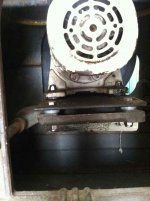
Ok guys...the band saw pulleys are 14" The pulley attached to the motor is12". The top drive pulley is 5". ImageUploadedByTapatalk1363986443.279313.jpg
ImageUploadedByTapatalk1363986468.092245.jpgImageUploadedByTapatalk1363986489.594393.jpgImageUploadedByTapatalk1363986512.532809.jpg
 

zkling

Well-known member
Joined
Jan 23, 2007
Messages
16,939
Wow, I doubt if that thing has any torque. You need to start by switching the drive and driven pulleys. That will double your delivered toque instead of cutting it in half as it is now.

Then with the pulleys switched, you will need 50 RPM at the motor to get ~80SFPM at the saw blade. Which is still super slow compared to the full speed of 1725. You will end up running at ~3% of full RPM. Ideally you would want to increase your belt ratio to something like 3" to 12", or even better do a compound ratio with gears.

Next you will need to look at your vfd and see how it handles low RPM (frequency) driving. Does it have a voltage boost function? Not sure if that motor can sustain 50RPM and if it does, what is the torque?

You may want to consider selling this saw and or purchasing a dedicated vertical metal saw. Such as this...

http://cincinnati.craigslist.org/tls/3638081211.html

I don't agree with the price, but it is from the factory designed to do 40SFPM to 3000SFPM with the twist of a gear selector knob.

Another option is to look at a DC drive, such as off of a treadmill as they usually have instantaneous torque even from 0 RPM.
 
Last edited:

Pumpman1968

Well-known member
Joined
Oct 21, 2012
Messages
1,520
Location
Upstate, NY
I'm sure what you say is true in a pump application, as those motors seem to be closely matched and at or near full load, unlike a typical machine tool, such as a lathe, drill press, mill, bandsaw, etc. These usually aren't at full load, and are intermittent duty. When running my 1725 RPM motors at 120 HZ, in my tool apps, you can put your hand on the motor case, at best they may be warm, never hot. Nothing better than being able to change the speed of a drill press from 200 RPM to 900 RPM with the twist of a knob. It's kind of funny, but on the old 1936 Van Norman #12 mill, that motor was actually happier running off a VFD than it was running off a 5 HP balanced rotary phase converter, could actually hear the difference. VFD's rock!
Jim

Gotcha..lower load equals lower hp required....lower hp required equals lower amps....lower amps equals lower heat. Never ran a drive on a machine tool. Makes sense. Thanks Boss.
 
OP
T

Todd.Brock

Well-known member
Joined
Jul 15, 2008
Messages
4,250
Location
Cincinnati
So I am looking at Treadmill motors. I am thinking that may be an interesting, yet doable project for me. I have grown attached to this band saw for some dumb reason and would like to get it set up, paint it, clean it up, etc.. I wonder if I could flip the pulleys, plug the box fan in and run the damn thing until it gives up the ghost... I am probably going to use it for about 20 minutes of run time to slice up my current steel pile ( five 12x12 squares of 10 gauge steel. I plan to cut each one into 2" strips) I doubt I will touch the saw after that for another 6 months. There is also a strong possibility my brother could be using for wood working stuff as well...
 
To avoid these ads, REGISTER NOW!
OP
T

Todd.Brock

Well-known member
Joined
Jul 15, 2008
Messages
4,250
Location
Cincinnati
I bought one from HF and returned it b/c it sucked for what I was trying to measure with my drill press. How do you convert RPM to SFPM?

Edit... I figured it out....
 
Last edited:

cnc-me

Well-known member
Joined
Jan 6, 2010
Messages
1,183
Location
MI
Not sure where this idea that you can't run a motor over 60 hz comes from, but it's not true. I have installed and used many VFD's on machines ranging from 1 HP 60"s drill presses to 7.5 HP 60's lathes to 1.5 HP van Norman mill from 1936, and many more in between. Currently have 5 machines in my shop on dedicated VFD's. All were set at a max frequency of 120 hz, effectively doubling the speed of the motor, and machine, with no ill effects. The bandsaw shown above needs to have the pulleys swapped as mentioned, as setup it is overdriving the wheel and blade. If you haven't actually seen a motor fail from being used at 60-120 hz, I think it's just repeating an urban legend, as I have lots of experience with no problems.
Jim

Have to agree with you 100%.
Got a 20" drill press that is running at 180Hz with no problems.
Its an eight pole motor so its still only turning at 2565 RPM
with a 2:1 reduction gives me 1280 to around 106 at the slowest.
Can twist a 1" bit in steel with no problems.
I try not to use 2 pole motors on drives because they don't have as much torque. Also 50hz motors are desirable when running on an ac drive.
 

cnc-me

Well-known member
Joined
Jan 6, 2010
Messages
1,183
Location
MI
Jim....if you are referring to my comment, I was just going by my experience....and again....its mostly from use on pumps. What I've seen is over 60 cycle, up goes the amps and the heat. I've had premature bearing and shaft seal failure. Possible its more from the actual speed rather than the heat. Keep in mind that a lot of my situations, the motor never completely shuts down. Rather, we used the drive with either a pressure transducer or flowmeter to maintain either pressure or flow.

On most pumps the HP requirement goes through the roof as you increase the
speed and that will overload your motor. Not so with machine tools.
As long as the balancing and bearings of the motor, and machine, can stand it
you can drive it faster. Have a shop full of equipment running on VFD's and
almost all of them are running over 60Hz. We have a CNC router for
example that runs at 300 hz, it is a special motor though.
From the motors standpoint a lower frequency can be harder on the windings
than a higher one such as 120hz.
 

cnc-me

Well-known member
Joined
Jan 6, 2010
Messages
1,183
Location
MI
Todd, that Sumitomo looks like a gear reduction unit, do you have anymore info
on it like a gear ratio?
I would not get rid of this saw if it already has a gearbox on it.
 
OP
T

Todd.Brock

Well-known member
Joined
Jul 15, 2008
Messages
4,250
Location
Cincinnati
It appears to be a non geared saw. There is a 12" pulley on the motor and a 5" pulley on the saw. I have not seen exactly how the 5" pulley is connected to the lower band saw wheel, but it appears to be a direct 1:1 connection.
 
Last edited:

zkling

Well-known member
Joined
Jan 23, 2007
Messages
16,939
cnc-me,
The saw he has is walker turners basic wood cutting 14" saw. The did make the same thing with a metal cutting lower end, but it has a very obtrusive and obvious gear reduction system on it. As seen in the following link.

http://vintagemachinery.org/photoindex/detail.aspx?id=13402

The motor appears to be a direct coupling to the lower pulley. Unless it has a co axial planetary gear system on it, the pulley would be offset of the motor shaft, which it does not appear to be in the pics.

EDIT after a second watch of the video and look at the motor I think there may be a gear box on the output of the motor. Todd, can you please post some better pics of the motor / pulley assembly? After watching the video, it looks like you are running around 20hz, which if you were directly driving the 12 to 5" pulley would put you well above 3000SFPM. Something is not adding up here. I think I now see a gear box attached to the motor.

sumatrogearbox.jpg


Todd,

The pulley is directly connected to the bandsaw saw wheel. Just a through shaft supported by bearings.

I would start by switching the motor and saw pulleys, assuming they are the same shaft size. With the 5" pulley on the motor and 12" on the saw.
For a bandsaw speed of 100FPM you will be looking at 28 RPM at the wheel. Coming from a 5" to 12" pulley you will need ~67RPM at the motor. So try dialing your VFD to ~2.5hz. See if your motor has any torque at this low of frequency by cutting something. Just keep a foot or hand or other device on the motor to monitor it's temp since the internal fan will be spinning so slow.
 
Last edited:
OP
T

Todd.Brock

Well-known member
Joined
Jul 15, 2008
Messages
4,250
Location
Cincinnati
Thanks again for all the time. It is REALLY hard to get in there and get good photos. I will remove the pulleys and take some better pictures. I understand that the pulleys need to be swapped. I will try what you said about going to 2.5 hz. I have a directv Satellite pole that i tried to cut through and stalled. All this welding practice is taking up time, but i need the saw for the welding practice!
 

zkling

Well-known member
Joined
Jan 23, 2007
Messages
16,939
Thanks again for all the time. It is REALLY hard to get in there and get good photos. I will remove the pulleys and take some better pictures. I understand that the pulleys need to be swapped. I will try what you said about going to 2.5 hz. I have a directv Satellite pole that i tried to cut through and stalled. All this welding practice is taking up time, but i need the saw for the welding practice!

Todd, my previous statement may not be correct about the 2.5hz. That was on the assumption that the motor is directly driving the 5" pulley.

You really need to nail down what your entire drive train consists of. Or measure the RPM of the bandsaw saw wheel. Otherwise now we are just shooting in the dark and guessing the SFPM. If there is something like a 100:1 gearbox on the face of that motor, then the PO may not be far off with his setup. Just when I watched you video a second time it looks like you are running at ~20hz and it threw up a red flag to me.

Either which way, cutting your torque in half between the motor and saw is still a pretty bad design on the PO's part. Which is probably why you state is was stalling out. We really need the whole picture here to fully help you.
 
OP
T

Todd.Brock

Well-known member
Joined
Jul 15, 2008
Messages
4,250
Location
Cincinnati
So I thought I would swap out the pulleys, but that wasn't happening b/c the shafts are different thicknesses. That would have been too easy! The welded bushings are going to make it difficult to swap out. If I had a piece of 3/4" or 1" round stock to fit them up and align them, I could run a small bead in a few places. He has them tig welded it looks like. I got the top pulley off easy enough but the motor pulley is going to put up a fight. I am going to have to take the saw off the base to really get at the motor. I will say that the motor was damn near impossible to turn with the 12" pulley attached. It felt like it was turning in a transfer case of some type. you all might be onto something. One time I wish I had a cherry picker to take the top half apart!!,I was turning it to get to the grub screws. You can see the edge of the motor next to the 12" pulley.


ImageUploadedByTapatalk1364429590.614699.jpg
ImageUploadedByTapatalk1364429611.875466.jpg
ImageUploadedByTapatalk1364429633.027262.jpg
ImageUploadedByTapatalk1364429650.813412.jpgImageUploadedByTapatalk1364429666.579847.jpg
 
Last edited:

Nelson58

Well-known member
Joined
May 29, 2010
Messages
278
Location
New York, New York
Well, thanks to Jim's post, I will definitely run my VN #12 mill off a VFD, or maybe two, since it has a spindle and feed motor.

Nelson
 

454ragtop

Well-known member
Joined
Mar 24, 2008
Messages
5,011
Location
Carver, MA
Well, thanks to Jim's post, I will definitely run my VN #12 mill off a VFD, or maybe two, since it has a spindle and feed motor.

Nelson

used to have a #12, put a VFD on the spindle, and changed the 1/4HP feed motor to single phase.
 

cnc-me

Well-known member
Joined
Jan 6, 2010
Messages
1,183
Location
MI
Keep us posted, Todd.
If both the pulleys have the same size bore you could grind off
the welds and swap them and then re-weld them back on.

I think you might have a 60:1 gear reduction unit.
What size is the shaft on the motor (or gear box)?
 
OP
T

Todd.Brock

Well-known member
Joined
Jul 15, 2008
Messages
4,250
Location
Cincinnati
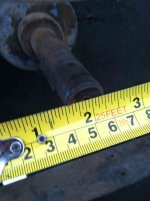
Thanks for the insight. I need to find something the correct diameter to slide the pulleys and bushings over like a piece of conduit or a socket or something. I will have to rummage around the socket drawer with the digital calipers to find something. I don't have any extra motor shafts. I suppose I could tack it together on the saw and then run a couple beads on the bench. The picture above is the motor shaft with the pulley still attached. The tape measure points to about a 1 inch shaft diameter. It is connected directly to the pulley.
 

Nelson58

Well-known member
Joined
May 29, 2010
Messages
278
Location
New York, New York
used to have a #12, put a VFD on the spindle, and changed the 1/4HP feed motor to single phase.

Jim, don't want to hijack the post, but...when it was single phase, did you just plug in the single phase motor when you needed to use table feed, or did you rig it up electrically to draw single phase off the 240 from the spindle motor wiring when the spindle was operating (which I would prefer). And if so, can you tell me how you did so?

Danke.


Nelson
 
OP
T

Todd.Brock

Well-known member
Joined
Jul 15, 2008
Messages
4,250
Location
Cincinnati
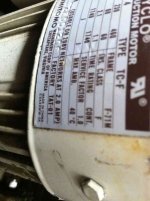
So it appears you all are correct. There is a gear reducing unit in the motor. Here is a pic of the tag. It's has a ratio of 51 and and RPM output of 34. Can you all help me interpret all that?
ImageUploadedByTapatalk1364853690.369897.jpg
2y8a8umu.jpg

ujezases.jpg
 
Last edited:

zkling

Well-known member
Joined
Jan 23, 2007
Messages
16,939
Hey Todd, now we are making some progress. Looks like you have a co axial gear box on the end of the motor. Probably planetary.

So it is a 51:1 gear box. Meaning for every 51 turns of the input (motor), the output will turn once. Since it is coupled to a 1740RPM input motor, it will output (1740RPM/51)=34.12 RPM to the bottom pulley. Which is what you see stated on the gear box tag.

So.... If you stick with your 12" pulley on the motor and 5" pulley on the shaft. You will have a blade speed of ~300 SFPM (81.88RPM) on the blade at the full 60Hz operating freq of the motor (1740rpm, full speed). Now since a gear box and VFD's act as a multiplier you will have

~600SFPM at 120Hz (you will be over speeding the motor and gearbox BTW)
~150SFPM at 30Hz
~100SFPM at 20Hz.
~50SFPM at 10Hz.

With that motor, you are pretty much locked into a metal cutting saw. You may want to get different pulleys that are not so extreme. Even though you are multiplying your torque out of the motor by 51, you are then cutting it back to 40% of that through the belt system. Remember that torque is inversely proportional to speed change. Try to end up with a 40-275SFPM saw, and you should be able to cut just about all metals on it.
 
Last edited:
OP
T

Todd.Brock

Well-known member
Joined
Jul 15, 2008
Messages
4,250
Location
Cincinnati
Ok, so if I hear you, the pullies are correct? That's great b/c even though I spent an hour trying to get the moor pulley off, it's rust welded on!! Now I can just tap it back in. So.... If the pullies are too extreme, what sizes should I use... I only really want this thing for metal. I envision steel and possibly aluminum. I know that aluminum needs faster but What size pullies can I use to get the rate closer to 60hz for a slow speed for steel?
 

zkling

Well-known member
Joined
Jan 23, 2007
Messages
16,939
Hey Todd, are you familiar with the old saying... "Give a man a fish...Teach a man to fish" :lol_hitti I think it is time for you to practice the calculations.

It's not that they pulleys are wrong so to say, they will work, just not optimally. They are one of the reasons you said you were having problems cutting before and stalling the saw out. If it cuts fine as is, then great go use it. But from what you stated before it sounded like you experienced a lack of torque when trying to cut. Also check for belt slip, which is a big reason why commercial saws usually use a direct drive from the gearbox to the saw. Quite a bit of torque to transmit, you are putting 51X the torque of a standard 1/2hp motor into that belt. V belts really don't like to transmit high torque at low speeds.

You want to get closer to a 1:1 ratio on the pulleys. The problem is the closer your speed ratio, the lower the top speed of your saw will be. Aluminum is usually cut fast, sometimes around wood cutting speeds. If you could set that saw up for 40 to ~300 sfpm you would have a good general purpose metal saw.

If it was my saw I would set it up to run ~200 SFPM at 60Hz, which would be full motor speed (34.12RPM). That would require ~56RPM at the lower wheel. If you kept your 5" saw pulley, you would need around a 8" motor pulley. This would give you a torque gain of 21% over your current config.

Personally I would put it back together, check belt tension and see how well it cuts steel at ~30HZ. Which is still half of the motors intended speed. Finally you may want to find a manual on your VFD and see if you can modify any of the ramp settings to get as much torque as possible at lower frequencies.
 
Last edited:
OP
T

Todd.Brock

Well-known member
Joined
Jul 15, 2008
Messages
4,250
Location
Cincinnati
I can appreciate your fish comment. I could not figure out the formula to get the speed right, hence the reason for me asking. I was trying to take into account the gear reduction in the wrong place. I do appreciate all the explanation as well!! I will see what I can do on the 8" pulley.
 

zkling

Well-known member
Joined
Jan 23, 2007
Messages
16,939
I can appreciate your fish comment. I could not figure out the formula to get the speed right, hence the reason for me asking. I was trying to take into account the gear reduction in the wrong place. I do appreciate all the explanation as well!! I will see what I can do on the 8" pulley.

Wasn't trying to rift you with the fish comment. You can do as you like, only holding yourself back if you don't want to learn the calcs. There is a big difference in not knowing, and not wanting to know. That way in the future you can build something better or help others with their project.

I have no problem double checking your calcs or adding advice here and there. I just have found and think you will get more satisfaction out of it if you try to run through them yourself a few times.

Remember for pulleys --> Output RPM= input RPM*(input pulley pitch diameter / output pulley pitch diameter)

Now get to cutting metal. If you need help on the calcs or VFD, post. That is what we are all here for.
 
Last edited:
To avoid these ads, REGISTER NOW!
Top Bottom