To avoid these ads, REGISTER NOW!

100 amp or 200 amp service coming in from power company

SRoberts006

Active member
Joined
May 7, 2013
Messages
26
Location
Leland, NC
So I have another thread on here about weather or not I should upgrade my service coming into the house. Well I'm trying to figure out how to tell what is coming in from the power company now. I have a meter and box capable of handling 200 amps, but I know that doesn't nessesarly mean that is what the power company has coming in. I called and emailed the power company to ask them to tell me, but they said to just get a licensed electrican to tell me. And of course no electrican will come out just to look at that especially without the promise of work once they determine that. So how can I figure it out without the help of the "people in the know"?
 
To avoid these ads, REGISTER NOW!

matt151617

Well-known member
Joined
Dec 17, 2011
Messages
488
Location
New Jersey
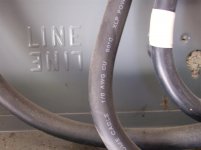
Take a look at the wires coming into your panel, or going into the meter box. If they're marked 4/0, you have 200 amp.

The wires that belong to the power company coming from the pole are smaller because they're exposed to air.
 
OP
S

SRoberts006

Active member
Joined
May 7, 2013
Messages
26
Location
Leland, NC
Well unfortunately they are enclosed in conduit from where the lines reach the house to the meter box. Guess ill have to try to take that off an look.
 

pattenp

Well-known member
Joined
Jun 4, 2008
Messages
10,175
Location
Virginia - USA
Normally the meter base box is sealed and you will need to cut a security tag to open it. Which you do not want to do. If it's a 200A meter you should have 200A capacity at the meter. I'm willing to bet the service entrance cable from the meter to the service panel is only good for the 100A and will need to be replaced. You can look at the SE cable in the service panel to see what size it is.

Edit: If the SE is 4/0 for 200A, one of the conductors will be about 9/16" in diameter if it's aluminum. This is just a ball park size.

Also the 100A main breaker will take at max may be a 3/0. If by chance the SE is copper and is at least 2/0 that will be good for 200A.
 
Last edited:

Charles (in GA)

Well-known member
Joined
Jan 11, 2006
Messages
12,489
Location
50 mi south of Atlanta
Normally the meter base box is sealed and you will need to cut a security tag to open it. Which you do not want to do. If it's a 200A meter you should have 200A capacity at the meter. I'm willing to bet the service entrance cable from the meter to the service panel is only good for the 100A and will need to be replaced. You can look at the SE cable in the service panel to see what size it is.

Not true in todays world. Many power companies are now making the switch or already have switched to Smart Meters. The most common Smart Meter, probably 90% or better of the ones in use are made by Sensus, and they don't make a meter that is rated at less than 200 amp. They are wholesale going around swapping out meters, and if you have 60 or 100 or 150 amp service (and conductors sized to those amperages by the poco) you will still find a Smart Meter installed that has a 200 amp rating on it.

We still have a few 60 amp services around here on old farm houses and 100 amp service is rather common.

Charles
 

wyliesdiesels

Well-known member
Joined
Aug 14, 2012
Messages
20,006
Location
Modesto, CA
If u have to, just cut the tag IN ONE PLACE ON THE WIRE(dont make it obvious!). I have to do this sometimes at work to kill the power to pump panels so i can hook up a new panel(theres usually no disconnect on meter sockets feeding pump panels!) I have also had to do this on residential services when the PoCo slacks off or misses an appt. to kill the power! I have been on site working on a panel AFTER i have cut the meter seal tag and the PoCo worker just shook his head and installed a new one. Hell, i even had to cut the seal on the meter hasp because the way the PoCo installed it, made it impossible to open the door on the breaker section more than 5 inches. I thought the PoCo would surely come out because i ended pulling the meter out slightly causing it to shut off, but this was 8 months ago and still hvent had a visit from the PoCo!

To expand on what 'PATTENP' said, check your meter for the letters 'CL'. Next to that will be either 100, 200, etc., in which 100= 100a, etc. and that is the load the meter can handle. Then check the service entrance feeders coming from the PoCo as 'PATTENP' suggested!
 
Last edited:

Roots

Well-known member
Joined
Oct 31, 2010
Messages
1,788
Not true in todays world. Many power companies are now making the switch or already have switched to Smart Meters. The most common Smart Meter, probably 90% or better of the ones in use are made by Sensus, and they don't make a meter that is rated at less than 200 amp. They are wholesale going around swapping out meters, and if you have 60 or 100 or 150 amp service (and conductors sized to those amperages by the poco) you will still find a Smart Meter installed that has a 200 amp rating on it.

We still have a few 60 amp services around here on old farm houses and 100 amp service is rather common.

Charles

+1

I was a bit perplexed, the first time I came across a 60 amp service. They are still out there.
 

theoldwizard1

Well-known member
Joined
Feb 22, 2011
Messages
43,148
Location
SE MI
Not true in todays world. Many power companies are now making the switch or already have switched to Smart Meters. The most common Smart Meter, probably 90% or better of the ones in use are made by Sensus, and they don't make a meter that is rated at less than 200 amp. They are wholesale going around swapping out meters, and if you have 60 or 100 or 150 amp service (and conductors sized to those amperages by the poco) you will still find a Smart Meter installed that has a 200 amp rating on it.

We still have a few 60 amp services around here on old farm houses and 100 amp service is rather common.

Your missing the point pattenp is making. It is reasonable to assume that when the panel was installed it was inspected. It is also reasonable to assume that no inspector would allow a 200A main on a Service Entrance cable not rated at 200A.

So I would agree with pattenp, if the main is 200A then the SE is 200A.
 
OP
S

SRoberts006

Active member
Joined
May 7, 2013
Messages
26
Location
Leland, NC
Your missing the point pattenp is making. It is reasonable to assume that when the panel was installed it was inspected. It is also reasonable to assume that no inspector would allow a 200A main on a Service Entrance cable not rated at 200A.

So I would agree with pattenp, if the main is 200A then the SE is 200A.


I hope that is the case. I'm going to call the power company tomorrow and be a little mean to try to get the answer. Hopefully I will get someone better on the phone.
 

wyliesdiesels

Well-known member
Joined
Aug 14, 2012
Messages
20,006
Location
Modesto, CA
Your missing the point pattenp is making. It is reasonable to assume that when the panel was installed it was inspected. It is also reasonable to assume that no inspector would allow a 200A main on a Service Entrance cable not rated at 200A.

So I would agree with pattenp, if the main is 200A then the SE is 200A.

I get what Charles is saying. To take it a step further, I've never seen a 100a rated smart meter. I dont know for sure but maybe the smart meter manufacturers arent making 100a versions because there is just no point! Every smart meter i see is 200a regardless of some being installed on a 100a service! Maybe the backlash against smart meters will come to a head when someone tries to pull over 100a continous through one and the underground feeder cable on the PoCos side is only rated for 100a and it catches fire! Technically, if its ubderground it probably wouldn't be in flames but would just melt!
 

Charles (in GA)

Well-known member
Joined
Jan 11, 2006
Messages
12,489
Location
50 mi south of Atlanta
Your missing the point pattenp is making. It is reasonable to assume that when the panel was installed it was inspected. It is also reasonable to assume that no inspector would allow a 200A main on a Service Entrance cable not rated at 200A.

So I would agree with pattenp, if the main is 200A then the SE is 200A.

He did not say MAIN, he said METER, huge difference.

Charles
 

pattenp

Well-known member
Joined
Jun 4, 2008
Messages
10,175
Location
Virginia - USA
You are correct Charles. I was saying 200A at the meter. I was assuming if the meter was a 200A then the drop to the house could supply 200A. The SE cable to the service panel from the meter is a whole different thing. I would assume it's only 100A since the main breaker is 100A. But, you know what assuming does.
 

RustFarmer

Well-known member
Joined
Mar 5, 2010
Messages
246
Location
The Rust Belt
What size is the conduit between the meter and the panel? Report back to us with the outside diameter and material (PVC or metal). It's not definitive (you might have 100 amp wires inside a 200 amp conduit) but if the conduit is sized for 100 amp wires, then you definitely don't have a 200 amp service.
 

theoldwizard1

Well-known member
Joined
Feb 22, 2011
Messages
43,148
Location
SE MI
He did not say MAIN, he said METER, huge difference.
OOppss !

You are correct Charles. I was saying 200A at the meter. I was assuming if the meter was a 200A then the drop to the house could supply 200A. The SE cable to the service panel from the meter is a whole different thing. I would assume it's only 100A since the main breaker is 100A. But, you know what assuming does.

But wouldn't you assume that if there are 200A mains, that the meter and SE are capable of supplying 200A. I mean, you don't want the meter/base or SE to act as a "fuse" !
 
Last edited:

pattenp

Well-known member
Joined
Jun 4, 2008
Messages
10,175
Location
Virginia - USA
If the main service panel has a 200A main breaker then obviously the SE cable and meter should be sized for the 200A service. The main service breaker is the overload protection for the SE cable. The OP has a 100A main breaker and most likely only has a SE cable that is for the 100A. He may only need to up size the the SE cable from the meter to the service panel along with putting in a 200A main breaker panel. After saying all of that I'm not sure what prompted your statement.

But wouldn't you assume that if there are 200A mains, that the meter and SE are capable of supplying 200A. I mean, you don't want the meter/base or SE to act as a "fuse" !
 
To avoid these ads, REGISTER NOW!

theoldwizard1

Well-known member
Joined
Feb 22, 2011
Messages
43,148
Location
SE MI
... The OP has a 100A main breaker and most likely only has a SE cable that is for the 100A. He may only need to up size the the SE cable from the meter to the service panel along with putting in a 200A main breaker panel. After saying all of that I'm not sure what prompted your statement.

I guess I missed that detail.
 

laser3kw

Well-known member
Joined
Nov 17, 2012
Messages
7,276
Location
northen IL
I just went thru this scenario. I found I had a 200 amp meter, so I called Com Ed.They came out ad said "yup, the wires from the pole to the SE are good to 200 amp. But my panel main disconnect breaker was a 100 amp and the wires in the weather head to the meter and from the meter to the panel were sized for 100 amp (1/0 copper)
I also found out most commonly in residential, the main breaker is bonded to the chassie and is not removable (but there are panels with removable). If I want to take advantage of the 200 amp, I would have to up size the wire to the meter, meter to panel and the panel upsized to a 200 main.
 
Last edited:

RustFarmer

Well-known member
Joined
Mar 5, 2010
Messages
246
Location
The Rust Belt
For those considering upgrading from 100 to 200...

In addition to up sizing the wires between the weatherhead and the meter, and the wires between the meter and the panel, you may also need to up size the conduit. Just because the wires physically can be pulled through the conduit, doesn't mean it meets code and is safe.

Could one of the electricians on the forum post the outside diameters of correctly sized conduit for 60, 100, and 200 amp service? Thanks.
 

pattenp

Well-known member
Joined
Jun 4, 2008
Messages
10,175
Location
Virginia - USA
The conduit size is based on the conductor fill not the amp capacity. Aluminum wire for 200A is normally going to take a larger conduit than Copper wire for 200A. The wire insulation type also has a bearing on conductor fill.


For those considering upgrading from 100 to 200...

In addition to up sizing the wires between the weatherhead and the meter, and the wires between the meter and the panel, you may also need to up size the conduit. Just because the wires physically can be pulled through the conduit, doesn't mean it meets code and is safe.

Could one of the electricians on the forum post the outside diameters of correctly sized conduit for 60, 100, and 200 amp service? Thanks.
 

theoldwizard1

Well-known member
Joined
Feb 22, 2011
Messages
43,148
Location
SE MI
I also found out most commonly in residential, the main breaker is bonded to the chassie and is not removable (but there are panels with removable).

I wouldn't use the term "bonded", but yes, they are most commonly permanently attached. The only upgrade is swap out the box. $$$
 

laser3kw

Well-known member
Joined
Nov 17, 2012
Messages
7,276
Location
northen IL
I wouldn't use the term "bonded", but yes, they are most commonly permanently attached. The only upgrade is swap out the box. $$$

you are correct.
The sparky I talk to used that term meaning the main breaker itself is permanently attached to the "chassis" and is not removable. The chassis in this case being the rails and conductors the breakers attach to. Not to be confused with the "panel" cabinet itself.

In addition to up sizing the wires between the weather head and the meter, and the wires between the meter and the panel, you may also need to up size the conduit.
good point. That was also pointed out to me. And in my case, that would also mean breaking the seal where the SE goes through the roof. SO the new SE will have to be re shingled and tarred up for weather protection.


That was my experience. One thing lead to many many details. It isn't as simple as it looks!:willy_nil
 

RustFarmer

Well-known member
Joined
Mar 5, 2010
Messages
246
Location
The Rust Belt
The conduit size is based on the conductor fill not the amp capacity. Aluminum wire for 200A is normally going to take a larger conduit than Copper wire for 200A. The wire insulation type also has a bearing on conductor fill.

All true. My point was with conduit below a certain size there is no way you can upgrade to 200 amp, unless you replace the conduit. Measuring the OD of conduit is easier than removing the panel cover and determining the guage of LIVE service feed wires.
 

Milton Shaw

Well-known member
Joined
Feb 11, 2011
Messages
4,837
If you have overhead wiring you should be able to see the wire size and maybe even read the writing on it to determine the size. Normally here the overhead mast is a 2 1/2" rigid conduit down to the meter base. That gives enough strength to pull the street drop to the mast and weather head.
 

laser3kw

Well-known member
Joined
Nov 17, 2012
Messages
7,276
Location
northen IL
If you have overhead wiring you should be able to see the wire size and maybe even read the writing on it to determine the size.
The only caveat is the PoCo plays by different rules. They allow themselves to use different size conductors that normally would be questioned anywhere else. Others here suggest that the drop conductors are allowed to be smaller because the are in "free air" (as opposed to confined, no air circulating inside a conduit) and therefore have a different "ampacity". That is what I have gathered, right or not so right.
Case in point: my service. the picture shows the drop from the pole and the connection to the SE. CommEd came out and verified that their drop was good for two hundred amp. The wire going down the SE is 1/0 copper, good for about 175 amp. Notice the obvious difference in size?
 

Attachments

  • 001.jpg
    001.jpg
    134.3 KB · Views: 32
  • 4-21-13 003.jpg
    4-21-13 003.jpg
    146.8 KB · Views: 37

matt151617

Well-known member
Joined
Dec 17, 2011
Messages
488
Location
New Jersey
Same thing on mine:
photo2.jpg
 

Norcal

Well-known member
Joined
Mar 16, 2008
Messages
13,754
PoCo's are under different standards & are not under NEC requirements, do not rely on what they use to size a service.
 

wyliesdiesels

Well-known member
Joined
Aug 14, 2012
Messages
20,006
Location
Modesto, CA
If you have overhead wiring you should be able to see the wire size and maybe even read the writing on it to determine the size. Normally here the overhead mast is a 2 1/2" rigid conduit down to the meter base. That gives enough strength to pull the street drop to the mast and weather head.

Overhead 'free air' wire used by PoCos for service drops. This wire has a different ampacity than building wire!

The only caveat is the PoCo plays by different rules. They allow themselves to use different size conductors that normally would be questioned anywhere else. Others here suggest that the drop conductors are allowed to be smaller because the are in "free air" (as opposed to confined, no air circulating inside a conduit) and therefore have a different "ampacity". That is what I have gathered, right or not so right.
Case in point: my service. the picture shows the drop from the pole and the connection to the SE. CommEd came out and verified that their drop was good for two hundred amp. The wire going down the SE is 1/0 copper, good for about 175 amp. Notice the obvious difference in size?

First of all, PoCos DONT 'allow themselves to use different size conductors', rather they CAN use different gauge conductors for overhead drops because the wire and insulation is DIFFERENT than inside building wire and has a higher temperature and ampacity rating. And yes this wire is called 'free air' and the ampacity table in the 2011 NEC for this wire is 310.15(b)(17).

When it comes to residential electrical there is actually 3 different ampacity tables and 2 different wire types starting with the service drop and ending at the branch circuit wiring. As i already said, service drops are sized on one table, main service entrance wires(the wire between the service drop and meter socket) are sized on NEC 2011 T310.15(b)(7), and branch circuit and feeder wires are sized on NEC 2011 T310.15(b)(16).
 
Last edited:

Notch1988

Well-known member
Joined
Feb 20, 2006
Messages
527
Location
Fort Saskatchewan, AB, Canada
I did this upgrade last summer after buying my new-to-me home. PoCo said I was good to go for 200 amp so I just had to upgrade my meter base and change out to a 200 amp panel. I too saw a 200 amp meter and thought maybe I was good, but now that I have a 200 amp meter base there is a huge size difference.
 
To avoid these ads, REGISTER NOW!
Top Bottom