To avoid these ads, REGISTER NOW!

Could foam lines show up in concrete?

bfarroo

Well-known member
Joined
Jul 5, 2012
Messages
179
Location
Green Bay WI
I've been talking with a few different contractors the past two weeks to get quotes on buildings and site prep. One mentioned that his concrete guy said the vapor barrier should go over the foam to keep the concrete from seeping down between the cracks between the sheets and leaving lines in the finish. I've never heard anyone do it that way and I told him that typically the vapor barrier goes down then the foam on top. Have any of you heard of this happening? maybe the mix was to thin? I know I've seen some people tape the foam together which I may consider if it could be an issue. Also is there any value to putting the foil type insulation in the areas where the lift will go? I'm thinking not but figured I'd ask. Have any of you had issues with the foam wanting to blow away after it gets put down before the tubing gets installed and the rebar gets set?

Thanks for the help guys,
 
To avoid these ads, REGISTER NOW!

stingry

Well-known member
Joined
Oct 14, 2006
Messages
732
Location
Western Nebraska
I've been talking with a few different contractors the past two weeks to get quotes on buildings and site prep. One mentioned that his concrete guy said the vapor barrier should go over the foam to keep the concrete from seeping down between the cracks between the sheets and leaving lines in the finish. I've never heard anyone do it that way and I told him that typically the vapor barrier goes down then the foam on top. Have any of you heard of this happening? maybe the mix was to thin? I know I've seen some people tape the foam together which I may consider if it could be an issue. Also is there any value to putting the foil type insulation in the areas where the lift will go? I'm thinking not but figured I'd ask. Have any of you had issues with the foam wanting to blow away after it gets put down before the tubing gets installed and the rebar gets set?

Thanks for the help guys,

NO
NO Foil is basically worthless for underslab insulation. I put XPS under the whole floor, including under the lift.
and NO

Cheers
Steve
 

wssix99

Well-known member
Joined
Mar 2, 2011
Messages
5,161
Location
Chicago, IL
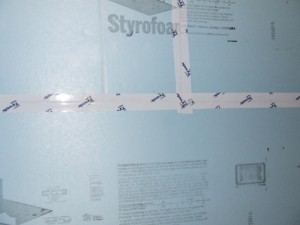
The foam should be sealed with special tape:

tyvek-tape-on-blue-board-300x225.jpg


This article from the Portland Cement Association gives the info on where to place the barrier: http://www.cement.org/tech/cct_con_vapor_retarders.asp
 
OP
B

bfarroo

Well-known member
Joined
Jul 5, 2012
Messages
179
Location
Green Bay WI
They don't show using insulation in the article though. Where do you get the tape from? I'd prefer not to tape it just because of the size of the building but will if there is a chance of the concrete sagging.
 

brownbagg

Well-known member
Joined
Mar 20, 2006
Messages
5,208
the vapor barrier always goes against the concrete, the form board be under the vapor barrier
 
To avoid these ads, REGISTER NOW!

wssix99

Well-known member
Joined
Mar 2, 2011
Messages
5,161
Location
Chicago, IL
They don't show using insulation in the article though. Where do you get the tape from? I'd prefer not to tape it just because of the size of the building but will if there is a chance of the concrete sagging.

The article is all about engineering the vapor and slab, but even that (not to mention location of the insulation) is debatable and regularly debated by experts and the concrete trade associations. The problem is trade-offs between trapping water in the concrete, (and seeing more cracking from differential shrinkage) constructability, and longevity of the insulation.

The tape is available from any commercial building supply that sells the foam.


i didn't tape my foam in my 40x32. no lines showed. i can't see how they would anyways.

I'd think that if there is a pathway in some areas for moisture to get away from the concrete, it could influence how shrinkage cracks propagate and the slab curls. Likewise - I can't figure out how this would create lines on the surface.


the vapor barrier always goes against the concrete, the form board be under the vapor barrier

PCA recommends (in the article above) in some cases putting the barrier under the sub base to improve quality of the concrete and reduce curling. A lot of it depends on the environment the slab is in.
 

cyamaha2007

Well-known member
Joined
Apr 20, 2009
Messages
2,001
Location
St.Charles MO
When we had to meet a specific grade of precast concrete decking for over basements and stuff we had to tape the seams of the foam. It was so the thin mud couldnt seep between the **** join of the foam. It was for structural reasons due to making a imperfection creating a stress point. This may not be what your contractor is talking about but I taped the seams on my xps for vapor barrier reasons. If the foam is taped its a vb all on its own. Since the standard plastic vb can deteriorate over time its just a back up. I would put the xps under the lift its fine in this application. Im not a engineer but do know a great deal about concrete unfortunately.
 

Quijote

Well-known member
Joined
Feb 27, 2013
Messages
179
Location
Greater Boston
Is an epoxy finish considered a "moisture-sensitive finish?" I may well epoxy my yet-to -be built garage, so I am curious if I should request a vapor barrier beneath the slab.
 

Kevin C

Well-known member
Joined
Aug 4, 2011
Messages
1,653
Location
Portland OR
Is an epoxy finish considered a "moisture-sensitive finish?" I may well epoxy my yet-to -be built garage, so I am curious if I should request a vapor barrier beneath the slab.

Epoxy does not like back pressure from moisture. Regardless, of floor finish, you should put in a vapor barrier. Last I checked its a code requirement, even for a garage.
 

wssix99

Well-known member
Joined
Mar 2, 2011
Messages
5,161
Location
Chicago, IL
Is an epoxy finish considered a "moisture-sensitive finish?" I may well epoxy my yet-to -be built garage, so I am curious if I should request a vapor barrier beneath the slab.

No, its not moisture sensitive. After talking to my contractors, I think we are going to go with the barrier above the sub base and under the foam, even though its in a protected and conditioned space. We figured that the barrier would hold up better long term in that location vs. being sandwiched between two rough surfaces.

PCA recommends putting the barrier lower for some slabs to allow more moisture to escape from the slab as it cures. This is probably more critical for industrial slabs that have curling concerns.
 
To avoid these ads, REGISTER NOW!
Top Bottom