To avoid these ads, REGISTER NOW!

Questions about Decks and Footers

ryan t

Well-known member
Joined
Nov 12, 2012
Messages
177
Location
Bristol, Va.
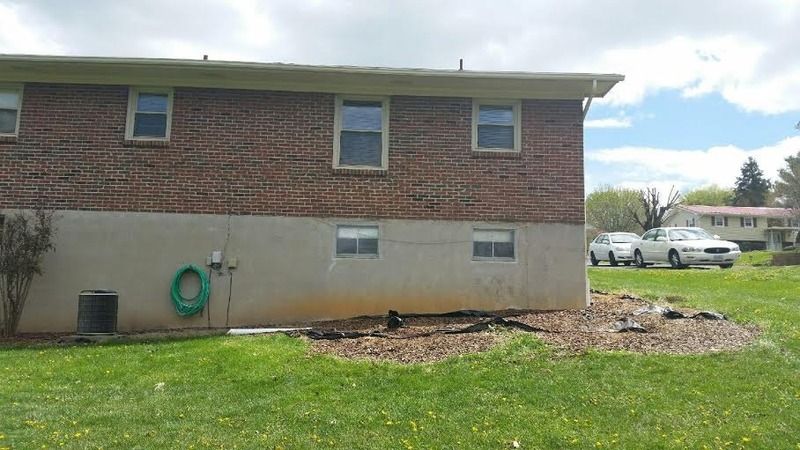
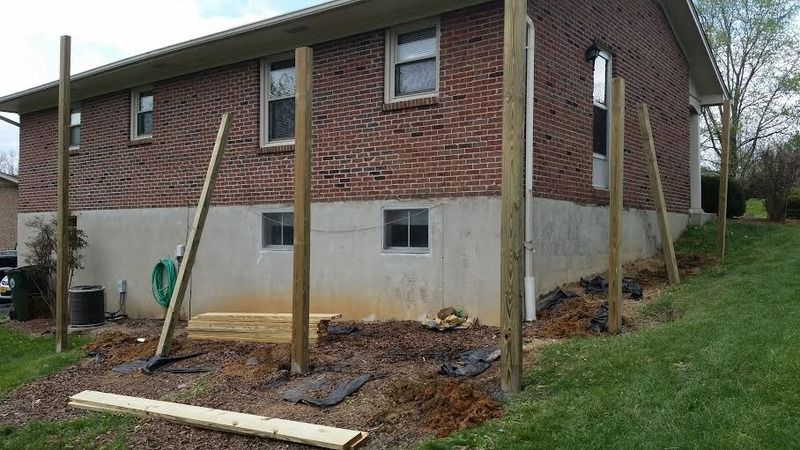
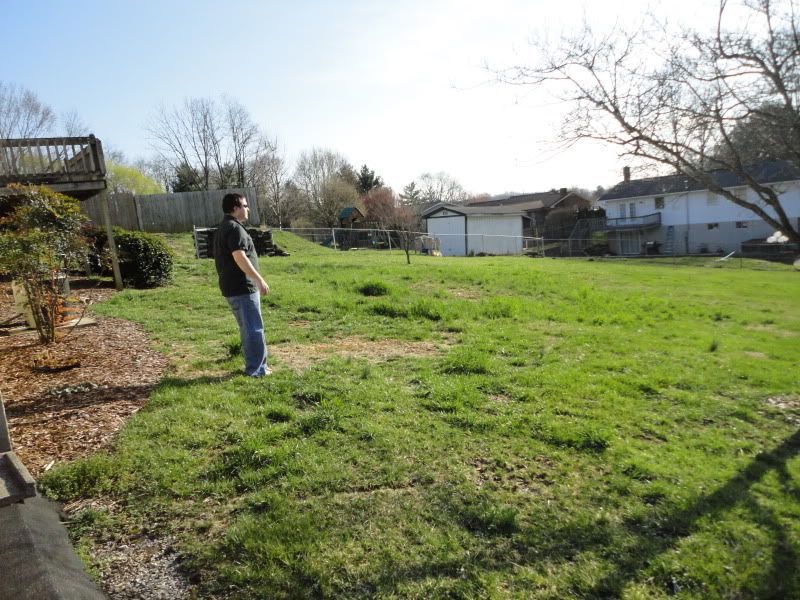
So the deck on our house isn't in the greatest of shape and, while not dangerous, is in need of replacement. I've helped build some decks in my past but they have always been on ground level/just slightly off the ground. Our deck is on a slight angle which will require the support posts to be of different heights (from about 9' from the ground at the tallest to about 3' at the shortest. Below is a really REALLY crappy Paint drawing of our deck. My question is, do I need to pour full concrete footers and mount the vertical supports above the ground, or pour a few inches of footer, then insert the post into the ground and pour concrete around it. Or is there some other good way to do it? Basically I'm looking for some deck advise. Home is not built in a flood zone and is in southwest Virginia. Unfortunately I don't have any great pictures of the deck except for this one from when we were looking to buy the house. Don't mind the crappy back yard and my fat ***, the yard is now very green and lush. Me...not so much! Thanks in advance for any advice and help.

deck_zps2b0bb6d5.png


DSC00928.jpg
 
To avoid these ads, REGISTER NOW!

bczygan

Well-known member
Joined
Nov 4, 2009
Messages
22,002
Location
DETROIT! Arsenal of Scrappers
I MUCH prefer a post be fastened to a metal base plate and then the plate be secured to the concrete. Concrete against wood just isn't good. Post in concrete = rot and decay.

Now, this assumes that there is good lateral support or triangulation of the structure. If you don't get the triangulation in the joints and connections, then X bracing or knee bracing of some kind will be needed.
 
OP
R

ryan t

Well-known member
Joined
Nov 12, 2012
Messages
177
Location
Bristol, Va.
I don't see any reason to put any knee or X bracing. There isn't any now and it stands just fine. If it wasn't for the lack of care from the previous owner the deck would be fine. It is mounted to the house and I intend to use 2x10s for the underside and at 16" spacing. The ground posts are currently 15' apart but I also plan to put the supports closer together to add strength.
 

willymakeit

Well-known member
Joined
Apr 27, 2009
Messages
1,243
Location
Springfield Mo.
Put a flat paver in the bottom of your hole with the post on top. We used to seal around the post and the end grain with roofing tar before back filling.
Run your diagonals across the bottoms of the joist if you want to keep it from racking.
Knee bracing is dependent upon the spacing of your posts and the size of your joist or beams.
 

bczygan

Well-known member
Joined
Nov 4, 2009
Messages
22,002
Location
DETROIT! Arsenal of Scrappers
I don't see any reason to put any knee or X bracing. There isn't any now and it stands just fine. If it wasn't for the lack of care from the previous owner the deck would be fine. It is mounted to the house and I intend to use 2x10s for the underside and at 16" spacing. The ground posts are currently 15' apart but I also plan to put the supports closer together to add strength.

You don't see the connection I am making. And this would only be at the tallest post, if then.

When posts are embedded in the ground, they act as a beam in a vertical plane, with the portion in the ground providing a continuous member all the way up. It's a cheap, quick and dirty way to build a structure and almost universally used. It's what you have now, and requires no lateral bracing.
If you mount the base of the column on an exposed concrete pier, you create a joint and have less resistance, thus, either a thicker column or bracing will make up for that.

What is wrong with the deck right now? What lack of care resulted in what damage?

And if the present structural design is adequate, why are you changing it?
 
OP
R

ryan t

Well-known member
Joined
Nov 12, 2012
Messages
177
Location
Bristol, Va.
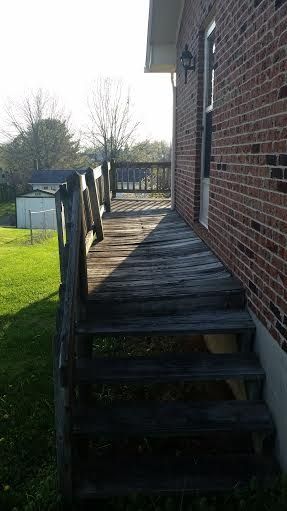
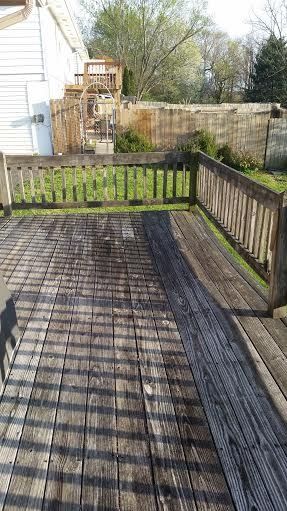
The previous owner never put any sealant or anything on the deck. The current wood is starting to rot and the deck planks are starting to come loose/starting to sag because the span between ground supports is too wide. The current spacing is 24" and are only 2x6" supports. I intend to use 2x10s at 16" and seal it yearly. The supports coming off of the house also don't attach to the support beams in the center but are nailed together (if that makes sense). I plan to rebuild it to the current building code I'm just not sure how to do the footings. Here are two photos I just took (sorry for the nighttime pics) of how the previous builder attached the deck planks and supports.

deck1_zps42f2f8cd.jpg


deck2_zps3072f9e6.jpg
 
OP
R

ryan t

Well-known member
Joined
Nov 12, 2012
Messages
177
Location
Bristol, Va.
You don't see the connection I am making. And this would only be at the tallest post, if then.

When posts are embedded in the ground, they act as a beam in a vertical plane, with the portion in the ground providing a continuous member all the way up. It's a cheap, quick and dirty way to build a structure and almost universally used. It's what you have now, and requires no lateral bracing.
If you mount the base of the column on an exposed concrete pier, you create a joint and have less resistance, thus, either a thicker column or bracing will make up for that.

What is wrong with the deck right now? What lack of care resulted in what damage?

And if the present structural design is adequate, why are you changing it?

I'm sorry I don't see the connection in the post you made. I am not experienced at all in high above ground deck building. I am comfortable doing the work needed but I am beyond my skill level in the logistics of the work needing to be done. I hope my ignorance is not seen as an insult to you, I am just hoping to learn. Thanks my friend.
 

bczygan

Well-known member
Joined
Nov 4, 2009
Messages
22,002
Location
DETROIT! Arsenal of Scrappers
OK.

We need more measurements and photos to gauge the condition of the existing deck. It is obviously weathered. But can't tell of the joists or beams are damaged. From the photos, it is starting to look like a standard cheap builders deck. If you want a top notch deck, it may be better to build new, but let's look at the structure first.

I tend to be conservative with structure. My rule of thumb is to look at the deck span tables and go one size bigger to make the deck "Feel" sturdier and less bouncy.

Bracing and blocking also adds to this feeling of walk-ability. One place to pay particular attention to, is the connection to the house. The way it is through bolted (NOT lag bolted) there, and how it is waterproofed, will determine the safety and life of the deck.
We need to look at this connection on the existing deck. Even if the existing structure is sound, this connection may not be.
Then there are the decisions for decking material, fastening methods and materials and railing treatments.
 

theoldwizard1

Well-known member
Joined
Feb 22, 2011
Messages
43,200
Location
SE MI
First, footing and attachment to the main building are covered by local codes and can vary quite a bit. Check with you city/county building department.

Second, what he said
I MUCH prefer a post be fastened to a metal base plate and then the plate be secured to the concrete. Concrete against wood just isn't good. Post in concrete = rot and decay.

Third, the main beams, typically those running parallel to your house, nerd to be directly supported by the post, not bolted or nailed to the post ! Typically this done by notching a post (typically 6x6) so that the load of the beam rests squarely in the notch. Nails and or bolts just keep the beam from slipping out of that notch.

Fourth, joists (perpendicular to the main beams) must either sit on top of the main beams are be attached to the beams with joist hangers and the appropriate type and quantity of nails.
 

Automatic Slim

Well-known member
Joined
Feb 26, 2013
Messages
284
Location
In a shack by the river in Central Arkansas
i still bury post and use a gravel fill for bottom before concrete pour. helps with lateral support on rails, imo.

also sometimes notch out posts to support header, all that is holder your header board and deck are some rusty old nails. on inside supports i sometimes use two 2x4 sunk in crete on every other joist and attach, and place 2x4 under joists, secured, between the two 2x4. adds a lot of strength and aint moving.

also usually add support to building footer on header board against house, or flat block to add support against house (as opposed to just a few lags.

don't like the 5/4 radius decking, but whateva.

i use a gas powered auger and drive the puppy 2 ft deep as well.

call before you dig. gl & have fun.

haven't nailed a deck in a while, always 3" screws, but that's me.

adequate support on the header boards and joists - this deck does not have.

block, and brace, and use a ledger for additional joist support.
 

Jackfre

Well-known member
Joined
Dec 26, 2010
Messages
4,411
Location
N CA
I had a walk out basement in my last home. The deck was elevated as yours is. I put sono-tubes in for frost requirements, which you likely won't have to meet. I don't mean to be spending your money, but this is just a thought. In MA where we were we could not use the deck in the late pm evening due to Mosquitos. I built a screened in porch which became the best and most used room in the house...6 mos a yr. I then put pea gravel on the re-graded ground, sided the lower enclosure (ano power or insulation) and that was where the lawn mower and equipment went. Lot of good storage and good living space.
 
To avoid these ads, REGISTER NOW!

cburnscrx

Well-known member
Joined
Jan 15, 2013
Messages
1,751
Location
Indianapolis
OK.

We need more measurements and photos to gauge the condition of the existing deck. It is obviously weathered. But can't tell of the joists or beams are damaged. From the photos, it is starting to look like a standard cheap builders deck. If you want a top notch deck, it may be better to build new, but let's look at the structure first.

I tend to be conservative with structure. My rule of thumb is to look at the deck span tables and go one size bigger to make the deck "Feel" sturdier and less bouncy.

Bracing and blocking also adds to this feeling of walk-ability. One place to pay particular attention to, is the connection to the house. The way it is through bolted (NOT lag bolted) there, and how it is waterproofed, will determine the safety and life of the deck.We need to look at this connection on the existing deck. Even if the existing structure is sound, this connection may not be.
Then there are the decisions for decking material, fastening methods and materials and railing treatments.

I haven't done it on anything that tall before, but the decks I've built are not attached to the house via header board. I've never understood the need for a header board on a ground level deck, other than laziness. I built the deck to my last house with less than a half inch gap between the house and the deck including around a bump out. You'd never know there wasn't a headerboard attached to the structure. The big benefit to not having a header board? Less rot and a chance for water to sit up against the edge of your house. Caulk will fail, it's just a matter of when.

*that said, I've been using Lexel lately...fantastic!!!

 
Last edited:
OP
R

ryan t

Well-known member
Joined
Nov 12, 2012
Messages
177
Location
Bristol, Va.
OK.

We need more measurements and photos to gauge the condition of the existing deck. It is obviously weathered. But can't tell of the joists or beams are damaged. From the photos, it is starting to look like a standard cheap builders deck. If you want a top notch deck, it may be better to build new, but let's look at the structure first.

I tend to be conservative with structure. My rule of thumb is to look at the deck span tables and go one size bigger to make the deck "Feel" sturdier and less bouncy.

Bracing and blocking also adds to this feeling of walk-ability. One place to pay particular attention to, is the connection to the house. The way it is through bolted (NOT lag bolted) there, and how it is waterproofed, will determine the safety and life of the deck.
We need to look at this connection on the existing deck. Even if the existing structure is sound, this connection may not be.
Then there are the decisions for decking material, fastening methods and materials and railing treatments.

I don't intend to re-use ANY part of this deck. I'm going to tear it down and build a brand new one. The current deck is attached to the house. I think keeping it attached may be best since it's so far off the ground, gives it a good strong mounting point. I intend to use 6x6"s and 2/10 @ 16" apart for the joists. Pressure treated wood because composite is too expensive. Really the only part I haven't figured out is the footers. The current posts were put in the ground and concrete poured around them. There is one section where during heavy rain water runs off and has displaced enough dirt to uncover the concrete that was previously buried. Due to the layout of our property there is not a whole lot I can do about that. I'm planning on putting lattice work around the sides of the deck below the floor but that will only provide so much protection.
 

bczygan

Well-known member
Joined
Nov 4, 2009
Messages
22,002
Location
DETROIT! Arsenal of Scrappers
I haven't done it on anything that tall before, but the decks I've built are not attached to the house via header board. I've never understood the need for a header board on a ground level deck, other than laziness. I built the deck to my last house with less than a half inch gap between the house and the deck including around a bump out. You'd never know there wasn't a headerboard attached to the structure. The big benefit to not having a header board? Less rot and a chance for water to sit up against the edge of your house. Caulk will fail, it's just a matter of when.

*that said, I've been using Lexel lately...fantastic!!!


I also prefer decks that are detached from the house. It solves the water problem at the connection. Some other things I would think about or do:
Choose a premium decking material and use a hidden fastener system.
Create different levels so the deck area becomes an extension of indoor space as well as an intimate connection to the surrounding yard.
Integrate seating, landscaping and structures (Like pergolas and shade structures or awnings), into the deck for varied spaces.
Don't forget power and lighting, including lighting for steps and consider landscape lighting to integrate the deck into the yard.
Think about a water feature. It can even be just a pot with a small fountain for a pleasant sound.
Think of planters with plants that have pleasant aromas.
Consider the functions your deck and yard will accommodate, and design it to meet those needs. It might be totally different than your present one.
Incorporate a hot tub or make space for a chaise lounge or swing seat or even outdoor couches or a hammock.
Think about views from different parts of the deck and design it to frame those views when furnished.
Think about a hard canopy over part of it so you could use it in the rain.

Consider running a gas line for BBQ hookup and a hose bib for water.
 

bczygan

Well-known member
Joined
Nov 4, 2009
Messages
22,002
Location
DETROIT! Arsenal of Scrappers
And before you go hog wild with 2x10 joists, think about cutting the span with a second line of beams. Might end up cheaper. I like to use my beams for the best support by cantilevering them off the ends of the posts. Rule of thumb is 1/3 of span. You have the height to do it. And it leaves the posts back further under the deck and better hidden. I also cantilever the joists over the beams for the same reason.

And take care with the design of your railing system. Most are abortions, especially with the advent of codes demanding balusters that not pass a small ball between them. Work hard to design something that really works with the house and deck architecture by either complementing or contrasting with it.
 

pattenp

Well-known member
Joined
Jun 4, 2008
Messages
10,175
Location
Virginia - USA
You better check with your building official. That 1/3 third rule of thumb may not be allowed. Our building official limits deck cantilevers to 2 feet.

And before you go hog wild with 2x10 joists, think about cutting the span with a second line of beams. Might end up cheaper. I like to use my beams for the best support by cantilevering them off the ends of the posts. Rule of thumb is 1/3 of span. You have the height to do it. And it leaves the posts back further under the deck and better hidden. I also cantilever the joists over the beams for the same reason.

And take care with the design of your railing system. Most are abortions, especially with the advent of codes demanding balusters that not pass a small ball between them. Work hard to design something that really works with the house and deck architecture by either complementing or contrasting with it.
 

skiingman

Well-known member
Joined
Apr 25, 2010
Messages
280
I MUCH prefer a post be fastened to a metal base plate and then the plate be secured to the concrete. Concrete against wood just isn't good. Post in concrete = rot and decay.

Now, this assumes that there is good lateral support or triangulation of the structure. If you don't get the triangulation in the joints and connections, then X bracing or knee bracing of some kind will be needed.
I just took some 25 year old 4x4s out of the ground to replace for my parent's deck. They settled because the footings weren't big or deep enough for our climate, but they were in excellent condition.

Putting the post in the ground has several advantages. It's faster, cheaper, and provides significant lateral stiffness when done in a climate like ours with deep frostlines. The post bases you prefer in general provide negligible lateral stiffness on their own, requiring bracing and generally more stuff from the Simpson catalog to connect it all.

I find it somewhat odd that pole barns are as popular and successful as they are across America and yet the mass "wisdom" is that posts set in the ground are an inferior solution for a deck that stands a few feet high.

If I lived somewhere where PT posts didn't last in the ground I'd probably be on your side.
 
OP
R

ryan t

Well-known member
Joined
Nov 12, 2012
Messages
177
Location
Bristol, Va.
The most recent big task I've undertaken is rebuilding our dilapidated deck. It was built with nothing but 4x4 posts, 2x4 joists, floor boards and nails. It's was still standing but was by no means safe. First task was cutting down two 9' tall holly bushes behind the deck. A chainsaw made quick work of those and my truck and a logging chain made quick work of the stumps.

Here's the old deck. 3 of the posts were just stuck in the ground with no concrete at all and the rest were only about 8-10" deep with very little concrete.

20130725_221535_zpsozmop3pr.jpg


As you can see from this side, it's leaning and sagging pretty bad. The bannisters are also too low.

20130725_21_zpszo2rdu2y.jpg


20130725_23_zps3v00vf7n.jpg


A chainsaw made quick work of the old deck. 90 minutes and the whole thing was down and on the trailer headed for the dump.

20130725_29_zps6u5pnjgp.jpg


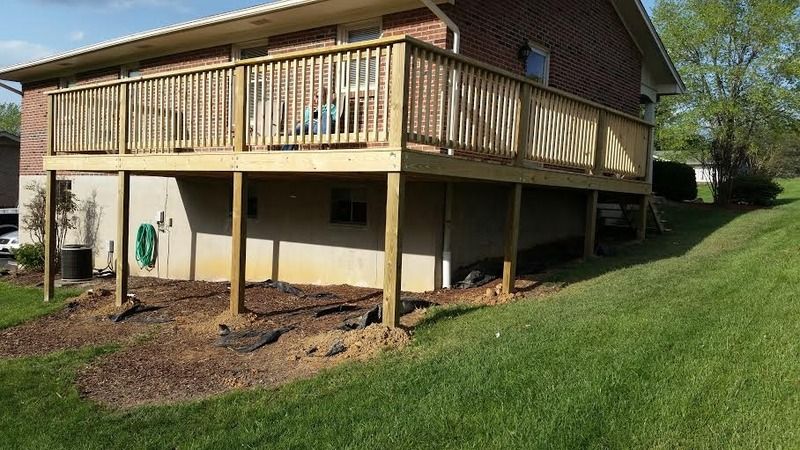
New posts are each a minimum of 22" deep with a 50lb bag of concrete per post. These 4x6 posts aren't going anywhere.

20130725_24_zpspskg2ffk.jpg


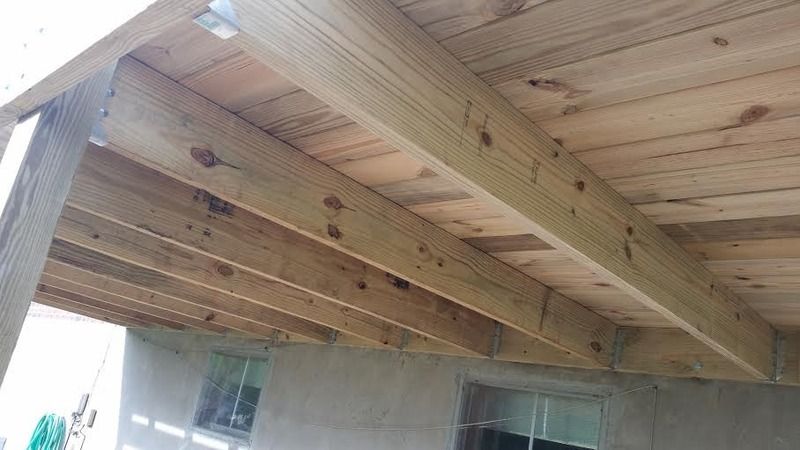
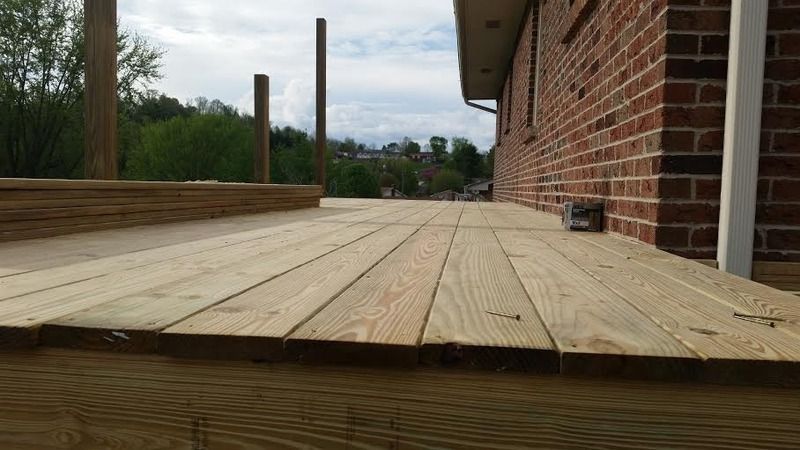
Posts set for a couple days to cure before the supports, band boards and achor bolts went in. Instead of the screws and nails that held the old deck together we used 4" lag bolts both into the house foundation and into the support posts. Everything is screwed in, even the floor boards. Not a single nail on this deck. We also raised it up a few inches so you don't have to have much of a step into the kitchen.

20130725_25_zpspxulp6du.jpg


20130725_26_zpsvwrdnyve.jpg


20130725_27_zpsnr2qddv8.jpg


Main section of flooring down. Don't mind the nails, they were just used to hold the band boards and supports level while we screwed in the anchor bolts. The rest will come this weekend and the banister/steps/gate at the steps will come early next week as time and weather permits. Once it's all built we will be putting gravel underneath it and lattice work around the sides. More pics to come as work gets completed.

20130725_28_zps1mkaa9vb.jpg
 
Last edited:
OP
R

ryan t

Well-known member
Joined
Nov 12, 2012
Messages
177
Location
Bristol, Va.
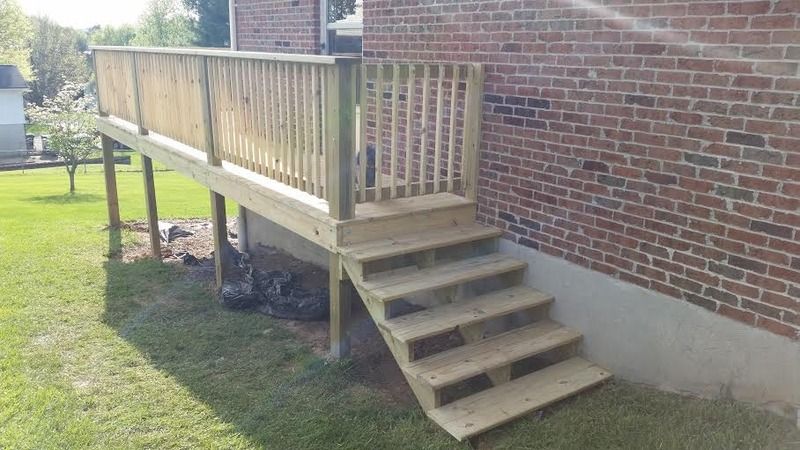
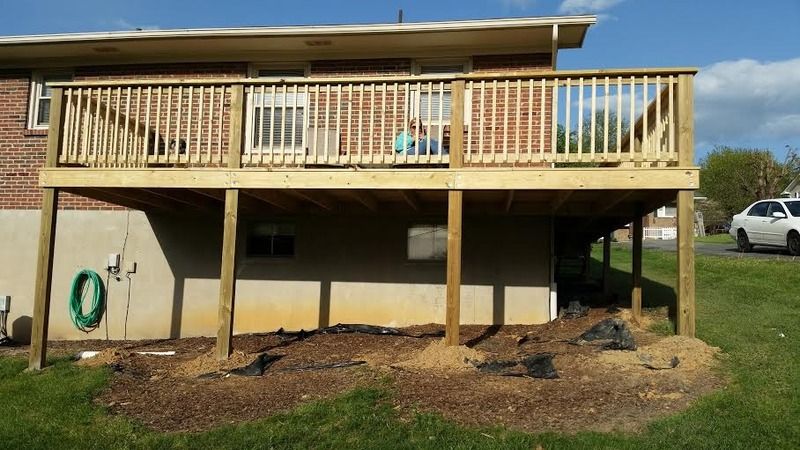
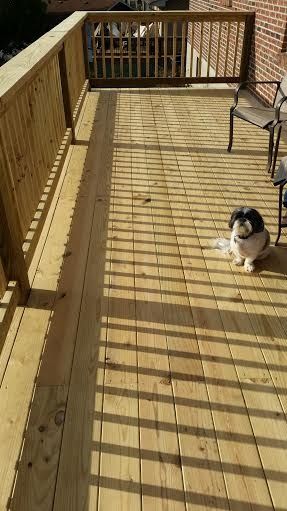
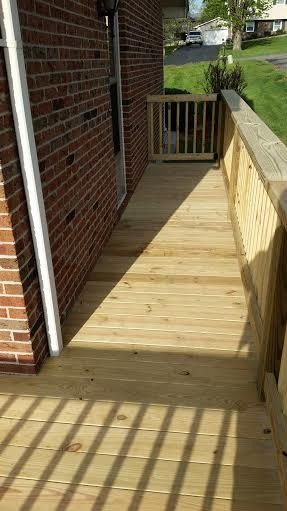
Were still going to put some lattice work on the outside and put some chipped brick underneath it to deal with some water drainage we get due to the natural slope on our lot, but the hard part is over. We made the rail 42" tall because I like the extra security of that height. We also put 2"x8" boards all the way across the top of the handrail to provide room to rest your arms on, put a drink on or sit a plate on if needed. We left about 3" between the deck floor and the bottom rail of the bannister to allow room to sweep or use the leaf blower to blow debris off the deck. We also put in a gate so we can let our dogs out on the porch and not have to watch them.

deck1_zpsoecmkdkq.jpg


deck2_zpsdxa6utvw.jpg


deck3_zpsrlvwulsd.jpg


deck4_zps1yzq1yye.jpg


deck5_zps2hxk7fop.jpg
 
To avoid these ads, REGISTER NOW!
Top Bottom