To avoid these ads, REGISTER NOW!

Difference between fluke 87 and 88?

redwrench60

Well-known member
Joined
Sep 10, 2011
Messages
6,076
Location
East Tennessee
This may be an error on the Fluke web page but when I use their product compare page for the 87V and 88V they both show as True RMS. It seems like if the 88V were indeed true RMS, they would have that all throughout the literature. Overall, the comparison showed them to be very similar meters. Unless you're working on VFD's it seems like either would work well for both home and auto.

Yeah, it's a mistake. Read the technical specs for both meters. It even says true RMS on the face of an 87 but not on an 88
 
To avoid these ads, REGISTER NOW!

zkling

Well-known member
Joined
Jan 23, 2007
Messages
16,939
I have both. The only time i really need RMS is working on DC to AC inverters as they have a square wave and voltage is off w/o true RMS feature. Work on gensets for a living and find both useful. Either meter will do more than most folks will use in an automotive arena. I find Power Probe 3 the fastest on cars which means more money on flat rate. My.02$

Is it purely a square wave form, or is it a sine wave with a square wave on top of it? On a constant square wave form doesn't Vp=Vrms=Vavg? Out of curiosity when do you find the 88 to be more useful than the 87?

Yeah, it's a mistake. Read the technical specs for both meters. It even says true RMS on the face of an 87 but not on an 88

I believe they left out the RMS feature on the 88, because it can cause issues with the pulse reading "feature". The 87V has a built in low pass filter that you can turn on and off if you need to calculate pulses via frequency and duty cycle.

Ironically the 88 overall is a more basic, not as accurate meter aimed at the auto pro. Where as the 87V is more of a basic all around advanced meter. It can do dang near every thing under the sun short of a scope, but sometimes you just have to get tricky about how you do it.
 
Last edited:

redwrench60

Well-known member
Joined
Sep 10, 2011
Messages
6,076
Location
East Tennessee
Is it purely a square wave form, or is it a sine wave with a square wave on top of it? On a constant square wave form doesn't Vp=Vrms=Vavg? Out of curiosity when do you find the 88 to be more useful than the 87?


I believe they left out the RMS feature on the 88, because it can cause issues with the pulse reading "feature". The 87V has a built in low pass filter that you can turn on and off if you need to calculate pulses via frequency and duty cycle.

Ironically the 88 overall is a more basic, not as accurate meter aimed at the auto pro. Where as the 87V is more of a basic all around advanced meter. It can do dang near every thing under the sun short of a scope, but sometimes you just have to get tricky about how you do it.

I've often wondered why they didn't make a "super meter" and just combine all the good features of the 88 and 87 in one meter. Guess it'd have a "super price"...........

Oh and my misinformation comments weren't directed at you. :)
 
Last edited:

zkling

Well-known member
Joined
Jan 23, 2007
Messages
16,939
Earlier you mentioned the lag of the of the RPM accessory clamp, would you mind elaborating on that? How often is a multimeter that reads RPM useful as a full time auto pro? What would be the preferred tool if someone needs to measure RPM with good response on a modern automobile? Just for kicks a few times, and mostly on outboards. I have measured RPM with my 87, just based on a frequency reading and then calculating RPM based on # of cylinders.

I think fluke was just trying to get an edge into the market with the 88. If you look at the general accuracy specs it is really not that great. But they do have the features (Like RPM) to advertise to the Auto field. Which we all know, advertising is more than half of the game.
 
Last edited:

redwrench60

Well-known member
Joined
Sep 10, 2011
Messages
6,076
Location
East Tennessee
Earlier you mentioned the lag of the of the RPM accessory clamp, would you mind elaborating on that? How often is a multimeter that reads RPM useful as a full time auto pro? What would be the preferred tool if someone needs to measure RPM with good response on a modern automobile? Just for kicks a few times, and mostly on outboards. I have measured RPM with my 87, just based on a frequency reading and then calculating RPM based on # of cylinders.

I think fluke was just trying to get an edge into the market with the 88. If you look at the general accuracy specs it is really not that great. But they do have the features (Like RPM) to advertise to the Auto field. Which we all know, advertising is more than half of the game.

Basically the RPM features baud rate is just too slow and it lacks fine resolution. Ive tried to use it a few times to set idle on old non tach equipped vehicles and got frustrated due to it's inability to show a real time RPM.

Really I have no need for a meter to read RPM. This info is readily available on a scan tool or just the dash tach, lol. But it could come in handy for small engine repair and diag.
 

pfbz

Well-known member
Joined
Dec 17, 2008
Messages
959
Most homeowners, hobbyists and part-time auto mechanics would go a lifetime without ever understanding let alone needing to measure "True RMS AC" voltage... I certainly wouldn't make that particular feature central to a decision on which multimeter to purchase unless you had a specific need for it.

i-K46vC9W.jpg


Electronic technicians and engineers do often need the true RMS AC and higher accuracy DC capabilities that some Fluke meters offer, but buying a meter because it has those capabilities when you have no need to make those types of measurements is pointless... and as mentioned earlier, if you are working with equipment that is putting out non-sinusoidal AC voltage, you are probably going to want to be looking at it with a scope, not a meter.

I have an 88 as well as some Fluke high-accuracy true RMS meters... One useful feature of the 88 is the ability to measure and tune older Bosch fuel injection systems (like air cooled Porsche) using the duty cycle measurement feature.
 
Last edited:
To avoid these ads, REGISTER NOW!

zkling

Well-known member
Joined
Jan 23, 2007
Messages
16,939
Really I have no need for a meter to read RPM. This info is readily available on a scan tool or just the dash tach, lol. But it could come in handy for small engine repair and diag.

Interesting, thanks for the info. Yea I have used the 87 a few times on outboards and other small engines to adjust idle and high low setting, but nothing real mission critical. I must be one of the few that has a manual transmission and no dash tachometer. (Seriously) :dunno: It is the true definition of an econo box. :lol_hitti But hey for 35-40mph I can't complain.
 
Last edited:

pfbz

Well-known member
Joined
Dec 17, 2008
Messages
959
...additionally,

I don't think either the 87 or 88 is necessarily the best choice for most of the people on a forum like this.

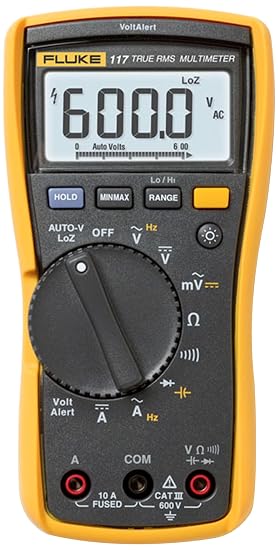
Fluke 117 is an awesome meter at $166 brand new and shipped on Amazon. Less than you'll spend on a used, no warranty 87 or 88.

81Sjvm2PiLL._SY550_.jpg
 
Last edited:

Lurch67

Well-known member
Joined
Dec 2, 2012
Messages
169
Location
Near Philly, Yo.
When reading AC voltage signals, a true RMS meter (such as a Fluke 87) provides a different reading than an average responding meter (such as a Fluke 88). The only place this difference is important is when a reading is to be compared with a specification. See attachment.
 

Attachments

  • Picture1.jpg
    Picture1.jpg
    42.3 KB · Views: 31
Last edited:

richfinn

Well-known member
Joined
Jan 29, 2011
Messages
4,817
Location
Leeds, Yorkshire, England
...additionally,

I don't think either the 87 or 88 is necessarily the best choice for most of the people on a forum like this.

Fluke 117 is an awesome meter at $166 brand new and shipped on Amazon. Less than you'll spend on a used, no warranty 87 or 88.

81Sjvm2PiLL._SY550_.jpg

I agree the 88 is plenty good enough for vehicles and its extra features are better suited to the average tech.

I still have an old 78 and besides not having a backlight or pulse width it's been fine for me, I do have a scope mind you.
 

Vvmvbb

Well-known member
Joined
Aug 5, 2011
Messages
746
Location
CT
While not too relevant to a homeowner or auto tech, I'll chime in with another very important need for true rms readings: to measure electrical noise levels.
 

JTH

Well-known member
Joined
May 4, 2012
Messages
167
Location
MO Ozarks
late reply to zkling. Sensata Dimensions inverters both Pure sine and Quasi sine units. Use the 88 for pulse width on older ford and air cooled german cars.
 
To avoid these ads, REGISTER NOW!
Top Bottom