To avoid these ads, REGISTER NOW!

1950s Refrigerator to Kegerator - or how an engineer builds a kegerator

machine_punk

Well-known member
Joined
May 14, 2011
Messages
2,540
Location
Napa Valley, California
WOW...I thought I was a bit retentive in my projects. I guess there are other folks out there with the same sickness. Overly-Attentive To Detail.

I have a similar surveyor's tripod in the garage, waiting for refurb for essentially the same reason...only I am going to mount an old Fresnel stage light on mine (with a colored CFL inside.

Looking forward to seeing the final product. Looks great so far.

Kev
 
To avoid these ads, REGISTER NOW!

Socophreak

Well-known member
Joined
Jun 18, 2010
Messages
231
If you're having problem with scratches, you could probably just put some electrical tape around each roller to stop the scratching until you could get some nylon rollers.

Other wise, looks pretty sweet! I've run 1000's of feet of tubing and fittings, and it sure takes a lot of work to make it good. You're also going to scratch the **** out of the bends with those 9.99 benders. The only style I know that has rollers in them is the swagelok brand. I also used to use a 7inch plastic square to check how "true" the corners were, as we typically used to do full 20FT runs with several bends.
 
OP
A

aggierailroad

Well-known member
Joined
Jan 8, 2012
Messages
581
Location
Houston, TX
WOW...I thought I was a bit retentive in my projects. I guess there are other folks out there with the same sickness. Overly-Attentive To Detail.

I have a similar surveyor's tripod in the garage, waiting for refurb for essentially the same reason...only I am going to mount an old Fresnel stage light on mine (with a colored CFL inside.

Looking forward to seeing the final product. Looks great so far.

Kev

The sickness is spreading. Some of mine I caught from you - Incra rules (I now have 3 types) and your rivet parallel expanding tool thing. Those touches show the hobbyist that perfection is in reach and affordable.

I really thought about mounting a Fresnel on mine because the original owner said the transit wouldn't fit. It did after some small tweaks so I stuck with the transit. Do you already have the light?

If you're having problem with scratches, you could probably just put some electrical tape around each roller to stop the scratching until you could get some nylon rollers.

Other wise, looks pretty sweet! I've run 1000's of feet of tubing and fittings, and it sure takes a lot of work to make it good. You're also going to scratch the **** out of the bends with those 9.99 benders. The only style I know that has rollers in them is the swagelok brand. I also used to use a 7inch plastic square to check how "true" the corners were, as we typically used to do full 20FT runs with several bends.

After reading this I took another look at my free to me benders. I'm not sure if they will bend a 180 which is critical to my design. Do you have any experience with the kind I have? The swageloks sure do look tempting..
 

machine_punk

Well-known member
Joined
May 14, 2011
Messages
2,540
Location
Napa Valley, California
The sickness is spreading. Some of mine I caught from you - Incra rules (I now have 3 types) and your rivet parallel expanding tool thing. Those touches show the hobbyist that perfection is in reach and affordable.

I really thought about mounting a Fresnel on mine because the original owner said the transit wouldn't fit. It did after some small tweaks so I stuck with the transit. Do you already have the light?

I'm glad you are enjoying the Incra Rules. They really make some of that fidgety measuring and layout work much easier.

Yep...I got the light years ago, as a trade for some work I did. I got the idea from the old show, Will & Grace...the guy has a huge, brass searchlight on a transit-like base. I've been looking for a similar spotlight, but it occurred to me that I have that Fresnel stage light I will probably never find another use for.

Kev.
 
OP
A

aggierailroad

Well-known member
Joined
Jan 8, 2012
Messages
581
Location
Houston, TX
Yep...I got the light years ago, as a trade for some work I did. I got the idea from the old show, Will & Grace...the guy has a huge, brass searchlight on a transit-like base. I've been looking for a similar spotlight, but it occurred to me that I have that Fresnel stage light I will probably never find another use for.

Those lights are very hard to come by - especially aged originals.

Just a small update on the bender. I spent the first night staring at parts and scraps and swatting mosquitoes. What an efficient use of my time.

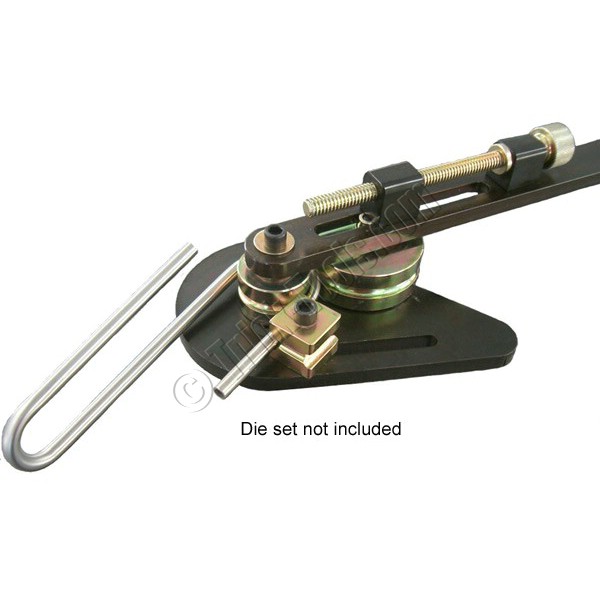
I was trying to create something like this from wood and carriage bolts:

hb1.jpg


It just wasn't coming to me. No surprise. I was befuddled by the bolt head sticking through the roller and causing interference with the carrier body. I finally decided to just wing it and not lock down the roller to the swinging handle and just let it slide loosely over the frame.

I grabbed some soft fir and drilled holed 1.5 inches apart (roller radius (0.75" x2 rollers). I clamped in a peg to hold the tubing and tried to roll it around.

It didn't work.

I immediately saw why the roller separation on the nice HB1 bender is adjustable. You either need to be able to drill very accurate holes and have very accurate bearings or have an adjustable slide.

I needed an adjustable slide. More work for me. Those $70 single tubing sized benders aren't looking so bad. I also determined that I needed a way to capture the roller rigidly to the arm. I was drawing a blank so I went inside and looked through some designs on the internet.

This is what I found:

rdb10-manual-bender.jpg


It's obvious. Make the carrier frame the same size as the inner roller. Then a nut sticking below the outer roller can traverse the entire arc without interference.

Here's what I got done before the wife got home:


I really want a piece of 1/4" aluminum for the handle. It would make it more compact and much sexier.

Here's to some more progress :beer:
 
OP
A

aggierailroad

Well-known member
Joined
Jan 8, 2012
Messages
581
Location
Houston, TX
Made some progress on the tubing bender. Here it is in it's rough form right before making a test bend.


Here are the results:


I'd call that a 180. Not bad for $4 in parts. After a little spit and polish here is what the entire package looks like:


spin_prod_221357101


Come on now, you didn't think I could live with those bends? It crushed the tube into some oblong cross section. Can't have that can we? Went to Sears and picked up this bender for $40. Probably worth the time and effort to get great and easy bends.

Can't win them all I guess.

To get started bending I added all of the jewelry to the Christmas tree. That's a nickname in the oil field for the string of gate and ball valves at the head of the well. Think the part that broke on the BP oil spill... With all of the valves, manifolds and regulators I thought it would be appropriate. Here she is all dolled up:


The manifold is just clamped in right now because I'm not quite sure how to attach it. I'm thinking of using a set screw in the back to clamp it against the front piece.

Now, to get to the meat of all of this tool making... Oh yeah, cut me some slack - my first tube bending experience. I'm not thrilled with how it turned out and may swap out the 90 degree fitting for a straight one and just making 2 90* bends. I'll maybe use the 90 in the other valve, make a 180 to go over that first inlet and make a run to the next.

The whole reason I did the 180 was because I could not for the life of me get a Z bend that would drop the tube 3/8". It just looked like **** and the bender wouldn't do it. If there is a tube bending expert reading this - please chime in - I'm open to any suggestions.

Enough talk - here it is:


The gauge face has blue tape on it to protect the plexi. Only took 2 screw up pieces to get this one done... Not bad :beer:
 
OP
A

aggierailroad

Well-known member
Joined
Jan 8, 2012
Messages
581
Location
Houston, TX
Project Manifold

Little bit of an update here, sprinkled in with some goodies...


Finally kind of figured out this tube bending thing. Still miscalculating my lengths when I make my cuts - so like most guys - I overcompensate and add a few inches..

I'll start with the goodies. Spoiler alert, I'll be reposting this in the tool section too.

Browsing Craigslist while in a training session at work I came across an add for some vintage tools. Couldn't pass up the deal and the guy actually worked a few blocks down from me.

Paid $50 for these two boxes. It's great that they are still in their original boxes.

Boxes_zps0ae00b86.jpg


The one on the left is a set of Wiss-17 snips. Never been used and still in the wax paper with cosmoline on the blades.

Snips_zps15c68a12.jpg


And the greatest prize is the one on the left - a Parker Kalon No. OX sheet metal punch. Patented in 1915! I've found a few other sets for sale and have heard that it will punch up to 14 ga. steel!

Punch_zps9adb502c.jpg


Onwards and upwards - Had to do some retakes but I'm finding my way with the bender. In a bout of frustration I pulled it all out and decided to finish out the bottom of the tree.

I still cannot get my hole saw to cut true and straight. I'm pretty sure the arbor doesn't let the saw sit square and flush. DeWalt brand if it matters to anyone. This resulted in me cutting the other scallop with the grinder - which sucked. I cut the pipe down to size length-wise first. Then I tacked it in the cutouts making sure that it was flush with both faces. I used the square tubing as a guide to cut off the round tube. Welded it in, ground it flush and then in a stroke of brilliance I squared the bottom in my dry cut saw. Here's the blurry result:

Xtreebottom_zpsfa9d9fba.jpg


Decided to finally fab up the manifold mount. Started by squaring the cutouts with a file. Always a good time to be filing steel in 90% humidity. I decided to just use some kind of set screw to clamp in the manifold.

I used a 1/4"-20 all-thread coupler as the main piece. Ground it down a little bit to fit and then welded it in with a bolt in place to ensure that it was square.

ManifoldRetainermockup_zps640f2275.jpg


Of course I don't have a nice allen set screw so I cut down a bolt and then ground a slot in it to create a groove for a flat screwdriver. The trick to it was that I screwed in the short piece (set screw) and from the other side tightened up a longer bolt to keep the short piece from rotating while I cut the groove.

Note the gloves - safety first!
locknut_zpsad3431e5.jpg


And finally a glamour shot of the empty tree with some of the bent tubing hanging off of it.

Xtreelines_zpsc9335d66.jpg


Thanks for reading, I hope everyone has enjoyed it as much as I have.
 

Shobra

Active member
Joined
Mar 2, 2009
Messages
38
When you need a highly accurate hole cut with a hole saw DO NOT USE THE PILOT DILL BIT.

You need to use a plug on the inside of the hole saw in place, here is a video link for ya to describe it better.

http://www.eaavideo.org/video.aspx?v=19541820001

It will take longer, but that's the price you pay for quality.
 
OP
A

aggierailroad

Well-known member
Joined
Jan 8, 2012
Messages
581
Location
Houston, TX
When you need a highly accurate hole cut with a hole saw DO NOT USE THE PILOT DILL BIT.

You need to use a plug on the inside of the hole saw in place, here is a video link for ya to describe it better.

http://www.eaavideo.org/video.aspx?v=19541820001

It will take longer, but that's the price you pay for quality.

Now you tell me.... Thanks for the tip, I just spent an hour watching those videos. I didn't use the pilot bit for the half hole, but there was a video on doing half holes by clamping on a backer plate. Either way great stuff, highly appreciated :rocker:
 

Socophreak

Well-known member
Joined
Jun 18, 2010
Messages
231
I think you were on the right track with the benders before.

These are what I used to use all the time
swagelok-tubing-bender.jpg


They lock the tube in on the "top" and two small rollers bend the tube. No scratches in the tubing, perfectly round, and perfect 90 deg angle every time. Granted they aren't cheap, but they are the best.
 
OP
A

aggierailroad

Well-known member
Joined
Jan 8, 2012
Messages
581
Location
Houston, TX
I think you were on the right track with the benders before.

These are what I used to use all the time
swagelok-tubing-bender.jpg


They lock the tube in on the "top" and two small rollers bend the tube. No scratches in the tubing, perfectly round, and perfect 90 deg angle every time. Granted they aren't cheap, but they are the best.

Are those also Imperial brand? That looks like what I was after. With my 470-H model benders I can get some kinking if I bend too fast and without lube :bounce: when doing 180s. The roller is definitely the way to go but my setup wasn't rigid enough :bounce:

I'm thinking I might have to buy those.... Now that I'm getting so many tubing tools I need another drawer in my toolbox... Need another toolbox.... need a bigger shop... all for just some 1/4" SS tubing.

Thanks for the tip - always open to some help.
 

Jim B

Well-known member
Joined
Mar 31, 2012
Messages
196
Location
California, USA
Those are Swagelok benders. A must have tool if you bend tubing all day. A little pricey for the homebrewer though. You had me going with the home built bender. Too bad it didn't work out. I used to homebrew and there are endless projects like yours that one can come up with. Can't wait to see yours completed.
 

litljay

Well-known member
Joined
Jun 26, 2009
Messages
156
Location
Fresno, CA
Just for some more "wow" factor, have you considered running a couple LED strips inside the xmas tree that will provide some light for your gauges? Or did I skim over that part?
 
OP
A

aggierailroad

Well-known member
Joined
Jan 8, 2012
Messages
581
Location
Houston, TX
Just for some more "wow" factor, have you considered running a couple LED strips inside the xmas tree that will provide some light for your gauges? Or did I skim over that part?

Mind reader :bowdown:

My thought was to use the high power 3-5 watt LED pucks on the back of the gauges to make them look back lit.

Here's one for you: how do I cap the top off??? I was thinking this weekend about fabbing a removable cap of some kind. I scoured the local antique stores looking for period correct styling cues but am drawing blanks. Any "finned" tail lights out there about 2 inches wide?


Jim, I think the bender would work with two mods: rollers with better bearings and rollers with better bearings. Ok, Ok, or maybe a way to better keep the roller and die parallel.

I'll keep working on the design as I'm sure folks would like a cheap bender.
 
OP
A

aggierailroad

Well-known member
Joined
Jan 8, 2012
Messages
581
Location
Houston, TX
Bifurcation - Phase I

Finally back after a hiatus of working on the cube table, building a power supply to make an electrolysis tank, and starting a new job. Fortunately that one left me with a week at the house to get some fab time in on the kegerator.

First things first - I reworked the regulator tree. I didn't like how the tubing outlets from the distribution block were not lining up with the regulator inlets which forced the tubing to have some freaky bends. In the v1.0 configuration I also could not assemble the gas-in line, it just would not physically fit. To summarize, I made the slot wider, slid back the dist. bar, and re-did most of the lines. Little bit cleaner now, I think. I also had to run the left most line really tight to give me as much clearance as possible for the kegs. Despite this, I still ended up adding 10.5" vs. 6" planned.


Now the big decision came - the one I've been dreading this entire build - cutting her in half. I was/am nervous about welding it without oil canning it, and I didn't like my plan for cutting it at the back to avoid forming the sheet would have been a design flop. I bit the bullet, bought a bead roller and a big abrasive blade and went to town.


The worm drive Ridgid is a beast.

I laid out my cut lines with tape, working with the box being out of square as best I could. First attempt at a straight edge involved bar clamps and a wooden guide.. It didn't work. I slept on it and kicked myself the next morning that I didn't think to tack the straightedge to the shell. Duh.


Nice and sweet 1/8" cut.


Repeat 4 times and you get this...


An inner fridge shell bifurcated. Let the fun begin.

Got myself some 18ga. carbon steel at a local sheet metal fab shop. 40' of 10.5" wide strips (4x 10ft pieces) was about $100. Great deal. Perfectly square using their nice big shear.


The gauge is hanging off some test strips I cut up to determine the best welder settings and to test the panel clamps I finally decided to buy. Lot of decisions to make when deciding to weld up long runs of flat sheet, but I decided that the clamps would help me keep it square and both sheets in plane -the longest run will be nearly 5 foot of weld..

Gapped at 0.04in. I put the veniers on them and found them to have a +/- tolerance of 0.003in. Not bad for HF.


Thanks to the guys here (Robert) and at allmetalshaping.com for tips on fitup and hammer planishing the welds.

Here are the shapes that need to be made - an approximate 1/4" radius bend, and the panel inset.


Got lucky and had a router bit and some maple to make a forming buck with.


Test piece tipped over with just a ball peen hammer, Estwing of course :willy_nil.

Shot of the setup I used to keep everything in line while creating the bend. Nothing too fancy here. I started with a 7/8" stickout, which ended up being too much. 1/2" should work fine next time. It's probably worth mentioning here that I decided to build it in 4 pieces and weld the "corners". My plan is to tack each piece to the back shell, tack the corner seams, then tack on the rest of the shell so that I can keep it all square as I go. I anticipate the need to add bracing bars.. One last decision is whether or not to add some stiffening beads - wish I would have thought of it earlier because the filler piece isn't in the exact middle, and I'm not sure I can bead roll over the ceramic/porcelain coating on the existing metal.

Final product.


And the final mockup.


I wasn't sure how to measure and layout the second corner so I just put the wooden buck in the original frame and clamped it to the new piece, pulled it all out and made a wild guess. Worked out perfectly.

Phase II will actually start with me beefing up the bead roller and possibly making some dies so that I get the raised panel bit correct. It's at an odd angle, but I'm new to panel rolling.

Thanks for reading.
 
To avoid these ads, REGISTER NOW!

sam03

Well-known member
Joined
Mar 30, 2012
Messages
68
Location
Gainesville, Fl
Subscribed! Holy **** that some amazing work nearly a lost art these days to see something that was "actually made"!!!!
 
OP
A

aggierailroad

Well-known member
Joined
Jan 8, 2012
Messages
581
Location
Houston, TX
Thanks. I'm learning as I go. Anyone can do it. Lots of help and ideas from this place, and it's always inspiration to get out there and sweat a little by reading comments like yours, Sam03.
 
OP
A

aggierailroad

Well-known member
Joined
Jan 8, 2012
Messages
581
Location
Houston, TX
Inner box - Small update

Small update today:

Finally back in town after a 3 week hiatus saving the world in California. Gave me some time to track down and buy these from Summit Racing:

IMG_05251_zps1b6d71cd.jpg


Oh yeah, hammer was about $25 and the dolly was around $40 I think.

Many thanks to the guys contributing to the sheet metal welding thread and allmetalshaping.com for recommending them for planishing. Proves you can still learn something every day. Hammer feels a little lighter than I'm used to, and I wish the handle were a tad longer, but the fit and finish are great. The dolly could use a minor buff and polish with a DA, but it's pretty nice overall.

I got the cheap-o HF bead roller to roll out the 18ga. quite nicely. I had to weld some square tubing on the side to clamp it to the table, but I got a nice test piece done that actually matches the contours I need. I was really worried this wouldn't work out. I ended up using the 1/4" panel raising die and offsetting them a bit to get a nice "Z" bend to match.

Here's the test piece beside the fridge inner shell. It's hard to tell what you're looking at, but it all lined up after three adjustments to the machine. I'm going to roll the big piece when I can convince the wife to crank the wheel for me...

IMG_05261_zpsaa1132e1.jpg


Lastly, here's the progress so far, tacked up and with a 3/8" square rod to hold it all together. I've got a concern that the panels aren't square and parallel, but it will be tough to determine until I get the other side mocked up. The metal wants to bow and sag under its own weight, so having the other shell on there will allow me to figure it all out.

IMG_05271_zpsb098b19e.jpg


I've thought about rolling a bead in the new panels, but just can't bring myself to do it because I know I'll roll them crooked. I'll probably just tack on some straps on the back to make it a bit more rigid.

Thanks for reading. More to come this week.
 
OP
A

aggierailroad

Well-known member
Joined
Jan 8, 2012
Messages
581
Location
Houston, TX
Guess it's not going to be ready for the first game next weekend?

Of course.


Not.


Talk about motivation though...


I got the wife to crank on my handle (bead roller handle gutter brains) and got the raised panels made for the top piece. Wasn't too hard, there's a slight wobble in it that I can blend out easily with the high build primer.

The panel heights are not quite perfect, but all of the contours were coaxed a little with my new body hammer. Anyways, here's how I laid out the "beads."

Roll the first one while leaving enough overhang to trim it all up later. You want some extra meat to cut of because of the shrinking/stretching happening when you roll the panel into it. That's a tip I learned from some old experts. Then I just worked my way down the panel, marking the bends from the "template" onto the blank piece. Once all four were rolled, square up the pieces and clamp everything down.

Scribe/mark the backside for cutting and get to work. On the pic below, notice the overhang on the left and right.

IMG_05291_zpsbdb0b48c.jpg


Once it's cut out, clamp it all back down and start tacking. I ended up busting some old tacks and closing up the gap a tad. Once the box was cut apart it let go of its internal stresses and bowed back a little. I used some F clamps to bring it all back into alignment. Also had to massage the corners a bit and radius the inner "panel" to get better fitment.

IMG_05311_zps88eb7cd5.jpg


Closeup.

IMG_05301_zps5381f3e7.jpg


Below is a shot of the entire box turned upside down and from the inside (the panel is the top from which the freezer box is hung). I think you can better see the contours of the raised panels and what I was trying to do.

IMG_05321_zps2e999db3.jpg


Originally wanted to just section it behind the panel, but I'm happy I went this route and bought/learned how to use a bead roller.

Thanks for reading, hope you are getting as big a kick out of this as I am. Everything I've done is with inexpensive tools and more or less my first time at it all. Anyone can tackle a project like this with some patience and YouTube!
 
OP
A

aggierailroad

Well-known member
Joined
Jan 8, 2012
Messages
581
Location
Houston, TX
Inner Panel - Stretched and Tacked

Howdy all,

Little bit of work today - after all, you don't want to over-do it.

Got the bottom panel made and fitted. Same procedure as before, but with only one panel to "raise". I had trouble getting this one square. I wobbled on my cuts, so I tried the hand shears, they bowed the **** out of the flange, so I had to dolly it all back as straight as I could. Moral of this story is that I need to get a shear.

This is actually the bottom - it's just flipped over.

IMG_05331_zps6efe5fe2.jpg


Below is the "new" inner shell. The white box in the background is the original fridge box as a reference for how much this thing grew. It's more the size of a modern fridge now. You can just reach the back of it without straining. I don't see this being fun welding up and even less fun planishing.

IMG_05341_zpsfd20e2a2.jpg


So now I didn't have a plan except to start at the top, flip it over, and tack together to bottom, leaving the sides for last because there are no features to line up. Again, the clamps were a huge asset, along with some magnets and the new body hammer.

IMG_05351_zpsd84d4aa4.jpg


And done. I haven't planished anything, and there is a bit of shrink on one of the sides that is trying to oil-can. My main concern is the panels being welded together perfectly in plane. On such a long flat surface it would be easy to have them butted up at an ever so slight angle. Luckily only one side is visible and I can massage any imperfections out.

IMG_05371_zps449b4cf1.jpg


The whole deal. Not that exciting but a major project milestone for me.

IMG_05361_zps5131c7db.jpg


Thanks for checking it out.
 
OP
A

aggierailroad

Well-known member
Joined
Jan 8, 2012
Messages
581
Location
Houston, TX
Most unexciting update post ever, but another big hurdle overcome... Thanks to the tips from MP&C in the patch panel thread, I got the oil canning out of the bad side of the box. I was just pushing it around, then stopped before I got frustrated and re-read the thread.

I needed to shrink an area, but don't have a torch.... So I burned some metal with the MIG and the thing popped back into position perfectly. :dunno: Beginner's luck.

Welded, 90% ground, and planished about 36" of weld... only another 16 feet to go.


Getting some "undercutting" on the ceramic side. The stuff is nearly impossible to grind and really dirties up the welds. If anyone knows of a way to remove baked on porcelain/ceramic "paint" I'd love to know.

Thanks for reading.
 

jmlcolorado

Well-known member
Joined
Sep 23, 2009
Messages
794
Location
Elbert County, CO
Damn! I was hoping I stumbled onto an old thread so I could read it in full from start to finish in one shot :lol_hitti
It's looking great man! I really enjoy that your trying new techniques during this project and you aren't afraid to admit it, and still show off your work.
Inspiring!
Keep it up! I'm subscribed as I want to follow the rest of your progress and see the finished product.


BTW, how do you like your auto set miller? I'm REALLY thinking about jumping on one of those soon. It would be a giant leap up for me, but it's time.
 
OP
A

aggierailroad

Well-known member
Joined
Jan 8, 2012
Messages
581
Location
Houston, TX
Damn! I was hoping I stumbled onto an old thread so I could read it in full from start to finish in one shot :lol_hitti
It's looking great man! I really enjoy that your trying new techniques during this project and you aren't afraid to admit it, and still show off your work.
Inspiring!
Keep it up! I'm subscribed as I want to follow the rest of your progress and see the finished product.


BTW, how do you like your auto set miller? I'm REALLY thinking about jumping on one of those soon. It would be a giant leap up for me, but it's time.

Sorry for the bust!

I have a love hate with the welder. Only got 110V so that's no fault of the welder's, I've never used the auto set but it does feel like it burns hot compared to other welders I've used, including miller brand. I do miss having the advanced controls of a bigger machine but balance that by reminding myself that it's just a hobby welder.

Pros: it's so easy to flip on and strike an arc and has enough power for the hobbyist. Power cord is really heavy duty

Cons: the fan always runs.. The torch and ground clamp both feel cheap, but again, I won't ever wear them out, and consumables are available everywhere.

Unfortunately there's no in between size machine after this one, so, yeah I'm happy with this one and would get it again.
 
To avoid these ads, REGISTER NOW!
Top Bottom