Sounds like good advice Paul, I think I will follow your process. Having the epoxy crack would be very frustrating. I imagine after a couple years stripping and recaulking is necessary. But that sounds far easier then any other option
Well, let's call my thoughts one approach. You can also fill with special flexible epoxy any/all joints and then epoxy over, but the filler is expensive and the epoxy can possibly crack later on with that method. The Sikaflex SL is good stuff. It is very hard and tough. While not epoxy, I have no expectations that a re-caulk of it will be necessary for my floor for 30 years at least, which are also my expectations for the epoxy. Will get scratches in my clear coat and maybe a few chips when tools fall on it (easily repaired), but I'm talking about the main floor life here and a total/catastrophic type of failure for it. It will likely outlive my time with this house and may well outlive ME too at this point (I am likely past that mid-life point already)! (No it is not as tough as tile for those many tile aficianados we have on the forum and my floor can't likely do that! But I have pretty flakes and you don't so ha ha!)
I have gone ahead and also put just a Johnson's Floor Wax over the top of my clear epoxy-coat for added scuff/scratch protection for it. For those interested in that, this totally dulls the gloss clear and makes it matte clear instead. For my shop, this is just fine. The gloss clears turn more matte anyway over time otherwise due to the scuffs/scratches you will get on them. The Johnsons you can just wipe on and not polish or do anything else and it dries in an hour or two on its own (smelly though). Pretty fast and easy. Don't know that I would do this in a garage though but you could try it. I used twice recommended SharkGrip on mine and have lots of little chips too for good friction so slip is NOT any kind of concern for me with wax there. Wax like this is easily tried for anyone. You can remove it easily with a single wipe of denatured alcohol if you don't like it and get back to the original glossy clear under it. I'm interested in others who try this - maybe add to the forum your product recommendations/tips for top covering an epoxy or urethane clear with something like a wax.
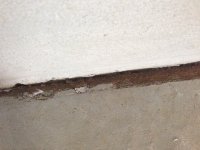
For those interested, the Sika comes in either a medium gray or a beige color. The gray is close to the medium gray from Epoxy-Coat, just a little lighter shade (no not light gray or dark gray epoxy-coat, but would also work with those). Goes nicely with my medium gray and flakes basecoat and looks like an accent or trim line around the edge. If I put real trim on the floor edge later with the wall, it would cover up most of the width of the expansion joints anyway and sit above the Sika just fine. It looks so nice though, I don't think I'll bother with trim after doing it.
ZMW, on the Sika, it will go though and down any crack/hole available to it, so you have to have a "sealed" joint floor under it or you'll end up using much more of it than you want to. You should be fine on yours if you use the foam backer rod, except for the very ends of it. On mine, without any backer rod, I just ran a small bead of normal silicone caulk on the front and rear of the joint at the edges of the fiber material before the Sika to just seal the joint floor under it and any little cracks/holes there. After dry, apply the sika and it will fill in the top of the joint. It doesn't shrink, so fill it carefully right to the top of the joint to be level with the floor. If your floor is not perfectly flat, you may have to first underfill to cover the whole joint on the floor, then come back later on and re-fill again those parts too low. If you tried to fill to the top all at once with a non-perfectly flat floor, you would "flood" over the top in the lower areas because the Sika self levels really good to be flat. So do it gradually to find the top of it before doing more. You can do multiple steps with Sika. The 2nd/3rd application will just blend with the earlier lower ones just fine. Just use a little putty knife/spreader on the two ends slightly to mate with the previous layer and blend well there. Maybe 8 hours or so between applications if you do this. You can also cut/trim the top of the sika when dry to perfectly match an uneven floor, but I did not do this or need to and got within a mm or 1/16" inch with mine easily on height.
ZMW, you have already chiselled/cut out enough of your fiber joint filler material to use Sika, but for those facing this with a joint right at the wall like mine, how to cut it out easily and quickly? I used a vibrating multi-tool with wood cutting bit, but you *can't* hold this such that you can cut the whole width of the fiber filler material due to being too close to the wall to get the tool there. What to do? I custom bent about 45 degrees *backwards and down* one of the metal wood cutting blades, then I can go from above the filler material towards me and down and away from the wall to get that half of the filler material to cut. The vibration of the tool cuts in this backwards direction just like the forwards direction and goes gradually so this is very safe to do with a vibrating multi-tool. This way, you can easily cut out 1/2" of the top of the filler material out without doing time consuming chiseling or similar methods. If you end up hitting the cement alot with the wood cutting blade, you may end up grinding off the kerf of the blade. If so, you can restore a needed kerf by just using a dremel with a square grinding bit on the end of the wood cutting blade and cut some little teeth back into it in a minute or two. I did this a couple times and worked fine. You can also put a diamond coated tool on the end of these and do fine scuffing/grinding or trimming of cement as needed for small areas. This is another option to handle small/tight grinding instead of a dremel. Either can work for that and work a little differently. I had some uneven spots in my expansion joints and i used this to *smooth* the edge so the expansion joint edge to the epoxy was nice and straight. Harder to do that with a dremel. Every home owner needs one of these multi-tools! Super cheap one is like $16 at Harbor Freight on sale! I got a deal on a cheap one at Menards a couple years back. Works like a champ. Great for drywall cutting/trimming/fitting jobs too. - Paul