To avoid these ads, REGISTER NOW!

Xps board for under concrete slab

hockey88fan

Well-known member
Joined
May 25, 2011
Messages
428
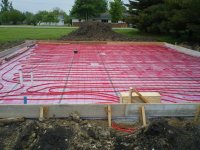
Hi all, been driving myself crazy searching for info on the xps insulation board I should use under the concrete pour for my garage floor thought I'd look for some input here. I'm going to install pex tubing so I can have radiant heat in the garage, it calls for 2" xps board under the pour for insulation. The cheapest I found was at HD, it's Owens corning at $25 per 4x8 sheet. Thing is the 2" has a psi rating of 15, the 1" has a psi of 25. I'd like to use the 2" for the insulating properties, question is is the 15psi strong enough for under a 4" concrete pour? Looking at the description it does it is approved for use under concrete floors. Also, the installation instructions say to run the insulation along the perimeter so heat doesn't escape, but then how do you finish the concrete to the edge of the wall? If the slab is 4" do you just run the insulation up the side to 3" then pour over it so you don't see the foam board all along the perimeter when the pour is complete? Or would the edges crack off with having only a 1" thick concrete along the edge? Like I said I'm driving myself crazy trying to figure this stuff out, thanks for info!!!
 
To avoid these ads, REGISTER NOW!

CADPoint

Well-known member
Joined
Jan 31, 2011
Messages
155
Location
WSW of **** City
In most cases the heating coils are in the slab. One does not put concrete on foam board or visa versa.

There's various resources out on the Web that can be used as to the aspects you think your using or determine to exactly what you need as an applicaition!

JMHO
 
Last edited:
OP
H

hockey88fan

Well-known member
Joined
May 25, 2011
Messages
428
In most cases the heating coils are in the slab. One does not put concrete on foam board or visa versa.

There's various resources out on the Web that can be used as to the aspects you think your using or determine to exactly what you need as an applicaition!

JMHO

4" stone base, then 6 mil vapor barrier, then 2" foam insulation, then wire mesh, then pex, then pour
 

Possum

Well-known member
Joined
Dec 10, 2008
Messages
302
Location
KS
Chances are if you find a commercial building suppler that carries XPS; they will have the 25 PSI stuff cheaper than the big box stores.
 

JaxGarage

Active member
Joined
May 15, 2011
Messages
30
I've heard the 2" foam breaks/cracks real easy when walking on it. Is this true or are these people just trying to sell me the insultarp
 

stingry

Well-known member
Joined
Oct 14, 2006
Messages
732
Location
Western Nebraska
I've heard the 2" foam breaks/cracks real easy when walking on it. Is this true or are these people just trying to sell me the insultarp

Not the EPS (extruded polystyrene) made for underslab installation. It is fairly tough and isn't affected by walking on at all. I'm guessing what they are telling you is just a sales pitch. EPS is the best product for underslab insulation, IMHO!

Cheers
Steve
 

tdkkart

Well-known member
Joined
Jun 17, 2006
Messages
6,887
Location
Eastern Iowa
I've heard the 2" foam breaks/cracks real easy when walking on it. Is this true or are these people just trying to sell me the insultarp

If your foam board cracks as you're walking on it your base is not as flat or compacted as it should be. Blaming this on the foam board is like blaming the paint when it peels off an unprimed surface.
 

JaxGarage

Active member
Joined
May 15, 2011
Messages
30
I think you meant XPS and not EPS. XPS is apparently much stronger than EPS ( Expanded Polystyrene).
 

JaxGarage

Active member
Joined
May 15, 2011
Messages
30
Would anybody recommend the c-200 foamular which has a 20psi rating or should the 30psi rating by used.
 

tmars

Active member
Joined
Jan 27, 2011
Messages
33
Location
Central Illinois
Here's what I just did, it is 25psi. It did seem odd to pour a foundation, put insulation down and pour 5 inches of concrete on top. It does create a thermal break, so far no cracks....


100_0499.jpg

DSC00045.jpg

DSC00063.jpg
 

50cal

Well-known member
Joined
Sep 20, 2009
Messages
100
Your local contractor supply store will maybe save you a couple dollars per sheet. Definately use a good vaper barrier and tape the seams.The supply store will have the tape. If you have footings ,sounds like they are already poured. On my footings we lined the interior dirt wall with 2 inch and poured the footings then poured a short 8 inch stub wall with dowels and rebar in it for the steel to sit on. then I placed 1 1/2 inch vertical on the stub wall before pouring the floor. You can see the 1 1/2 but I plan to finish so it will be covered eventually. You need that thermal break just dont run it passed your door openings. you could even go narrower 3/4 passed the door openings and gouge it out alittle bit and use some of that flowing caulk made just for that purpose. Again to be found at supply store.
 
Last edited:

jsmith6752

Well-known member
Joined
Oct 11, 2010
Messages
67
Location
Southeastern PA.
As mentioned above you will be putting cement on foam board. Unless I am missing some thing the cement will be on the foam then the wire and the pex. Is this not correct?
 

JaxGarage

Active member
Joined
May 15, 2011
Messages
30
Here's what I just did, it is 25psi. It did seem odd to pour a foundation, put insulation down and pour 5 inches of concrete on top. It does create a thermal break, so far no cracks....


100_0499.jpg

DSC00045.jpg

DSC00063.jpg

Around here all there are telling me they have is the 20 psi or the 30psi in the pink xps.
 

tmars

Active member
Joined
Jan 27, 2011
Messages
33
Location
Central Illinois
I got it at Menards was like $28 a sheet. I put the insulation down, stapled the pex to it and then laid wire mesh over it all. It worked for me so far
 

Highbeam

Well-known member
Joined
Feb 15, 2011
Messages
2,292
Location
Mt Rainier foothills, WA
As far as the vertical form insulation. You don't want to look at the foam or expose it to chemicals, UV etc. What you do is cut the top of the foam at a 45 degree angle so the foam is full height at the wall and 2 inches below the concrete as you move from the wall. You do this on a table saw or with a circular saw. This way you get foam up to the top, minimal chance of cracking, and cover the foam. You end up sliding your screed on the top of that foam so a small 1/4" or so horizontal exposure is nice.
 

leeklm

Well-known member
Joined
Jul 15, 2011
Messages
72
Location
Minneapolis
I paid $20 per sheet for#250 2" pink stuff at Menards, spent about $1K for 1,300 sq ft garage including perimeter. I have yet to install around the perimeter of my slab, which has 8" block on top. I am digging a trench about 18" below the bottom of slab, and running the foam up to the osb wall (which is 36" total). I am not sure how much it will help going 18" below the slab, but should help keep the frost out.
 
Last edited:
To avoid these ads, REGISTER NOW!

Highbeam

Well-known member
Joined
Feb 15, 2011
Messages
2,292
Location
Mt Rainier foothills, WA
6" concrete slab only weighs 0.52 psi. The required strength rating of your foam is determined by what you put on the slab. 15psi rated EPS can handle the weight of 14.4 feet of concrete at less than 1% deflection. It is not the weak link.

Major loads can be placed on a 6" slab over 15 psi EPS without failure. You do NOT need 25 psi foam. You should be more worried about concrete failure.
 

UpstateNY

Well-known member
Joined
Jan 2, 2012
Messages
662
Sorry to dredge this up, but could someone with experinece please comment:

30' x 40' build: Installing a 15 mil vapor barrier on top of 18-24" crusher run base, then Dow XPS blue board, rated 25 PSI. Above that will be the 6" x 6" mesh, then the 1/2" Pex affixed to that. Above that 5" 4,000 PSI fiber reinforce concrete. Atop that will be a Bendpak 10k car lift. It'll at most be used to lift a 1/2 ton pickup, or circa 6,000 lbs

My question is: is the 25 PSI XPS foam board truly enough ? I called Dow and they told me that the XPS is de-rated based on the number of "cycles" it's subjected to. 1 cycle is a car driving on and off it.

Has anyone used the 25 PSI Dow blue board in a radiant heat application with a car lift for any # of years, no issues ? How thick were/are your floors ? Are they fiber re-inforce ?

I know they make the 40 PSI product but it seems it's hard to find and more pricey.
 

rburke65

Well-known member
Joined
Nov 10, 2007
Messages
12,349
Location
Canfield, Ohio
You could do a search on this forum for TONS of info. This has been talked about "six ways to Tuesday". You could read for a month. I used EPS....approx. 15psi. Your money.....
 

SiGmA_X

Well-known member
Joined
Aug 13, 2005
Messages
1,111
Location
Portland, OR
Sorry to dredge this up, but could someone with experinece please comment:

30' x 40' build: Installing a 15 mil vapor barrier on top of 18-24" crusher run base, then Dow XPS blue board, rated 25 PSI. Above that will be the 6" x 6" mesh, then the 1/2" Pex affixed to that. Above that 5" 4,000 PSI fiber reinforce concrete. Atop that will be a Bendpak 10k car lift. It'll at most be used to lift a 1/2 ton pickup, or circa 6,000 lbs

My question is: is the 25 PSI XPS foam board truly enough ? I called Dow and they told me that the XPS is de-rated based on the number of "cycles" it's subjected to. 1 cycle is a car driving on and off it.

Has anyone used the 25 PSI Dow blue board in a radiant heat application with a car lift for any # of years, no issues ? How thick were/are your floors ? Are they fiber re-inforce ?

I know they make the 40 PSI product but it seems it's hard to find and more pricey.
Dude, search. Come on now. However, there are tons of builds on this forum with exactly what you want - car lifts, and XPS. And car lifts and EPS. IMO, go with EPS, for all the reasons Highbeam has outlined here and elsewhere.

Also, if it were my slab, I would run rebar instead of mesh. I would do rebar for the whole slab, but if you're looking to save money, just do rebar around the lift area.

Make sure the type of fiber you use isn't the type that leaves a crappy floor surface, unless you're planning to grind and epoxy. Fiber has come a long way in recent history, but a lot of times leave less than desirable surface finishes.
 

UpstateNY

Well-known member
Joined
Jan 2, 2012
Messages
662
You could do a search on this forum for TONS of info. This has been talked about "six ways to Tuesday". You could read for a month. I used EPS....approx. 15psi. Your money.....

I did search, a lot. You'd be wrong if you think there's a difinitive answer on this board to the grade of blueboard to use. Standard is 25 PSI, but Dow makes 40,60 and 100 PSI for a reason. I assume your 15 PSI worked well for you, that's the kind of info I needed, real-world feedback backed by time and the lack of problems post install.
 
Last edited:

SiGmA_X

Well-known member
Joined
Aug 13, 2005
Messages
1,111
Location
Portland, OR
I did search, a lot. You'd be wrong if you think there's a difinitive answer on this board to the grade of blueboard to use. Standard is 25 PSI, but Dow makes 40,60 and 100 PSI for a reason. I assume your 15 PSI worked well for you, that's the kind of info I needed, real-world feedback backed by time and the lack of problems post install.
I haven't seen much discussion (any? Edit: I am aware it exists, my folks have been in contact w multiple manufactures for a remodel/slab/etc and I've read extensive notes from the various contractors and manufactures. Should be noted all contractors said 25psi is overkill but what they usually use, not that contractors are a source of 'correct' info, but rather practical experience.) of XPS over 25psi. Most discussion is 15-25psi. The reason is that concrete is not that heavy per inch - Like Highbeam said, in the range of half a pound per square inch for 6" of concrete. Due to the rigidity of concrete, it spreads weight out over a larger area than you're making contact with on the surface. Unless you are using some equipment that may require a 24" 4500psi slab with #6 every foot (100k+ lb machine that uses only a dozen or so levelers), you will be absolutely fine.

I have read of zero settling/compression problems due to 15psi EPS, let alone 25psi XPS. You're going to be good to go!
 
Last edited:

MScott

Well-known member
Joined
Jun 30, 2009
Messages
1,616
Location
Eastern Ontario
Be aware that, unless you use stands, mesh placed under the pex will probably end up right at the bottom of the concrete and will add absolutely nothing to the strength of the slab. I placed my mesh on top of the pex to ensure it is within the bottom third of the slab where it will do the most good.
 

BadgerBoilerMN

Well-known member
Joined
Aug 4, 2011
Messages
837
Location
Minneapolis
First, 4-6" of Class-5 crushed stone compacted smooth, then 6mil vapor retarder, 2" of 25psi extruded (XPS) or expanded (EPS) followed by PEX stapled to the foam and wire over all. The edge of the slab must be insulated by one of various methods common to the industry.

Your designer/supplier should have made all of this clear to you.
 

Highbeam

Well-known member
Joined
Feb 15, 2011
Messages
2,292
Location
Mt Rainier foothills, WA
First, 4-6" of Class-5 crushed stone compacted smooth, then 6mil vapor retarder, 2" of 25psi extruded (XPS) or expanded (EPS) followed by PEX stapled to the foam and wire over all. The edge of the slab must be insulated by one of various methods common to the industry.

Your designer/supplier should have made all of this clear to you.

This is really the best summary for the huge majority of residential garage installations.
 

UpstateNY

Well-known member
Joined
Jan 2, 2012
Messages
662
First, 4-6" of Class-5 crushed stone compacted smooth, then 6mil vapor retarder, 2" of 25psi extruded (XPS) or expanded (EPS) followed by PEX stapled to the foam and wire over all. The edge of the slab must be insulated by one of various methods common to the industry.

Your designer/supplier should have made all of this clear to you.

Badger and all,

I'm the designer :lol_hitti .

But thank you very much for allying my concerns regarding use of 25 PSI XPS. From reading other posts, I know that you, Badger, are the subject matter expert on this topic, so your opinion is highly valued.

And thanks for the wire-over-pex idea. I know that has been hotly debated on these boards (that mesh goes first, then pex on top), but getting the mesh into the concete by installing it on top of the Pex makes so much sense to me. As long as stepping on the mesh during the pour does not damage the 1/2" Pex, but my understanding is that Pex is tough as nails and either way, the Pex and mesh might get stepped on anyways.
 
Last edited:

BadgerBoilerMN

Well-known member
Joined
Aug 4, 2011
Messages
837
Location
Minneapolis
There is no debate, among knowledgeable people, about where reinforcing wire goes in a slab. PEX is not afraid of anything but fire and sharp objects.
 

ksj9393

Well-known member
Joined
Jul 5, 2011
Messages
162
Location
Minnesota
Agree with others in the sequencing of layers. Here in MN by the Mississippi River, radon gas is an issue. Local code requires "radon rock" beneath the gas impermeable 6 mil polyethylene sheeting. For me, that was the real issue. How do you compact 3/4" rounded river rock?

As for the foam, I think it matters not whether you use 15 psi or 25 psi foam beneath your slab. I went cheap, and used 2" Foamular 150. My reasoning was simple. Any point load on the surface of the concrete gets distributed to an area beneath roughly equal to the area of the base of a cone with 45 degree slope... in other words, for my 5" thick concrete floor, a point load on the surface gets distributed over an area of almost 80 square inches. Furthermore, since concrete doesn't flex, the load is actually distributed over a MUCH larger area. But even if we ignored this fact, 15psi foam will not depress until I exceed a 1180 lb point load at the slab surface.

Plus, because of the requirement for the "radon rock" the layer beneath my foam isn't likely to even be this supportive. Even considering the native earth beneath my rock layer, I figured it was 2000 PSF dirt (typical for clay/loam mix). This is the same as 14 psi - or less than the cheap 15psi foam. So my advice? Spend your $ on what matters... THICKER foam!!
 

BadgerBoilerMN

Well-known member
Joined
Aug 4, 2011
Messages
837
Location
Minneapolis
15psi is certainly adequate. As for "radon rock" this is new to me, here in MN. I don't think anyone is paying attention. Nor can I comprehend why you would use anything but Class 5 but a vapor retarder and adequate ventilation should certainly allay any threat, real or imagined, from radon.

Most of these building are not living spaces nor occupied for significant amounts of time. We install many basement radiant heating systems and incorporate passive radon below the vapor retarding plastic and XPS.

http://www.engr.psu.edu/phrc/training/Building with Exterior Rigid Foam.pdf

Thicker foam at the perimeter perhaps, but more than R-10 in most of N.America is money ill-spent. The roof and the perimeter of the slab are the highest load areas.
 

Highbeam

Well-known member
Joined
Feb 15, 2011
Messages
2,292
Location
Mt Rainier foothills, WA
Agree with others in the sequencing of layers. Here in MN by the Mississippi River, radon gas is an issue. Local code requires "radon rock" beneath the gas impermeable 6 mil polyethylene sheeting. For me, that was the real issue. How do you compact 3/4" rounded river rock?

As for the foam, I think it matters not whether you use 15 psi or 25 psi foam beneath your slab. I went cheap, and used 2" Foamular 150. My reasoning was simple. Any point load on the surface of the concrete gets distributed to an area beneath roughly equal to the area of the base of a cone with 45 degree slope... in other words, for my 5" thick concrete floor, a point load on the surface gets distributed over an area of almost 80 square inches. Furthermore, since concrete doesn't flex, the load is actually distributed over a MUCH larger area. But even if we ignored this fact, 15psi foam will not depress until I exceed a 1180 lb point load at the slab surface.

Plus, because of the requirement for the "radon rock" the layer beneath my foam isn't likely to even be this supportive. Even considering the native earth beneath my rock layer, I figured it was 2000 PSF dirt (typical for clay/loam mix). This is the same as 14 psi - or less than the cheap 15psi foam. So my advice? Spend your $ on what matters... THICKER foam!!

I'm with you except for a couple of things. Probably just to clarify or expand on your thoughts...

The cone you speak of which distributes the point load is what would happen if the concrete were not rigid or not even there and instead gravel were installed on top of the foam. Rigid concrete does a great job of disributing load across a large area which is a large part of the reason that we use it. Ruts in roads don't happen with concrete because of the rigid pavement. Just know that it is much better than you think.

The money you save on foam shouldn't be spent on more foam. There are much better places to spend the money.
 

shelbyz28

Well-known member
Joined
Dec 27, 2012
Messages
71
Location
Central Iowa
So practically speaking, will 15 psi XPS generally hold up during the construction phase? My main concern about needing to spend the extra $250 (on sale at Menards now, 2240 ft^2) is to reduce the damage induced from placing pex, rebar and concrete. Maybe that's cheap peace of mind, but hey, $250 is $250...
 

Highbeam

Well-known member
Joined
Feb 15, 2011
Messages
2,292
Location
Mt Rainier foothills, WA
So practically speaking, will 15 psi XPS generally hold up during the construction phase? My main concern about needing to spend the extra $250 (on sale at Menards now, 2240 ft^2) is to reduce the damage induced from placing pex, rebar and concrete. Maybe that's cheap peace of mind, but hey, $250 is $250...

Of course it will hold up. Really though, what are you afraid will happen? Even if the sheet breaks, it won't float away in the concrete. Little dents from somebody dropping a hammer? None of that matters when you are putting 4-6" of concrete on top.
 

BadgerBoilerMN

Well-known member
Joined
Aug 4, 2011
Messages
837
Location
Minneapolis
We use 25# XPS for commercial garages and on some of our driveway snow melting systems where the local garbage truck, city plow and God knows whatever may happen by. Still more than enough.
 
To avoid these ads, REGISTER NOW!
Top Bottom