To avoid these ads, REGISTER NOW!

Retaining wall placement for grade

scootermcrad

Well-known member
Joined
Nov 26, 2011
Messages
405
Location
Concord, NC
Hey guys! I could use a little help from anyone with knowledge of retaining wall placement relative to a structure.

We're doing some lot layout planning for our property. We're going to be building a somewhat substantial and much needed garage/shop. We know almost to the foot where this thing is going to be and have a real good idea what it will look like dimensionally and structurally (framing wise). With that, we know we will also have to level out the grade a bit and do some back filling, which we are entirely cool with, since it will bring some great character to the lawn and lot.

We're figuring that where the garage will be placed, we will need a retaining wall approximately 5-foot at it's tallest point to bring the building location up to level grade and this will taper to zero gradually over about 60 feet from the front of the garage and again about 40 feet from the north face of the garage. Southwest corner being the tallest/deepest point. (yard slopes away from south to west)

We're a couple years away from putting down a slab for this structure ($$$), but in the mean time we would like to work on getting the grade how it needs to be so construction can start when we're ready as well as get the rest of the property laid out.

What I need to know is, how do I figure out how far the retaining wall needs to be from the slab to handle the soil pressure. Can anyone give me an idea how to figure this out? From there I can figure out what I need for blocking, fill, gravel, drainage, etc...

We are planning on using the Pavestone style interlocking retaining wall systems like these:
http://www.pavestone.com/content/product-types/retaining-wall-systems/

PAVESTONE_WALLS_DiaProStnCut_Buff_BTYa.jpg


Any help you guys could offer to help figure this out, would be appreciated so we can get our ducks in a row and start getting people out to talk to us about any work we don't do ourselves.

Here's some crude sketches...

This would be the south facing side of the garage showing sort of how the elevation would look. Hope it makes sense.

a8668804-03f1-4569-9442-bb974c992602_zpsf6638424.jpg


And here's how the top and east-facing elevation would look (east side is the entry side of the garage)

d8316f6f-5c4d-4eac-8be0-6a929b880205_zpsb7c51f43.jpg
 
Last edited:
To avoid these ads, REGISTER NOW!

Old Moparz

Well-known member
Joined
Jan 21, 2005
Messages
1,171
Location
Newburgh, NY 12550
Can't help you with your exact question, but depending on the type of wall & the soil conditions you have you can probably build a retaining wall just about anywhere you choose. The type of wall will be a factor but there are several different methods to install each type. Modular unit walls (individual concrete blocks in different sizes) can be built to a certain height without reinforcement. Once you get to a certain height, usually 5 feet, some type of soil reinforcement is necessary. This can be fabric or a plastic geogrid installed in horizontal layers. It uses the blocks & the soil to hold the top of the wall back against the slope.

Those layers will need to go back, away from the wall & into the slope. The slope is filled on top of however many layers you need. This also needs to be a minimum distance based on the height of the wall. In all of the site improvement plans I get at work, I haven't seen a layer of reinforcement go beyond 15 feet & that was for a wall that had several tiers & over 10 to 15 feet high. There are methods of reinforcement to make that distance less but it'll need to be engineered.

About 17 years ago I did exactly what you are currently planning. My backyard had a change in elevation of about 5 feet over a distance of about 45 to 50 feet. My garage is a pole building & I needed to either bring in fill & grade the site on a gradual slope, or build the wall to use a lot less fill. I didn't want a long slope since I have no flat areas on my property at all so I chose to build the wall. I ended up using about 140 CY of gravel & a item 4 under the slab. My retaining wall is a timber crib wall & hasn't moved in the 17 years it's been up. The garage hasn't budged either. The side retaining wall is 8 feet from left wall of the garage & the rear retaining wall is 4 feet from rear wall of the garage.

I never gave thought to engineering the fill placement & simply compacted it in layers as I went. It also sat for close to a year & settled before the slab was poured. The only thing I wished I would have done differently is to build the wall to at least 12 feet away so I could fit the trailer I have now adjacent to the garage.


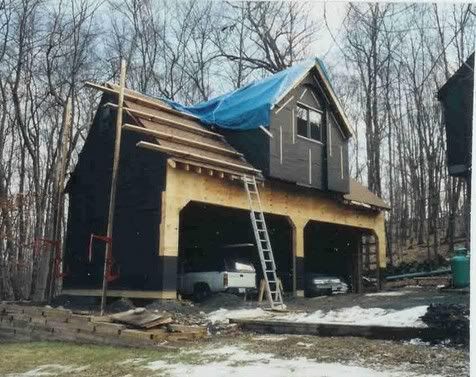
My garage under construction.....
Garage1997B.jpg


Timber Crib Wall (Not Mine).....
TreatedCribWall01.jpg


Found a drawing of the geogrid.....
grid-reinforcement2_zps9adf4b71.jpg
 
Last edited:

csp

Well-known member
Joined
Mar 23, 2010
Messages
5,720
Location
Franktown, CO
Any wall over 3' tall really should be engineered and your engineer will take into account your soil conditions and loads it will see.
 
OP
S

scootermcrad

Well-known member
Joined
Nov 26, 2011
Messages
405
Location
Concord, NC
Any wall over 3' tall really should be engineered and your engineer will take into account your soil conditions and loads it will see.

Good to know! Thanks!

I'm new to this type of thing. We were thinking that we may possibly take on the wall ourselves, but starting to re-think that idea. :scared:
 

Old Moparz

Well-known member
Joined
Jan 21, 2005
Messages
1,171
Location
Newburgh, NY 12550
Something else to consider doing is what I have seen done on the site plans I get at work to save money. In your case, you need a 5 foot high wall to get a flat area between the top of the wall & the building. If you don't need it to be flat you can build a shorter wall, say 3 feet & slope the remaining area. An advantage to this is that it also creates positive drainage away from the building. I pitched mine about 6" to 9" downward over the 8 feet & didn't build the wall as high as the finished floor of the garage.
 
OP
S

scootermcrad

Well-known member
Joined
Nov 26, 2011
Messages
405
Location
Concord, NC
Something else to consider doing is what I have seen done on the site plans I get at work to save money. In your case, you need a 5 foot high wall to get a flat area between the top of the wall & the building. If you don't need it to be flat you can build a shorter wall, say 3 feet & slope the remaining area. An advantage to this is that it also creates positive drainage away from the building. I pitched mine about 6" to 9" downward over the 8 feet & didn't build the wall as high as the finished floor of the garage.

Now that's good thinking! :thumbup: And with the amount of rain we get around here, that is definitely something to consider!

I plan on putting any A/C equipment (if I take it that far) and possibly the air compressor with weather provisions in the strip between the garage and the retaining wall. So I know I will need a minimum of 4 to 5 feet distance just for those items to be installed.
 

theoldwizard1

Well-known member
Joined
Feb 22, 2011
Messages
43,216
Location
SE MI
Any wall over 3' tall really should be engineered and your engineer will take into account your soil conditions and loads it will see.

Well, I would not say "any", but if you are going to put a structure on top of it, I would definitely get it engineered !

Good to know! Thanks!

I'm new to this type of thing. We were thinking that we may possibly take on the wall ourselves, but starting to re-think that idea. :scared:

Pay for the plans but not until your local building department approves them.

This still a DIY job, if you have enough time and muscle and can follow the plans. Backfill, drainage, type of deadman and proper compaction are all critical for a wall to having a long life.
 

RickP

Well-known member
Joined
Jan 15, 2013
Messages
1,552
Location
Annapolis, MD
Any wall over 3' tall really should be engineered and your engineer will take into account your soil conditions and loads it will see.

+1 on the engineer. My neighbor had a retaining wall installed professionally, but didn't get an engineer to look at it. It's supporting the edge of the driveway and has been slowly failing in the past five years. The wall contractor and the driveway contractor both point the finger at each other, and the homeowner is left paying to fix it. If you can shorten the wall to 3 feet, you should be okay, but make sure you still reinforce it somehow.

I helped my Dad reinforce a 5' wall in 1979 that is still standing today. We buried treated 4x4s horizontally behind the wall and drove re-bar vertically down through the back end of each 4x4. Geogrid fabric would be easier, but only if it's all fill behind the wall.
 

jhelrey

Well-known member
Joined
Sep 15, 2010
Messages
7,253
Location
MN
Could always go bigger block or pour a solid concrete wall and veneer it with stone.
 

WNYflyer

Well-known member
Joined
Sep 13, 2009
Messages
2,120
Location
Lockport, NY
Well to locate the wall such that the garage foundation or pavement loading will have no affect on the retaining wall, then:

-Strike a horizontal line at the elevation of the bottom of the garage footer

-Strike a vertical line at the exterior edge of the garage footer

-At the point those two lines cross then strike a 45 degree line downwards toward the garage side face of the retaining wall. Make sure your garage side face of the retaining wall falls outside that 45 degree "influence" line. That should get you in the ball park at least.

-For the edge of pavement do the same thing, edge of pavement vertical, bottom of pavement horizontal then a 45 degree line towards the retaining wall. Of course over time many people end up paving right up to retaining wall what with the garage so close to begin with. So keep in mind the future and possble future owner.

-Now if any of the retaining wall face falls within those 45 degree lines then you have to account for the additional lateral load on the wall caused by the vertical load from the garage footer and pavement.

Quick and dirty like I said what with typically many variables not known but a good starting point for layout purposes. I even noticed that your North Carolina Residentail Building Code eliminated there reference to similar situations. Probably trying to limit there own risk.

Hope it helps some.
 
Last edited:

where2

Well-known member
Joined
Dec 12, 2010
Messages
772
Location
South FL
FWIW, you can pay an engineer to engineer systems, and still build things yourself to the engineer's plans. Paying an engineer to design something does not necessarily mean you have to pay a contractor to build it. I just got my final inspections yesterday on a structurally engineered system with design wind load rating of 170mph (no, that wasn't a typo, it said 170). Installed the whole PV system without a contractor, and had the local structural and electrical inspectors both ask me if I would please teach the local PV contractors how to install something as neatly and well thought out as my system.

I've hired a contractor and friends who have been in construction for 20+ years and had to tell them to look at the engineer's plans again and add more nails to a window header that the engineer clearly spelled out the minimum nail spacing on... No contractor gets up in the morning wanting to fail an inspection. They want to pass their inspections, get paid, and get on to the next job. I've found the easiest way to pass inspections is to follow the engineer's drawings, and when in doubt: Ask! My inspectors will gladly express their opinion on what they want to see, if I ask for their opinion, especially if I ask before I go and make up my own way...
 
To avoid these ads, REGISTER NOW!

nolimits76

Well-known member
Joined
Jul 11, 2013
Messages
959
Location
Oklahoma
Could always go bigger block or pour a solid concrete wall and veneer it with stone.

If you decide to do a cast-in-place (CIP) wall, a cheaper and easier solution than veneer is to use a form liner and stamp the concrete. Ashlar stone is a popular style we use on DOT projects around here. There are 2 types of forms, a cheaper 1 (maybe 2 or 3) use liner and a more expensive rubber liner that can be used multiple times. I'd do the cheaper version for your project, or consider renting from a local supply house. Last project we got quoted around $3.5/sf to purchase the cheaper version.

Here is an example of what I'm talking about (not our project):

11019-ashlar-formliner-001.jpg


FWIW, you can pay an engineer to engineer systems, and still build things yourself to the engineer's plans.

I've found the easiest way to pass inspections is to follow the engineer's drawings, and when in doubt: Ask! My inspectors will gladly express their opinion on what they want to see, if I ask for their opinion, especially if I ask before I go and make up my own way...

You are correct about this. Nothing to prevent a person from getting an engineered system and self-installing. FYI, many times a supplier (especially retaining wall systems) have in-house engineers that will gladly engineer and stamp a project for you so you buy their materials. We do this all the time on our DOT projects. Even if you can't get it for free, it's worth the money to know it's right.

In regards to the inspections and all that jazz, it sounds like where2 lives in an area where inspectors are involved and want to really help. I live in an area where they are either a PITA and fail you on everything or have no concern at all and barely looks before giving you the green stamp. No digs intended. Just saying take the inspectors with a grain of salt as your mileage may vary considerably.

One last thought I'll leave you with is the use of a precast wall. It's called verticrete around here. Downside is you need cranes or heavy equipment (depending on size/weight) to place the wall panels. Below is a link to some examples of a supplier we have used. They are very good and well respected. They also have a recon wall system like you originally started asking about.

http://www.arrowheadprecast.com/product-gallery/arrowhead-precast-products/recon-retaining-wall
 
OP
S

scootermcrad

Well-known member
Joined
Nov 26, 2011
Messages
405
Location
Concord, NC
Well to locate the wall such that the garage foundation or pavement loading will have no affect on the retaining wall, then:

-Strike a horizontal line at the elevation of the bottom of the garage footer

-Strike a vertical line at the exterior edge of the garage footer

-At the point those two lines cross then strike a 45 degree line downwards toward the garage side face of the retaining wall. Make sure your garage side face of the retaining wall falls outside that 45 degree "influence" line. That should get you in the ball park at least.

-For the edge of pavement do the same thing, edge of pavement vertical, bottom of pavement horizontal then a 45 degree line towards the retaining wall. Of course over time many people end up paving right up to retaining wall what with the garage so close to begin with. So keep in mind the future and possble future owner.

-Now if any of the retaining wall face falls within those 45 degree lines then you have to account for the additional lateral load on the wall caused by the vertical load from the garage footer and pavement.

Quick and dirty like I said what with typically many variables not known but a good starting point for layout purposes. I even noticed that your North Carolina Residentail Building Code eliminated there reference to similar situations. Probably trying to limit there own risk.

Hope it helps some.

That REEEEAAAAALLY helps! Thank you sir!! That's the sort of "ball park" answer I was looking for. I was sort of thinking it would be something like that, but I didn't want to make that assumption.

WOW! You guys are awesome! This is some really great information. I'm learning a ton in this thread. The additional options are nice to know about, as well. Those stamped form liners look great.

Has anyone here used the interlocking style systems like Pavestone and various other companies offer? Are they worth dealing with? I've been leaning that direction simply because I like the look of them and like that I don't have to invite a concrete truck out to the site. I have an old asphalt drive that will just disintegrate with the weight of one of those trucks, so I would like to wait to destroy the drive until I have the slab poured. :D HAHA!

Just so happens I'm lucky enough to have Pavestone RIGHT NEXT DOOR from where I work now. I will run next door and get some information on their products as well as see if they have an Engineer in-house that could do the required planning.

I'm going to get down to business and do some layout for the garage and then get a ball-park location of the wall and survey it out to get the ACTUAL height of the grade. I think 5 feet will be the max height of the wall, but could be realistically closer to 4 feet max when all is said and done. I'm planning for the worst case, though.

Fantastic information guys! If anyone has experience with any particular type of wall system, please share your experiences. Especially from a DIY standpoint.

Thanks folks!
 
OP
S

scootermcrad

Well-known member
Joined
Nov 26, 2011
Messages
405
Location
Concord, NC
For curiosity sake, I went next door to Pavestone, real quick. The lady wasn't a big help, since they don't really do any sales to the public directly out of the manufacturing plant, but I did ask if they had an engineer on-staff and was surprised to hear that they do not. Hmmm... That was sort of unexpected. BUT! The lady and I were talking and she said that they call for 4-feet as maximum height without engineering drawings. I'm going to verify that with my local code, though.

Now. With all that being said, since we're talking about a significant structure that will be built above the retaining wall, I would still have it engineered, and I'm sure an inspector and code enforcement would be interested in all the engineered drawings as well.

This is all new to me. This is going to be a good learning experience...
 

wssix99

Well-known member
Joined
Mar 2, 2011
Messages
5,161
Location
Chicago, IL
in the mean time we would like to work on getting the grade how it needs to be so construction can start when we're ready as well as get the rest of the property laid out.

Are you talking about grading all the way down to where the foundations will sit? If so, I would caution against this until you are ready to pour the foundation walls. If you remove some of the overburden that's there now, you could loosen up the soil where you want your foundations to go and create a need to dig down further in the future for the foundations.


What I need to know is, how do I figure out how far the retaining wall needs to be from the slab to handle the soil pressure. Can anyone give me an idea how to figure this out? From there I can figure out what I need for blocking, fill, gravel, drainage, etc...

Soil pressures aren't typically a worry with walls of this size. Its all water pressure. If you think about it, you can pile dirt 10 feet high and it won't move much. The grains of the dirt interlock and provide support to surrounding areas. Its the water that flows freely in the dirt the creates the problematic pressure on the wall.

So, a durable retaining wall will always have fill and drainage requirements to move water away from the wall. Since you are so close to your foundation, its probably best for your engineer to work the retaining wall design in to your foundation wall and drainage design when that is done.


We are planning on using the Pavestone style interlocking retaining wall systems like these:
http://www.pavestone.com/content/product-types/retaining-wall-systems/

In the technical documents section of the Pavestone web site, under CAD Details, they have some documents that show the type of gravel fill, geotextiles, and drainage that you will need to install behind the product. Your engineer should be able to utilized these per-engineered details so they don't have to go back and reinvent the wheel.


Another thing to consider would be if your local code requires you to put a railing or fence at the top of the foundation wall. If so, that would be another feature to design in.
 
OP
S

scootermcrad

Well-known member
Joined
Nov 26, 2011
Messages
405
Location
Concord, NC
Are you talking about grading all the way down to where the foundations will sit? If so, I would caution against this until you are ready to pour the foundation walls. If you remove some of the overburden that's there now, you could loosen up the soil where you want your foundations to go and create a need to dig down further in the future for the foundations.

Soil pressures aren't typically a worry with walls of this size. Its all water pressure. If you think about it, you can pile dirt 10 feet high and it won't move much. The grains of the dirt interlock and provide support to surrounding areas. Its the water that flows freely in the dirt the creates the problematic pressure on the wall.

So, a durable retaining wall will always have fill and drainage requirements to move water away from the wall. Since you are so close to your foundation, its probably best for your engineer to work the retaining wall design in to your foundation wall and drainage design when that is done.

In the technical documents section of the Pavestone web site, under CAD Details, they have some documents that show the type of gravel fill, geotextiles, and drainage that you will need to install behind the product. Your engineer should be able to utilized these per-engineered details so they don't have to go back and reinvent the wheel.

Another thing to consider would be if your local code requires you to put a railing or fence at the top of the foundation wall. If so, that would be another feature to design in.

Aaaa! These are GREAT points! Thank you! And yes, I saw those details for drainage, and what not. They definitely help.

Maybe what I need to do here, is find the contractor that will ultimately pour the slab. Chances are, they could do whatever is needed for the excavation to begin with, so may as well keep it within one party to prevent miscommunications and future implementation issues. I'll get the design done so we know what the foot print and loads will look like, and then move forward with at least getting the grade setup.

When the wall is built, plot is leveled, and the soil is compacted and everything else, is it wise to know where the plumbing will be for the building BEFORE it's all compacted down? I just know that I will have a line going to the septic, and at least two floor drains, and of course plumbing coming in for sinks and toilet. I'm assuming I don't need to know that right off the bat, but maybe I should consider having that at least partially run so it doesn't have to be dug up again. Thoughts? Dumb idea?

Love this thread! You guys are a huge help!
 

wssix99

Well-known member
Joined
Mar 2, 2011
Messages
5,161
Location
Chicago, IL
Maybe what I need to do here, is find the contractor that will ultimately pour the slab. Chances are, they could do whatever is needed for the excavation to begin with, so may as well keep it within one party to prevent miscommunications and future implementation issues. I'll get the design done so we know what the foot print and loads will look like, and then move forward with at least getting the grade setup.

Is your intent to build the retaining wall now and back fill for the future garage now? If so, you'll need to redig it all for the future foundations and also remove some of the soil to account for the slab and its base. Depending on how your retaining wall drainage has to be done, this could upset the drainage/stone for your retaining wall. (The closer the foundation is to the wall, the greater that chance. Your foundation trench will need to be wider than the wall and if it requires room for a worker to get in - you'd probably undermine the retaining wall drain tile.)

Trying to do the grading now could waste a good bit of money in the long run or cause damage to what you are looking to build now. If you have the money to do the grading, you are probably better off putting it in the bank, earning interest on it, and then doing everything at once when you are ready to build the whole structure. Likewise, anything you invest now (without adding the new building) will probably be sunk and not translate in to any future resale value, should you encounter an unexpected life event, etc.


When the wall is built, plot is leveled, and the soil is compacted and everything else, is it wise to know where the plumbing will be for the building BEFORE it's all compacted down?

IMO - No. your excavator will probably destroy whatever you put down with heavy machinery. Best to have your plumber re-dig and re-compact once the foundations are in.


I just know that I will have a line going to the septic, and at least two floor drains, and of course plumbing coming in for sinks and toilet. I'm assuming I don't need to know that right off the bat, but maybe I should consider having that at least partially run so it doesn't have to be dug up again. Thoughts? Dumb idea?

Not a dumb idea. I just had the same idea and had to work through this on our new house, which is in progress. When we worked out the sequencing of stone, heavy equipment, etc. its obvious any vertical pipe and some of the horizontal pipe has a high chance of getting crushed by moving equipment.

I think we are going to back fill and then leave our base gravel piled off to the side of the interior areas getting our plumbing stacks so we don't have to dig through the nice compacted base. Once we dig and do the dirt back fill for the plumbing, we'll spread our base and compact that over top.
 
OP
S

scootermcrad

Well-known member
Joined
Nov 26, 2011
Messages
405
Location
Concord, NC
wssix99,

Thank you for the response! I believe that is some good advice. Probably best just to wait and do the grade and slab work all at once so I don't find myself undoing everything. I'll have to figure out where that leaves me with doing the retaining wall myself.

On another note, looking over the area this weekend where the garage is planned to be and the wall needs to be built, I think I'm actually going to be in better shape to build a 2-tiered terraced type wall. We have the room and that would probably make for some nicer landscaping features around it. I'll have to see how this effects drainage behind each of the walls, though.

Learning a ton here! I was going to get out the string and start marking stuff this past weekend, but rain sort of screwed that plan up. Looking forward to mapping it all out!
 

Flounder_Pounder

Well-known member
Joined
Jan 6, 2012
Messages
81
Location
Spring Branch Texas
Wow that was big question and some really good answers!
After reading the question I thought who's going take time to tackle that one...
A modular block wall with gravel backfill and good drainage is a good way to go. Pavestone etc will/do engineer custom plans for customers but not sure about smaller jobs and if they cut an individuals a break
 

theoldwizard1

Well-known member
Joined
Feb 22, 2011
Messages
43,216
Location
SE MI
BUT! The lady and I were talking and she said that they call for 4-feet as maximum height without engineering drawings.
All "man made" retaining wall blocks have a maximum height, regardless if the installation is "engineered". (Every installation is different. The max height was calculated by engineers for a "typical" installation. YMMV !)

The block I used has a maximum height of 2' or 3', but it only has small lip on the back to lock the blocks together.

Footings, drainage and dead-man (a.k.a. tie-back or anchor) are CRITICAL, even at 4' high ! Even more important when the soil above has a structure on it !!
 

wssix99

Well-known member
Joined
Mar 2, 2011
Messages
5,161
Location
Chicago, IL
I'll have to figure out where that leaves me with doing the retaining wall myself.

Yea, that's a tough one. IMO - The hard part is moving the gravel for drainage and the dirt for the back fill. Since equipment and manpower will already be there doing this for your future foundations, I'd expect the incremental cost for a little more fill behind the wall would be worth letting the construction company do most of the work.

At the years go on between now and the project, those blocks will also get heavier on you. :) Something about the time escalation of gravity, or something like that. (My wife says I'm getting old, but I don't believe her.)
 
OP
S

scootermcrad

Well-known member
Joined
Nov 26, 2011
Messages
405
Location
Concord, NC
Yea, that's a tough one. IMO - The hard part is moving the gravel for drainage and the dirt for the back fill. Since equipment and manpower will already be there doing this for your future foundations, I'd expect the incremental cost for a little more fill behind the wall would be worth letting the construction company do most of the work.

At the years go on between now and the project, those blocks will also get heavier on you. :) Something about the time escalation of gravity, or something like that. (My wife says I'm getting old, but I don't believe her.)

Haha! They're getting heavier by the day! :p

All good points for sure. That's thing, also. Getting all the equipment lined up, etc. Sure, it can all be rented and if I were experienced doing this kind of thing, I wouldn't hesitate.
 

Kevin54

MEMBER EMERITUS
Joined
Jan 12, 2005
Messages
29,341
Location
Urbana, Ohio
Moparz is spot on and it's probably one of the best descriptions around. Almost all walls fail because they are not properly tied back in to where they won't move. Even the landscaping blocks NEED to be tied back into the ground so soil pressure doesn't move them. They make a geotextile fabric that you can use to do this. Ever other course or so of stackable blocks, you lay the fabric down, so it goes far enough back into the ground, then you backfill on top of it. Lay another couple of courses and repeat. Also with the retaining wall blocks, you want to backfill with crushed stone, some landscape fabric, and weeping tiles every so often along the length of the wall so you don't have water pressure pushing the wall. This is overly important in areas that you would get freezing and thawing which would drive frost down into the ground.

And if you are a couple of years away from putting your slab down for your structure, now is the time to plan out the wall and get it up. Two years will do a lot for soil compaction, but it won't compact completely in that amount of time without some mechanical help. The reason I know this is that we filled a pond in by doing a third of the pond at a time over a period of years. In 2004 we filled in an area behind my garage, and I think it has finally quit settling. The ground used to actually be a little high or just a little higher than level. Over the years it has sunk to the point that there is a depression and depending on how much it rains, it will hold water for a while whereas it used to run off.
 
To avoid these ads, REGISTER NOW!
Top Bottom