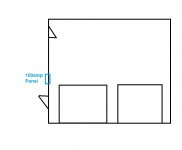
30x30 garage....I've got 2, 9x8 garage doors. I've only got 2, 36" man doors...one to go into the house and one to the back yard. I'll be pulling copper from my main 200amp breaker from the house. (which is way underutilized)
I'll echo "pattenp"'s comments that aluminum 2-2-2-4 MHF would be more cost-effective than copper for that feeder. It's also good for ~90A (or at least it is in a detached garage scenario; not sure if attached is different, but I doubt it's significantly so), which from the sounds of things would be more than adequate for your purposes.
I'm going to have 2 garage door openers in the garage, a refrigerator, and a chest freezer. Across from the garage, I'll be feeding a 220v circuit for a minisplit to heat/cool the upstairs of the garage. I mention that because that may eat up some of the available amperage.
They will, but nothing outrageous. Of the items you mention, the largest load would undoubtedly be the mini-split system; but even a relatively large one (such as, just to throw a dart,
http://www.homedepot.com/p/GREE-Pre...-208-230V-GWH36LB-D3DNA3E/203536863?N=1z11reb) will typically chew up less than 20A when it's running (tho' you'll surely want to put it on a 30A circuit to account for start-up loads & such).
The thing to remember is, the refer, freezer and HVAC system are all effectively "24/7" loads -- i.e., you don't (directly) control when they will be running and/or starting up. So, sooner or later, you WILL encounter the "perfect storm" of several/all of them trying to start up concurrently, Hence, they should be on separate circuits if at all possible (the refer & freezer can probably share a 20A 120V circuit).
I'm thinking about doing outlets on the ceiling for plugin florecent lights and wiring them on a switch...there are no windows in the garage, except some obscure glass on the garage doors.
That's one way to do it, and it's a fairly popular approach. But I really don't see the need for all those plug-in connections, each of which is a potential trouble spot down the road (think contact corrosion, weakening retention springs, etc.); plus there's the "ugly clutter" of all those hanging cord loops. Beyond that, see
http://www.garagejournal.com/forum/showpost.php?p=3387494&postcount=5&b=4 for my general thoughts on lighting.
It's pretty easy for me to compute convenience outlet circuits inside the house...I'm just needing some ideas about what's normal when power tools may be involved.
How many outlets do I need along the garage walls? How many can I put on one circuit, reasonably? I've included a rough drawing...
From the bulk of your comments, it doesn't sound like you're planning on getting all that "serious" about power tools & such. It's mostly the big stationary machines (table & miter saws, dust-collection systems, really big air compressors, certain other machine tools, vehicle lifts, etc.) that you really need to specifically plan for. But my impression is, you're not going to have many/any of those. Still, a 30A/240V outlet or two for such things as a portable welder might not be a bad idea.
Anything you can hold in your hand and stow in a portable case when you're done will surely draw less than 15A @ 120V (usually MUCH less). So again, not much of a concern from an overall load point of view. I agree on the double-duplexes (four sockets, total) every several feet approach; every six feet might be
slightly closer spacing than really needed, but it certainly won't hurt anything. And the recommendation to keep them at least 49-50 inches off the floor is a good one for several reasons.
However, unlike "sands35", I
would put at least two 20A/120V circuits on each wall (tho' given the "mostly one man shop" assumption, you could near-certainly use the SAME two circuits for all three walls. Within each of those two-gang boxes, I'd have each of the duplexes fed from alternate circuits. If you are CERTAIN this will always and forever be ONLY a "one man shop", this is not strictly "necessary"; but there are several good reasons to do it anyway, and the marginal cost is minimal in the overall scheme of things. Also, before leaving this sub-topic: The initial run from the breaker panel to the first pair of duplexes
can be done with a single 12/3 NM-B cable; but I would run independent 12/2 for each circuit anyway. Beyond my general distaste for shared Neutrals in 120V circuits, this side-steps the need for common-trip breakers on those circuits, and may well make future troubleshooting and/or expansion simpler & easier. And again, the marginal cost difference is trivial.
Finally, I would probably also run one more 20A 120V circuit to wherever your workbench will be located. That area will become a magnet for all sorts of plug-in gadgets, so best to have some added capacity there. One or two double-gang boxes with two duplexes in each will probably suffice, as you can also use mounted outlet strips for various minor loads like the battery chargers for your hand tools, the stereo, etc.
I don't plan on putting in a fixed compressor. My pancake compressor has served me well for the past 10 years and I just never needed more volume than its 6lb tank.
You might want to re-think this.
I understand that your day-to-day needs are probably rather minimal. But nonetheless, once you pipe the garage for air (which is not difficult or grossly expensive), the convenience & usefulness of pneumatic tools becomes REALLY seductive. Also, a permanently installed compressor can (at least usually) also be a somewhat "remotely located" compressor, however that term might apply in any particular situation (in your case, perhaps in the crawl space, or in a closet under the stairs, or...?). The acoustic isolation this can provide will seem like a Godsend when you don't have the racket of even that pancake unit just over your shoulder. And thus, pneumatic tools become still more attractive.
You certainly don't need a King Kong compressor in order to remotely install it. For that matter, even a wheeled "portable" compressor can be "permanently" mounted by simply parking it in a suitable (ventilated) closet or similar, and running a short length of hose to the inlet for the air distribution lines (which would originate there); and it can still be "portable" if/when needed. That said, doing this with a little (10-year-old, yet) pancake unit is probably pushing your luck. Were I in your shoes, I'd probably target something similar to this:
DeWALT 1.6 HP Workshop Compressor D55168, 200 PSI, 15 Gallon
http://www.homedepot.com/p/DEWALT-1...-Compressor-D55168/100497924#customer_reviews
up to MAYBE this (which is probably a bit on the overkill side, for you):
Campbell Hausfeld Portable Air Compressor VT6275, 240V, 3.2HP, 60 Gal
http://www.globalindustrial.com/p/p...-tools/vt6275-air-compressor-32hp-240v-60-gal
The point is, if you think about this now, before construction is complete, you can easily and inexpensively at least make provision for it.
I wasn't planning on putting in an AC unit in the garage, but I might change my mind since I'm putting in a mini split upstairs, I might just get a multi-zone unit and run a fan in the garage when I want it.
Do you have a suitable spot, preferably relatively high on an exterior wall, to through-wall mount a so-called "Window" air conditioner? Maybe you should think about framing in such a spot now, even if you don't plan to use it right away. This would also be the time to install a 240V circuit & outlet for it, while the walls are open and everything is easy to get to. Again, this is one of those things which is easy & relatively cheap to do now, as opposed to later.
This is an attached garage, so the copper run is probably 40-50 ft under the crawlspace (or in the attic) I don't want to run aluminum inside...If it were detached, it wouldn't even be a question.
I won't fault you for preferring copper; but it WILL be more expensive. As long as you're OK with that, go for it.

I'm nervous about picking 1 location for the fridge/freezer to live. It's like trying to decide where to put a sofa....I know my wife is going to try to weigh in on the location after it's set.
For obvious reasons, it would be best to nail that down NOW. Explicitly seek your wife's input on this. Maybe even defer to her preference (or at least make it seem that way). Then, if/when she later decides a different spot would be "better", you can legitimately point out that she picked the current location, and that she'll just have to live with it.
[The BBS software is nattering at me that the message is too long. So I'm breaking it here. Continued in next message...]