To avoid these ads, REGISTER NOW!

Work Bench Outlets.

Micscience

Well-known member
Joined
Aug 22, 2012
Messages
140
I want to route a bunch of outlets near my work bench so I can have power every where. Something similar to a power strip but instead I'm going to use like 3-4 wall outlets in various locations some what near each other. I have never done this before but I'm assuming all I have to do is run the power into the first outlet and then out to the second outlet then maybe a third outlet which will all be connected in one circuit with one breaker per 3 outlets is this ok?

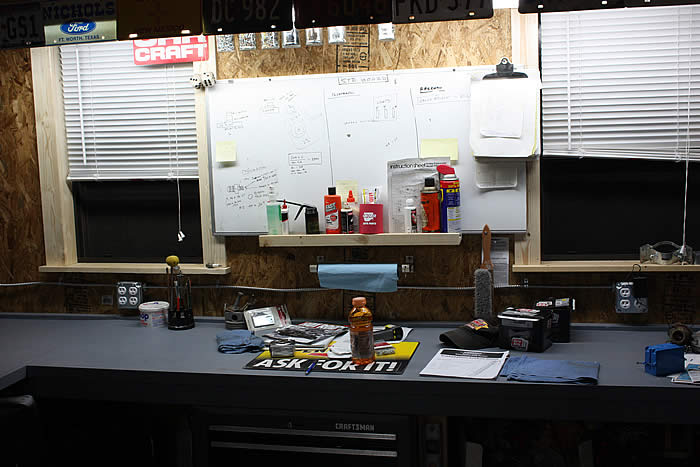
If not can someone break down the process how it is done and give me some pointers. I have seen some pics here with a nice outlet setup which I would like myself. Here is one of the pictures he is a member of GF and I thought it looked nice.
yug5.jpg
 
To avoid these ads, REGISTER NOW!

Rocket79

Active member
Joined
Nov 13, 2013
Messages
30
Location
Kansas
I am NOT an expert. Someone fell free to correct me if I am wrong, But, As far as I know the number of total outlets is not important, since you won't run every outlet at once. The number you are trying to get to is the total consumption of energy per circuit, That will tell you how many circuits you need. That number is usually figured in watts, and you should shoot for no more than 60-65 percent use of the total available watts.

i.e. 20 amp breaker x 120 volts = 2400 watts total available
2400 x 65% = 1500 watts for safe usage

So.... any number of outlets is fine as long as you don exceed 1500 watts of load.
 
OP
M

Micscience

Well-known member
Joined
Aug 22, 2012
Messages
140
Those power strips are nice, that would be my first solution for 15 amp stuff however I have everything I need to build my circuits and outlets for free plus I'm going to add mix match 15-20 amp outlets threw out the area.

Rocket79 I do appreciate the way you broke it down it is always good to know average or good working load capacity of circuit. I never ran a series circuit before so I was hoping someone could verify is if all I have to do is keep extending the power to the next outlet and I'm good?
 

mdkingsley

Well-known member
Joined
Nov 18, 2012
Messages
371
Location
Chickamauga Ga
That's the way I did it, under the edge of my workbench and they all tie together and are on one breaker. You can see some of them on my build thread.
 

NUTTSGT

Super Moderator
Staff member
Joined
Sep 14, 2009
Messages
50,982
Location
Northern Central Ohio
When I built my new work bench, I decided to put an outlet on each end instead of on the front of the bench. I didn't want to being doing something or lifting and bang into an outlet. My dumb luck, I would fumble a screwdriver out of my hands only to catch it and stick it into an outlet right beside my YKK zipper being stuck in the outlet.

Yes, I have that kind of dumb lucʞ.
 

mbatarga

Well-known member
Joined
Sep 14, 2005
Messages
883
Location
GA
Outlets on the underside of a workbench are fine - depending on what type of work you do!

I worked as an engineer at a very large communications company as my first employer out of college. They had outlets on the underside of all of their technician benches similar to the pictures posted above. One day, a technician working on a piece of a satellite communication system rotated the chassis on his workbench. One of the many wires from the loom he was working on slide off the edge of the workbench and just happened to curl under the table top and find itself sticking into the hot leg of the 120 outlet! It zapped a multi-million dollar piece of gear rendering it worthless. Within hours - every single outlet under the table edge of every workbench in that building was disconnected from power.
 

NUTTSGT

Super Moderator
Staff member
Joined
Sep 14, 2009
Messages
50,982
Location
Northern Central Ohio
Outlets on the underside of a workbench are fine - depending on what type of work you do!

I worked as an engineer at a very large communications company as my first employer out of college. They had outlets on the underside of all of their technician benches similar to the pictures posted above. One day, a technician working on a piece of a satellite communication system rotated the chassis on his workbench. One of the many wires from the loom he was working on slide off the edge of the workbench and just happened to curl under the table top and find itself sticking into the hot leg of the 120 outlet! It zapped a multi-million dollar piece of gear rendering it worthless. Within hours - every single outlet under the table edge of every workbench in that building was disconnected from power.

Talk about an "oh ****" moment. :shocking:
 

Bjm364

Active member
Joined
Nov 19, 2013
Messages
38
Location
No. IL
I have receptacles mounted just under my work surface on the framing of my bench. Very convenient. They need to be wired in paralell, and do not jump from screw to screw on the device. You must "pigtail" it by wirenutting the blacks together and the whites together separately. Then taking another black out to the brass screw from the black wirenut, then to the silver screw from the white wire nut. This way the little tab between the screws is not forced to take the whole load of the circuit down stream from there.
 

Bib Overalls

Well-known member
Joined
Dec 4, 2006
Messages
3,318
Location
Jonesboro, Arkansas
IMHO 15 amp spec grade outlets have no place in a shop. Unless you have tools with the distinctive 115V 20 amp plugs a premium 15 amp outlet will be OK. You can wire 15 amp outlets into 20 amp #12 awg circuits. Premium outlets can be safely back wired because the wires are held in place by a mechanical clamping force. Spec grade outlets have spring clamps that are considered by many to be hazardous. If you use spec grade outlets make the connections under the terminal screws.

2X on the pigtails.
 

Dick in Wisconsin

Well-known member
Joined
Mar 3, 2012
Messages
3,048
Location
Shawano, Wisconsin
You must "pigtail" it by wirenutting the blacks together and the whites together separately. Then taking another black out to the brass screw from the black wirenut, then to the silver screw from the white wire nut. This way the little tab between the screws is not forced to take the whole load of the circuit down stream from there.

Is this really necessary? If its a 20amp receptable ... aren't those "little tabs" designed to take that kind of load?

Or has practical experience taught you differently? That a lots of pigtailing!
 

Dick in Wisconsin

Well-known member
Joined
Mar 3, 2012
Messages
3,048
Location
Shawano, Wisconsin
Premium outlets can be safely back wired because the wires are held in place by a mechanical clamping force. Spec grade outlets have spring clamps that are considered by many to be hazardous. If you use spec grade outlets make the connections under the terminal screws.

2X on the pigtails.

Can you backwire both "in and out" of the receptacle? or just pigtail into the backwire?
 

MrMark

Well-known member
Joined
Jan 25, 2010
Messages
4,626
Location
Southern Cal.
Pigtail is just a quality job. You only see the outlets daisy chained off the outlet itself in low rent jobs and noobs. The one exception would be for a tight box with a quality backwire outlet.
 

LennyTheLizard

Well-known member
Joined
Oct 25, 2010
Messages
325
Location
Southeast MO
One trick I did in my shop was run double gang boxes every 10'.
Run 2 circuits through the loop so that each receptacle in one box is not on same circuit.
This way if you ever are closed in one area, you aren't running all your tools off the same circuit.
 

Bjm364

Active member
Joined
Nov 19, 2013
Messages
38
Location
No. IL
Can you backwire both "in and out" of the receptacle? or just pigtail into the backwire?
The little tab between the screws is for breaking apart if you want to switch half of your receptacle. Pigtailing is necessary at each outlet except the last one in the line where you can take the wires straight to the device. Each metal box must be bonded via the grounding conductor also btw.
 

Charles (in GA)

Well-known member
Joined
Jan 11, 2006
Messages
12,489
Location
50 mi south of Atlanta
Outlets on the underside of a workbench are fine - depending on what type of work you do!

I worked as an engineer at a very large communications company as my first employer out of college. They had outlets on the underside of all of their technician benches similar to the pictures posted above. One day, a technician working on a piece of a satellite communication system rotated the chassis on his workbench. One of the many wires from the loom he was working on slide off the edge of the workbench and just happened to curl under the table top and find itself sticking into the hot leg of the 120 outlet! It zapped a multi-million dollar piece of gear rendering it worthless. Within hours - every single outlet under the table edge of every workbench in that building was disconnected from power.

Weatherproof covers with spring loaded sealed doors would have been a more graceful way of correcting the problem, but I understand why they did what they did.

Charles
 

pattenp

Well-known member
Joined
Jun 4, 2008
Messages
10,175
Location
Virginia - USA
Branch circuits should be sized by using 100% of the non-continuous loads plus 125% of continuous loads. Using 60-65% is a very generous safety margin. Using load calculations based on continuous loads only at 125% is equal to 80% capacity.

QUOTE=Rocket79;3512521]I am NOT an expert. Someone fell free to correct me if I am wrong, But, As far as I know the number of total outlets is not important, since you won't run every outlet at once. The number you are trying to get to is the total consumption of energy per circuit, That will tell you how many circuits you need. That number is usually figured in watts, and you should shoot for no more than 60-65 percent use of the total available watts.

i.e. 20 amp breaker x 120 volts = 2400 watts total available
2400 x 65% = 1500 watts for safe usage

So.... any number of outlets is fine as long as you don exceed 1500 watts of load.[/QUOTE]
 

sberry

Banned
Joined
Jun 18, 2005
Messages
35,747
Location
Brethren, Michigan
Put a couple simple circuits where you need, all that looks nice but is a waste of time and energy, whats a guy going to plug in to 15 outlets in 300 sq ft? There are place where several are needed out of the way on back of shelf for chargers etc. Put up a couple power strips.

This stuff is old, since been cleaned and stripped of obsolete stuff.
 

Attachments

  • ps outlets 1.JPG
    ps outlets 1.JPG
    67.6 KB · Views: 197
  • ps outlets.JPG
    ps outlets.JPG
    70.5 KB · Views: 163
Last edited:

sberry

Banned
Joined
Jun 18, 2005
Messages
35,747
Location
Brethren, Michigan
Its human nature to come to the conclusion we need more than we do. The fear of loss so great that the extended warranty and the lifetime warranty that comes with every add lives on and is the single most profitable thing in marketing.

In my shop I have the wiring used pretty good, last out building I stuck some extra in that will sit idle.

As a learning excercize is cheap education to fix up the electric especially if you have demand not met or stuff is old. Its a good thing to be able to install the equipment you use. While its true that a compressor and a heavy duty chop saw can run some from most circuits ideally they would have a home on a dedicated.
 
To avoid these ads, REGISTER NOW!

sberry

Banned
Joined
Jun 18, 2005
Messages
35,747
Location
Brethren, Michigan
A shop is about like a kitchen. It needs a couple dedicated circuits and a couple convenience circuits that can handle the parasitic and even some lights etc? Nothing beats a single wire to a single outlet and welding, comps or occasional motors. saws etc have it as good as they can and a fault or trip doesn't shut the rest of the place down.

I personally didn't follow any great plan, as I needed it that day wire it up that evening. One place 30 running ft of wall and no outlet and a couple others 20 and then a couple with a dozen or more in 10 ft.

Some real simple. I used a 12 cord to put the outlet on but then in hindsight realized all I needed was a power strip to reach the wall. There are a couple outs left of the panel feed parts washer and phone,tv etc
 

Attachments

  • desk sink p.JPG
    desk sink p.JPG
    43.5 KB · Views: 127
Last edited:

Rocket79

Active member
Joined
Nov 13, 2013
Messages
30
Location
Kansas
Branch circuits should be sized by using 100% of the non-continuous loads plus 125% of continuous loads. Using 60-65% is a very generous safety margin. Using load calculations based on continuous loads only at 125% is equal to 80% capacity.

That’s absolutely a generous safety margin. In a house I wouldn’t have a problem running 80-85%. But it a shop, when higher amperage motors are common, I like to keep the draw a little lower. It also allows for extra when you run into situations where you leave a tool running, and pick up another to do something quick.

I can’t count the number of times I’ve been running a router at the shop, see something that doesn’t look sanded right, flip the router over (running), grab the sander and hit the spot. That maybe an unsafe work practice, but the circuits I’ve put in place never cause me concern.

Also since it’s in a shop, expansion of tools always happens. A little over building now can prevent re-building later.
 

Falcon67

Well-known member
Joined
Jun 11, 2009
Messages
18,371
Location
Merkel, TX
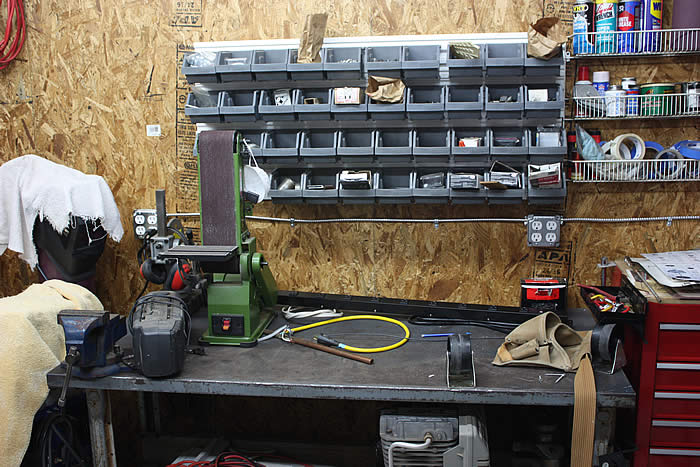
I used quad boxes and MC cable. That way, if I didn't like the layout I could change it up pretty easy. All runs have a GFCI at the head end. Put in more than you think - I have several outlets chewed up by little BS stuff - lights on machines, power cord for laptop, bench lights, charger for phone, radio, clock, 19.2V tool battery charger, fridge, etc, etc. Very little high current stuff.

Inside14.jpg


Inside15.jpg
 
Last edited:

FarmerPete

Well-known member
Joined
Jul 24, 2013
Messages
258
Location
Lansing, MI
I was always told that the reason you use a pigtail vs direct wiring an outlet has nothing to do with the capacity of the outlet. The reason is that if an outlet ever dies, it's significantly harder to troubleshoot the issue (assuming you don't know the wiring layout). Since if you split the signal off of the outlet, any outlet dieing will kill everything downstream from it on the wire. Use a pigtail, and just the single outlet will break.
 

Falcon67

Well-known member
Joined
Jun 11, 2009
Messages
18,371
Location
Merkel, TX
My thought process was more like - string the boxes and MC, then build the covers on the bench. Once all the covers were put together, install went 1-2-3-done. But good point about the "Christmas light string" problem.
 

pattenp

Well-known member
Joined
Jun 4, 2008
Messages
10,175
Location
Virginia - USA
I get where you're coming from. I was thinking you were saying in your first post that 65% is an absolute rule for sizing circuits.

That’s absolutely a generous safety margin. In a house I wouldn’t have a problem running 80-85%. But it a shop, when higher amperage motors are common, I like to keep the draw a little lower. It also allows for extra when you run into situations where you leave a tool running, and pick up another to do something quick.

I can’t count the number of times I’ve been running a router at the shop, see something that doesn’t look sanded right, flip the router over (running), grab the sander and hit the spot. That maybe an unsafe work practice, but the circuits I’ve put in place never cause me concern.

Also since it’s in a shop, expansion of tools always happens. A little over building now can prevent re-building later.
 

2ManyProjects

Well-known member
Joined
Jul 18, 2013
Messages
757
I want to route a bunch of outlets near my work bench so I can have power every where. Something similar to a power strip but instead I'm going to use like 3-4 wall outlets in various locations some what near each other. I have never done this before but I'm assuming all I have to do is run the power into the first outlet and then out to the second outlet then maybe a third outlet which will all be connected in one circuit with one breaker per 3 outlets is this ok?

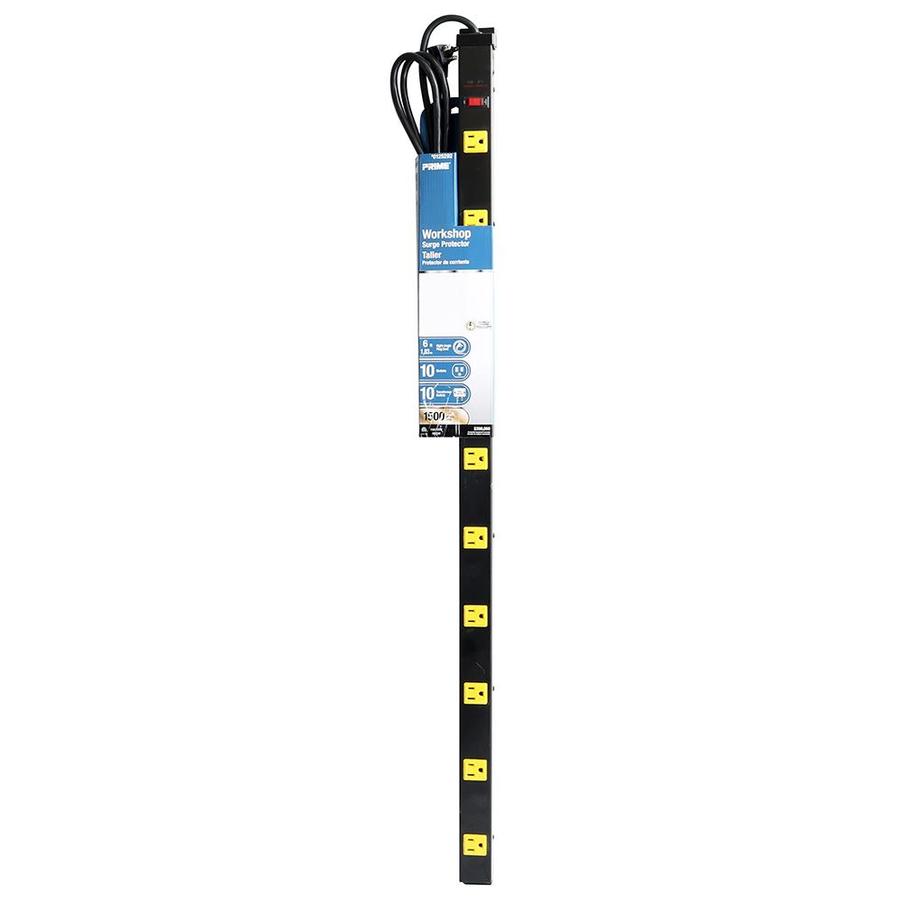
You CAN do it that way; but it is largely a waste of time & effort. For light-duty stuff like battery rechargers and most hand-held power tools (drills, sanders, etc.), a simple outlet strip will be more than adequate. I happened to use this one:

http://www.lowes.com/pd_125292-16503-UTPBS010_?PL=1&productId=1214065
054732807185.jpg


recently when I built myself a new desk and computer workstation, in order to have plenty of places to plug in all the various little gadgets. The generous spacing between outlets means that "wall warts" are a non-issue. (In that case, I fed it off a UPS; but in a garage, that would be fairly silly.)

Those power strips are nice, that would be my first solution for 15 amp stuff however I have everything I need to build my circuits and outlets for free plus I'm going to add mix match 15-20 amp outlets threw out the area.

You seem to be laboring under a misconception here.

There is near-certainly no need for any 20-Amp OUTLETS, per se. Virtually nothing you plug in will have the NEMA 5-20 plug that would require the corresponding NEMA 5-20 socket. Use top-quality NEMA 5-15 duplex outlets, and you'll be just fine. HOWEVER... The circuits which FEED the various 120V outlets in your garage should indeed be "20-Amp" types, using (at least) AWG 12 wiring. So in effect, there will be no practical difference between "15-Amp" and "20-Amp" outlets.

What DOES matter is the NUMBER of circuits feeding those outlets, vis-a-vis the total load of the various devices you're planning to run concurrently. For most "home hobbiest" garages, my usual recommendation is two 20A circuits, both fed to double-gang boxes placed at 6-8 foot intervals all around the space; one duplex in each box runs off "Circuit A", the other off "Circuit B". One more 20A circuit to feed thw area near the workbench is usually a good idea, particularly if you have any high-draw stationary tools (bench grinder, drill press, etc.) in that area.

Rocket79 I do appreciate the way you broke it down it is always good to know average or good working load capacity of circuit. I never ran a series circuit before so I was hoping someone could verify is if all I have to do is keep extending the power to the next outlet and I'm good?

It is NOT "a series circuit". What you are referring to is a "daisy-chain" arrangement; but all of the outlets are nonetheless wired in PARALLEL.

I was always told that the reason you use a pigtail vs direct wiring an outlet has nothing to do with the capacity of the outlet. The reason is that if an outlet ever dies, it's significantly harder to troubleshoot the issue (assuming you don't know the wiring layout). Since if you split the signal off of the outlet, any outlet dieing will kill everything downstream from it on the wire. Use a pigtail, and just the single outlet will break.

Ding! Ding! Ding! Ding!

We have a winner! :thumbup:

 
OP
M

Micscience

Well-known member
Joined
Aug 22, 2012
Messages
140
Bjm364 I'm glad you mentioned pigtailing because I was going to install it threw the tabs I forget about pigtails all the time.

Bib Overalls I'm confused here I know you are saying to run 15 amp receptacles on 12gauge circuit but what is back wiring?
 
OP
M

Micscience

Well-known member
Joined
Aug 22, 2012
Messages
140
I have receptacles mounted just under my work surface on the framing of my bench. Very convenient. They need to be wired in paralell, and do not jump from screw to screw on the device. You must "pigtail" it by wirenutting the blacks together and the whites together separately. Then taking another black out to the brass screw from the black wirenut, then to the silver screw from the white wire nut. This way the little tab between the screws is not forced to take the whole load of the circuit down stream from there.

IMHO 15 amp spec grade outlets have no place in a shop. Unless you have tools with the distinctive 115V 20 amp plugs a premium 15 amp outlet will be OK. You can wire 15 amp outlets into 20 amp #12 awg circuits. Premium outlets can be safely back wired because the wires are held in place by a mechanical clamping force. Spec grade outlets have spring clamps that are considered by many to be hazardous. If you use spec grade outlets make the connections under the terminal screws.

2X on the pigtails.

You CAN do it that way; but it is largely a waste of time & effort. For light-duty stuff like battery rechargers and most hand-held power tools (drills, sanders, etc.), a simple outlet strip will be more than adequate. I happened to use this one:

http://www.lowes.com/pd_125292-16503-UTPBS010_?PL=1&productId=1214065
054732807185.jpg


recently when I built myself a new desk and computer workstation, in order to have plenty of places to plug in all the various little gadgets. The generous spacing between outlets means that "wall warts" are a non-issue. (In that case, I fed it off a UPS; but in a garage, that would be fairly silly.)


You seem to be laboring under a misconception here.

There is near-certainly no need for any 20-Amp OUTLETS, per se. Virtually nothing you plug in will have the NEMA 5-20 plug that would require the corresponding NEMA 5-20 socket. Use top-quality NEMA 5-15 duplex outlets, and you'll be just fine. HOWEVER... The circuits which FEED the various 120V outlets in your garage should indeed be "20-Amp" types, using (at least) AWG 12 wiring. So in effect, there will be no practical difference between "15-Amp" and "20-Amp" outlets.

What DOES matter is the NUMBER of circuits feeding those outlets, vis-a-vis the total load of the various devices you're planning to run concurrently. For most "home hobbiest" garages, my usual recommendation is two 20A circuits, both fed to double-gang boxes placed at 6-8 foot intervals all around the space; one duplex in each box runs off "Circuit A", the other off "Circuit B". One more 20A circuit to feed thw area near the workbench is usually a good idea, particularly if you have any high-draw stationary tools (bench grinder, drill press, etc.) in that area.


It is NOT "a series circuit". What you are referring to is a "daisy-chain" arrangement; but all of the outlets are nonetheless wired in PARALLEL.


Ding! Ding! Ding! Ding!

We have a winner! :thumbup:


2ManyProjects thanks for taking the time clarify it up for me. When I first started this thread I thought it was either a series circuit something like x-mas tree lights or a parallel circuit. I guess I cannot count a receptacle as load. I get what you mean now about 20-amp outlets not being necessary. I have regular cheapo Lowes 15amp outlets which are new hopefully they are (NEMA 5-15 duplex outlet) like you described.

I'm not hip to all the electrical terms. Personally out of every field I think electrical has the biggest vocabulary. I do not have any near outlets without using an extension cord.
 
OP
M

Micscience

Well-known member
Joined
Aug 22, 2012
Messages
140
Any idea what GJ member's shop that is? What a nice setup! I'd like to learn a little more about that one!

Sorry I do not know what I do is collect every picture of garages from here and save them to my pictures folder so I don't have anything that ties them to the owner.
 

Dick in Wisconsin

Well-known member
Joined
Mar 3, 2012
Messages
3,048
Location
Shawano, Wisconsin
I was always told that the reason you use a pigtail vs direct wiring an outlet has nothing to do with the capacity of the outlet. The reason is that if an outlet ever dies, it's significantly harder to troubleshoot the issue (assuming you don't know the wiring layout). Since if you split the signal off of the outlet, any outlet dieing will kill everything downstream from it on the wire. Use a pigtail, and just the single outlet will break.

Can't you accomplish the same thing using the high quality, industrial outlets and back wiring them? The two wires are connected to same backwire location with the a single screw.

What could wrong? You're not relying on anything inside the outlet or a "little piece of metal" to carry the electricity.
 

2ManyProjects

Well-known member
Joined
Jul 18, 2013
Messages
757
2ManyProjects thanks for taking the time clarify it up for me. When I first started this thread I thought it was either a series circuit something like x-mas tree lights or a parallel circuit. I guess I cannot count a receptacle as load.

As you might imagine, it all depends on what gets plugged into those outlets.

I get what you mean now about 20-amp outlets not being necessary. I have regular cheapo Lowes 15amp outlets which are new hopefully they are (NEMA 5-15 duplex outlet) like you described.

If they are the real rot-gut "builder's specials" (typically about $0.50-1.00 each) you might want to reconsider using them in a harsh environment like a garage/shop, especially if you can foresee frequent plugging/unplugging. A high-quality duplex outlet is not so expensive (maybe $2.00-3.00 each) that it makes sense to pinch the pennies tighter than that (unless you're using them by the hundreds/thousands, which is why builders so often DO go with the rot-gut stuff).

I'm not hip to all the electrical terms. Personally out of every field I think electrical has the biggest vocabulary.

Live and learn. We all had to start somewhere.

I do not have any near outlets without using an extension cord.

That is something you DO want to fix.


Can't you accomplish the same thing using the high quality, industrial outlets and back wiring them? The two wires are connected to same backwire location with the a single screw.

What could wrong? You're not relying on anything inside the outlet or a "little piece of metal" to carry the electricity.

Even relying on the socket-bridging tabs should be OK from a load perspective. If a given outlet is rated to handle 15A, the manufacturer has to assume that, at least sometimes, that entire "maximum rated load" will be drawn from the socket OPPOSITE the end where the wires are connected, hence through the tab(s). And over a "run" as short as those little tabs, the difference between 15A and 20A is vanishingly trivial. Bottom Line: This is a non-issue.

The main thing is to use the screw terminals, and not "back stab" the connections. The screw-down clamps you describe are also OK.


Charles (in GA)

Well-known member
Joined
Jan 11, 2006
Messages
12,489
Location
50 mi south of Atlanta
I had a Wiremold brand outlet strip and finally scrapped it. The individual receptacles were cheap and eventually wore and didn't grip plugs well, and the wire crimps inside at the receptacles were equally poor. Possibly they have improved them in the past 25 years however.

If you look at Chris's workbench in the pic below, look closely at the front of the legs, very top, barely visible under the edge of the bench, on the left, just below the vise, and also on the right. There are knockouts for receptacles. You install the receptacle from the back, cover it with a handybox, and screw the whole works together with two screws from the front. This is an industrial grade workbench, not sure what brand, but I've seen this same setup on a couple of different brands.

Second pic shows the knockouts very clearly, it is one I found on Google images.

Charles

Inside15.jpg


53-419_BK_thumbProduct.jpg
 
Last edited:

sberry

Banned
Joined
Jun 18, 2005
Messages
35,747
Location
Brethren, Michigan
Quote:
I do not have any near outlets without using an extension cord.

That is something you DO want to fix.
This I agree with, the object isn't to put as many in as you can but get ones you need. As for outlets, some are better but I got 50 cent ones on my bench, some of them have thousands of cycles on them, several times higher than would ever be found in a home shop. I cant recall the last time I had to replace a failed one.

(unless you're using them by the hundreds/thousands,
That is an interesting concept, I wonder how many I have in service, its got to be somewhere between 500 and a thousand, I got about 25,,, maybe 30 panels. Between 3 and 400 breakers so I bet way closer to 1000
 
Last edited:

Falcon67

Well-known member
Joined
Jun 11, 2009
Messages
18,371
Location
Merkel, TX
Here is a post showing a link to the nice shop pic posted above - "search for image on Google" is your friend LOL
http://www.garagejournal.com/forum/showthread.php?t=58848

I also put a power strip under the front lip of one of my benches. It comes in handy for small stuff like soldering irons when you don't want the cords running across the bench top. Like those occasions when it's covered with projects. Like, every day :lol:

Good info on the bench outlets - forgot about those knockouts. I've thought about wiring one of those up, just to do it. Those locations and the power strip under the bench lip are great when you need to fire up the shop vac.

That steel bench is my $30 auction special. And I have a set of those legs in the shed - been hanging on to them for nearly 20 years! And STILL haven't found a way to use them!
 
Last edited:

Falcon67

Well-known member
Joined
Jun 11, 2009
Messages
18,371
Location
Merkel, TX
Section of bowling alley lane? or butcher block?

I never seem to have space to build One More Bench that is 30" deep. I've thought about using them for a fold up - hinge the legs to the wall so they swing out, with a top that swings up to rest on the legs.
 
OP
M

Micscience

Well-known member
Joined
Aug 22, 2012
Messages
140
I had one more question. Could I add a 12 gauge circuit off of a 10 gauge circuit near my work bench? The 10 gauge circuit is only dedicated for when I use my welder.
 
To avoid these ads, REGISTER NOW!
Top Bottom