
You are using an out of date browser. It may not display this or other websites correctly.
You should upgrade or use an alternative browser.
You should upgrade or use an alternative browser.
quality t8 fixture and ballast in one package?
- Thread starter asmasm
- Start date
bczygan
Well-known member
Welcome to GJ!
BillK
Well-known member
I am not looking for HO ballasts.
Just a hint ..... the commercial ballasts are not held to as good a standard as far as RFI compared to the residential ones
 You need to get residential ballasts. I found this out the hard way when I replaced a couple of lights in my attached garage. I bought the ones with commercial ballasts thinking I was getting something better ....... until I turned my Ham radio on The commercial ballasts were making so much noise it was stupid I replaced them with residential ballasts and they are silent as far as radio noise.
Just thought I would let you know,
diehardnova
Member
Got my light fixtures from contractorlighting.com. They have the 32w t8's for a fair price and ship them to your door. Service is good, had a bad one and they shipped out a new one the next day. I do not work for these guys, just a good place to check.
Here's the link:
http://www.contractorlighting.com/4ft-lamp-watt-fluorescent-double-channel-strip-120277-p-400.html
Here's the link:
http://www.contractorlighting.com/4ft-lamp-watt-fluorescent-double-channel-strip-120277-p-400.html
Those look like exactly what I wanted. I ended up buying a bunch of cheapo lithonia t12 fixtures and putting good quality t8 ballast in them.
diehardnova- what was the build quality on those like? The lithonia fixtures are sharp and easily bent. Also, the knockouts don't actually knock out. I have gotten good at getting them out but it involves a vice, pliers, and bending it back to shape.
diehardnova- what was the build quality on those like? The lithonia fixtures are sharp and easily bent. Also, the knockouts don't actually knock out. I have gotten good at getting them out but it involves a vice, pliers, and bending it back to shape.
Last edited:
diehardnova
Member
I'm no expert, but the quality seems good to me. I found this place from another members post and so glad I did. I've bought a lot of stuff from them and saved a lil money.
TonyBuonocore
Member
- Joined
- Nov 17, 2013
- Messages
- 9
I would recommend the Simkar CH232B11-UNV. We do not sell this fixture on our website (Westway Electric Supply) because there is a high probability that it will be broken in transit. You are better off purchasing it from a local supply house.
Good luck!
Tony
Good luck!
Tony
OX1
Well-known member
Got my light fixtures from contractorlighting.com. They have the 32w t8's for a fair price and ship them to your door. Service is good, had a bad one and they shipped out a new one the next day. I do not work for these guys, just a good place to check.
Here's the link:
http://www.contractorlighting.com/4ft-lamp-watt-fluorescent-double-channel-strip-120277-p-400.html
If you don't mind, any way you can tell me which ballast these came with?
diehardnova
Member
If you go to the link provided, there is a spec sheet that listed it as "Phillips Advance ICN-4P32-SC “NEMA Premium Electronic Ballast “. Hope thats what you needed
Angelfire
Well-known member
I too used contractorlighting.com Same fixtures I believe. I've had no issues with mine. Call them for pricing and they may cut you a better price.....they did for me (actually I emailed them).
Cheers,
cc
Cheers,
cc
Falcon67
Well-known member
FWIW - I have 14 of the "cheap" 8' 4 bulb Lithonia fixtures from HD - $40 a pop. In three years, I've had one bulb fail.
OX1
Well-known member
If you go to the link provided, there is a spec sheet that listed it as "Phillips Advance ICN-4P32-SC “NEMA Premium Electronic Ballast “. Hope thats what you needed
I called the place to ask them specifcally which ballast they use. He said the current batch of 4 light, T-8, 8 footers uses a GE 432MV-N, 74463 (he also said they sometimes get an "advance", which I assume means the phillips one you stated).
I asked if it was a residential ballast and he (Chris Petty) said he has never heard of a residential ballast or it being different than a commercial one. I explained to him there had been many complaints of commercial ballasts knocking out FM reception. He said it was due to crappy chinese ballasts and maintained there is no such thing as a residential ballast. I asked him if possibly they used a high enough quality ballast that it did not matter if it was res or commerc, and hence why he had never heard of the difference, but he did not know.
Looking that ballast up, it does not seem to specify if it is commercial or residential.
http://genet.gelighting.com/LightProducts/Dispatcher?REQUEST=BALLASTSPECPAGE&PRODUCTCODE=74463
But, it is not hard to find a ballast from GE that is definately residential.
http://www.amazon.com/dp/B0021V9XPE/?tag=atomicindus08-20
So I was all set to order from them, but they are not giving me a warm and fuzzy about their ballast choice, especially since he said their major business is large orders to wharehouses, schools, stores, etc...
EDIT: Found more info on the phillips ballast and it is commercial.
"Centium ballasts are an optimal choice for a broad range of new construction and retrofit applications within the commercial sector including general office lighting, conference, meeting, and board room applications, indirect and decorative lighting, and new fixture designs requiring smaller ballasts"
http://www.ballastshop.com/icn-4p32-sc.html
So I guess I'm back to square one if I really want residential ballasts. Until I read that 5 page thread on FM reception, I didn't care either way.

Last edited:
OX1
Well-known member
FWIW - I have 14 of the "cheap" 8' 4 bulb Lithonia fixtures from HD - $40 a pop. In three years, I've had one bulb fail.
What height cieling and any FM reception problems?
soapii
Well-known member
What height cieling and any FM reception problems?
Sorry for the threadjack............
Curious why you asked this? I was going to post a thread about the same thing.
I have T8's in my garage with 12' ceilings and during the day with the lights off my receiver gets a great reception, but come night time when I turn the lights on the reception is terrible. I can stand by the switch and turn the lights on and off and hear the radio go from clear to fuzz. I got what I thought was a damn good antenna for my receiver but it didn't make any difference.
These are the fixtures I have....
http://www.homedepot.com/p/Lithonia...ture-IB-632-MVH/202193185?N=c7bu#.UpOfBW3yUjo
What is the reasoning for that and is there any fix besides replacing the ballasts?
--Joe
Last edited:
2ManyProjects
Well-known member
- Joined
- Jul 18, 2013
- Messages
- 757
I called the place to ask them specifcally which ballast they use. He said the current batch of 4 light, T-8, 8 footers uses a GE 432MV-N, 74463 (he also said they sometimes get an "advance", which I assume means the phillips one you stated).
I asked if it was a residential ballast and he (Chris Petty) said he has never heard of a residential ballast or it being different than a commercial one.
Ooops! That's the first big red flag. There most definitely IS a difference.
I explained to him there had been many complaints of commercial ballasts knocking out FM reception. He said it was due to crappy chinese ballasts and maintained there is no such thing as a residential ballast.
And here he has gone deep into CYA/BTWBS (Cover Your A__ / Baffle Them With B---S---) mode. Typical salescritter.

I asked him if possibly they used a high enough quality ballast that it did not matter if it was res or commerc, and hence why he had never heard of the difference, but he did not know.
Next time, ask him if the ballast in question is certified as a "Class B" device under the FCC Part 15 regulations. If it is, it WILL say so right on the label (such labelling is part of the requirements for certification).
So I guess I'm back to square one if I really want residential ballasts. Until I read that 5 page thread on FM reception, I didn't care either way.
There is potentially another way to skin this cat. You can add in-line filters to the circuits feeding the fluorescent lights, which will go a long way toward reducing the emitted EMI/RFI. They're often not 100% effective, but they usually don't need to be; you only need to reduce the interference ENOUGH that the receiver can "capture" the desired signal vs. the undesired one (which generally requires the "desired" signal to be about 1.0-2.0 dB stronger at the receiver's input, assuming a decent-quality tuner).
What height cieling and any FM reception problems?
Sorry for the threadjack............
Curious why you asked this? I was going to post a thread about the same thing.
I have T8's in my garage with 12' ceilings and during the day with the lights off my receiver gets a great reception, but come night time when I turn the lights on the reception is terrible. I can stand by the switch and turn the lights on and off and hear the radio go from clear to fuzz. I got what I thought was a damn good antenna for my receiver but it didn't make any difference.
Where exactly is this "damn good antenna" located? And exactly what type is it? If it is one of those "magic" (yes, I'm being sarcastic) amplified indoor antennas popularized by such outfits as Terk, it is near-certainly doing more harm than good.
Your GJ profile says you're in "SE Michigan"; I'm guessing that means somewhere in the greater Detroit / Ann Arbor / Toledo area. If that guess is correct, inadequate signal strength from the broadcast station is very likely the LEAST of your issues. Your problem is that you ALSO have a strong local source of interference signals (i.e., the lights/ballasts). What you need (besides either better ballasts and/or EMI/RFI filters on their power feeds) is a high-quality PASSIVE antenna, located as far away from the interference source(s) as possible. If this is a directional antenna, aimed to put the interference source(s) into one of the nulls of the polar pattern, so much the better. Either way, the other thing you need is to shield the utter He__ out of the transmission line between that antenna and the tuner's input; a good-quality quad-shield RG-6/U cable would likely be your best bet here.
These are the fixtures I have....
http://www.homedepot.com/p/Lithonia...ture-IB-632-MVH/202193185?N=c7bu#.UpOfBW3yUjo
I would be utterly amazed if those had Residential-appropriate ballasts in them.
2ManyProjects
Well-known member
- Joined
- Jul 18, 2013
- Messages
- 757
OX1
Well-known member
so still no concrete location to get this then?
Not so far.
I'd considered getting the Lowes 8 footers which currently have a Sylvania QTP4x32T8/UNV ISN-SC commercial ballast.
http://www.greenelectricalsupply.com/qtp4x32t8-unv.aspx
At least it is listed an <10% THD, which I've read in other threads here that is pretty decent.
I figured worse case, I would replace them with these at a later date. 18$ and no shipping if you know someone with a prime account.
http://www.amazon.com/dp/B0021V9XPE/?tag=atomicindus08-20
EDIT: nevermind, this thread leaves those ballasts in the same crappy RFI boat.
http://www.garagejournal.com/forum/showthread.php?t=28982&page=3
Ooops! That's the first big red flag. There most definitely IS a difference. And here he has gone deep into CYA/BTWBS (Cover Your A__ / Baffle Them With B---S---) mode. Typical salescritter.
There is potentially another way to skin this cat. You can add in-line filters to the circuits feeding the fluorescent lights, which will go a long way toward reducing the emitted EMI/RFI. They're often not 100% effective, but they usually don't need to be; you only need to reduce the interference ENOUGH that the receiver can "capture" the desired signal vs. the undesired one (which generally requires the "desired" signal to be about 1.0-2.0 dB stronger at the receiver's input, assuming a decent-quality tuner).
Guess I'll start trying electrical supply houses, see what I can find. Worse, case, might have to cobble together my own.
BTW, sorry for any threadjacks, but I guess it is all relevant.
Last edited:
ForceFed70
Well-known member
An inline filter (can you even buy those for residential applications?) will not help with this problem. The ballast is the cause of the interference - not the device suffering from the interference.
FWIW: Installed 9 x 4lamp T8 Sylvania Commercial grade fixtures in my shop 2 years ago. No notable effect on FM reception or wireless network signal.
FWIW: Installed 9 x 4lamp T8 Sylvania Commercial grade fixtures in my shop 2 years ago. No notable effect on FM reception or wireless network signal.
FFaust
Member
So, on the topic of high-quality T8 fixtures:
Just about done with a garage refresh and am looking at my lighting options. I think that 6 or 8 double 4' T8 fixtures will do the trick.
Garage is attached to the house, heated, and insulated. There is a two-post lift, and I will mostly be doing maintenance on my track car.
Dropped by the local electric supply store, and they recommended using Cooper Vaportite fixtures @ approx $90/ea, compared to other "regular" fixtures in the $25 - $30 range. They say that they are much better in an environment where the temp fluctuates, and that, since they have a cover, they will come back up to bright quicker if turned off and back on.
Would this be a waste of money, or is there enough quality here to justify paying the higher price in spite of not needing a covered and sealed unit?
First post btw
Just about done with a garage refresh and am looking at my lighting options. I think that 6 or 8 double 4' T8 fixtures will do the trick.
Garage is attached to the house, heated, and insulated. There is a two-post lift, and I will mostly be doing maintenance on my track car.
Dropped by the local electric supply store, and they recommended using Cooper Vaportite fixtures @ approx $90/ea, compared to other "regular" fixtures in the $25 - $30 range. They say that they are much better in an environment where the temp fluctuates, and that, since they have a cover, they will come back up to bright quicker if turned off and back on.
Would this be a waste of money, or is there enough quality here to justify paying the higher price in spite of not needing a covered and sealed unit?
First post btw
Last edited:
Kevin C
Well-known member
An inline filter (can you even buy those for residential applications?) will not help with this problem. The ballast is the cause of the interference - not the device suffering from the interference.
FWIW: Installed 9 x 4lamp T8 Sylvania Commercial grade fixtures in my shop 2 years ago. No notable effect on FM reception or wireless network signal.
The inline filter works both ways... It filters what the device gets and reduces what a device can transmit out the power line.
At work, I keep a few of them in my just in-case box. Very common band aid when having to pass EMI tests with switching power supplies and drive motors.
BTW... All ballasts are going to generate some EMI, its just a matter of how much. So far, it seems that if the ballast has a good power factor and low harmonics, they did not test to meet consumer EMI requirements.
ForceFed70
Well-known member
The inline filter works both ways... It filters what the device gets and reduces what a device can transmit out the power line.

Yes, I could see that. But the issue here is FM signal interference not EMI on the line itself.
Kevin C
Well-known member
Yes, I could see that. But the issue here is FM signal interference not EMI on the line itself.
What are some common sources of radiated interference?
The most common offender in the radiation of EMI is the electrical power cord of the electronic device itself. Since the powercord can act as an antenna, conducted EMI can also become radiated interference.
EMI that will swamp an FM signal can easily be transmitted on the power line. I think your point is that it could be from the frequency of the lamps... In that case, as you point out, not a lot you can do on the power line side.
http://www.jmkfilters.com/faq.htm
Good FAQ
http://www.lrc.rpi.edu/programs/NLPIP/lightinganswers/pdf/view/LAEMI.pdf
A bit more info....
http://www1.eere.energy.gov/buildings/appliance_standards/residential/pdfs/flb_nopr_tsd_ap05e_emi.pdf
External EMI filters can be installed on the line side of an electronic ballast to limit
unwanted conducted EMI from entering the building wiring. Additionally, a fixture can be
designed with a grid lens or grounding cage to cover the lamp chamber in order to increase the
impedance to a specific frequency and to bring radiated EMI to ground. Although ballasts do not
have to meet FCC standards for radiated EMI, this type of EMI still presents a practical issue and
fixture manufacturers must account for it. Because high frequency EMI has a very short
wavelength, it can escape fixtures through very small openings, making high quality fixture
design important
Last edited:
2ManyProjects
Well-known member
- Joined
- Jul 18, 2013
- Messages
- 757
An inline filter (can you even buy those for residential applications?) will not help with this problem. The ballast is the cause of the interference - not the device suffering from the interference.
As "Kevin C" pointed out, it works both ways. As I said earlier, they're rarely 100% effective; but they very often ARE effective ENOUGH.
FWIW: Installed 9 x 4lamp T8 Sylvania Commercial grade fixtures in my shop 2 years ago. No notable effect on FM reception or wireless network signal.
Count yourself lucky (and/or, note the make/model of those ballasts, and post it here for posterity).
The inline filter works both ways... It filters what the device gets and reduces what a device can transmit out the power line.
Yes, I could see that. But the issue here is FM signal interference not EMI on the line itself.
But with enough junk on the line, the wire itself becomes a big honkin' transmitter antenna.
EMI that will swamp an FM signal can easily be transmitted on the power line. I think your point is that it could be from the frequency of the lamps...
My gut reaction is to seriously doubt that. I know that modern electronic ballasts run the lamps much faster than the traditional 120 Hz; but are they really up into the multi-MHz range? A few dozen kHz, I could easily imagine; and with a strong enough harmonic structure, you MIGHT get up into the range (400-500 kHz) where AM tuners would be affected. But even the IF frequency in an FM tuner is up at 10.7 MHz, let alone the carriers at 88-108 MHz.
OX1
Well-known member
Sorry for the threadjack............
Curious why you asked this? I was going to post a thread about the same thing.
I have T8's in my garage with 12' ceilings and during the day with the lights off my receiver gets a great reception, but come night time when I turn the lights on the reception is terrible. I can stand by the switch and turn the lights on and off and hear the radio go from clear to fuzz. I got what I thought was a damn good antenna for my receiver but it didn't make any difference.
These are the fixtures I have....
http://www.homedepot.com/p/Lithonia...ture-IB-632-MVH/202193185?N=c7bu#.UpOfBW3yUjo
What is the reasoning for that and is there any fix besides replacing the ballasts?
--Joe
To add another monkey wrench, I currently have 2 of these.
http://www.homedepot.com/p/qv/202968125
and 5 of these.
http://www.homedepot.com/p/Lithonia-Lighting-2-Light-Utility-Light-3348-2L32W-WRAP/100654395
in a 64 X 50 with 14 foot walls.
I don't currently have FM major reception problems (not the greatest, but it is an older large "boom box" with single antenna on top of box). I'm guessing none of those lights have res ballasts. The lights are spread out pretty thin, min 30 feet from radio, not sure if that helps either, but that is why I asked about cieling height. They are there for basic overall lighting, I plan to add 9, 8 footers in my work areas. One caveot is I have clear plastic light panels on both eave sides, 4 foot high, 60 feet long. Not sure if that helps with the FM or not.
I suspect if I added 9 more lights, it may push me over the edge on the FM, but if higher quality lights are $90 each, I will buy the $38 lights (quality of the HD lights overall has been good enough for me so far) and replace with the $18 res ballasts if/as needed.
Last edited:
soapii
Well-known member
Where exactly is this "damn good antenna" located? And exactly what type is it? If it is one of those "magic" (yes, I'm being sarcastic) amplified indoor antennas popularized by such outfits as Terk, it is near-certainly doing more harm than good.
Your GJ profile says you're in "SE Michigan"; I'm guessing that means somewhere in the greater Detroit / Ann Arbor / Toledo area. If that guess is correct, inadequate signal strength from the broadcast station is very likely the LEAST of your issues. Your problem is that you ALSO have a strong local source of interference signals (i.e., the lights/ballasts). What you need (besides either better ballasts and/or EMI/RFI filters on their power feeds) is a high-quality PASSIVE antenna, located as far away from the interference source(s) as possible. If this is a directional antenna, aimed to put the interference source(s) into one of the nulls of the polar pattern, so much the better. Either way, the other thing you need is to shield the utter He__ out of the transmission line between that antenna and the tuner's input; a good-quality quad-shield RG-6/U cable would likely be your best bet here.
I would be utterly amazed if those had Residential-appropriate ballasts in them.
This is similar to the passive antenna that I have......
http://www.radioshack.com/product/i...ce=CAT&znt_medium=RSCOM&znt_content=CT2032189
It is located across the back wall of my garage above the receiver......figure maybe 8' below the ceiling.
The fixtures I have do not have residential rated ballasts. Could anyone point me in the direction of where I could look at purchasing residential ballasts? The fixtures I have have 2 ballasts per fixture so I have 16 ballasts in the 8 fixtures. How do I know what ballast to buy anyway, do I just match the specs on the one I have to a similar spec'ed one that is rated for residential use?
--Joe
Last edited:
OX1
Well-known member
Could anyone point me in the direction of where I could look at purchasing residential ballasts? The fixtures I have have 2 ballasts per fixture so I have 16 ballasts in the 8 fixtures. How do I know what ballast to buy anyway, do I just match the specs on the one I have to a similar spec'ed one that is rated for residential use?
--Joe
These say residential use right on the ballast and have an "RES" in the PN.
http://www.amazon.com/dp/B0021V9XPE/?tag=atomicindus08-20
better pic
http://www.lighting-gallery.net/gallery/displayimage.php?pid=71792&fullsize=1
--------------------------------------------------
EDIT: Called local electrical supply. Claims no 8 foot T-8's fixtures with res ballast. Wants $53.62 for 4 bulb 8 footer. Also asked "why would you want a res ballast that will burn out in a year". I have stumbled on other message boards that claim res ballasts do not last as long as commercial, so that may be the trade-off.
So final price.......
Lowes fixture
http://www.lowes.com/pd_163723-337-...L=?Ns=p_product_qty_sales_dollar|1&facetInfo=
with lowes card (5% off) and NJ 7% tax equals $365.66 for 9.
Res ballasts for $17.97 each, no shipping with amazon prime and NJ tax = $173.07
So that is out the door of $58.65 each for each light (not including bulbs).
Now the question is do I put in the Res ballast in before I mount the light up on a 14' ceiling, or do I gamble on the orignal ballast, hoping they work with FM well enough, and try to save the $173??
Last edited:
Kevin C
Well-known member
My gut reaction is to seriously doubt that. I know that modern electronic ballasts run the lamps much faster than the traditional 120 Hz; but are they really up into the multi-MHz range? A few dozen kHz, I could easily imagine; and with a strong enough harmonic structure, you MIGHT get up into the range (400-500 kHz) where AM tuners would be affected. But even the IF frequency in an FM tuner is up at 10.7 MHz, let alone the carriers at 88-108 MHz.
Two frequencies in the ballast. One is what the lamp is driven at and the other is the switching power supply. The power supply runs at a much higher frequency. Anecdotal evidence... Lots of people ask how to prevent their florescent lights from interfering with their FM radios.
http://talk.newagtalk.com/forums/thread-view.asp?tid=209802&DisplayType=nested
http://weldingweb.com/showthread.php?43645-I-have-a-problem-with-T5-amp-T8-fluorescent-lights
I can not use an FM radio. AM is fine. FM is so full of interference it is not pleasant to listen to, if you can make it out at all. The two T8 are switched separate from the four T8's, and it is almost tolerable with only two on, and out of the question with all six, or even four.
Falcon67
Well-known member
What height cieling and any FM reception problems?
8' and no radio problems. I mostly use Pandora and sat radio in the shop now, but I still have a cobbled up FM antenna on the stereo that works fine for the two strong stations in this area. No difference in reception lights on or off.
2ManyProjects
Well-known member
- Joined
- Jul 18, 2013
- Messages
- 757
I have T8's in my garage with 12' ceilings and during the day with the lights off my receiver gets a great reception, but come night time when I turn the lights on the reception is terrible. I can stand by the switch and turn the lights on and off and hear the radio go from clear to fuzz. I got what I thought was a damn good antenna for my receiver but it didn't make any difference.
Where exactly is this "damn good antenna" located? And exactly what type is it? If it is one of those "magic" (yes, I'm being sarcastic) amplified indoor antennas popularized by such outfits as Terk, it is near-certainly doing more harm than good.
Your GJ profile says you're in "SE Michigan"; I'm guessing that means somewhere in the greater Detroit / Ann Arbor / Toledo area. If that guess is correct, inadequate signal strength from the broadcast station is very likely the LEAST of your issues. Your problem is that you ALSO have a strong local source of interference signals (i.e., the lights/ballasts). What you need (besides either better ballasts and/or EMI/RFI filters on their power feeds) is a high-quality PASSIVE antenna, located as far away from the interference source(s) as possible. If this is a directional antenna, aimed to put the interference source(s) into one of the nulls of the polar pattern, so much the better. Either way, the other thing you need is to shield the utter He__ out of the transmission line between that antenna and the tuner's input; a good-quality quad-shield RG-6/U cable would likely be your best bet here.
This is similar to the passive antenna that I have......
http://www.radioshack.com/product/i...ce=CAT&znt_medium=RSCOM&znt_content=CT2032189
It is located across the back wall of my garage above the receiver......figure maybe 8' below the ceiling.
Oh.
That is just a simple dipole, made from two chunks of 300-Ohm twin-lead, such as is (or at least "was", before the bean-counters took over EVERYTHING) often packaged as a "freebie" when you buy an FM tuner or receiver. Definitely NOT what I would call a "damn good antenna". And mounting it in close proximity to (Hell, within the space lit by) the interference sources completes the "worst of all worlds" scenario.
Here are a few representative examples of what I meant by "a high-quality PASSIVE antenna":
http://www.solidsignal.com/pview.as...irectional-fm-antenna-(fmss)&sku=716079001182

http://www.solidsignal.com/pview.as...irectional-FM-Antenna-(HD6010)&sku=1579839812

http://www.solidsignal.com/pview.as...ar-1000-fm-antenna-(hd-6000)&sku=615798398187

http://www.solidsignal.com/pview.as...s-FMYAG1-High-Gain-AMFM-Yagi-Antenna-(FMYAG1)

http://www.solidsignal.com/pview.as...latinum-FM-Antenna-(HD6055P)&sku=615798398408

The first couple are omnidirectional, meaning it doesn't matter which way you aim them relative to the transmitter antennas. The rest ARE directional to at least some degree, and so are more appropriate if most of the desired stations lie in more-or-less the same general direction; but they also provide higher "gain", and so will do a better job of picking up distant signals. Which would be best for you will depend on where exactly your property sits relative to the radio stations you want to get.
Either way, you would ideally mount the antenna on a rooftop mast, as far (and hopefully pointing away, in the case of a directional antenna) from the garage (i.e., the interference source) itself as possible. In the case of antennas with a 300-Ohm native impedance, a Balun transformer is used AT THE ANTENNA TERMINALS to adapt that to a 75-Ohm coaxial downlead (preferably RG-6/U or better; but for your application, the shielding is really more important than the high-frequency attenuation losses). Run that coax to the back of your FM receiver, where it will connect to the antenna input (via another Balun transformer, if necessary).
Can anyone recommend me a quality 2 lamp 32w t8 fixture and ballast combo? I have some from lithonia lighting and they are cheap on both counts. I am not looking for HO ballasts and am looking for wire in fixtures with exposed 4' tubes.
which lithonia lights are you having issues with? im about to pull the plug on some, assuming you got them from home depot. save me some trouble if you can.
thanks.
OX1
Well-known member
I grabbed one of the GE residential ballasts the other day while @ HD.
Says right on the front Residential Electronic Ballast, and Grade B.
Open it up and it comes with this paperwork that says Commercial use only, Class A
ARRRRG...............

Says right on the front Residential Electronic Ballast, and Grade B.
Open it up and it comes with this paperwork that says Commercial use only, Class A
ARRRRG...............
Kevin C
Well-known member
I grabbed one of the GE residential ballasts the other day while @ HD.
Says right on the front Residential Electronic Ballast, and Grade B.
Open it up and it comes with this paperwork that says Commercial use only, Class A
ARRRRG...............
The ballast is fine... Wrong paperwork with it.
http://genet.gelighting.com/LightProducts/Dispatcher?REQUEST=BALLASTSPECPAGE&PRODUCTCODE=97783&BreadCrumb=Linear%20Fluorescent^Straight%20Linear&CATEGORY=Ballasts_Fluorescent&FILTER=FT0077:Linear%20Fluorescent^FT0100:Lamps_Linear%20Fluorescent_Straight%20Linear^FT0001:Resi%20Proline
Looks like a high quality consumer ballast ( no PFC) with a ballast factor of .83.
Last edited:
2ManyProjects
Well-known member
- Joined
- Jul 18, 2013
- Messages
- 757
I grabbed one of the GE residential ballasts the other day while @ HD.
Says right on the front Residential Electronic Ballast, and Grade B.
Open it up and it comes with this paperwork that says Commercial use only, Class A
ARRRRG...............
The ballast is fine... Wrong paperwork with it.
But either way, it's mislabeled. With regard to EMI/RFI from misc. devices, the pertinent section of the FCC regulations is 47 CFR Part 15 (cf. http://en.wikipedia.org/wiki/Title_47_CFR_Part_15 and http://www.ecfr.gov/cgi-bin/retrieveECFR?gp=&r=PART&n=47y1.0.1.1.16). Further, Part 18 (which deals specifically with industrial, scientific, and medical equipment) does not even include any reference to "Class A" vs. "Class B" equipment (cf. http://www.ecfr.gov/cgi-bin/text-idx?c=ecfr;rgn=div5;view=text;node=47:1.0.1.1.18;idno=47;cc=ecfr).
Kevin C
Well-known member
But either way, it's mislabeled. With regard to EMI/RFI from misc. devices, the pertinent section of the FCC regulations is 47 CFR Part 15 (cf. http://en.wikipedia.org/wiki/Title_47_CFR_Part_15 and http://www.ecfr.gov/cgi-bin/retrieveECFR?gp=&r=PART&n=47y1.0.1.1.16). Further, Part 18 (which deals specifically with industrial, scientific, and medical equipment) does not even include any reference to "Class A" vs. "Class B" equipment (cf. http://www.ecfr.gov/cgi-bin/text-idx?c=ecfr;rgn=div5;view=text;node=47:1.0.1.1.18;idno=47;cc=ecfr).
Labels with cert marks are really tightly controlled, no way that's a typo and you would think that big companies like GE and UL would know what subsection to list.
Even worse, other ballast manufactures have the same mistake!!!
Or....
http://www.tscm.com/FCC47CFRpart18.pdf
Page 719 lists RF lighting devices "FCC Part 18, Subpart C".
The products I work with use the same standard, its a fun read.
On your link to the section 18 regulations search for the term "lighting".
Last edited:
2ManyProjects
Well-known member
- Joined
- Jul 18, 2013
- Messages
- 757
Labels with cert marks are really tightly controlled, no way that's a typo and you would think that big companies like GE and UL would know what subsection to list.
Even worse, other ballast manufactures have the same mistake!!!
I don't think it was a "mistake", per se; I think they're talking about something else, and/or engaging in a bit of corporate CYA.
Or....
http://www.tscm.com/FCC47CFRpart18.pdf
Page 719 lists RF lighting devices "FCC Part 18, Subpart C".
The products I work with use the same standard, its a fun read.
On your link to the section 18 regulations search for the term "lighting".
Interesting. Given that the scope of Part 18, as established in §18.101, is explicitly limited to "industrial, scientific, and medical equipment..." (a category of devices which I would not normally consider a run-of-the-mill light fixture to be a part of), and the term "RF lighting" is never actually defined within the statute (AND the word "lighting" is NEVER otherwise used except as part of the undefined term "RF lighting"), they've created sufficient ambiguity to keep lawyers arguing over it (at OUR expense) for decades to come.
Yep... Typical Washington, DC.
OX1
Well-known member
WOW, lot of good info there. I attempted to call GE for clarification, but no one home the day after TG I guess.
My plan is to run a plug off the same outlet the radio is plugged in. Put all the bulbs in and hook up the lights one by one and see if it changes anything. If it does, I will sand off the back of ballast and make sure they all have good grounds (read something about that in one of the links I stumbled on). If that does not help, I will try swapping out to the res ballasts, one by one (after confirmation they really are what they say they are, which I believe you confirmed the sticker on them rules over any included documentation).
Some of the threads on here made it seem like it was a quantity issue. Like 3 lights on and it was fine, but more than 3 and it caused interference. I have 5, 2 bulbers and 4, 4 bulbers currently on, and no problem yet. Adding 9 more, 4 bulbers, so we shall see............
My plan is to run a plug off the same outlet the radio is plugged in. Put all the bulbs in and hook up the lights one by one and see if it changes anything. If it does, I will sand off the back of ballast and make sure they all have good grounds (read something about that in one of the links I stumbled on). If that does not help, I will try swapping out to the res ballasts, one by one (after confirmation they really are what they say they are, which I believe you confirmed the sticker on them rules over any included documentation).
Some of the threads on here made it seem like it was a quantity issue. Like 3 lights on and it was fine, but more than 3 and it caused interference. I have 5, 2 bulbers and 4, 4 bulbers currently on, and no problem yet. Adding 9 more, 4 bulbers, so we shall see............
Kevin C
Well-known member
I don't think it was a "mistake", per se; I think they're talking about something else, and/or engaging in a bit of corporate CYA.
Interesting. Given that the scope of Part 18, as established in §18.101, is explicitly limited to "industrial, scientific, and medical equipment..." (a category of devices which I would not normally consider a run-of-the-mill light fixture to be a part of), and the term "RF lighting" is never actually defined within the statute (AND the word "lighting" is NEVER otherwise used except as part of the undefined term "RF lighting"), they've created sufficient ambiguity to keep lawyers arguing over it (at OUR expense) for decades to come.
Yep... Typical Washington, DC.
What I have found is that there are the rules and then there is the application of them. I read them, and then talk to the engineers at the NRTL i'm working with to see if I am interpreting them correctly.
My experience is that you need to be working in the field for a while to understand how and what to apply where. I went through this on several details of my project. The project engineer would explain why he felt a particular rule applied to my device. If I did not like his interpretation, I could provide a counter point and try and persuade him or find another lab and see if they agreed with me.
The testing labs do this all day, I don't.
In this case, its not the into in the scope that determines the device, its why its generated that matters.
Part 15 is for unintended generators: "Unintentional radiators are devices that internally generate RF energy to perform their intended function. In so doing, they may accidentally radiate unwanted RF signals."
Part 18 covers intended generators. "This category of commercial products also purposefully generates RF energy to perform an intended function. In operation, this equipment may accidentally radiate RF energy. Examples of products in this category include, RF lighting devices, medical diathermy equipment, and cooking devices (e.g., microwave ovens) that generate heat by induction. "
http://www.analab1.com/emission.html
If you read 18.107 part C, it includes equipment designed to generate and use locally RF energy, they include domestic usage.
18.107 Part G includes equipment for use by the general public.
That's why a home microwave oven is covered by part 18.
My initial interpenetration was the same as yours, part 15, its not until you read the subsequent sections that you realize it covers every device ever made.
2ManyProjects
Well-known member
- Joined
- Jul 18, 2013
- Messages
- 757
What I have found is that there are the rules and then there is the application of them. I read them, and then talk to the engineers at the NRTL i'm working with
Oh, Dear... An OSHA invention. You have my sympathy.
to see if I am interpreting them correctly.
My experience is that you need to be working in the field for a while to understand how and what to apply where. I went through this on several details of my project. The project engineer would explain why he felt a particular rule applied to my device. If I did not like his interpretation, I could provide a counter point and try and persuade him or find another lab and see if they agreed with me.
All of which boils down to... "Opinion Shopping" -- and you know what they say about opinions, right? Further, once you've decided what YOUR opinion is going to be, that still doesn't mean you really got it right, or that you won't be sued over it later.
More to the point, NONE of this idiotic tapdance would be necessary IF the legislation/regulations were written competently in the first place, as the correct interpretation would then be crystal clear from the outset. (Actually no, scratch that... It would be so clear that NO "interpretation" would even be required.)
It's like no one within the Beltway has ever heard the phrase, "Say what you mean, and mean what you say." Yes, it's that simple -- at least outside of DC.
In this case, its not the into in the scope that determines the device, its why its generated that matters.
On the contrary, the scope of ANY legislation or regulation is ALWAYS established WITHIN that legislation or regulation. Failing that, NO scope is established, and the legislation or regulation is therefore effectively unenforceable. Usually (such as is the case in the Part 15 and Part 18 regs under discussion), such declarations are done explicitly in the introductory sections of said legislation or regulation; see Part 15 §15.1, and part 18 §18.101.
Part 15 is for unintended generators: "Unintentional radiators are devices that internally generate RF energy to perform their intended function. In so doing, they may accidentally radiate unwanted RF signals."
Actually, Part 15 covers BOTH intentional AND unintentional generators. I refer you specifically to "Subpart C" (§15.201 - §15.214), vs. "Subpart B" (§15.101 - §15.123).
Part 18 covers intended generators. "This category of commercial products also purposefully generates RF energy to perform an intended function. In operation, this equipment may accidentally radiate RF energy. Examples of products in this category include, RF lighting devices, medical diathermy equipment, and cooking devices (e.g., microwave ovens) that generate heat by induction. "
From where exactly is that quote sourced? I searched the entire text of Part 18 (including for several selected short-phrase excerpts of the quote in question), and it appears nowhere that I can find.
Ahhh... Nevermind. I now see that you were quoting a secondary source, not the original controlling document. The problem with that should be fairly obvious. As a third-party "opinion", Analab's statements hold about as much water as a unwaxed cheesecloth sack. Anything they say could be right, wrong, or indifferent. Arguably, to the extent that Analab's statements differ AT ALL from the original document (including even "trivial" changes in phrasing), they are by definition wrong. But regardless, the larger point is that their "opinion" won't matter one iota, if YOU are being hauled into court over such "interpretations", unless perhaps they court recognizes them as an Expert Witness in THAT case.
If you read 18.107 part C, it includes equipment designed to generate and use locally RF energy,
Actually, it's defined quite a bit more tightly than that. The full sentence you are referring to is part of "§18.107 - Definitions":
(c) Industrial, scientific, and medical (ISM) equipment. Equipment or appliances designed to generate and use locally RF energy for industrial, scientific, medical, domestic or similar purposes, excluding applications in the field of telecommunication.
Notably, this further limits the scope of Part 18.
they include domestic usage.
18.107 Part G includes equipment for use by the general public.
Ummmmmm... WHAT "Part G"?!? 47 CFR Part 18 includes Subparts "A" (§18.101 - §18.121), "B" (§18.201 - §18.213) and "C" (§18.301 - §18.311). There is no Subpart "D" or beyond.
Kevin C
Well-known member
(g) Consumer ISM equipment. A category of ISM equipment used or intended to be used by the general public in a residential environment, notwithstanding use in other areas. Examples are domestic microwave ovens, jewelry cleaners for home use, ultrasonic humidifiers.
This is the "g" I was referring to.
http://www.ecfr.gov/cgi-bin/text-idx?c=ecfr;rgn=div5;view=text;node=47%3A1.0.1.1.18;idno=47;cc=ecfr
(c) Industrial, scientific, and medical (ISM) equipment. Equipment or appliances designed to generate and use locally RF energy for industrial, scientific, medical, domestic or similar purposes, excluding applications in the field of telecommunication. Typical ISM applications are the production of physical, biological, or chemical effects such as heating, ionization of gases, mechanical vibrations, hair removal and acceleration of charged particles.
The important point is designed to generate but is to be used localy.
15 is unintended generation or intended generation. The intended generation is not used locally (transmitters).
Fluorescent lights with electronic ballasts, electronic ballasts and CFLs typically
operate under Part 18.
http://www.arrl.org/files/file/About%20ARRL/Committee%20Reports/2013/July/Doc_20d.pdf
http://apps1.eere.energy.gov/buildings/publications/pdfs/alliances/high_efficiency_troffers_spec.pdf
http://www.w0qe.com/RF_Interference/grow_light_electronic_ballasts.html
Most florescent ballasts I looked at were tested to Part 18. LED ballasts are typically tested to Part 15.
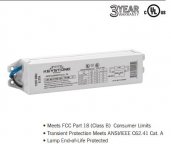
The big picture... Testing lab I linked to explains why its part 18, UL and GE tested the product to FCC part 18. I find a picture of a similar electronic ballast, it labeled with FCC Part 18. I look up the literature from every major electronic ballast manufactures (Phillips, GE, Espen, Osram, Keystone etc) and its the same thing, FCC Part 18. Energystar.gov... Part 18.
My interpenetration of the FCC's rules says its Part 18. But your still sure that Part 18 was the wrong standard for the GE (and other electronic) ballast? UL and GE (and a huge bunch of others) have some splainin to do!
Attachments
Last edited: