To avoid these ads, REGISTER NOW!

Critique My Electrical Before Inspection

FarmerPete

Well-known member
Joined
Jul 24, 2013
Messages
258
Location
Lansing, MI
So, I've moved a 60 amp sub panel from my basement to my garage, and wired up 18 20 amp outlets, and two 50 amp outlets. I must say, I've learned a lot about electrical. I'm planning on calling for an inspection soon. If anyone notices any problems, please let me know. Every outlet works. Every 120v garage circuit is chained off of a GFCI. I've verified GFCI functionality of every outlet with my little tester. I'm getting 240v from my 50 amp outlets with my multimeter. This was my first time working with electrical other than replacing an outlet or a switch. While I hope that everything is to code, I am sure I'm violating code somewhere.

Here is my panel. I'm going to build a chase cover between the panel and the wall cavity using OSB to keep the wires protected. My plan is to make it removable.
attachment.php


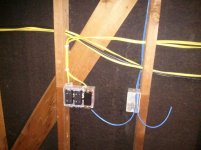
Here's one of a few places I had to move the cable path uneven due to lack of planning. The 2x4 has a bit knotched out for the diaganol board. I didn't want to weaken it further in that spot. I also have my wiring for the two Ethernet ports that I'll be terminating once the walls are together.
attachment.php


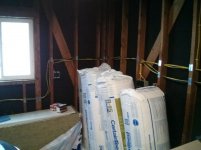
Here's a long shot of the rear garage wall.
attachment.php


Another shot of the rear wall.
attachment.php


The plan is to eventually have my workbench in this corner. Hence the double outlets.
attachment.php


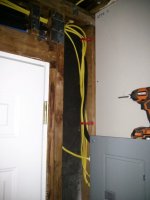
Here's the cables going over the door. I'm not sure if this is too many cables too close together. I'm hoping not.
attachment.php


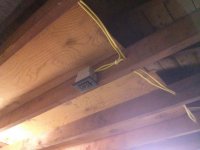
One of the ceiling outlets where I'll be attaching one of my shop lights.
attachment.php
 

Attachments

  • 2013-12-01 16.06.50.jpg
    2013-12-01 16.06.50.jpg
    140.5 KB · Views: 1,890
  • 2013-11-21 20.18.54.jpg
    2013-11-21 20.18.54.jpg
    133.8 KB · Views: 1,815
  • 2013-11-21 20.19.15.jpg
    2013-11-21 20.19.15.jpg
    141.7 KB · Views: 1,806
  • 2013-11-21 20.19.57.jpg
    2013-11-21 20.19.57.jpg
    138 KB · Views: 1,809
  • 2013-12-01 15.54.51.jpg
    2013-12-01 15.54.51.jpg
    141.7 KB · Views: 1,817
  • 2013-12-01 15.55.04.jpg
    2013-12-01 15.55.04.jpg
    141.3 KB · Views: 1,826
  • 2013-12-01 15.55.29.jpg
    2013-12-01 15.55.29.jpg
    146.2 KB · Views: 1,818
To avoid these ads, REGISTER NOW!

kd3pc

Well-known member
Joined
Aug 10, 2013
Messages
3,630
Location
Northern Neck
in some areas, your circuits each need their own connector in the panel....can not double up cables in one connector

in my area, you will need nail plates over every hole you drilled in a 2x4 to pass romex for.

All up to the AHJ, so you may be just fine.

Looks better than a lot of work I have seen by "pro" electricians
 

ishiboo

Well-known member
Joined
Oct 27, 2010
Messages
9,481
Location
Oshkosh, WI
in some areas, your circuits each need their own connector in the panel....can not double up cables in one connector

in my area, you will need nail plates over every hole you drilled in a 2x4 to pass romex for.

All up to the AHJ, so you may be just fine.

Looks better than a lot of work I have seen by "pro" electricians

Looks pretty darn good to me too!

I'd be willing to bet 99.999% of areas allow whatever number of wires the connector is rated for.

In addition, the NEC allows 1.25" from the edge of a stud to the hole not requiring protection. So, any hole 1" or smaller centered in the stud would not need a nail plate, and almost nobody installs them when they're not required unless it's an area likely to get a big 'ole screw in it. I'm guessing 99.999% of areas follow this without their own changes as well.
 

Dr.Jones

Member
Joined
Dec 1, 2013
Messages
10
Location
Indiana, USA
Most of the time you shouldn't put the GFI in the ceiling because if it trips it could be hard to reach. You usually don't need bushings on your romex connectors. You may have some interference problems with your RG6 and CAT5 being that close to you line voltage. Good rule is to keep 24" between your line and low volt when you run parallel. It doesn't matter if you cross them. Your CAT5 will most likely be fine because the pairs are twisted to help prevent "cross talk." Your inspector will not care about the low volt. Good idea to use nail plaits, not always very easy to fix later if the drywall goes up and a wire gets hit. Some inspectors may require fire caulk in none insulated areas, they consider the holes the wire goes through a "chimney" i think its stupid but some inspectors can be dicks. Wiring looks good though. Staples are not to close the boxes and you didn't drill the holes 2" from the box ha. Panel looks clean, good job there, cant see in the picture, just make sure you do not have your bond screw in. Its the small green screw that came with the panel. You only need to bond at your first means of disconnect.
 

mooseeater19

Active member
Joined
Nov 29, 2013
Messages
31
Location
BC Canada
Not sure if the NEC allows branch circuits to run through the Main section of the panel , the CEC (Canadian code) doesn't allow it.
 
OP
F

FarmerPete

Well-known member
Joined
Jul 24, 2013
Messages
258
Location
Lansing, MI
in some areas, your circuits each need their own connector in the panel....can not double up cables in one connector

in my area, you will need nail plates over every hole you drilled in a 2x4 to pass romex for.

All up to the AHJ, so you may be just fine.

Looks better than a lot of work I have seen by "pro" electricians

Not sure what this is referring to. I don't have more than one cable in any connectors.
a3araqu7.jpg


Sent from my Nexus 4 using Tapatalk
 

jreaper

Member
Joined
Jan 31, 2010
Messages
5
Hello i have been an electrician for about 15 years and have my masters in 2 states (northern) you work looks pretty good. Like stated before ive seen alot worse by people that call them selves pros

Here are your main code rules for romex/nmb cable
No more than 4 wires through any size hole or its considered bundling.
No more than 2 wires under a staple on the flat not on edge.
Your holes need to be 1 1/4 back from the finished wall surface if less you need nail plates
Most cases inspectors will allow 2 of the same awg wire under a connector smaller than 10awg
Support 6" from box and every 4 after bored holes are considered supported.
No less than 1/4" of insulation beyond your box clamps and connectors
No bends shall exceed 5 times the diameter of the cable ( dont know anyone that follows that)
And gfcis have to be "readily accessible " meaning in reach without a ladder
 

ishiboo

Well-known member
Joined
Oct 27, 2010
Messages
9,481
Location
Oshkosh, WI
Hello i have been an electrician for about 15 years and have my masters in 2 states (northern) you work looks pretty good. Like stated before ive seen alot worse by people that call them selves pros

Here are your main code rules for romex/nmb cable
No more than 4 wires through any size hole or its considered bundling.
No more than 2 wires under a staple on the flat not on edge.
Your holes need to be 1 1/4 back from the finished wall surface if less you need nail plates
Most cases inspectors will allow 2 of the same awg wire under a connector smaller than 10awg
Support 6" from box and every 4 after bored holes are considered supported.
No less than 1/4" of insulation beyond your box clamps and connectors
No bends shall exceed 5 times the diameter of the cable ( dont know anyone that follows that)
And gfcis have to be "readily accessible " meaning in reach without a ladder

Seems to be some generalizations here which are pretty misleading. The NEC requires equipment is installed and maintained with the manufacturer's instructions.

Staples are made up to 4-8 cables. Of course a -2 NM cable has 3 wires within it, none are rated by wires. Some staples only allow a single wire.

Same "connector" I assume you mean the NM clamps, but outlet and breaker terminals/etc. are again like the staples rated by the manufacturer for however many they are allowed to have, what combination, etc.

I've never heard of a maximum bend rating, perhaps it exists but I'd be shocked (no pun intended.) Minimum bend radiuses are there to protect the cable/wire integrity.
 

MrMark

Well-known member
Joined
Jan 25, 2010
Messages
4,626
Location
Southern Cal.
Not to nitpic, but for the sake of accuracy, it's 8" for single gang plastic boxes without integral clamps, 12" for metal and plastic with clamps.

On the wires through the hole, if the hole is firecaulked then this would be correct as I believe 70 percent derating (where it starts to matter) would be applied for 9 or more conductors in combined nm cable. If no firecaulk I am aware of no code section that speaks to the number of wires allowed through a hole. If there is one I'd appreciate a cite or link.

Also, MC cable has a bend radius limitation but romex does not and all I see him using is romex.

I see Ishiboo beat me to it, but there is no rule on the staples or connectors either. It is what the listing of the particular staple or connector allows. The Home Depot brand nm Halex only allow 1. Many other brands allow 2 or more.

I think you are posting based on things your particular inspectors "like to see" rather than the real rules. As an aside, I wish more people would challenge these inspectors and make them give a cite for their "likes".

The problem is that the electricians working for a living don't want to ruffle any feathers and basically do whatever the inspector says even if they know it is wrong. Rare that any homeowner is going to come out and tell the inspector to give me the cite. So, the inspectors just get away with it.
 
Last edited:

ishiboo

Well-known member
Joined
Oct 27, 2010
Messages
9,481
Location
Oshkosh, WI
Not to nitpic, but for the sake of accuracy, it's 8" for plastic boxes, 12" for metal. On the wires through the hole, if the hole is firecaulked then this would be correct as I believe 70 percent derating (where it starts to matter) would be applied for 9 or more conductors in combined nm cable. If no firecaulk I am aware of no code section that speaks to the number of wires allowed through a hole. If there is one I'd appreciate a cite or link.

Another time it'd come into effect is if the wires are run within insulation. And then it's a slight ampacity decrease which often has no meaning, versus a hard limit on the # of cables.
 
OP
F

FarmerPete

Well-known member
Joined
Jul 24, 2013
Messages
258
Location
Lansing, MI
I am planning on insulating the walls if that's going to make a difference.

Sent from my Nexus 4 using Tapatalk
 
OP
F

FarmerPete

Well-known member
Joined
Jul 24, 2013
Messages
258
Location
Lansing, MI
Also, MC cable has a bend radius limitation but romex does not and all I see him using is romex.

I see Ishiboo beat me to it, but there is no rule on the staples or connectors either. It is what the listing of the particular staple or connector allows. The Home Depot brand nm Halex only allow 1. Many other brands allow 2 or more.

Only using Romex and thhn in the conduits. No mc.

**** on the staples. I'm using the ones from home depot. http://m.homedepot.com/p/Gardner-Be...-_-100196642&ci_src=14110944&ci_sku=100196642

I wonder if it's worth redoing. I am finding conflicting answers on line. I suppose it depends on how nasty my inspector is.


Sent from my Nexus 4 using Tapatalk
 

Norcal

Well-known member
Joined
Mar 16, 2008
Messages
13,754
Not to nitpic, but for the sake of accuracy, it's 8" for single gang plastic boxes without integral clamps, 12" for metal and plastic with clamps.

On the wires through the hole, if the hole is firecaulked then this would be correct as I believe 70 percent derating (where it starts to matter) would be applied for 9 or more conductors in combined nm cable. If no firecaulk I am aware of no code section that speaks to the number of wires allowed through a hole. If there is one I'd appreciate a cite or link.

Also, MC cable has a bend radius limitation but romex does not and all I see him using is romex.

I see Ishiboo beat me to it, but there is no rule on the staples or connectors either. It is what the listing of the particular staple or connector allows. The Home Depot brand nm Halex only allow 1. Many other brands allow 2 or more.

I think you are posting based on things your particular inspectors "like to see" rather than the real rules. As an aside, I wish more people would challenge these inspectors and make them give a cite for their "likes".

The problem is that the electricians working for a living don't want to ruffle any feathers and basically do whatever the inspector says even if they know it is wrong. Rare that any homeowner is going to come out and tell the inspector to give me the cite. So, the inspectors just get away with it.

NM (Romex®) does have bend radius,see 334.24

Not sure if the NEC allows branch circuits to run through the Main section of the panel , the CEC (Canadian code) doesn't allow it.

That a Canadian thing, Canadian panels do have a separate compartment for the main breaker, but I understand that is one reason that panels in Canada are sometimes mounted sideways, which is not allowed by the NEC.
 

mooseeater19

Active member
Joined
Nov 29, 2013
Messages
31
Location
BC Canada
That a Canadian thing, Canadian panels do have a separate compartment for the main breaker, but I understand that is one reason that panels in Canada are sometimes mounted sideways, which is not allowed by the NEC.

Thanks Norcal,I like to mount my panels with the Main on the bottom when ever possible , never liked a sideways mounted panel , very limiting to run feeders into. I am surprized it's not allowed under the NEC it is helpful in some situations.
 

Norcal

Well-known member
Joined
Mar 16, 2008
Messages
13,754
Thanks Norcal,I like to mount my panels with the Main on the bottom when ever possible , never liked a sideways mounted panel , very limiting to run feeders into. I am surprized it's not allowed under the NEC it is helpful in some situations.

The reason it' verboten is that , NEC art. 240.81 states that if a circuit breaker is mounted vertical, "ON" must be the "UP" position, one could mount a panel horizontal but 50% of the panel is unusable, so it makes no sense to do so.

All the major manufacturers built loadcenters with the circuit breakers upside down until the NEC no longer allowed it, for example, the ITE Imperial Corp EQ 4, EQ 6 & EQ 8 panels were that way, but ITE Imperial became Gould/ITE, in 1976 & is now Siemens.
 

MrMark

Well-known member
Joined
Jan 25, 2010
Messages
4,626
Location
Southern Cal.
Only using Romex and thhn in the conduits. No mc.

**** on the staples. I'm using the ones from home depot. http://m.homedepot.com/p/Gardner-Be...-_-100196642&ci_src=14110944&ci_sku=100196642

I wonder if it's worth redoing. I am finding conflicting answers on line. I suppose it depends on how nasty my inspector is.


Sent from my Nexus 4 using Tapatalk

I was unclear. My example referred to the metal nm connectors.

On the staples, you have to look at the listing. The blue ones are for 1 cable. There are longer staples there that work for two cables. As I recall, they are white or gray.
 
OP
F

FarmerPete

Well-known member
Joined
Jul 24, 2013
Messages
258
Location
Lansing, MI
I was unclear. My example referred to the metal nm connectors.

On the staples, you have to look at the listing. The blue ones are for 1 cable. There are longer staples there that work for two cables. As I recall, they are white or gray.

I don't have more than two cables going through a NM clamp into a junction box or the panel.

For the staples, the ones I'm using are 3/4". THe package says it's good for 14/3,12/3, or 10/3. I'm using it on 12/2, but I've often got 2-3, and 4 a couple times stapled together. I also used it on 6/2 wire for the 50 amp receptacles. I know it doesn't explicitly state it's fine for 6/2, but I figured 6/2 has to be about the same width as 10/3, and the staples seemed to fit perfectly fine on the 6/2.

Since the studs are 2x4, I wanted to keep the cables in the middle of the stud for protection when running vertical. If I can only use one wire per staple, I would have a very hard time doing that. Certainly, I could run a 2x4 cross brace in the cavity right next to the panel and staple everything individually to it. The main problem I have with doing that is, how the hell do you insulate? Even if I split the insulation in two, it's going to be a pain to insulate there because of the small confined space. But all that aside, a typical outlet has two wires going to it. A feed from the subpanel, and then a feed to the next outlet on the branch. Do I really need to staple them individually? That seems crazy. When I've been at HD/Lowes/Menards, I've looked for staples that were rated for more than one cable, and thus far I haven't found any that explicitly state it. The only staples they sell for 6/2 are the metal ones designed for service entrance cables. I personally feel the metal ones are more dangerous, and I don't like them as much.

These are the only ones I can find that are explicitly stated good for more than one cable: http://www.homedepot.com/p/Gardner-Bender-Multi-Cable-Staples-20-Pack-MCS-20W/100346576#.Up35bsRDtiZ
 

MrMark

Well-known member
Joined
Jan 25, 2010
Messages
4,626
Location
Southern Cal.
You need the cable stackers. Have you seen those? They have them right next to the staples at home depot. They are red and allow like 5 wires to be supported.

On the insulation, yeah, you split it in two to do a nice job. You just peel it back to slip the wires in. It's the right way to do it. Otherwise you will compress the insulation. Take pride in knowing that you are doing it better than the next guy.
 
To avoid these ads, REGISTER NOW!

diggler306

Well-known member
Joined
Jan 25, 2012
Messages
227
Location
Saskatoon, SK
Looks good man! Take pride in knowing you likely saved a bundle of money doing it yourself. Good luck on the inspection - let us know how it goes!
 
OP
F

FarmerPete

Well-known member
Joined
Jul 24, 2013
Messages
258
Location
Lansing, MI
And gfcis have to be "readily accessible " meaning in reach without a ladder

Do you think that me pressing the button without getting on a ladder would convince an inspector that it isn't a problem? I'm 6'3" and the ceiling is only a little over 8' tall. Not much of a stretch. Now my wife, she'd need a step stool.

Assuming I need to remove the GFCI from the ceiling, how do you legally install outlets in the ceiling? Do I have to put the first GFCI on the wall and then chain the rest off that? I could install an outlet right next to my light switch by the house door. It would require running a few more strands of THHN through the conduit to the switch. It shouldn't be to big of a problem, but I may have to get an extender for the JBox at the top. It's already got 8 conductors, and I think I would have to add 4 more connectors in the box. That would bring me to 12, which I think is too many for my current box. ******. I hate buying more boxes. I've made sooo many trips to HD/Lowes/Menards to buy that one or two pieces of conduit connectors or whatnot that I missed.
 

fourjeepin

Well-known member
Joined
Feb 12, 2011
Messages
3,658
Location
Atlanta, GA
Dedicated outlets don't have to be GFCI, right? Just swap that ceiling outlet out for a non GFCI model, and you're good.
 

Norcal

Well-known member
Joined
Mar 16, 2008
Messages
13,754
Doesn't every garage outlet need to be a GFI or on a GFCI circuit?

Yup. More of the exceptions to GFCI requirements are going away with every new NEC edition


This is a copy & paste from the 2008 NEC, need to reload the 2011.

210.8 Ground-Fault Circuit-Interrupter Protection for
Personnel.
FPN: See 215.9 for ground-fault circuit-interrupter protection
for personnel on feeders.
(A) Dwelling Units. All 125-volt, single-phase, 15- and
20-ampere receptacles installed in the locations specified in
(1) through (8) shall have ground-fault circuit-interrupter
protection for personnel.
(1) Bathrooms
(2) Garages, and also accessory buildings that have a floor
located at or below grade level not intended as habitable
rooms and limited to storage areas, work areas,
and areas of similar use

(3) Outdoors
Exception to (3): Receptacles that are not readily accessible
and are supplied by a dedicated branch circuit for
electric snow-melting or deicing equipment shall be permitted
to be installed in accordance with 426.28.
(4) Crawl spaces — at or below grade level
(5) Unfinished basements — for purposes of this section,
unfinished basements are defined as portions or areas of
the basement not intended as habitable rooms and limited
to storage areas, work areas, and the like
Exception to (5): A receptacle supplying only a permanently
installed fire alarm or burglar alarm system shall
not be required to have ground-fault circuit-interrupter
protection.
FPN: See 760.41(B) and 760.121(B) for power supply
requirements for fire alarm systems.
Receptacles installed under the exception to
210.8(A)(5) shall not be considered as meeting the
requirements of 210.52(G).
(6) Kitchens — where the receptacles are installed to serve
the countertop surfaces
(7) Laundry, utility, and wet bar sinks — where the receptacles
are installed within 1.8 m (6 ft) of the outside
edge of the sink
(8) Boathouses
(B) Other Than Dwelling Units. All 125-volt, singlephase,
15- and 20-ampere receptacles installed in the locations
specified in (1) through (5) shall have ground-fault
circuit-interrupter protection for personnel:
(1) Bathrooms
(2) Kitchens
(3) Rooftops
(4) Outdoors
 
OP
F

FarmerPete

Well-known member
Joined
Jul 24, 2013
Messages
258
Location
Lansing, MI
So the lights need gfci outlets, but I can't put the outlets on the ceiling.... So it's either chain them off a wall mounted outlet or get a gfci breaker for big bucks.

Sent from my Nexus 4 using Tapatalk
 

Kevin C

Well-known member
Joined
Aug 4, 2011
Messages
1,653
Location
Portland OR
So the lights need gfci outlets, but I can't put the outlets on the ceiling.... So it's either chain them off a wall mounted outlet or get a gfci breaker for big bucks.

Sent from my Nexus 4 using Tapatalk

Another issue is that multiple florescent lights often will trip a GFCI. My belief is that the consumer ballasts will have more problems than commercial, but I have not had a chance to test them.

On way around that is to hard wire the lights in.
 

Dick in Wisconsin

Well-known member
Joined
Mar 3, 2012
Messages
3,048
Location
Shawano, Wisconsin
So the lights need gfci outlets, but I can't put the outlets on the ceiling.... So it's either chain them off a wall mounted outlet or get a gfci breaker for big bucks.

Sent from my Nexus 4 using Tapatalk

Didn't you say you were going to put a GFCI right next to the switch for the lights? in the same box? That sounded like a great idea. Get a really good commercial grade one, spend a few bucks more for a good with a little pilot light on it.

I'm slowing replacing all the GFIs and GFCIs in our 20 year old house. It appears they are "going soft" ... at least that is how I look at it ... and are prone to tripping. The GFCI in the main bath was daisy chained to the outlet in the master back and then to the outlet in the garage. I turned the GFCI in the main bath to a dead end, put another GFCI in the master bath that is now daisy chained to the garage. I didn't build the house, so I didn't get to spec the electrical. But if I ever build a house, the electrical will be done "right" ... way beyond code. New 1000sf garage/race shop starting in the spring of 2014!
 
Last edited:

mooseeater19

Active member
Joined
Nov 29, 2013
Messages
31
Location
BC Canada
So the lights need gfci outlets, but I can't put the outlets on the ceiling.... So it's either chain them off a wall mounted outlet or get a gfci breaker for big bucks.

Sent from my Nexus 4 using Tapatalk

You could intercept the feeder at the electrical panel and put a gfci recpt or a faceless gfci in a box outside of the panel. If it trips you go to the panel to see which one tripped , breaker or gfci.
 

redlinetoys

Well-known member
Joined
Dec 25, 2007
Messages
69
This is an interesting thread. I am enjoying the productive discussion and am getting a few good pointers myself. Thanks guys.
 

daveroy

Well-known member
Joined
Sep 4, 2009
Messages
735
Location
Omaha NE
I am following this because I am in the process of planning out the electric for my new-to-me shop rewrite...

If all the outlets have to be gfi... How do you plug in a little 120 welder? I was under the impression they would trip gfi circuits.
 

mm08822

Well-known member
Joined
Jan 13, 2012
Messages
5,904
Location
NJ
Your info doesn't show a lighting plan or indicate the number of recepts installed in the ceiling for lighting, but you may want to consider removing all lighting recepts from the ceiling and hardwire the lights into each of the outlet boxes. Hardwiring will eliminate the need for gfci protection in the lighting ckt, where to locate it and the unpredictable nuisance trips - imagine working at night and the lighting gfci trips - depending on what you are doing that could be a real problem.

The code requires gfci's for 120vac 15/20a convenience recepts, but that does not mean every outlet needs it - a receptacle is a type of outlet. So the above suggestion is a practical work-around.

If you decide to keep the ceiling recepts, put a gfci breaker in the panel ($43) and be done with it – you’re 6 days into this post – your time now is worth something. Also you won’t be hitting the trip button accidentally as you could with a gfci recept.

Otherwise your work looks good, so call for the inspection. In the end it's up to the inspector to decide how he wants the job before he gives you the sticker – be it above code or otherwise.
 
OP
F

FarmerPete

Well-known member
Joined
Jul 24, 2013
Messages
258
Location
Lansing, MI
I'd consider hardwiring the lights, but I've already bought the lights. I'm just putting up the cheap Menards shoplights. I've bought 8 of them for $7-$10 each. I'm not sure how many I'll use. I may replace some of the noisy old 12-T analog ballast fixtures in my basement with the new style. That would allow me to not have to stock two sizes of bulbs too. I'm hoping to put the finishing touches on my electrical this weekend. I talked to the inspectors office and got a couple things clarified. I didn't pull a building permit, since I really haven't built much. I am planning on putting OSB on the walls eventually. I was a little confused as to if I needed one or two electrical inspections. I really don't feel like it's necessary to have all of the inspections that a new build would have. The two walls I'm going to insulate were already covered (one with drywall and the other with pegboard floor to ceiling). I'm just going to replace the covering with OSB and fill it with insulation.
 

Norcal

Well-known member
Joined
Mar 16, 2008
Messages
13,754
Maybe you will get this tag after inspection.

IMG_0076.JPG


Just kidding but thought it's good for a chuckle.
 
OP
F

FarmerPete

Well-known member
Joined
Jul 24, 2013
Messages
258
Location
Lansing, MI
Was fixing the issues in my garage, but got slowed down by the subzero weather, week long power outage, and holiday vacations. Here are some updated pictures. Just have to buy some more nail plates.

From this picture, you can see that I added the probably not necessary nail plates. Better safe than sorry though.
attachment.php


You'll notice that I replaced most of the staples with the multi-wire holders. My main concern with it is that it's not rated for 6/2 wire. Having said that, I can't find any staple or cable securing device that is explicitly rated for 6 gauge wire. I can find bigger, and I can find smaller, but no 6 gauge. It was very frustrating.
attachment.php


New wire staples. I used some SE staples for the 6/2 here.
attachment.php


You can see that I moved the GFCI outlet that was in the ceiling to right next to the light switch. I had to put a box extender at the top of the conduit to fit all of the new wires and connectors legally.
attachment.php


Hopefully this addresses any concerns people have. I'm hoping I can get the inspection scheduled for next week.
 

Attachments

  • 2014-01-06 09.02.57.jpg
    2014-01-06 09.02.57.jpg
    138.9 KB · Views: 409
  • 2014-01-06 09.03.18.jpg
    2014-01-06 09.03.18.jpg
    81.8 KB · Views: 411
  • 2014-01-06 09.03.39.jpg
    2014-01-06 09.03.39.jpg
    76.7 KB · Views: 405
  • 2014-01-06 09.04.07.jpg
    2014-01-06 09.04.07.jpg
    130.6 KB · Views: 407

pattenp

Well-known member
Joined
Jun 4, 2008
Messages
10,175
Location
Virginia - USA
Do you have the EMT fastened to the wall properly? Should be fastened at least every 10 ft and within 3 ft of the boxes and termination points?
 
OP
F

FarmerPete

Well-known member
Joined
Jul 24, 2013
Messages
258
Location
Lansing, MI
Do you have the EMT fastened to the wall properly? Should be fastened at least every 10 ft and within 3 ft of the boxes and termination points?

Good call. I've got the clips. I had to remove it when I added the outlet there. It's only 3-4 feet from box to box on the conduit, so it's certainly not going anywhere.
 

Falcon67

Well-known member
Joined
Jun 11, 2009
Messages
18,371
Location
Merkel, TX
I am following this because I am in the process of planning out the electric for my new-to-me shop rewrite...

If all the outlets have to be gfi... How do you plug in a little 120 welder? I was under the impression they would trip gfi circuits.

I have 4 convenience plug runs, all headed with a GFCI. I have no trip issues with any of my equipment - welder, etc.
 
OP
F

FarmerPete

Well-known member
Joined
Jul 24, 2013
Messages
258
Location
Lansing, MI
I was thinking of making a non gfci outlet for my kegerator. I know there is an exception for fridges in kitchens. I assume it applies in garages as well.

Sent from my Nexus 4 using Tapatalk
 

Norcal

Well-known member
Joined
Mar 16, 2008
Messages
13,754
I was thinking of making a non gfci outlet for my kegerator. I know there is an exception for fridges in kitchens. I assume it applies in garages as well. Sent from my Nexus 4 using Tapatalk

Never assume anything, because the exception went away years ago.
 
To avoid these ads, REGISTER NOW!
Top Bottom