
To avoid these ads, REGISTER NOW!

Upgrading air compressor plumbing, any advice?

MTW

Well-known member
Joined
Aug 6, 2013
Messages
294
Location
SE Michigan
Strouty, I haven't had time to check back to the forum till now, but wanted to inquire if you have had a chance to fully test your system for effectiveness?
Have you used it with heavy demand while the atmospheric moisture was high and did it work as well as you expected?

If so, where is the moisture coming out of the system at % wise, beginning middle, end?

If not, tell the others to unsubscribe, because I led you down the path....

Your piping looks very good, and I'm sure that it will pay you many dividends in the future.

A few pointers about leaks, and my piping methods.

Threaded pipe fittings are designed to seal by a metal to metal contact of properly formed threads, without any pipe dope or Teflon tape, just a thin film of oil to lubricate the threads during the torque of assembly. Whenever I am piping anything, my main focus is inspecting and cleaning every fitting meticulously before using it, be it new or used. To clean male threads I use a soft wire wheel mounted on an old 1/2HP motor. To clean female threads I use wire brushes sold for cleaning copper fittings in various sizes. Female fittings are blown out before assembly to remove anything loosened by the brush cleaning. Every fresh cut male thread is wiped of excessive cutting oil and then cleaned of small chips with a hand wire brush. Female fittings that are rusty and crusty inside but must be reused, in a pinch, are best cleaned out first with a pipe tap. Then give it the brush cleaning followed with air.

Fittings and cut threads are production work and there will be defects, however a close inspection after a through cleaning will weed out most if not all of them. It's 100 times easier to find this out on the ground before assembly that after its installed in the worst of places and fully pressurized.

I use a lot of scavenged pipe and fittings, and rarely have and leaks in my systems. Even new pipe comes with dinged up male threads from handling, threads full of crud from the oil left from the factory threading operation. I run my threader back over any thread that exhibits slightly damaged threads or dirty (old pipe dope).

For the pipe dope, my favorite is the white Teflon impregnated type (PTFE) it works on all types of materials and is non hardening. There are many brands and they all work well. Teflon tape is something I normally reserve for precision cut threads on brass fittings. Tape doesn't seem to work well on poorly made threads, or wrought fittings such as copper adapters. At work I see some fitters that use both for insurance, tape then dope, but for me I see that as a waste. It seems to me, that's compensation for lack of preparation of the threads before use, in a time saving effort. Normally these are the guys that have to come back to fix leaks the following day. When doping I fully cover the male thread only, then assemble. After tightening I wipe the excess of with my finger and apply it to my next fitting. Then I use a rag to clean any remaining traces of dope, so it doesn't get all over me and my tools while installing.

As to the tightening torque I strive to make it very snug, but not as tight as it will go. I always want to be able to adjust it once I put it in it's finished location and it needs a little tweak to be just right. On the other hand I don't want to have to disassemble a section to tighten a leak either. Future modifications are much easier if you don't have to break your shoulder before the fitting breaks loose. Overtightened fittings will gall the threads making them unsealable and unusable. I learned this while scavenging from behind one particular contractor, they are very big guys. Every female fitting was galled and scrap, and every male also needed to be cut off and re-threaded. These guys had more leaks than most.

I'm not sure if I should share this little trick with some out there, with little common sense, but this is for Strouty, use it at your own risk.

Bending the pipe can save a ton of fittings, and make smaller offsets and angles than available with standard fittings. Standard SCH 40 black pipe is very stiff and designed not to be bent, and to be used only in straight sections. A piping unapproved for pressure use but designed to be bent is SCH 40 GRC (galvanized rigid conduit) this pipe is the same thickness and OD as black pipe but it's metal formulation is designed to be malleable (bendable) and its galvanized inside and out. DO NOT confuse this with IMC ( intermediate metal conduit). IMC is much thinner wall and also much stiffer to bend. These materials come from the same electrical wholesalers and look very similar, so make sure it's GRC if your going to try this. By code each piece of pipe should be marked with it's type on it. Bending can be accomplished with standard conduit benders, GRC requires a bender one trade size larger than equivalent size EMT (electrical metallic tubing).

This would be a good solution for bringing drops down from a sloped upper trunk run. It is also good on the drop side taps, where you need a small offset away from the wall, to install a filter regulator in a small space. Using bent pieces means you will need a handheld threader to thread the piece after forming it. In practice you will usually require a union near the bent piece to facilitate installing it. Because of the swing of the bent section hitting other obstructions. I have used this arrangement many times over the years and have yet to have a problem with it. I don't however recommend it to eliminate standard solutions when those will work. Don't bend a 90 when a standard elbow will work. The more it's bent the more stress the metal has on it.

As another option for plumb drops from a sloped trunk is to hang the trunk from the ceiling or trusses. Point the tees down as suggested earlier and then put an ell headed towards the wall, and another ell at the wall. With these two ell's, you can adjust easily for the slope of the trunk.

As to the flexible connection to the compressor I use the metal hose variety called a flexible metal hose or sometimes referred to as a flexible coupling. An example can be seen here: http://www.grainger.com/Grainger/HOSE-MASTER-Flexible-Metal-Hose-6MP35?Pid=search these can be found at industrial plumbing and refrigeration supply houses. These can handle the high temperature, pressure and severe vibration from larger compressors. They don't bend well in shorter lengths, and are best used in a more or less straight section. This however is overkill for a small home compressor that is seldom used.

To the detractors of my methods, I clearly stated that my methods are unconventional, but they are tried and true and work well for my customers. If you like the conventional wisdom, use the picture example provided at the beginning of this thread (post#2).

To the admirer's thanks for all of the kind words, much appreciated. I love sharing knowledge with like minded folks that don't mind thinking out of the box, when I can find the time. I normally share with folks in my circle, but branched out to the folks here because I found the site interesting and informative.

Keep this thread going, submit your ideas or criticisms. By the number of views already this is an interesting topic for lots of folks.

If you like my unconventional line of thinking, check out this thread on shop ventilation ideas.
http://www.garagejournal.com/forum/showthread.php?t=211121
 
To avoid these ads, REGISTER NOW!

sberry

Banned
Joined
Jun 18, 2005
Messages
35,747
Location
Brethren, Michigan
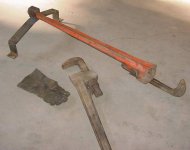
This little gizmo has since been painted. Handy for fabbing long sections on the floor.
 

Attachments

  • pipe wrench holder 1.JPG
    pipe wrench holder 1.JPG
    28.2 KB · Views: 107
  • pipe wr hold.JPG
    pipe wr hold.JPG
    52.9 KB · Views: 100

sberry

Banned
Joined
Jun 18, 2005
Messages
35,747
Location
Brethren, Michigan
I like the description MTW provides of tightening fittings, it should be a sticky. These threads remind me to do my own maintenance or upgrades. I just went thru and considered that the air has 2 comps on it, the second is backup, 99.5% or more of the air we use is made with 1, I killed the breaker. If we get a hose pop when its unattended at least we ruin only one unit.

In some threads I advocate for simplicity and minimalization when it comes to air. Turn one simple service valve off,,, or have few connections to minimalize paracitic leaks that air can be stored. I have air 24/7 just like electric, while we got 300 recepticals for it we serve multiple men on essentially 3 or 4 outlets of air with minor modifications as needed as demands become more obvious.

You can only use so much, can body work and paint a truck with a single hose.We don't have any connected 1/2 hose, all 50 ft 3/8 stock pieces, a couple 25's for whips out of the ceiling at hoist. The 2 or 3 times I needed heavy air guns in the shop I grab 50 ft I have hanging out of the way and connect direct, unplug a reel and connect. So simple.
 

All

Well-known member
Joined
Mar 28, 2013
Messages
606
I have NOT had very good luck at all with the "Great White" Teflon impregnated non hardening pipe dope by Oatey on brass fittings for water pressure to 3,500 psi. I selected this pipe thread lubricant sealant due to it's 10,000 psi pressure rating, and 400F temperature rating.

But all the pipe joints where this white Teflon compound was used, all tightened to within micrometers of their life, still leaked. A lot of frustrating work to have to completely undo, as the equipment cannot practically be pressurized partially like an air system, because several system safety components were downstream of the replaced components, and everything had to be connected before being pressurized.

I replaced all the leaking joints with "Blue Monster" Teflon tape by Mill-Rose. This PTFE tape is blue in color, and is not to be confused with the copy cat house brand label sold at Lowes that is called Blue something, but is not the same stuff (although both are made in China). I applied the Blue Monster tape 3-4 wraps around, 2-3 threads back from the opening orifices, and all the leaks went away for good, tested at spike pressures beyond 3,500 psi (water).

So be careful what white PTFE pipe dope you select (pursuant to MTW's recommendations). I would avoid the Oatey brand for that particular product.

On the other hand, I've had great luck and excellent results from Permatex High Temperature Thread Sealant (Item #59235). This product is also a white dope like paste that is non hardening. I used this product successfully on brass, steel, and aluminum NPT fittings carrying fluids at 3,500 PSI and 200F degrees constant, without any leaks. I do not know if there is any Teflon in the Permatex product, but it works to both lubricate the threads on assembly, as well as seal the threads in different metals, with different expansion and contraction rates and amplitudes, in high pressure service.
 

iajonesy

Well-known member
Joined
Feb 8, 2009
Messages
2,467
Location
Iowa
At my workplace we have switched over to LocTite's new pipe dope in stick form. The fitters say it works great is faster,easier,and cleaner than teflon tape or old fashioned pipe dope.

Mike
 

FTG-05

Well-known member
Joined
Oct 11, 2012
Messages
1,535
Location
TN
At my workplace we have switched over to LocTite's new pipe dope in stick form. The fitters say it works great is faster,easier,and cleaner than teflon tape or old fashioned pipe dope.

Mike

This stuff?

0159642w-oCap_hr4c.jpg
 
OP
S

Strouty

Well-known member
Joined
Mar 21, 2010
Messages
38,215
Location
Southern Maine
Strouty, I haven't had time to check back to the forum till now, but wanted to inquire if you have had a chance to fully test your system for effectiveness?
Have you used it with heavy demand while the atmospheric moisture was high and did it work as well as you expected?

THREAD SNIP

If you like my unconventional line of thinking, check out this thread on shop ventilation ideas.
http://www.garagejournal.com/forum/showthread.php?t=211121

MTW, I have not had a good chance to fully test it I am guessing I may be able to do a good test the last week of September. Thanks for all the advice on threads, you should start a thread on threads. I have used GRC before on towers for the lighting systems, you can make so really nice bends with it. As for my threads, I used a wire brush on the external, then cleaned the internal with a bit of brake cleaner to get the oil and stray chips out. I did not have an air source to blow them off at the time. I think a big issue with pipe threads is where they are made. I had some made in china ones that would not seal no matter what I did, I did not have even one bad fitting that was made in USA by Ward. I tightened most things to very tight, but they could go more if needed. I used unions so that I would be able to easily reposition the drops. I will report back once I have everything done. I am actually chasing a leak, but I have only been to the shop for a couple of hours in the last couple of weeks due to work. I figure that is a good thing though.

This little gizmo has since been painted. Handy for fabbing long sections on the floor.

That is a great idea, it takes away the second man or the smashing your knuckles into the floor issues.

This stuff?

0159642w-oCap_hr4c.jpg

I have not used that for sealant, but I have used the thread locker like that for years. I find that it works well and is easier to put on small parts. Now I will have to get some and try it out for thread sealant too.
 

59 wagon man

Well-known member
Joined
Oct 25, 2010
Messages
1,589
Location
hollywood fla
Here are some ideas that you may use if so inclined, I've been doing it this way for years at my own shop and customers I service. This go's against the common school of thought, such as provided by the sample link you provided.
Compressor%20Piping%20Sample.jpg


And here is the reasoning...

1)Temperature of the air. First thing to recognize in moisture removal and rust control is the temperature of the air. Compressing air makes it hot, hot air holds more moisture, heat raises the dew point. The dew point is the temperature where condensation occurs. You need to cool the air before condensation can occur to effectively remove water from the system. The most condensation collection inside the piping trunk is usually within the first 20-30' of piping where the air gets a chance to cool after leaving the hot compressor tank. If you look at most heavy duty industrial units, they have an after-cooler radiator right on the side of the compressor to help dissipate the heat as soon as possible.

You can build your own radiator out of piping to dissipate the heat as soon as it leaves the compressor tank, such as done in this post.
http://www.garagejournal.com/forum/showpost.php?p=960267&postcount=38 I have seen this method used in bump shops in the past, and I suspect it works pretty good, when done properly.

2) Slope Pipe. My method is a little different. I just use the main trunk piping to cool the air. Then install it like a plumbing drain system would be, sloped 1/4" per foot or more to a drip leg drain.

Your sample drawing shows this slope to drain, however I think the slope is backwards from the way it should be. The way the sample shows it, any condensation in the trunk pipe is forced all of the way to the end of the run before it can drain off to the drip leg at the end of the run. Therefore any air passing over the water accumulating in the bottom of the trunk pipe can pickup more moisture.

Sloped back towards the compressor is more ideal, this is where the moisture is coming form, and usually much closer to where the actual dew point occurs inside the piping, especially on systems that are not run very hard (hot). To reference the sample drawing again, this is where you really want/ need a drip leg drain point, and it is lacking one there. Most of the condensation occurs early in the piping and should be removed as soon as practicable to prevent buildup and rusting of the system. Normally about 70-80% of the system moisture can be removed at this point.

I have serviced Industrial systems with a 3" trunk piped just like the sample is and the trunk became so full of water that no air could flow to the drops, from the water buildup almost entirely blocking the flow of air. Any air that did escape through the water blockage was at 100% humidity, and didn't bode well for their tools or paint jobs. The drain at the end had been neglected so long that the rust sediment completely blocked off the drain valve even when it was opened under pressure.

Another advantage that can be had by draining the trunk at the compressor end is the combination of drains. Where the sample drawing shows the flex hose connected to the trunk riser, install a tee here with the supply hose coming in the side inlet, and a drip leg out the bottom. Keep the drip leg pipe the full size of the trunk run, as long as possible and put on a drain valve. From the bottom of the drain valve reduce down to 3/8" polyethylene tubing. Install a polyethylene tubing fitting in the tank drain after the drain valve. Combine these two 3/8" tube drains into one manifold and install an automatic drain valve with timer. In this way the tank and trunk pipe can both be drained automatically with the same automatic valve, adding convenience and saving money, with only one automatic drain valve. Usually this type setup will remove about 80-90% of the condensation from the system, and help prevent rusting of the trunk piping and bottom of the tank. All while saving you the hassle of trying to remember to manually drain the system as you should.

A word of advise about automatic drain valves. Most commercial units come with 1/8 or 1/4" pipe size fittings, and the actual orifice hole inside the solenoid valve is usually an 1/8" or less. This does not work very well when you have scale and rust coming out of the tank bottom and trunk piping. It will clog the small orifice, cause erratic operation of the valve, the valve no longer drains and usually sticks open when debris gets in the seat area. This can be remedied by installing a larger solenoid on the existing timer control box.

I try to keep all drain lines no less than 3/8" ID to pass scale and crud particles. For the solenoid valve I use 1/2" NPT port units which normally have a 3/8" orifice in the valve body. While piping this drain/manifold setup if you add some extra ports you can install drain tubing from your other trunk drip legs, coalescers, aftercoolers, and refrigerated dryer if you have them. Run all polyethylene tubing drains downward, in a loop fashion, for it to collect water in the tubing, then back upwards to follow the trunk piping back to the drain manifold. Once the valve opens all collected water slugs in all the drain's tubing's will be forced back to the drain manifold. One last thing is to install a globe valve at the output of the drain solenoid, to throttle the output as required. When you have several drains connected to a single manifold you get a lot of output all at once, and is unnecessary to get rid of the condensate.

Here is an example of one unit I constructed for a problem job at a customer site.
Drain%20manifold%20construction.jpg

The left upper rail is for system components that had their own automatic drain valve, it dumps downward to the outlet to the oil/water separator tank. The right rail is for all of the constantly pressurized system drains that I spoke of above.

Continued...

a lot of good info here except draining back to comp. if water flowing away from the comp will pick up moisture then it will def pick up water while pushing up thry it. drain away from the comp and the water will separate and drain off quicker. I live in so fla and we all know how humid it is .never have any water issues. this comes from yrs of steam heating experience where water in a steam line not only can cause water bubbling out of the radiator byt water hammer so severe it can burst pipes and fittings. come out of the comp into the side or BYLL of the tee ,install a drip leg in the bottom for a drain and then run straight up to the highest point and slope downhill from there
 
Last edited:
OP
S

Strouty

Well-known member
Joined
Mar 21, 2010
Messages
38,215
Location
Southern Maine
So, I know everyone is curious...... After using a needle scaler for about 30 minutes, I checked all of the drops, no moisture in furthest from compressor, no moisture in third from compressor, and definitely moisture in the second drop away from the compressor. The one at the compressor had very little water as well, but I figure that was due to the first section of pipe being warmer than the rest. I will be using it more tomorrow and will report back. I also have a warning for people buying black beauty from tractor supply. It *****, it had big threads of glass not even broken and it kept plugging up my sandblast gun. At first I thought it was moisture, but it was not, as soon as I changed media brand the gun worked perfectly. Now I have to find a way to sift the big **** out or not use it. I tried to take some pictures, but it is kind of hard to see. I will upload and post those as well. So far I am agreeing with MTW's way of thinking on the plumbing.
 
OP
S

Strouty

Well-known member
Joined
Mar 21, 2010
Messages
38,215
Location
Southern Maine
Here are the pictures of the sandblast media. These examples were all through the media and I think it was causing the gun grief. It is designed for 12 grit media and smaller, this was suppose to be 20/30 grit. I ended up using 30/40 grit and it cleaned the heavily rusted steel ten times better than the 20/30 grit did.


MTW

Well-known member
Joined
Aug 6, 2013
Messages
294
Location
SE Michigan
Hi again, as a follow up I thought I'd post a follow up on what not to do when installing your piping system. This is an example of what I commonly come across in my field work. The following system was installed by a customer and requested wiring for a new 7.5HP screw compressor. I took these shots during my electrical install and thought I could share these to get across my points made during earlier posts on this tread.

The pics first then a little discussion on why not.

Front Left & Oil Water Separator
FrontLeft.jpg


Front Right
FrontRight.jpg


Automatic Drain Assembly
Automatic%20Drain.jpg


Outlet Connection
OutputConnection.jpg


Trunk1
Trunk1.jpg


Trunk2
Trunk2.jpg


Trunk3
Trunk3.jpg


Trunk5
Trunk5.jpg


Trunk6
Trunk6.jpg


Trunk7
Trunk7.jpg


To start with this particular customer is very educated and is always in the interest of doing things the right way with the best materials and equipment. One of the employees stated that one of the reasons to install this machine was to help eliminate excessive moisture in their existing system. I want to show you that if you don't slope and drain the system as discussed previously, you will have water problems, eventually.

The compressor is a top notch unit and I have connected many of these units in the field. These brand units normally come with a built in after-cooler and refrigerated dryer as a self contained unit. The salesmen of these units really play up these extra features as a selling point. Many customers are so oversold on these features, that they often point them out to me, while we are discussing their install. But I can tell you from personal experience that the output of these machines is not very dry at all, when they are run long and hard, making lots of heat. Like I said previously when the air and pipe is warm or hot no condensation occurs until it cools off.

The unit to the left of the compressor is an oil/water separator. It receives the drainage discharge from the compressor and drain lines and separates the oil from the water and puts them out different ports for collection and disposal. Very similar to how a grease trap or oil skimmer works, float the oil and drain it off with baffles and skimmers.

Behind the unit is the automatic drain assembly. It is connected to three connections from the unit. The bottom is the tank drain. The top one is the output line going to the trunk piping. The poly tube from the upper back of the unit is from the internal refrigerated dryer condensate. You can see the automatic drain timer solenoid on the floor with the tube and electrical connections. This valve appeared to have a large port as suggested earlier, as it had a 1/2" die cast connection to its inlet. On the oil/water separator you see three poly tubes from all of the drain sources, manifolded together. This is much the same type thing here as suggested with the fabricated drain manifold I showed earlier, mine just had more ports for more drains.

Also you can see that there is a drip leg from the main output line pointed down with a copper tube connecting it to the tank drain line. This will bleed gross liquid from the discharge pipe before it will get to the coalescer filter. Then comes the coalescer, this particular one is the automatic float drain type. When it gets full of water the float opens the drain to empty it automatically. I see the placement of the coalescer at this point in the system less than ideal. At this hot spot in the system the air will likely be too hot (high dew point) for most of the moisture to coalesce out here. Most likely condensation would be more complete 20' further down the trunk than here.

Output connection. This is a piece of hydraulic hose more than adequate for the service it being asked to do. However you see it sloping downward towards the main trunk line. The trunk riser has no drip leg to carry away the water, so this hose will become a water trap. The way its pictured any water draining back from upstream trunk would have to go back through this hose to the coalescer drain. Along the way it would become trapped in the hose, because the dip in the hose is more than one pipe diameter in depth, creating a P trap just like your sink drains. Any air exiting the system will be forced through this standing water and will surely get re-humidified if not completely saturated with moisture, before ever getting into the trunk. A drip leg installed here and connected to the automatic drain would be the ideal solution. Both the trunk pipe and compressor output hose could drain automatically, allowing no water to stand in the airway.

Shop Trunk Piping. The pictures are ordered to show the trunk progression as it courses through the shop to connect on the other side of the building to the existing reciprocating compressor system, and a bit beyond there.

When it leaves the compressor corner it's pretty level, as it crosses the header, it starts running uphill before it penetrates the wall into the next room. In the next room it turns up again to follow across the building on the bottom of the truss. At the other-side of the building it turns up again to connect with the existing compressor trunk manifold mounted high on the wall. At no point in the trunk is there a drain drip leg. The piping is generally sloped back towards the compressor. As it is, any water anywhere in this trunk run will be forced to drain back to the coalescer bowl behind the compressor, that is the only exit point that there is in the first 60' of pipe. That's a lot of pipe to drain all the way back to a 3/8" poly tube on the coalescer bowl, even while it's taking on water from the compressor too. If you look at the latter trunk pictures you will also see other changes in elevation of the piping where water will be trapped if it's in the piping. The old system piping also lacked adequate drainage for condensate and un-sloped main trunk runs, leading to liquid slugs accumulating in the piping.

The solution to a situation such as this is to drain early and often in the beginning of the system, so there is nowhere for water to accumulate where it is likely to first to condense. As I stated in an earlier post, my methods are to remove the water as quickly as possible near the beginning. So that it will eliminate the need to rework a half mile of existing piping in the ceiling that is also not installed to drain. If you can completely dry the air before it hits all of the old downstream water traps, then you can forget about them, as there is no water for them to collect. In existing sections of piping that are already likely under standing water, I will drill and tap a drain hole in the lowest section of the trap, drain completely, then install a pipe plug. If the front end of the drain system is working good, then no water will be available (dry air) to collect in the trap. You can occasionally remove the plug to confirm that the system is dry and no longer collecting water.

In this example to remedy the situation.

1st I would install a drip leg drain on the trunk riser next to the compressor. Connect the bottom of this drip leg to the automatic drain system with poly tubing.

2nd. In the adjacent room, right where the trunk pipe turns up the first time, I would install a drip leg here. From the bottom of this drain connection point I would install a poly tube, back to the automatic drain system.

As an alternative to just a drip leg collection point here, I would consider relocating the existing coalescer here. This is about 20' of pipe from the compressor and it would be much more effective here. I would rework the pipe to turn it down first, to the coalescer, installed low where it can be serviced, then back up to feed the overhead trunk. From the drain of the coalescer, install a poly tube back to the automatic drain.

This would be the most effective as the final coalescent point, with reduced temperature, gravity pulling the water down, coalescer extracting moisture and then dry air heading up to the existing water traps in the system.

3rd. A the end across the room near the old compressor I would install another drip leg on the lowest point. There I would place a manual drain valve to check the system to ensure that all moisture is completely removed from the system before entering the existing piping with its many water traps. If after testing the system at this point any water was still found to be accumulating I would install an additional automatic drain, to finish it off.

The moral of the story is make sure your system is designed to drain well and automatically. I don't care if you like your trunk to slope downstream or upstream, just make sure it's sloped to drain somewhere and eliminate water traps. Collect the moisture early and often in the system and forget about the downstream problems. Run your poly drain lines back to a main collection point to simplify servicing the system.

Every piping layout is different and so will yours be. Uses the principals laid out in this thread to design your system to work for you
 

SatisTraction

Well-known member
Joined
May 28, 2013
Messages
122
I just finished this up today. here is the outlet headed up and the 1st blowdown.


across the garage wall with lots of fall. notice the plugged "T" for expansion.


another "T" here for expansion and the only air tap.


last blowdown. the blowdowns will have a 3/8" ****** and blow down to the outside.


FTG-05

Well-known member
Joined
Oct 11, 2012
Messages
1,535
Location
TN
MTW, that's an excellent little treatise, I appreciate it!

When I design and install my air compressor plumbing, I plan to design it just as you discussed.

Thanks,
 

CNGsaves

Well-known member
Joined
Sep 26, 2012
Messages
13,233
Location
KS and OK
^ ^ Satistraction ^ ^ I would add a drop between the two garage doors and a hose reel mounted up on the wall, as that is wasted space anyway.

Nice black pipe steel airline system. :thumbup:
 

CNGsaves

Well-known member
Joined
Sep 26, 2012
Messages
13,233
Location
KS and OK
Question for MTW . . . . is Kaeser rotary screw compressor more "efficient" at producing dry air as effectively you have nothing in terms of tank or Franzinator to drop out moisture (except it has high-end aftercooler and refrigerated dryer)?? Any systems you've done with a rotary screw feeding a tank??

Also at Trunk 5, looks like there is conventional horizontal compressor that is supplementing the compressed air in the line . . . that right (thus 2 sources of compressed air)??
 
Last edited:

MTW

Well-known member
Joined
Aug 6, 2013
Messages
294
Location
SE Michigan
CNGsaves, as far as I've witnessed screw compressors produce just as much water vapor as a piston pump, its a function of what it's breathing in. Usually they pump more oil out into the system than a piston pump.

As to a tank this unit has a built in receiver tank on the bottom of the unit, it appeared to be about 50Gal capacity. You can see the tank drain line exiting from the bottom of it. Every other large screw system that I've seen always has a external receiver tank for storage.

An Aftercooler is an air to air heat exchanger with a fan source across the coil. On large piston pumps these are installed on the side of the belt guard using the fan blades on the compressor pulley to move the air. Screw units either have a separate fan, or a takeoff of the main motor for the fan. On piston pumps the aftercooler coils is usually installed between the 2 stages on the pump.

As to a Franzinator, that was a new one for me, had to look it up to see what you were referring to. For others some links here, http://z6.invisionfree.com/ToolBoxTalk/index.php?showtopic=1460

http://s6.invisionfree.com/ToolBoxTalk/ar/t829.htm

To me this looks to be a water-cooled dryer coalescer. Sort of a poor mans refrigerated dryer, requiring no refrigerant, but instead a large tank of water and a pump to circulate it. Most commercial solutions use the refrigerated variety to eliminate the water cooling tank and replace with refrigerant which can become much colder therefore more effective. The unit in question has the refrigerated dryer built in internally, the drain line from it is the poly tube exiting at the center rear of the case.

The existing reciprocating compressor you see mounted high on the wall is the old system that was running the shop before the screw install. It will be left in place as a backup system, not operated in parallel. I do have a customer that does operate two screw compressors in parallel. A 25HP unit provides for the daily needs. A 100HP unit provides the additional oomph during periods when they spray their concrete (shotcrete).
;)
 

SatisTraction

Well-known member
Joined
May 28, 2013
Messages
122
^ ^ Satistraction ^ ^ I would add a drop between the two garage doors and a hose reel mounted up on the wall, as that is wasted space anyway.

Nice black pipe steel airline system. :thumbup:

thought about that but with a 2.5 car garage I really only need one drop :sad:
 

MTW

Well-known member
Joined
Aug 6, 2013
Messages
294
Location
SE Michigan
Here is a sample of a open (covers removed) screw compressor with a built in after-cooler, this is an older 50HP model being retired. You can see that this one has a separate fan blowing through the coil mounted on the top of the unit. Basically an air to air heat exchanger. This coil would make an excellent after-cooler for a small shop system, without the fan or a smaller one. The surface area is large, and its designed for the pressures involved. This larger unit has to be connected to an external receiver tank, not enough room in the frame for inclusion.

LEFT HAND
LH%20Screw.jpg


FRONT
Front%20Screw.jpg


RIGHT HAND
RH%20Screw.jpg


AFTERCOOLER
AirAftercooler.jpg


The latter pics are of the separate refrigerated dryer, with 3" inlet/outlet fittings. The refrigerant compressor is in the back of the unit. Basically the inside of the unit is two large coils of copper tubing placed together to transfer the heat from one to the other. This coil assembly is then encapsulated in a block of foam for insulation. This unit was from a 100HP system. This is not your poor mans solution, its big, expensive, and cost plenty to run. It accomplishes the same thing as the Franzinator mentioned earlier, but better.

FRONT
DryerFront.jpg


REAR
DryerRear.jpg


I can't stress enough the importance of thinking through your design and forcing the system to drain properly, early and often. This dryer was removed from a large system that I built the automatic drain manifold for, mentioned earlier. It didn't do its intended job, even with a large air to air after-cooler installed in front of it in the piping. And the compressor had it's internal after-cooler. No matter how much equipment you may throw at the problem, you will still have water issues, if you don't design and install it properly. At this project, my modifications using the principals described in post #2 earlier solved the problem entirely and requires little oversight by the plant personnel to keep it working properly. Reworking the existing piping near the pumps to drain and installing many collection point headed to the central drain point, collects it all at one place. And that's for 125HP worth of throughput, a demanding application with lots of oil and water to deal with, not to mention the 60 years of pipe scale. I will try to find the pictures from that install to post for reference. If I can't find em I'll try to remember to get some fresh ones next time I visit the plant it's located in.
 

MTW

Well-known member
Joined
Aug 6, 2013
Messages
294
Location
SE Michigan
Here is the pics I could find from the beginning of the install. These pics were from the beginning (cleanup) part of the install. The system was temporarily connected to get the customer up and running first, then a scheduled time was used to do a complete and proper install. I can't find the finished pics now so I'll wait to comment much on them until I get some of the finished ones.

Old Drain Manifold Setup.
Original%20Drain%20Manifold.jpg


Modifying an existing drain timer for a larger external drain solenoid.
Modifying%20Drain%20Timer.jpg


Modifying%20Drain%20Timer2.jpg


Drain%20%26%20OilWater%20Separator.jpg


Inside the Oil/Water Separator
Inside%20OilWaterSeparator.jpg


Beginning of New Drain Manifold Install
Beginning%20Drain%20Rework.jpg


New Equipment to Install
New%20Equipment.jpg


Variable Speed Screw Unit
Variable%20Speed%20Screw%20Interior.jpg


Trunk Before Piping Rework
Trunk%20Before%20Drain%20Rework.jpg


Temporary Piping Install
TemporaryPipingConnections.jpg


TemporaryPipingConnections2.jpg
 
To avoid these ads, REGISTER NOW!

FTG-05

Well-known member
Joined
Oct 11, 2012
Messages
1,535
Location
TN
[snip]

As to a Franzinator, that was a new one for me, had to look it up to see what you were referring to. For others some links here, http://z6.invisionfree.com/ToolBoxTalk/index.php?showtopic=1460

http://s6.invisionfree.com/ToolBoxTalk/ar/t829.htm

To me this looks to be a water-cooled dryer coalescer. Sort of a poor mans refrigerated dryer, requiring no refrigerant, but instead a large tank of water and a pump to circulate it. Most commercial solutions use the refrigerated variety to eliminate the water cooling tank and replace with refrigerant which can become much colder therefore more effective. The unit in question has the refrigerated dryer built in internally, the drain line from it is the poly tube exiting at the center rear of the case.

[snip]
;)

Actually, the Franzinator is just a passive compressed air cooling system relying on physics and mechanics to cool and dry out the compressed air.

It's a tube with the incoming compressed air coming in the bottom third of the tube (usually 2"-3" diameter or so), the air is forced to chang direction, causing the water to drop out and the air to go out the top.

Here's a pic of my version of the Franzinator, a 5' long 5"x5"x 3/8" thick rectangular tubing.

airdryer.jpg
 

MTW

Well-known member
Joined
Aug 6, 2013
Messages
294
Location
SE Michigan
FTG-05, How well does your Franzinator work for you? Does it remove all of the moisture, if not all how effective is it ? Do you use it for the portable compressor on the shelf?
 

FTG-05

Well-known member
Joined
Oct 11, 2012
Messages
1,535
Location
TN
MTW,

It works very well, I get a lot of water out of it, very little out of the compressor tank. It's easy to drain the franzinator, a PIA to drain the compressor tank.

The portable compressor above the franzinator is no longer portable since it's hard plumbed to the franzinator. (BTW, I bought that compressor using a gift card from my wedding in 1994, well before the WWW became a reality along with all this knowledge of how to select an air compressor. Shorter version: Gift Card $$$ = size of air compressor).

I've re plumbed it since this pic was taken.

Compressor head to bottom of franzinator through the unloader valve (i.e. franzinator is always full of air) >>> air rises the full length of the 5" long 5"x5" tube >>> air then goes to the compressor tank from the top of the franzinator >>> output quick disconnect to air line >>> air tools.

When I install a new air compressor in my new shop, I'll plumb it so all my compressed air goes through this franzinator prior to entering the main trunk line. I'll probably have to shorten it about a foot or so, plus make a new 1" inlet and outlet.

Thanks,
 
Last edited:

MTW

Well-known member
Joined
Aug 6, 2013
Messages
294
Location
SE Michigan
Follow on Update with pictures from earlier posts on this thread, namely 2,3,139,140. I made it back to the plant where the automatic drain system I spoke of earlier was installed. I didn't have pictures of the finished system to share so here they are. This system was installed/modified in 6/09, it is now 10/13 and it has worked flawlessly, without any maintenance by the customer except for cleaning/emptying the oil water separator.

First the automatic drain manifold. The left rail labeled Automatic Drains is for devices that have their own drain timer or float drain. These drain at their own time frame, not with the drain solenoid. The right rail labeled Manual Drains is for all of the drip line drains and devices that don't have their own timer or float. These lines all drain at the same time when the timed solenoid opens. The gate valve after the solenoid is used to throttle the flow into the oil/water separator to prevent overflow and damage. Seven 3/8" poly tubing's can convey quite a bit of flow when all open at the same time. The drip loops in the poly tubing form a slug trap, and permit visual inspection if the trap is empty or not and see the flow while activated. Most of the poly tubes used were natural color to be able to see the water flow action, two were red (labeled Sullair and Tank). The natural tubes allow you to view the flow and get darker on the drains that are removing the most oil. The darkest one looks black (filter 1/4"), this is from the large coalescer bowl, most of the oil is dropping out here. The next dark one (gray) is from the refrigerated dryer. What oil is passing the coalescer is being pulled out here. the remainder of the system drain tubes appear to be almost oil free.

Manifold
Drain%20manifold%20close.jpg

Automatic Drain and Oil Water Separator
CompleteDrainAssembly.jpg

Tank Drain Line & Manual Test Valve
TankDrain.jpg


The system equipment was arranged in linear fashion, by function, to simplify the piping required to connect the components. In post #140 there are pictures of this system at the beginning of this install, a temporary install.

The flow is from right to left in the photos. Starting at the Sullair screw, two drip legs, aftercooler, drip leg, coalescer filter, refrigerated dryer, drip leg, tank, tank drain, two more overhead trunk drip leg, and a downstream test plug.
Sullair Screw Output Drains, One Manual, One Automatic
SullairDripLegDrain.jpg


Second Drip Leg (also serves as freestanding trunk support)
2nd%20DripLeg.jpg


Aftercooler with forced air
Aftercooler1.jpg

Aftercooler2.jpg

Coalescer/Filter Assembly- Biggest Oil Collection Spot
FilterDrain.jpg

Refrigerated Dryer with Drain, Downstream Trunk Drip Leg
DryerAutomaticDrain.jpg

DryerDripLeg.jpg

Overall Layout View From Tank End
General%20Layout.jpg

Polytube Lines with Drip Loop around union, allows another trap point and visual inspection for flow and standing water. It was working so well that I couldn't find any poly line to photograph a slug of water in the lines, to demonstrate what I was talking about previously.
PolytubeLinesTrapLoop.jpg

Overhead main Trunk Drip 1
If you notice here, this is the last collection point before the trunk leaves the area to supply robots. The tube here appears as clean as the day it was installed,
MainTrunkDrip1.jpg

Production Trunk Line 1
ProductionTrunk1.jpg

Production Trunk Line2
ProductionTrunk2.jpg

Production Trunk Line Test Plug.
This test plug allows manual testing for water at the lowest collection point before the trun goes uphill again to the critical production equipment. If any water was found here, another drain tube could be added, but it was found to be not required.
ProductionTrunkDrainTest.jpg


As you can see the existing trunk piping was installed without consideration for draining the water, and is very typical. This is why it's so important to get the moisture out of the system as soon as possible, and not have to modify all of the downstream piping that is not arranged to drain.

Not visible in the pictures is another 100HP screw hidden in a shed outside the building wall, that is used part time for spraying cement. The customer has not said a word about this system since it was installed. It solved the problem permanently and requires almost zero maintenance. All system condensation is gathered at the head of the system and drained automatically to one collection point for disposal, no need for other downstream collection points to fool with.

Always be aware of piping that will allow water to be trapped with no way to drain, as in the above example.

The Moral is drain early and often, and back to one central location.
;)
 

sberry

Banned
Joined
Jun 18, 2005
Messages
35,747
Location
Brethren, Michigan
Lots of good stuff to copy from there. Super nice write up.

Something not so critical at home but for bigger work it sure is nice to have a supply with one step reducing bushings couplings and t's.
 
Last edited:

sberry

Banned
Joined
Jun 18, 2005
Messages
35,747
Location
Brethren, Michigan
I like the franzinator concept and use something similar. I like the fact that MTW keeps preaching the concept of drain drain drain. I am sure he see's this fundamental issue daily and in some form or another in threads on a continuous basis.

I got a couple of dead ends I will take a look at, one of my mains is from a t etc.
 

porschedude996TT

Well-known member
Joined
Oct 28, 2007
Messages
2,384
Location
Santa Maria, California

sberry

Banned
Joined
Jun 18, 2005
Messages
35,747
Location
Brethren, Michigan
I can see his interest is in the dry air, I understand that, my own is the interface of the man meeting the utility. I have reached a limit for the most part in my own shop where adding or improvement is worth any real effort.

Its strictly a matter of effort on other projects, just cant make it much faster and easier by changing/adding fittings anymore. In fact its actually has a bit of suckback for lack of better wording. Last real hydrant I added I simply relocated and added a pipe. I didn't leave "just in case" but removed it. I need a fist full of 3/8 pipe plugs and could cap a few couplers as it is.
 

sberry

Banned
Joined
Jun 18, 2005
Messages
35,747
Location
Brethren, Michigan
I worked on big ones and a sheet load of makeshift deals, lots of hose from the compressor stuff, seen it all, saw a plant production start up with an itty bitty engine drive rental compressor with a hose run in the door. The last thing that ever must have went thru these peoples mind after they hired a crew was the air and working bathrooms, un frikken real but,,, they got the degrees.

Cost them 5x what a planned pro job would have. But,,, this duty demand is different than one man shows and having extra dead end equipment doesn't always make it easier. If I had my heart set on 3/4 main would run it as far as practical or to a split and get to simple 1/2, its just easier and get as much in one size fitting as possible.

When you are all done will be left with a few fittings left to make some mods. If a guy has 3 sizes he never uses any of them.
 

sberry

Banned
Joined
Jun 18, 2005
Messages
35,747
Location
Brethren, Michigan
If you are piped to a regulator from a 2 stage a 1/2 will handle 2 body shop tools under 100 ft, enough to easily drain a 20 cfm comp in short order with continuous use. It will supply both operators at 60% though and 3 can get by in a shop most of the time, I don't recall the specific curve but the higher numbers it gets to around 30% or so.

Obviously sand blasting with 5 hp will be a sole operation, you don't need to provide full service pipe elsewhere, a 1/2 port coming out of the comp will deliver all the air the unit can for this operation, only reason for a bigger port would be one inch impact,,, 50 plus cfm, 1/2 or better hose, a 3/4 would run it for 30 seconds in bursts, ha.

Home garage and small shop really irrelevant.
 

sberry

Banned
Joined
Jun 18, 2005
Messages
35,747
Location
Brethren, Michigan
All this discussion has lead me to turn the breaker off to my secondary backup. If a hose gives it up no use ruining 2 units. I was going to flip it the other day before I went to do blowdowns but forgot and just was a little thrifty and timed a couple things to give recovery, extra power wasn't needed. I keep about 200 gallons capacity charged and use a 3 hp, the secondary come on so rarely didn't even sound insulate it, for sandblast which is outside anyway.

A thrifty pro body guy can do cars with the 3 hp. 5 hp not a problem and you can light sandblast with that. I have about 28 cfm electric, with a new nozzle I can blast a lot before I need to time out, if I was doing it regular might opt for another 5 hp
 
Last edited:
OP
S

Strouty

Well-known member
Joined
Mar 21, 2010
Messages
38,215
Location
Southern Maine
I would like to do an update. My drains are catching water as MTW described. The drip leg farthest from the compressor has consistently been dry and the water becomes heavier as you get closer to the compressor. Now I need to set up a manifold and automatic drain. I will try and post up some video so you can see it first hand. Maybe this weekend I will get around to that.
 

Xicaque

Well-known member
Joined
Jun 24, 2012
Messages
463
Location
I move every 2.5-3 yrs. No choice.
OP
S

Strouty

Well-known member
Joined
Mar 21, 2010
Messages
38,215
Location
Southern Maine
I still do not have a video of the draining, but I will post one by the end of the year. I need to work on my automatic drain system as well as much better water and oil separators. I hope to have the other leg completed as well.
 

C96

Well-known member
Joined
Nov 30, 2013
Messages
1,251
Hi all, new to The Garage Journal.

It’s nice to see people so passionate about their interests, hobbies and work. Really enjoyed reading this thread, especially MTW’s posts, very educational.

I am wondering about 2 things:

• At the beginning of this thread, it was about installing a better plumbing system that would help to eliminate the accumulation of water in the piping system. MTW mentioned a good black iron pipe system installed properly would help considerably at eliminating this problem. He seems to imply the more pipe used in the system, the better for the radiator effect. Ok, this makes good sense.

Strouty, then runs with this information and installs his system, but installs it in
isolated sections. Each section is insulated from the other through a rubber hose.

Correct me if I’m wrong here, but this seems to defeat the whole purpose of
building a continuous metal piping system that creates the radiator effect in order
to dissipate the heat.

Would it have been better to use back to back 90 degree ells swiveled into place
bringing the vertical drops back into the plumb position? At least it would have
kept a continuous metal pipe thus making for a better radiator.
(Just my 2 cents)

• MTW has been drilling and tapping metal piping systems at various locations and
plugging as needed.

Again, correct me if I’m wrong, but this practice seems a little dangerous. I
realize for the most part he is just trying to salvage a bad installation, but I don’t
think the pipe is made to be drilled / tapped like that especially as thin as it is
and still maintain its structural integrity and PSI rating.

Well, don’t mean to come off sounding a little like sberry…LOL. I think this entire thread is great, and very educational.

Strouty, keep up the excellent work. I think your system is great; I just personally would lose the red rubber segments and find a way to keep it all metal. Either way, a great system. Looking forward to seeing it fully automated.
 
OP
S

Strouty

Well-known member
Joined
Mar 21, 2010
Messages
38,215
Location
Southern Maine
MTW mentioned a good black iron pipe system installed properly would help considerably at eliminating this problem. He seems to imply the more pipe used in the system, the better for the radiator effect. Ok, this makes good sense.

Strouty, then runs with this information and installs his system, but installs it in
isolated sections. Each section is insulated from the other through a rubber hose.

Correct me if I’m wrong here, but this seems to defeat the whole purpose of
building a continuous metal piping system that creates the radiator effect in order
to dissipate the heat.

Would it have been better to use back to back 90 degree ells swiveled into place
bringing the vertical drops back into the plumb position? At least it would have
kept a continuous metal pipe thus making for a better radiator.
(Just my 2 cents)

Welcome to the forum, and I never thought of reducing the cooling capacity of the steel. My guess is it is not enough to really do that much, since rubber is a poor conductor of heat, I would assume it would just continue on to the next section. Maybe we can get MTW to chime in. He would have to answer about the drilling and tapping, I have no experience with that at all. I have had a kidney stone issue and have not been able to get to the shop all this week. Hopefully I will be able to get things moving again.
 

JimmyTheMonkey

Well-known member
Joined
Aug 14, 2013
Messages
128
Location
Atlanta, GA
Sorry I am so late to getting pictures up of my setup. Life got in the way of doing fun things in the garage.

I will post so preliminary pictures of my setup and how its performing now and then hopefully find the time this month to take better pictures and post them here.


The tank is sitting on its shipping crate. It doesn't vibrate at all and the shipping crate is easy to move for cleaning, so I found no point in hard mounting the tank to the concrete floor.

I used Milton V style fittings all around. I used 2 Flexzilla 1/2" whip hoses to make my flexible connections as they are readily available on Amazon for $15-20 and it's just a better use of my time to buy them as opposed to making flex lines. As you can see, the first 2 foot whip hose runs a couple of feet to the wall to the copper piping system. I used 1/2 Type L copper pipe from Lowes. Around 33 feet total. It is a very simple setup, pretty much identical to the crappy drawing I posted on this thread a few months back. I used simple T and L shape 1/2 copper couplers for the bends. I used brass bell hangers to mount the pipe to the wall with Tapcons.

Everything is inclined slightly to run down towards the tank. I dealt with the problem of having the 90* angle couplers by bending the pipe just a little before mounting it to the wall. It doesn't look perfect, as you can see in the pictures, but I don't really care. My compressor is still sitting on the shipping crate, after all!


Here you can see that I plumbed the tank drain by adding a few pieces of brass couplings from Lowes at the bottom to make the drain vale reachable. I also bought some cheap nylon tubing from Lowes that I put on this release valve and at the bottom of all of the drip valves so I can just spray the water into a bucket. This tubing wasn't installed when I took the picture.


The copper pipe runs around 15 feet up my wall, around a 90* corner on the wall, and travels 10 more feet to end up here, at a much more accessible part of my garage. The trunk line takes a 90* turn downward to line with a drip valve. It branches off to the right, through the Milton filter/regulator, through a 4 foot whip hose, and up to the Reelworks 50' hose reel.

It is hard to tell on the picture, but in order to make everything fit the way I wanted, I bolted scrap pieces of 2x4 into the wall above and below the trunk line, and then bolted the hose reel to that. I wanted to make sure that super heavy reel didn't pull or mess with anything. It is very secure, although I definitely needed the help of a friend to lift and securely bolt everything into place.


I have been running this system for around 2 months now and have probably used it a dozen times. I love it so far and I have no complaints. I didn't realize how helpful just being able to blow off things around my shop would be. There are no big leaks, although big changes in weather (common here in Atlanta where it can change 40* in 24 hours this time of year) do affect the pressure in the tank. It was my first time soldering, so I was surprised it worked out well. The solders are ugly, but I overdid it to make sure everything was leak-free. I have never seen any moisture out of my final drain valve. I definitely get some moisture out of my main tank release valve. Once in a while I get some moisture out of the first drain valve near the tank.

I think the system is working well to prevent moisture build up. It was fun to build and looks great. I will post an update sometime next year if anything changes.
 
Last edited:

C96

Well-known member
Joined
Nov 30, 2013
Messages
1,251
Strouty, thanks for the welcome.
Sorry to here about the stone issue.
Hope your doing ok and all is well.
 
To avoid these ads, REGISTER NOW!
Top Bottom