To avoid these ads, REGISTER NOW!

My Electrical Dilemna

brianch

Member
Joined
Dec 16, 2013
Messages
6
My house currently is running on 100AMP service. I have inquired about upgrading to 200AMP service but the cost is frightening at the moment.

I am looking at buying a compressor and a heater + ac for the garage.

The compressor requires a 30AMP breaker @ 240V. Runs at about 22AMPs

The heater requires a 40AMP breaker @ 240V. Runs at 35 or so amps.

Not to mention my polishers and lights (I detail cars)...

I was originally recommended to run a 60AMP subpanel to the garage but after looking at my usage I dont really know if that'll work. So do I run a 100AMP sub from my 100 AMP box?

The compressor isn't on all the time.. But if it comes on while the heater is running will it trip right away?

How do I not blow up my house? :lol_hitti
 
To avoid these ads, REGISTER NOW!

2ManyProjects

Well-known member
Joined
Jul 18, 2013
Messages
757
My house currently is running on 100AMP service. I have inquired about upgrading to 200AMP service but the cost is frightening at the moment.

How "frightening"?

Much depends on the local utility (and bureaucratic climate); but typically, the PoCo will upgrade the feeder, meter, etc., gratis, as long as they can see a legitimate "need" for the higher-capacity service; and in this day and age, it doesn't take much to justify 200A. That would leave just the breaker panel itself, meter pan, some conduit & other misc. hardware, and of course the labor, on your nickel.

I am looking at buying a compressor and a heater + ac for the garage.

All of which are, as you've surely noted, rather high-load devices.

The compressor requires a 30AMP breaker @ 240V. Runs at about 22AMPs

The heater requires a 40AMP breaker @ 240V. Runs at 35 or so amps.

Not to mention my polishers and lights (I detail cars)...

I was originally recommended to run a 60AMP subpanel to the garage but after looking at my usage I dont really know if that'll work.

It would be an "edge case", at best.

So do I run a 100AMP sub from my 100 AMP box?

I'd probably go for 90A (which is the limit for AL 2-2-2-4 MHF, which in turn is likely to be about your most cost-effective feeder cable. You didn't mention whether this garage is attached or detached; but especially if the latter, this is likely your only really practical (again, read that as "cost-effective") choice.

The compressor isn't on all the time.. But if it comes on while the heater is running will it trip right away?

You mean if they're both fed from a common 60A breaker (which in turn feeds the garage sub-panel)? It certainly wouldn't surprise me, particularly if you had other misc. loads (lights, stereo system, electric hand tools, etc.) running at that moment. Like I said above: "Edge Case."

As a secondary issue... Even if you were to go with a 90/100A sub-panel, thus providing more than adequate electrical capacity to the garage itself, there's still the matter of the 100A service to the home as a whole. AFAIK, there is no rule which states you can't run a 100A sub-panel off a 100A main panel; but the basic arithmetic still stands: If the various "stuff" in the garage is drawing, say, 60-80A, that doesn't leave all that much capacity left over to run the house. Do you perchance have an electric range or clothes dryer? Is the house air-conditioned? Can you imagine yourself working in the garage while your wife is cooking Dinner and/or doing the laundry? Are you starting to appreciate the problem?

How do I not blow up my house? :lol_hitti

That's one thing you really SHOULDN'T need to worry about, presuming the installation of the sub-panel (and the service upgrade, if you also do that) is done properly. But with only a 60A feeder, you CAN look forward to a lot of nuisance trips.

Switch to a natural gas or propane heater

That would help somewhat, at least during heating season. But it would NOT be the whole solution, particularly as Summer rolls around and that Air Conditioner he mentioned starts getting active.


theoldwizard1

Well-known member
Joined
Feb 22, 2011
Messages
43,250
Location
SE MI
I'd probably go for 90A (which is the limit for AL 2-2-2-4 MHF, which in turn is likely to be about your most cost-effective feeder cable. You didn't mention whether this garage is attached or detached; but especially if the latter, this is likely your only really practical (again, read that as "cost-effective") choice.

Agree !

Expanding on this. Install the 100A panel in the garage and use the largest/most cost effective wire (2-2-2-4 MHF). You can always put a smaller breaker in the house for now (maybe 50-60A) and upgrade to a 90A later.

With only 100A service in the house, I'll bet you do NOT have many big loads (electric water heater, range, clothes dryer). If you do, you might trip the main in the house if more than one of them is operating and the compressor kicks on. Of course, this is not a big problem except for having to turn something off in the dark and then reset the main. Keep flashlights handy !!

Of course, upgrading to the 200A panel in the house means that you can re-use the old 100A panel for the garage.


I would definitely look into a different heat source. Depending on your average temperature and how many hours a week you are going to be in the garage, propane is not a bad option. Relatively inexpensive to install, maybe a little less than NG because of piping. Check into the cost of renting/leasing a tank. Many companies will not charge for the tank if you use a minimum quantity. With light use, you may only have to fill it once a year.
 
Last edited:

JoeFin

Well-known member
Joined
Sep 13, 2013
Messages
717
Location
NorCal - where the Rednecks Race
My house currently is running on 100AMP service. I have inquired about upgrading to 200AMP service but the cost is frightening at the moment.

I was originally recommended to run a 60AMP subpanel to the garage but after looking at my usage I dont really know if that'll work. So do I run a 100AMP sub from my 100 AMP box?

How do I not blow up my house? :lol_hitti


Easy

The panel manufactures didn't make different sized buss bars for 125 amp Metermain panels and 100 amp Metermain panels.

100 amp main panels became very popular when the code required a MINIMUM of a 100 amp main for residential electrical services. Most manufactures responded by placing a 100 amp breaker in their 125 main panels.

Get the model number of your panel and see if you can find a 1-800 number for the manufacturer. He'll probably suggest which breaker to use
 
OP
B

brianch

Member
Joined
Dec 16, 2013
Messages
6
Thank you everyone for your advice. This forum is awesome.

I've talked it over with myself and my electrician.

I think without giving up some items in the garage (which I don't really want to do)

I will have to go with the 200 AMP upgrade option...

I did some digging and it seems like my meter and incoming line are 200AMP capable so its just a matter of swapping out the box and the main line from the meter to the box.

I'm also starting to look into natural gas heating as I realize that electrical heater is going to kill me in cost over time. Where do I begin looking? I know nothing about natural gas heaters.

Once again, thank you everyone! Read over everything and pondered it all.
 
To avoid these ads, REGISTER NOW!

Aceman

Well-known member
Joined
Jan 28, 2007
Messages
2,513
Location
Eastern Oregon
I've talked it over with myself and my electrician.

I think without giving up some items in the garage (which I don't really want to do)

I will have to go with the 200 AMP upgrade option...

I did some digging and it seems like my meter and incoming line are 200AMP capable so its just a matter of swapping out the box and the main line from the meter to the box.

I've never done a service upgrade without changing EVERYTHING. Even if the meterbase happened to be a 200 amp unit, I'd still replace it. I think it would be a mistake to try and reuse an aging meterbase, they aren't that expensive, and now is the time to do it right.
 

FarmerPete

Well-known member
Joined
Jul 24, 2013
Messages
258
Location
Lansing, MI
My understanding is that the main cost to a service upgrade is that they have to bring the entire panel 100% to current code. So for example, my current panel is grounded to my water main at the point of entry only. To be code compliant, they would have to run about 40 feet of thicker copper cable to replace the ground to the water main, and they also would have to run copper cable 40 feet to run to dual grounding rods outside. Not a big deal, but 80 feet of copper and the man hours to do that would certainly have some cost. I'm sure there are other things they may have to do, depending on how old/non-compliant your current panel is. The quotes I got to do my 100a to 200a upgrade was $2200. I decided to decline that for now.
 

theoldwizard1

Well-known member
Joined
Feb 22, 2011
Messages
43,250
Location
SE MI
I've never done a service upgrade without changing EVERYTHING. Even if the meterbase happened to be a 200 amp unit, I'd still replace it. I think it would be a mistake to try and reuse an aging meterbase, they aren't that expensive, and now is the time to do it right.

I have to agree ! I'll bet his meter base is over 20 years old (maybe even over 40yo). Good time to replace it.
 

theoldwizard1

Well-known member
Joined
Feb 22, 2011
Messages
43,250
Location
SE MI
My understanding is that the main cost to a service upgrade is that they have to bring the entire panel 100% to current code. So for example, my current panel is grounded to my water main at the point of entry only. To be code compliant, they would have to run about 40 feet of thicker copper cable to replace the ground to the water main, ...

Oww! Never thought about that !
 

trainer

Well-known member
Joined
Nov 28, 2005
Messages
2,019
Location
Northern Ontario, Canada
When I built my garage, I put a new 200amp panel in the garage and fed the existing 100amp panel in the house from that. It was cheaper because I basically left the panel in the house alone
 

2ManyProjects

Well-known member
Joined
Jul 18, 2013
Messages
757
Thank you everyone for your advice. This forum is awesome.

I've talked it over with myself and my electrician.

I think without giving up some items in the garage (which I don't really want to do)

I will have to go with the 200 AMP upgrade option...

I think that, at the end of the day, this was inevitable.

I did some digging and it seems like my meter and incoming line are 200AMP capable so its just a matter of swapping out the box and the main line from the meter to the box.

Don't just assume this. DO let the PoCo replace the feeder & meter if they're willing to.

I'm also starting to look into natural gas heating as I realize that electrical heater is going to kill me in cost over time. Where do I begin looking? I know nothing about natural gas heaters.

This gets into another whole (and mostly off-topic) area. But the broad strokes are:

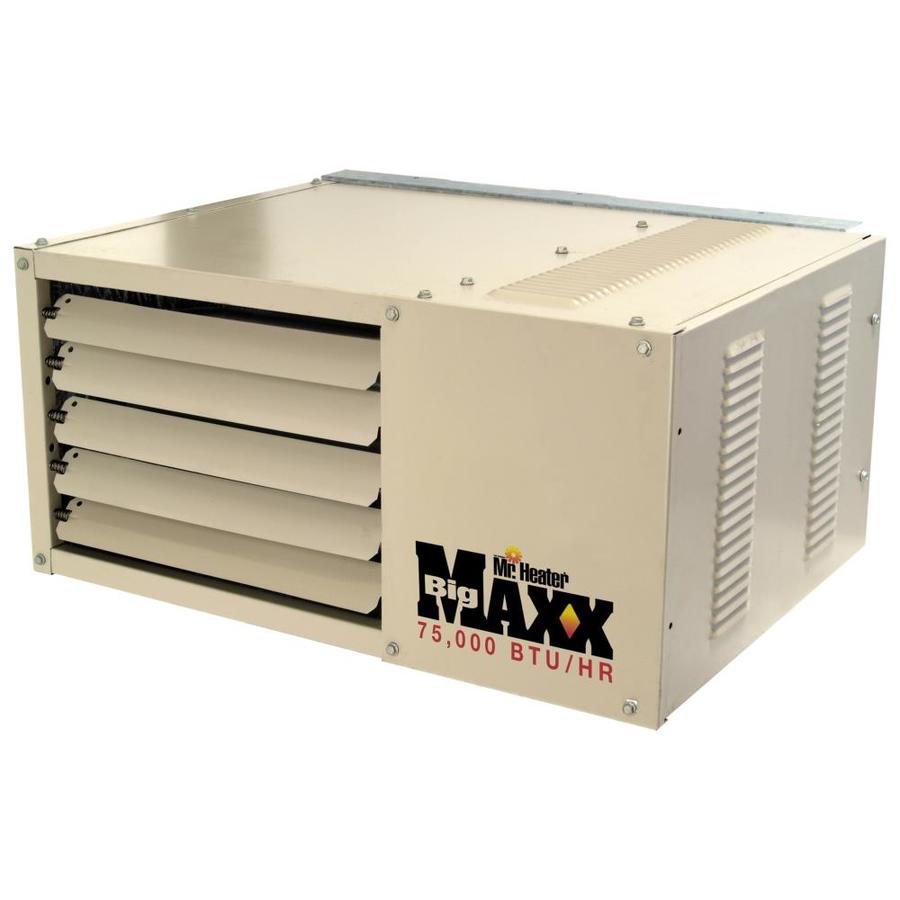
The most popular approach is to use a "one box" gas-fired forced-air heater, similar to (just as an example):

http://www.lowes.com/pd_36_0__?productId=3201863
089301607750.jpg


This would get hung from the ceiling, preferably somewhere near the middle of (but still a few feet away from) one wall, and probably angled so as to promote a somewhat circular flow of air around the space.

HOWEVER... I really dislike these things. They take up a lot of space, usually in a very inconvenient place at that. They're noisy, often horridly so. They tend to be very "crude" in their operation, producing big "blasts" of overbearing heat when they run (especially if you happen to be working near or in front of it), which then quickly dissipates as soon as it shuts off, leaving the space not really feeling all that warm & cozy. Lather, rinse, repeat. And finally, the blower fan not only distributes heat, it blows dust and dirt EVERYWHERE, making it much harder to keep the space clean.

My first choice for garage heating, by a WIDE margin, is in-floor hydronic. But that is rarely practical to retrofit into an existing space (you'd need to tear up and re-pour your slab).

Depending on a lot of stuff I'm going to mostly skip over, you MAY be able to use some form of hydronic baseboard heat, which will obviate most of the disadvantages I cited above for the box-type forced-air heater. But there are also some potential down sides to this: You need a separate source of heated water (i.e., a boiler of some sort); and obviously, any base cabinets and such would need to be worked around (there are special "toe kick" units to address this). Also, if you go with the cheap "tube & fin" type baseboard units, keeping the internal fins clean would be a required repetitive maintenance chore, and they would be somewhat subject to damage (think rolling floor jacks and similar). There are "finless" units (usually made from cast iron), which would obviate both of these concerns (and provide some other side benefits); but they aren't cheap.


FarmerPete

Well-known member
Joined
Jul 24, 2013
Messages
258
Location
Lansing, MI
Why not just stick with the 100 amp panel, the 60 amp subpanel, and then get a slightly smaller heater? How big is your shop? How often are you going to be out there? Do you really need a 35 amp 240v heater? 8400 watts seems a little on the high side to me, unless you have more than a two car garage and/or bad insulation. Here is a 500 SQ ft heater that uses 21amps. http://www.amazon.com/dp/B000TK2SWO/?tag=atomicindus08-20
That should be enough for a standard 2 car garage.
 

2ManyProjects

Well-known member
Joined
Jul 18, 2013
Messages
757
Why not just stick with the 100 amp panel, the 60 amp subpanel, and then get a slightly smaller heater? How big is your shop? How often are you going to be out there? Do you really need a 35 amp 240v heater? 8400 watts seems a little on the high side to me, unless you have more than a two car garage and/or bad insulation. Here is a 500 SQ ft heater that uses 21amps.

I would take any "heats up to *** square feet" claims with a grain of salt the size of Utah.

At the end of the day, the only thing that will really tell the tale is the actual BTU output rating of the heater in question, vis-a-vis the calculated heating load of the space in question. The unit you cited is apparently rated for 17,000 BTU -- which isn't all that much, in the overall scheme of things. The heating load of the space will depend on several different things, and really ought to be determined via a careful analysis by someone with the right tools AND the experience to use them correctly.

 
To avoid these ads, REGISTER NOW!
Top Bottom