
To avoid these ads, REGISTER NOW!

Would this have happened with a Snap-on Equivelent

JoeOef

Well-known member
Joined
Jan 10, 2013
Messages
100
Location
MN
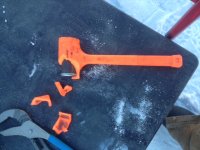
I was outside working yesterday. I needed to beat two pieces of rubber cable ends into alignment, and grabbed my HF deadblow to do it. It was -15F outside and the tools live in my work truck.

After about 20 minutes and maybe 30 blows, this is the result.

I am wondering if a higher end tool would have shattered as well, or if they are all equally suceptible to the cold. I am not a Snap-on or truck tool fanboy in general. My tools come from CM Industrial, SK, GW, JH Williams, and a few pieces from HF. I say that to say this...If I can prevent this from happening again, I am more than happy to spend more, even tool truck prices, to do so.
 

Attachments

  • hammer.JPG
    hammer.JPG
    128.7 KB · Views: 312
To avoid these ads, REGISTER NOW!

MLB0611

Well-known member
Joined
Aug 3, 2013
Messages
225
Yes it can happen to Snappy's versions too, the plastic they use doesn't like cold, keep them warm to keep it from shattering. I have never had one shatter like that but have had to warranty hammers that chunks have broken off of handles
 

INYER face hole

Active member
Joined
Dec 14, 2013
Messages
44
Location
Munford, TN
The older Snap-on dead blows did the same but the newer ones won't. I had one do it and they have me the new one on swap. I love it. And I call it the new style but it's been out for years now.
 

Fireball027

Well-known member
Joined
Aug 9, 2009
Messages
709
Location
Niagara, ON
I have had the older style of snap on hammers do the same thing. I cant tell you how the new ones hold up as I haven't used them for extended periods out in the cold.

The hammers are like us... They dont like the cold either.
 

cburnscrx

Well-known member
Joined
Jan 15, 2013
Messages
1,751
Location
Indianapolis
I can't confirm or deny that the Snap On would have held up, but anything plastic that cold is going to be brittle and susceptible to shattering.
 

4xdog

Well-known member
Joined
Aug 18, 2012
Messages
5,611
Location
Santa Fe, NM
We're running up against the limit of the materials here -- at –15°F that polymer (reaction-injection molded polyurethane, I think) is almost certainly below its glass transition temperature, or Tg. Glass transition describes the point where the polymer goes from being "rubbery", where movement between adjacent polymer chains can occur, to "glassy" where adjacent molecules can't move easily. (Note -- it's not at all the melting point, where materials change phase from solid to liquid -- this all happens in the solid phase).

It did pretty well to survive 30 blows at that temperature! One way to look at it might be that since the polymer is so hard at that temp, maybe it makes just as much sense to hit the work with a steel hammer -- the polymer one wasn't applying a very soft blow anyway.

Is it possible that other folk's polyurethane hammers have different Tg or higher ultimate strength? Yup, sure is possible. Is Snap-on better? Dunno...
 
OP
J

JoeOef

Well-known member
Joined
Jan 10, 2013
Messages
100
Location
MN
I understand that anything that cold is going to be susceptible to shattering. I am looking for an alternative that would make it less likely, as much of my work involves being outside in super cold temps. This hammer was kept in the cab of my truck. That's the best I can do when on the road.

Any suggestions for DB hammers I can pick up locally or order off Amazon while I try to track down a Snappy truck? Or is it back to HF I go?
 
OP
J

JoeOef

Well-known member
Joined
Jan 10, 2013
Messages
100
Location
MN
We're running up against the limit of the materials here -- at –15°F that polymer (reaction-injection molded polyurethane, I think) is almost certainly below its glass transition temperature, or Tg. Glass transition describes the point where the polymer goes from being "rubbery", where movement between adjacent polymer chains can occur, to "glassy" where adjacent molecules can't move easily. (Note -- it's not at all the melting point, where materials change phase from solid to liquid -- this all happens in the solid phase).

It did pretty well to survive 30 blows at that temperature! One way to look at it might be that since the polymer is so hard at that temp, maybe it makes just as much sense to hit the work with a steel hammer -- the polymer one wasn't applying a very soft blow anyway.

Is it possible that other folk's polyurethane hammers have different Tg or higher ultimate strength? Yup, sure is possible. Is Snap-on better? Dunno...

Thanks, this is a great answer. I love being able to understand the "why". I can't say hitting the hard rubber cable ends with a steel hammer would be any different, but I'm not ready to say that's the best solution either, although I totally understand your logic, and it makes more sense then mine. DB hammers make up 90% of my hammering use.
 

purplezr2

Well-known member
Joined
Jun 1, 2010
Messages
5,292
Location
Central MN
Yes even the news ones will do it, but they will usually do it on the shaft making the hammer usable still.
 

4xdog

Well-known member
Joined
Aug 18, 2012
Messages
5,611
Location
Santa Fe, NM
...DB hammers make up 90% of my hammering use.

Maybe a "soft face" hammer could work as an alternative to a "dead blow" hammer?

Dead blow hammers almost always have a core/shell structure, which isn't going to help durability in extreme cold due to differential expansion/contraction. Soft face hammers are normally monolithic.

There are a number of nylon (AKA polyamide or PA) soft blow hammers that might be stronger when cold that PU? I have several old Stanley soft face hammers that get used all the time and I like 'em. There are similar hammers -- including at HF, I think -- used for things like driving tent pegs. They might be an option for ya?
 

91bronc300

Well-known member
Joined
Oct 19, 2009
Messages
2,559
Get one of those Garland or similar hammers (mines a vaughan I think) that has rawhide on one side and copper on the other. Doesn't work in all situations but it's easily one of my favorite hammers.
 

rsanter

Well-known member
Joined
Dec 22, 2007
Messages
18,514
Location
visalia ca
What about a hide hammer as a replacement if you often work in those temperatures?

This is what I was thinking
Or get a dead blow that has replacable ends so you can use brass, raw hide, or plastic ends and replace them as they wear out

Bob
 

bimmerZ5

Well-known member
Joined
Aug 16, 2008
Messages
1,790
i think what you are looking for isn't about brand of dead blow hammer, you are looking for specialty equipment designed to work within the conditions you describe. you need to search for ultra low temperature application hand tools, not that brand or this brand. does SO make such a specialty application dead blow? I don't know but maybe... you need to check.
 

rlitman

Well-known member
Joined
Oct 18, 2010
Messages
24,599
Location
Long Island
The older Snap-on dead blows did the same but the newer ones won't.

The older orange Snap-on dead blows did that sitting in a warm toolbox without being hit.
I cannot say that in that cold a new Snap-on would hold up better than that HF hammer you have. Probably, but for me, warranty replacing an HF hammer is easier, so that's the one I'd be using first. . .

Get one of those Garland or similar hammers (mines a vaughan I think) that has rawhide on one side and copper on the other. Doesn't work in all situations but it's easily one of my favorite hammers.

That is what I was thinking.
What are you hitting?

The copper side gives a really good hit on steel. The rawhide side is fine on aluminum, although it can tear up the finish a bit.
You could always glue a rubber patch onto the face of the rawhide if you want something even gentler. Or apply a thin layer of silicone caulk. That won't get any harder in the cold.
 
OP
J

JoeOef

Well-known member
Joined
Jan 10, 2013
Messages
100
Location
MN
The older orange Snap-on dead blows did that sitting in a warm toolbox without being hit.
I cannot say that in that cold a new Snap-on would hold up better than that HF hammer you have. Probably, but for me, warranty replacing an HF hammer is easier, so that's the one I'd be using first. . .


That is what I was thinking.
What are you hitting?

The copper side gives a really good hit on steel. The rawhide side is fine on aluminum, although it can tear up the finish a bit.
You could always glue a rubber patch onto the face of the rawhide if you want something even gentler. Or apply a thin layer of silicone caulk. That won't get any harder in the cold.

I have no experience with hide hammers but I would worry (maybe unnecessary) that they wouldn't exert the needed force. I am hitting aluminium (3-4 inch air house connections and fittings) Hard rubber (Cam-lok electrical connectors) copper on heating and cooling equipment. I work on industrial generators, 1500cfm+ truckable air compressors and 400T+ chillers.
 

CNGsaves

Well-known member
Joined
Sep 26, 2012
Messages
13,233
Location
KS and OK
There's certainly a BETTER tool for the job.

Also, if your employer is expecting you to use HF tools at -15 temps that shatter like the hammer pictured, I sure hope that you were wearing eye and complete face protection.

Has your employer provided you with proper protection?? Will your employer be providing a BETTER tool for the job ??
 
To avoid these ads, REGISTER NOW!

zilla68

Well-known member
Joined
Jan 28, 2013
Messages
110
Location
Moore, OK
yes snap on does that, I just had 3-4 warrantied out, a real pisser when you touch a piece of metal and the thing falls apart, grab another, does it again, just went thru the drawer until I finally got to my cheap, 20 year old rubber mallet, worked like a champ, lol.

warrantied with no questions
 

rlitman

Well-known member
Joined
Oct 18, 2010
Messages
24,599
Location
Long Island
I have no experience with hide hammers but I would worry (maybe unnecessary) that they wouldn't exert the needed force. I am hitting aluminium (3-4 inch air house connections and fittings) Hard rubber (Cam-lok electrical connectors) copper on heating and cooling equipment. I work on industrial generators, 1500cfm+ truckable air compressors and 400T+ chillers.

Why? Rawhide is harder than the plastic in a deadblow. It is also more likely to mar a painted finish, if that is an issue.
It should hit as hard as a deadblow, considering they come with a few pounds of cast iron behind the hide. It just doesn't have the steel shot to prevent rebound. But the actual effect the steel shot in a deadblow has on it's imparted impact is minimal.
 
OP
J

JoeOef

Well-known member
Joined
Jan 10, 2013
Messages
100
Location
MN
There's certainly a BETTER tool for the job.

Also, if your employer is expecting you to use HF tools at -15 temps that shatter like the hammer pictured, I sure hope that you were wearing eye and complete face protection.

Has your employer provided you with proper protection?? Will your employer be providing a BETTER tool for the job ??

My employer provides, and I utilize the proper PPE. My employer does not provide any tools. Other than stating that there is a better tool for the job, can you offer me any other USABLE advice. I came here because I am willing to listen to it...
 
OP
J

JoeOef

Well-known member
Joined
Jan 10, 2013
Messages
100
Location
MN
Why? Rawhide is harder than the plastic in a deadblow. It is also more likely to mar a painted finish, if that is an issue.
It should hit as hard as a deadblow, considering they come with a few pounds of cast iron behind the hide. It just doesn't have the steel shot to prevent rebound. But the actual effect the steel shot in a deadblow has on it's imparted impact is minimal.

Looks like I will be looking for hide hammers!
 

dr_clyde

Well-known member
Joined
Jan 7, 2009
Messages
6,443
Location
Holland, MI
I would highly recommend the garland cast iron rawhide hammer. My #3 size hits very hard. They are available in a variety of sizes up to a sledge. You can replace the faces when they get beat up. Nylon, UHMW and various metal faces are also available.

Be sure to get the one with the split cast iron head though.
 

-Brent-

Well-known member
Joined
Dec 23, 2009
Messages
4,709
Location
Utah
I don't know what firefighters use but a dead blow is one of the tools I've seen the ice rescue (part of the FD where I grew up) guys use. It might be interesting to see what brand/type they use.

Side note, I have a buddy that worked on oil pipelines and spent a bunch of winters doing work. He wheeled with us a bunch and one thing I remember having was a spray bottle with anti-freeze (the automotive radiator fluid). One time one of us got stuck on a fairly deep, snowy trail. We'd crossed water and such that day and everything was iced up on our rigs. I can't remember what disabled the Jeep but I do recall him pulling out the spray bottle and getting under the vehicle and spraying whatever part before working on it.

This is the first time I've thought of that in a long time. He said it was a trick the guys used working on frozen/iced over parts to lubricate them.

Anyway, sorry for the hijack. But it may be something that'll suite you working on stuff out in the MN winters.
 
Last edited:

warmpancakes

Well-known member
Joined
Mar 12, 2010
Messages
8,097
Location
4th letter of the alphabet
the older snap ons that they changed the no longer sell? Yes. The new ones no, I have used mine just the other night outside (-14 or-15) to dislodge a spare tire that was frozen under the truck
)
 

Nortonscustom

Well-known member
Joined
Jun 5, 2008
Messages
375
Don't want to fuel a "SO vs HF" fire but I own both HF (for home use) and Trusty Cook (my work hammers) and can say with 100% certainty they are not made of the same material. Would the TC hold up better in extreme cold, I thank goodness have no idea nor do I wish to find out.

But anyways.... I asked a buddy what he uses, he does field service work for the oil fields in ND and MT. Uses dead blows everyday in all sorts of extreme cold temps. He said his go-to hammers are from Nupla. Said he has never had a problem.

So Joe for what it's worth you might want to look into trying one of those. Amazon seems to have a ton of different styles and sizes.

http://www.amazon.com/dp/B000LGE96Y/?tag=atomicindus08-20
 

warmpancakes

Well-known member
Joined
Mar 12, 2010
Messages
8,097
Location
4th letter of the alphabet
Don't want to fuel a "SO vs HF" fire but I own both HF (for home use) and Trusty Cook (my work hammers) and can say with 100% certainty they are not made of the same material. Would the TC hold up better in extreme cold, I thank goodness have no idea nor do I wish to find out.

a[/url]

trusty cook no longer makes snap on deab blows they did make the older ones that fell apart,
 

Bigplum

Well-known member
Joined
Nov 9, 2013
Messages
564
Location
Cotswolds England
Look up Thor hammers , widely available in the UK, pricey over there though, but they are great hammers , heavy as you want with lots of sizes , come with copper , nylon or hide inserts , you can beat the buggery out of something and barely leave a mark,
eBay uk would be a good hunting ground for used ones , I see them all the time at auto
Jumbles and farm sales usually for £10 to £15 for used big ones
 

zkling

Well-known member
Joined
Jan 23, 2007
Messages
16,939
There are so many factors that come into play on something like this it is really going to be hard to say for certain that hammer brand XYZ would have been better. With that said I have heard that the HF dead blows are notorious for breaking in cold weather.

As someone else said, I'm pretty sure I have seen cold water rescue teams use some type of dead blow looking hammer, you may want to ask them. Or do some research to see if any of the big name companies in hammers test their dead blow hammers to cold weather tolerances. Or as has been mentioned you may want to look at a different style of hammer. Just my 2¢ :beer:
 

DekeT

Well-known member
Joined
Aug 12, 2011
Messages
2,234
Location
USA
I was outside working yesterday. I needed to beat two pieces of rubber cable ends into alignment, and grabbed my HF deadblow to do it. It was -15F outside and the tools live in my work truck.

After about 20 minutes and maybe 30 blows, this is the result.

I am wondering if a higher end tool would have shattered as well, or if they are all equally suceptible to the cold. I am not a Snap-on or truck tool fanboy in general. My tools come from CM Industrial, SK, GW, JH Williams, and a few pieces from HF. I say that to say this...If I can prevent this from happening again, I am more than happy to spend more, even tool truck prices, to do so.

I think by bringing this question up you are obligated to purchase a Snap-on, Williams, SK and do the same test to it. Then report. Only you can replicate the same conditions.
 
OP
J

JoeOef

Well-known member
Joined
Jan 10, 2013
Messages
100
Location
MN
There are so many factors that come into play on something like this it is really going to be hard to say for certain that hammer brand XYZ would have been better. With that said I have heard that the HF dead blows are notorious for breaking in cold weather.

As someone else said, I'm pretty sure I have seen cold water rescue teams use some type of dead blow looking hammer, you may want to ask them. Or do some research to see if any of the big name companies in hammers test their dead blow hammers to cold weather tolerances. Or as has been mentioned you may want to look at a different style of hammer. Just my 2¢ :beer:

All good advice, and taken. Thank you.
 
To avoid these ads, REGISTER NOW!
Top Bottom